-
-
ChainLab Cover
-
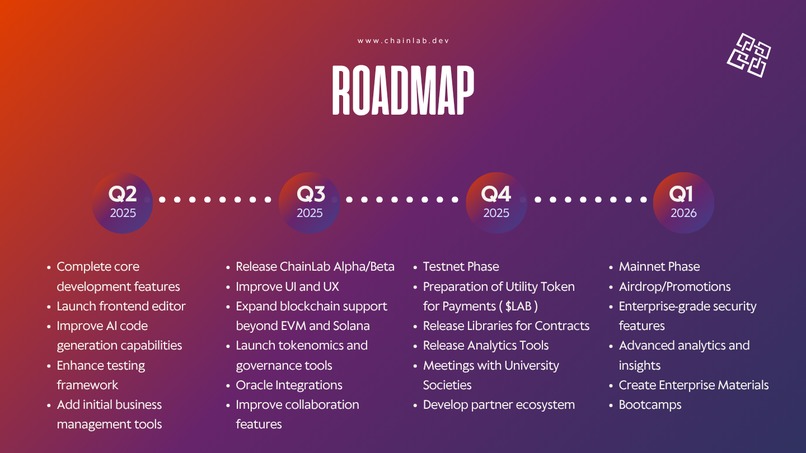
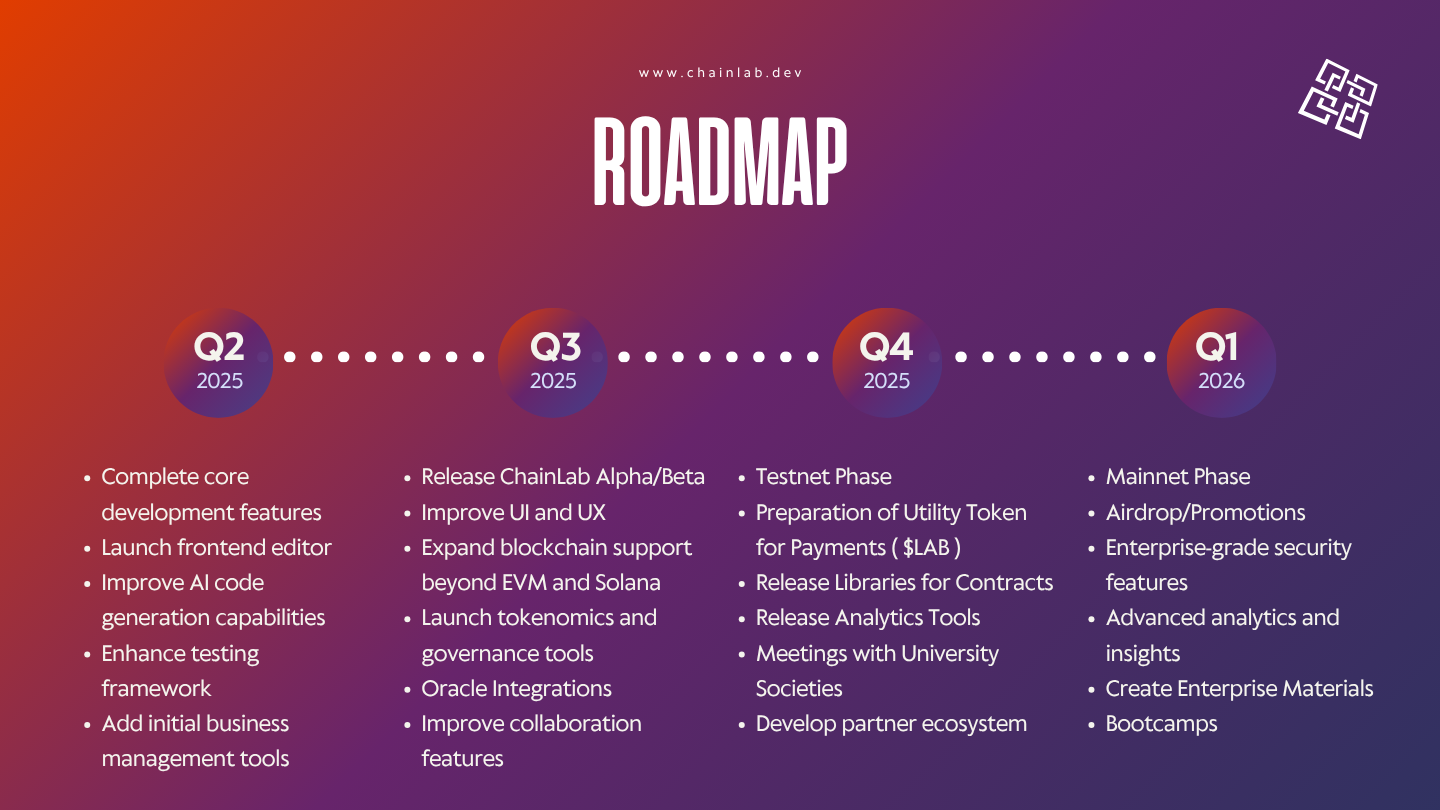
ChainLab Roadmap
-
Logo
ChainLab is revolutionizing Web3 development with a comprehensive, AI-powered platform that streamlines the entire blockchain application lifecycle. From smart contract generation and frontend design to testing, multi-chain deployment, and integrated business management, ChainLab offers a unified, browser-based environment. We empower developers of all skill levels to build, manage, and scale decentralized applications with unprecedented speed and minimal coding, dramatically reducing complexity and fostering innovation in the Web3 space.
What is Chainlab?
ChainLab is an advanced, AI-driven Web3 development platform designed to unify and simplify the entire lifecycle of building blockchain applications. It provides a seamless, browser-based experience, integrating traditionally scattered tools into one cohesive environment. Developers can effortlessly move from idea to production, leveraging AI for code generation, benefiting from real-time collaboration, and utilizing comprehensive tools for smart contracts, frontend UI, asset management, multi-chain deployment, and even business operations like tokenomics and DAO governance. ChainLab aims to be the industry standard, making Web3 development accessible, efficient, and collaborative.
Problem Statement
Current Web3 development is fraught with challenges that stifle innovation and slow down progress:
- Fragmented Development Experience: Developers are forced to navigate a complex ecosystem of disparate tools for different stages of the development stack.
- High Technical Barriers: Building secure and efficient smart contracts requires specialized, often scarce, expertise.
- Inefficient Collaboration: Teams often work in silos, leading to communication gaps and reduced productivity.
- Deployment Complexity: Transitioning applications from development to live production environments across various blockchains is a cumbersome and error-prone process.
- Limited Business Tools: Most development platforms lack integrated features for crucial business aspects like token economics, governance, and post-deployment analytics.
Our Solution
ChainLab directly addresses these critical pain points by offering:
- An All-in-One Unified Platform: Manage the entire Web3 development lifecycle – from concept to live dApp and beyond – within a single, intuitive interface.
- AI-Assisted Development: Leverage the power of multiple LLMs (including DeepSeek, O1, Claude, and custom models) to generate smart contract code from natural language, debug intelligently, and optimize for gas and security.
- Real-Time, Seamless Collaboration: Enable team members, regardless of their technical background, to work together efficiently with Google Docs-like collaborative editing and role-based access control.
- Effortless Multi-Chain Deployment & Publishing: Deploy smart contracts and frontend applications with one-click to various EVM-compatible chains (Ethereum, Polygon, BSC, Avalanche, etc.) and planned support for non-EVM chains like Solana. Integrated Vercel and Netlify support for web publishing.
- Integrated Business & Governance Tools: Go beyond code with built-in modules for tokenomics design, DAO governance setup, compliance checks, and in-depth analytics.
Why ChainLab? Why Now?
The Web3 ecosystem is poised for explosive growth, but its potential is hampered by development friction. ChainLab lowers the entry barrier for new developers and supercharges experienced ones. By dramatically reducing development time and complexity, ChainLab notifies not just building a platform; we're building the future of Web3 development itself. The time is now to democratize access, foster broader participation, and enable the next wave of decentralized innovation.
The Challenge: Optimizing AI-Powered Smart Contract Generation in the Browser
When developing our AI-powered smart contract generation feature, a significant hurdle was ensuring both the quality and security of the code suggested by various Large Language Models (LLMs) directly within our browser-based IDE. Early prototypes sometimes produced inefficient or vulnerable code snippets, and managing the latency from multiple LLM APIs without degrading user experience was complex.
How We Overcame It:
- Advanced Prompt Engineering & Multi-LLM Strategy: We developed a sophisticated prompt engineering framework specifically tailored for Web3 security patterns and smart contract logic. We also implemented an intelligent routing system to select the most appropriate LLM (from DeepSeek, O1, Claude, etc.) based on the context of the user's request.
- Multi-Layered Code Validation: To ensure code quality and security, we integrated a multi-layered validation process. This includes:
- Static analysis tools run in the background.
- Heuristic checks for common vulnerabilities.
- AI-assisted security reviews where a secondary AI agent critiques the primary AI's code.
- Asynchronous Processing & Smart Caching: To address latency, we re-architected our LLM interactions to be fully asynchronous. We also implemented a smart caching layer in IndexedDB for frequently requested code patterns and AI model responses, significantly improving the perceived performance and responsiveness of the IDE.
- Iterative Feedback & Fine-Tuning: We established a tight feedback loop with beta testers, allowing us to quickly identify areas where AI suggestions were suboptimal. This data was used to continuously refine our prompts and, where possible, fine-tune custom models for specific use cases.
This approach not only improved the reliability and security of our AI-generated smart contracts but also maintained a fluid and responsive user experience, which is critical for a browser-based development platform like ChainLab.
Key Features of ChainLab:
- AI-Powered Smart Contract Development:
- Natural Language to Code: Describe your smart contract logic in plain English and let AI generate the code.
- Intelligent Debugging & Optimization: AI explains errors and suggests fixes, plus automatic gas optimization and security best practice implementation.
- Advanced Testing Framework: AI-generated test cases, real-time in-browser execution, integrated security analysis, and test history tracking.
- Integrated Frontend Development:
- Visual Frontend Editor: Extensive library of Web3 UI templates and ready-to-use components (wallets, transaction forms, NFT galleries).
- Seamless Backend Integration: Auto-detection of contract ABIs, real-time event listeners, easy Web3 authentication, and cross-chain compatibility.
- Decentralized Asset Management:
- IPFS Integration: One-click uploads for decentralized storage of assets, version control, access management, and custom metadata.
- Multi-Chain Deployment & Publishing:
- One-Click Deployment: Deploy to any supported EVM chain and Solana with minimal configuration.
- Website Publishing: Direct deployment of frontend applications to Vercel and Netlify, with custom domain configuration.
- Git Management: Integrated with GitHub, GitLab, or BitBucket for version control and automated commits.
- Comprehensive Business Management Suite:
- Analytics & Insights: Dashboards for contract usage, user engagement, transaction metrics, and performance monitoring.
- Tokenomics Studio: Design custom tokens, manage distributions, simulate pricing, and analyze market data.
- DAO Governance Module: Framework for proposals, voting, automated execution, and community management.
- Compliance & Partnerships: Tools for regulatory checklists, terms generation, KYC/AML integration, and partner management.
- Real-Time Collaboration Features:
- Collaborative Editing: Multiple users can edit code simultaneously with presence indicators and intelligent conflict resolution (CRDT).
- Role-Based Access Control: Define custom roles and permissions for team members.
- Integrated Project Management: Meeting coordination, task assignment, progress tracking, and timeline visualization.
Target Audience:
Primary:
- Web3 Developers (seeking efficiency and an all-in-one solution)
- Web3 Startups (needing rapid iteration and reduced overhead)
- Traditional Developers (looking for an easier entry into Web3)
Secondary:
- Enterprise Blockchain Teams
- DAO Operators
- Content Creators integrating with Web3
Project Status & Roadmap Highlights (as of Q2 2025):
We are actively developing ChainLab with a clear roadmap:
Near-Term (Q2 2025):
- Completion of core AI-powered smart contract and frontend development features.
- Launch of the full frontend editor.
- Enhancements to AI code generation and the advanced testing framework.
- Rollout of initial business management tools.
Mid-Term (Q3 2025 - Q4 2025):
- Expansion of blockchain support beyond EVM.
- Launch of comprehensive Tokenomics Studio and DAO Governance tools.
- Further improvements to collaboration features.
- Development of a partner ecosystem and template marketplace.
Long-Term (Q1 2026 onwards):
- Introduction of enterprise-grade security features, advanced AI-driven project optimization, and a mobile companion app.
Our Competitive Advantages:
- Truly All-in-One: The only platform you need for the entire Web3 development lifecycle.
- Collaboration-First: Designed from the ground up for seamless teamwork.
- AI-Native: AI is deeply integrated to assist, not just augment, development.
- Business-Centric: Unique inclusion of tokenomics, governance, and analytics tools.
- Web3 Focused: Purpose-built to address the specific challenges of blockchain development.
Links:
- Website & Waitlist: www.chainlab.dev
- Whitepaper: https://www.chainlab.dev/whitepaper.pdf
- Twitter: @buildonchainlab
- GitHub: https://github.com/herasoftlabs/ChainLab
Videos:
- ChainLab Introduction (1-min): https://youtu.be/O9MwyCC_4H8?si=bCjuGZBl4lOEf4PG
- Deep Dive Series:
- MVP Live Demo / V2 Demo: https://www.chainlab.dev/
- MVP Live Demo / V1 Demo: https://chainlab.vercel.app/
- Presentation: https://www.canva.com/design/DAGWvKUIklU/9PLc9NwuFjwjKRvXjB9fjA/view
Frequently Asked Questions (FAQ)
Do I need blockchain knowledge to use Chainlab? No, Chainlab is designed for easy use by anyone.
On which blockchain networks can I deploy my projects? Currently, we support EVM-compatible networks (Ethereum, Binance Smart Chain, Taiko, Open Campus etc.) and Solana.
What makes ChainLab different from other Web3 development tools like Remix or Hardhat? ChainLab offers several key advantages:
- All-in-One Solution: It integrates the entire development lifecycle (IDE, frontend editor, deployment, business tools) into one platform, unlike specialized tools like Remix (EVM-only, no frontend) or Hardhat (local setup, limited AI).
- AI-First Approach: Deeply integrated AI assists with natural language to code, intelligent debugging, code optimization, and automated test generation.
- Real-Time Collaboration: Built for teams with features like simultaneous collaborative editing and role-based access control.
- Integrated Business Management: Uniquely includes tools for tokenomics, DAO governance, analytics, and compliance, going beyond just coding.
- Browser-Based & User-Friendly: Fully accessible via a web browser with a focus on intuitive user experience and minimal setup.
Do I need to be an expert blockchain developer to use ChainLab? No, while ChainLab offers powerful tools for experienced developers, it's also designed to lower the technical barrier to entry for those new to Web3. Features like AI-assisted code generation, pre-built templates, and an intuitive interface help users with varying skill levels to build and deploy blockchain applications effectively. Our vision is to democratize Web3 development.
Is there a free version or trial for ChainLab? Yes, ChainLab plans to offer a tiered pricing model, which includes a Free Tier. This tier will provide access to the basic development environment with limited AI assistance for public projects and community support, allowing users to experience the platform's core functionalities. Pro, Team, and Enterprise tiers with more advanced features and support will also be available.
Built With
- anchor
- hardhat
- javascript
- material
- next.js
- node.js
- react
- solana
- solidity
- supabase
- web3.js


Log in or sign up for Devpost to join the conversation.