-
-
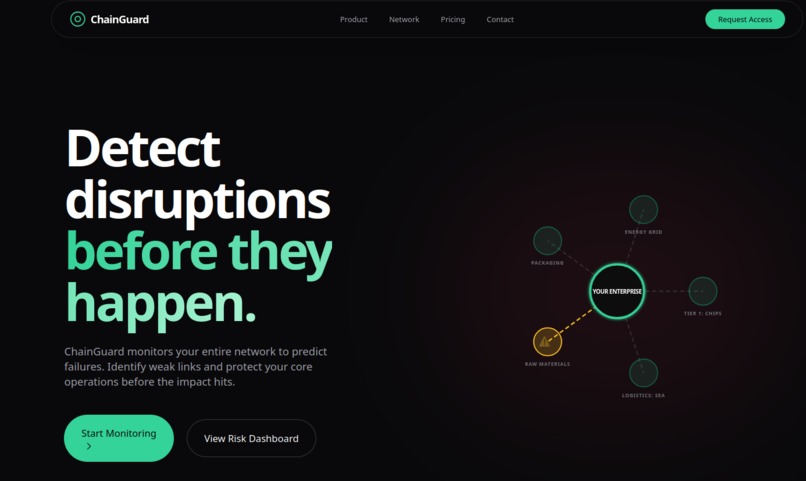
Landing Page
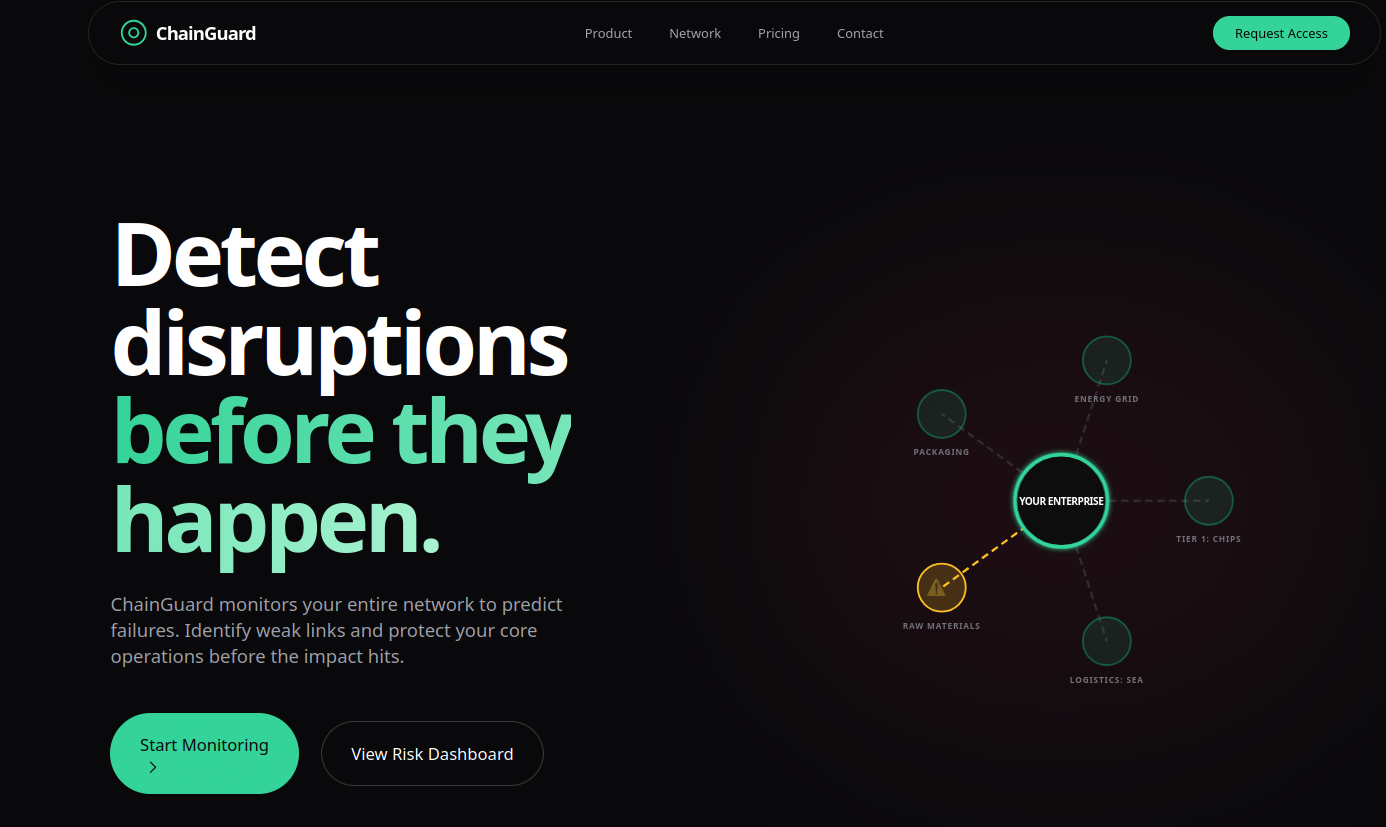
Inspiration
Recent global events have shown how fragile supply chains truly are. A single delay at a port or a raw material shortage can halt production for thousands of businesses downstream. We wanted to build a proactive, intelligent monitor capable of catching these disruptions before they become critical failures, giving companies the lead time they need to adapt and survive.
What it does
ChainGuard is an AI-powered supply chain monitoring platform. It actively monitors your suppliers' risk profiles by scanning relevant information from pre-defined websites. It also gives you a chance to find appropriate alternative suppliers.
- Smart Dashboard: Visualizes risk heatmaps, stock/price trends, and real-time alerts.
- AI Assistant: An intelligent agent that can autonomously crawl the web, synthesize information, and answer deep-dive queries about any supplier's vulnerability.
- Global Explorer: Helps businesses discover and vet alternative suppliers with pre-analyzed AI risk scores to build redundancy.
How we built it
We built the frontend using React, Vite, TypeScript, and Tailwind CSS (with shadcn/ui and Framer Motion) to deliver a premium, glassmorphic user experience. The backend is powered by FastAPI and Supabase for robust data management and authentication. At the core of our intelligence engine, we integrated LLMs (via OpenRouter/Claude) and automated web scraping pipelines to process unstructured data into actionable risk signals. We also deployed the web application using Vercel and Render.
Challenges we ran into
One of our biggest hurdles was designing an AI research pipeline that didn't block the user interface. Web scraping and LLM synthesis take time, so we had to engineer a responsive streaming UI (with progressive stage updates) to keep users informed while the AI worked in the background. Balancing the complexity of real-time data visualization with a clean, intuitive layout was also a tough design challenge.
Accomplishments that we're proud of
We're incredibly interested in the AI Assistant feature, especially the TinyFish web agent assistant. It doesn't just return canned responses; it visually breaks down its autonomous reasoning steps (searching, retrieving, reasoning, and synthesizing) so users can actually trust how the AI arrived at its risk assessment.
What we learned
- What to do in a hackathon.
- Diverse case studies using TinyFish web agent.
What's next for ChainGuard
In the future, we plan to fully automate mitigation strategies—allowing ChainGuard to not only alert users to a disruption but also automatically draft purchase orders to alternative suppliers discovered in the Explore tab.
Built With
- fastapi
- n8n
- react
- render
- supabase
- tinyfish
- typescript
- vercel


Log in or sign up for Devpost to join the conversation.