Inspiration
Healthcare records are often fragmented across different clinics, hospitals, and pharmacies. When a patient moves between providers, important medication information can be incomplete, outdated, or difficult to verify. We were inspired by a simple question: What if patients could carry a verifiable history of their healthcare records without putting their sensitive medical information directly on a blockchain? ChainCare combines Web3 and AI to address this problem. Blockchain provides a tamper-evident verification layer and transparent consent history, while AI helps identify inconsistencies when medication records from different sources are compared. Our goal was not to create another cryptocurrency-based application, but to demonstrate a practical use of Web3 technology for a real-world problem.
What it does
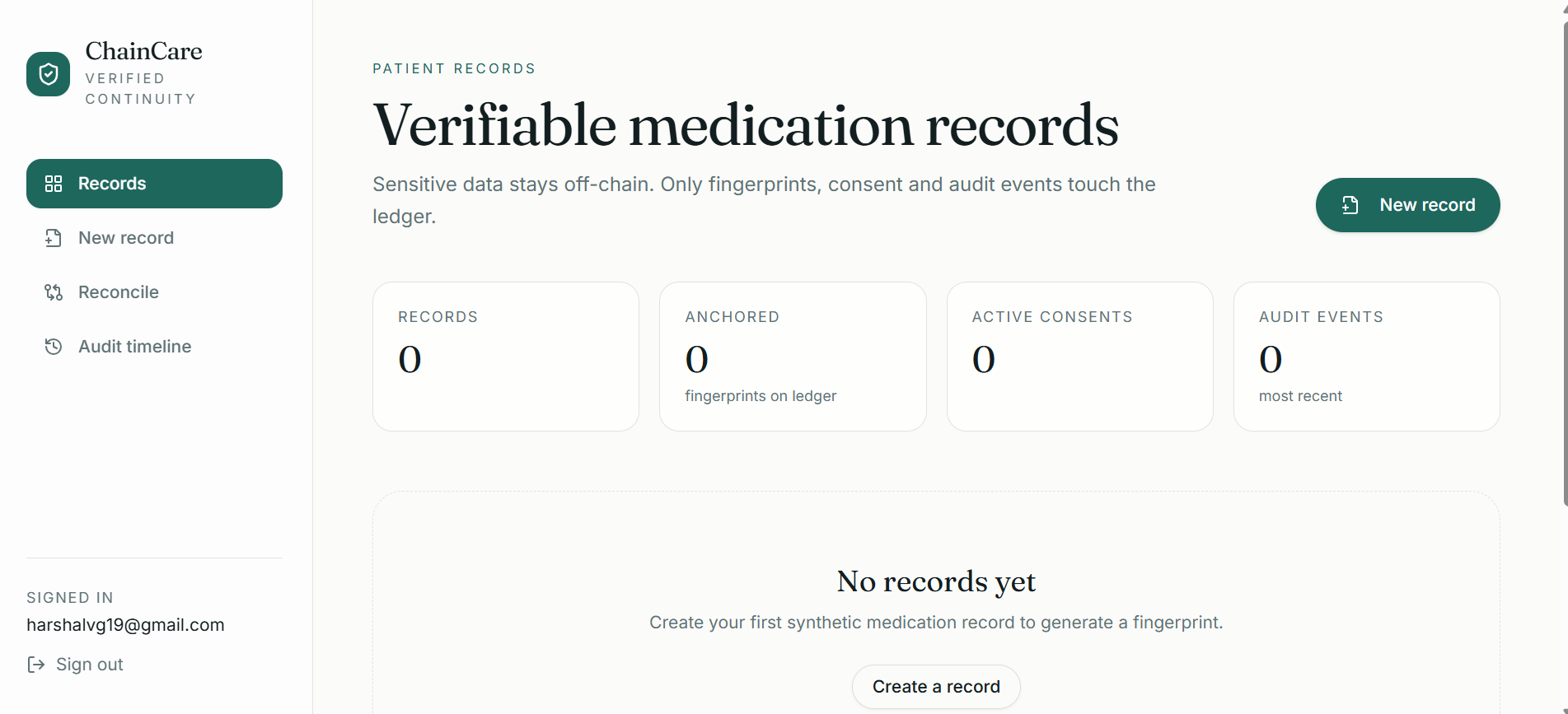
ChainCare is a privacy-focused healthcare record continuity platform.
Users can:
- Create and manage healthcare records using synthetic data.
- Generate a cryptographic fingerprint for each record.
- Store the fingerprint and verification information on a blockchain testnet.
- Allow patients to grant or revoke provider access.
- Verify that a healthcare record has not been altered.
- Compare medication lists using AI and flag potential inconsistencies.
- View an auditable timeline of record creation, verification, access, and consent events. Sensitive healthcare information remains off-chain. The blockchain stores verification and audit information rather than the medical records themselves.
How we built it
Frontend (React JS, Next.js, Tailwind CSS) Backend (Node.js, Express) Firebase, PostgreSQL
Security & Verification
- Cryptographic hashing
- On-chain record fingerprints
- Smart-contract-based consent and audit events
AI
- AI-assisted medication-list comparison
- Deterministic validation rules around AI results
- Human review remains part of the workflow
Challenges we ran into
One of our biggest challenges was deciding what should and should not go on-chain. Healthcare information is sensitive, so putting complete medical records directly on a blockchain would create unnecessary privacy concerns. We solved this by keeping the actual records off-chain and using the blockchain only for verification metadata and audit events. Another challenge was making the AI component useful without allowing it to become an uncontrolled decision-maker. We therefore designed AI as an assistive reconciliation tool, not a diagnostic or prescribing system. Its results are presented as potential issues that require human review. We also had to keep the scope realistic for a 24-hour hackathon. Instead of trying to build an entire healthcare ecosystem, we focused on one clear workflow: creating, sharing, verifying, and reconciling medication records.
Accomplishments that we're proud of
We are proud that ChainCare demonstrates a meaningful use of Web3 beyond tokens and speculation. Our key accomplishments include:
- Building a functional Web3 healthcare-record verification concept.
- Using cryptographic hashing to create tamper-evident records.
- Implementing blockchain-based verification.
- Designing patient-controlled consent and access.
- Integrating AI into a specific, practical workflow.
- Keeping sensitive health information off-chain.
- Creating a scalable architecture that separates healthcare data from blockchain verification.
- Turning a complex healthcare problem into a focused MVP that can be demonstrated clearly.
What we learned
We learned that Web3 is most valuable when decentralization, cryptographic verification, or immutable records solve an actual problem. We also learned that blockchain does not need to store everything. A hybrid architecture can combine conventional databases with blockchain verification to achieve a better balance between usability, privacy, and transparency. Working with AI taught us another important lesson: AI is most effective when it supports a clearly defined workflow rather than trying to replace human decision-making. Finally, the project taught us how important scope management is during a hackathon. A smaller number of well-integrated features is more valuable than a large collection of unfinished features.
What's next for ChainCare
Our next step is to move ChainCare from a hackathon MVP toward a standards-based healthcare interoperability platform. Our long-term vision is for ChainCare to become a portable verification and consent layer for healthcare information, allowing patients and authorized providers to verify that important records are authentic, current, and shared with the right people.

Log in or sign up for Devpost to join the conversation.