ChainBoard - Trust-Centric Project Management on Base
Transforming task management into verifiable on-chain contributions with NFT achievements
🎯 Inspiration
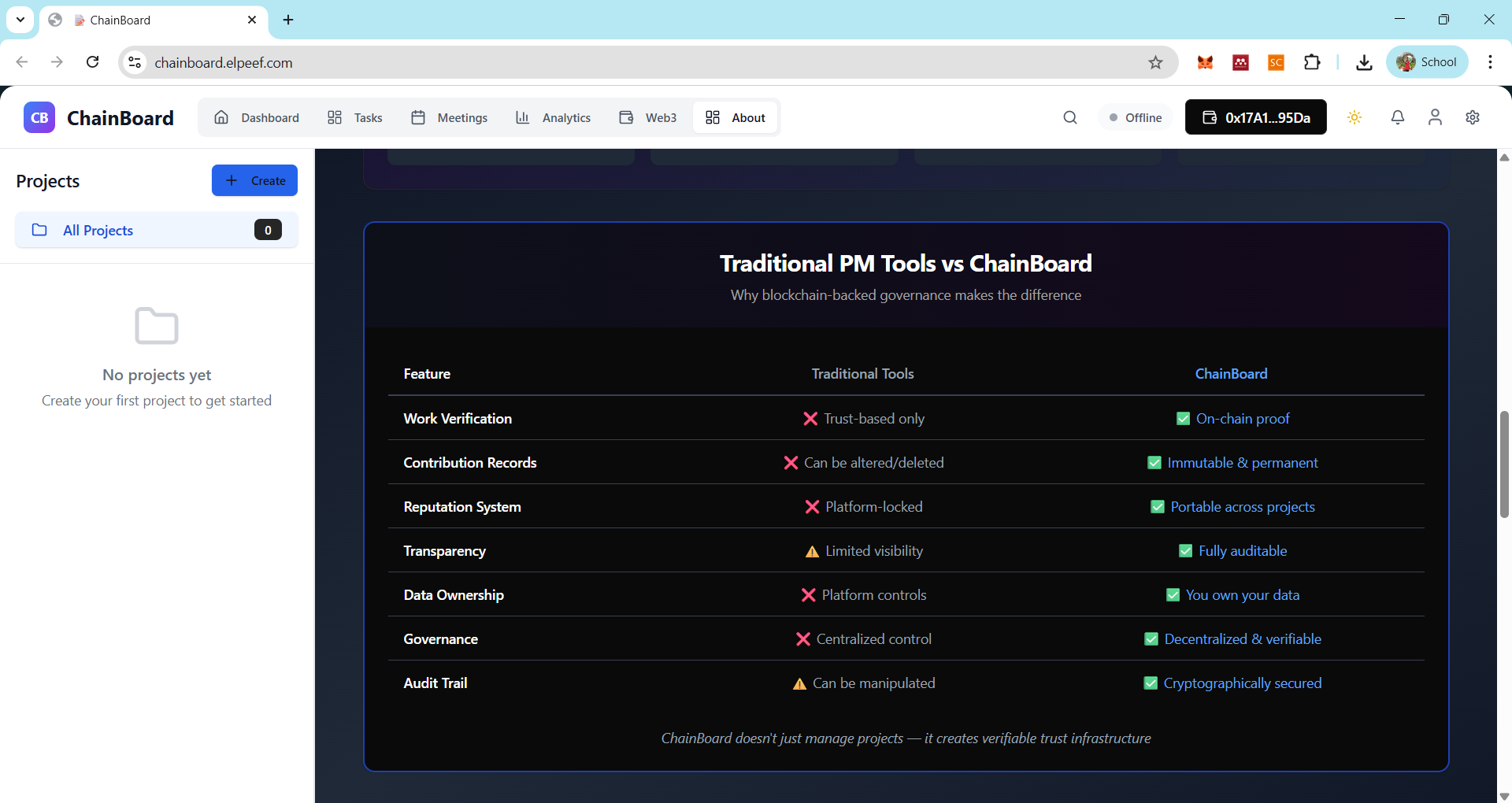
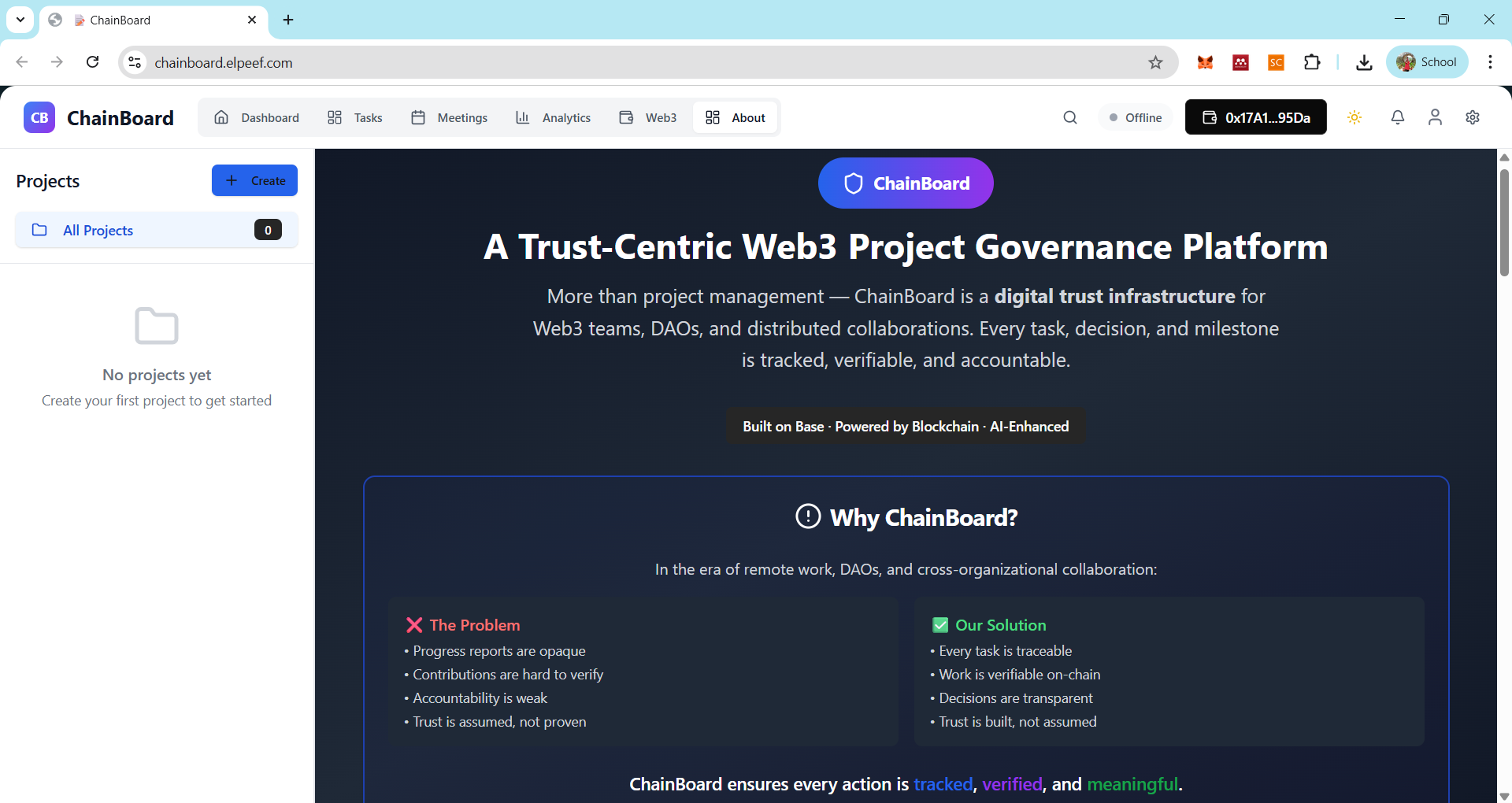
The Problem: Traditional project management tools lack transparency and verifiable proof of contribution. In remote teams and DAO collaborations, there's no immutable way to prove who did what, when, and how much effort was invested. Contributors have no portable reputation that moves with them across projects.
The Vision: We were inspired by the trust challenges in Web3 communities where:
- Remote teams struggle with accountability without micromanagement
- DAO contributors have no portable proof of their work history
- Freelancers can't prove their contributions when they move between projects
- Project managers lack transparent metrics for evaluating team performance
ChainBoard was born from the idea: "What if every completed task became an immutable proof of contribution, and every verified achievement became an NFT you could carry forever?"
We combined the familiar UX of tools like ClickUp with the transparency of blockchain to create a project management system where trust is built through verifiable on-chain actions, not just promises.
💡 What it does
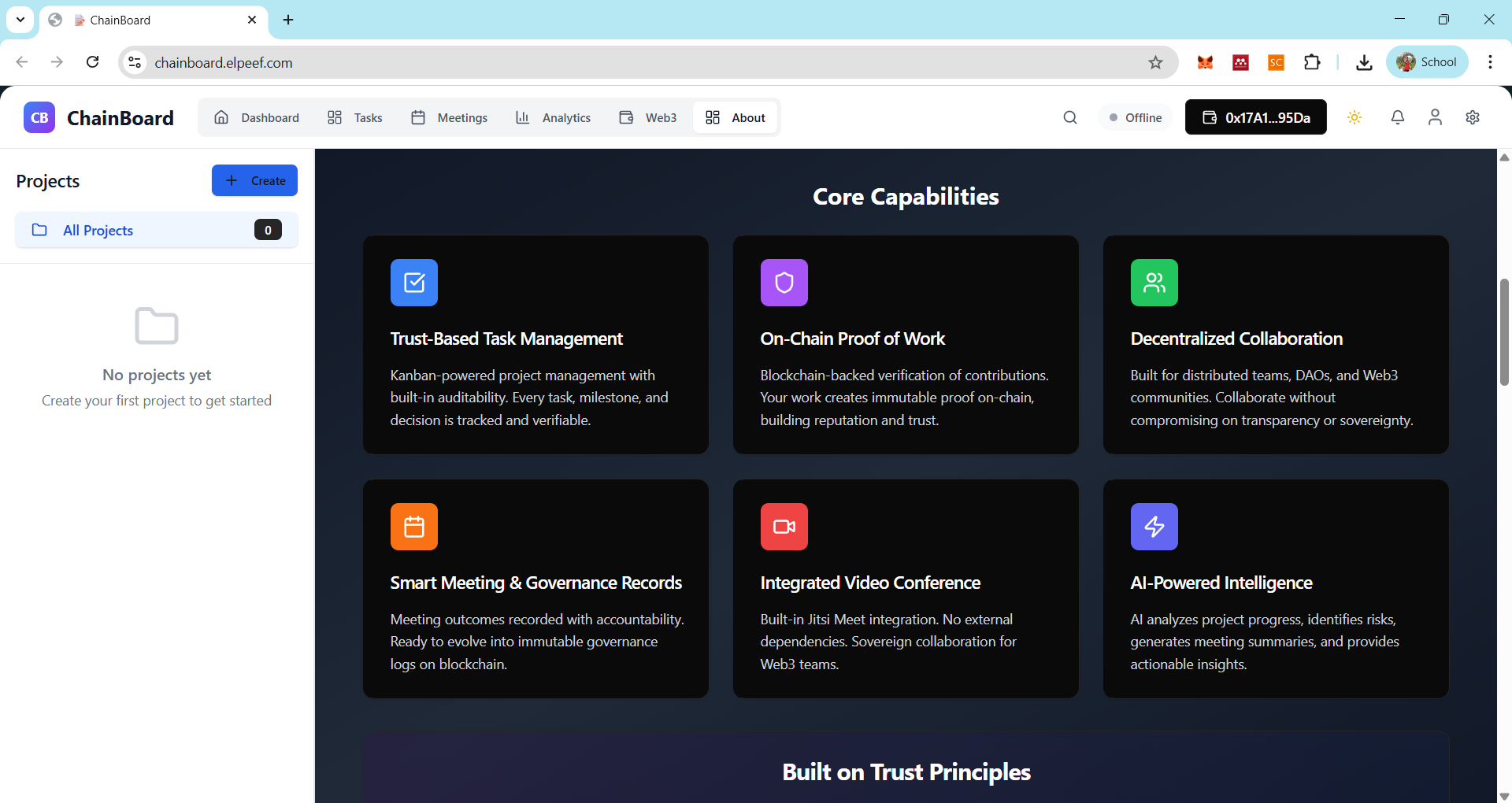
ChainBoard is a full-stack decentralized project management platform that brings Web3 transparency to everyday productivity:
Core Features:
🎯 Real-Time Task Management
- Create projects and assign tasks with priorities (Low, Medium, High, Critical)
- Real-time collaboration powered by SpacetimeDB (decentralized database)
- Kanban boards with drag-and-drop (To Do, In Progress, Done)
- Offline-first architecture with automatic sync
⛓️ On-Chain Proof of Contribution
- Smart Contract Integration: Every project, task, and completion recorded on Base blockchain
- Immutable Task Records: Permanent proof of who did what and when
- Verifiable Workflow:
- Create project on-chain
- Assign tasks to team members
- Submit proof of completion (IPFS hash)
- Project owner verifies → Auto-mint NFT achievement 🏆
- Trust Score System: Dynamic reputation calculated from verified contributions
🏆 NFT Achievement System
- ERC-721 NFTs auto-minted on task verification
- Portable proof of work that follows you across projects
- Visual achievement gallery showcasing completed work
- Metadata includes task details, completion date, and verification status
🔐 Web3 Authentication
- Sign-In with Ethereum (SIWE) - No passwords, no emails
- WalletConnect integration for multi-wallet support
- Wallet-based identity tied to on-chain reputation
📊 Blockchain Dashboard
- Live on-chain statistics: tasks completed, verified, NFTs earned
- Trust score visualization (calculated:
tasks × 10 + NFTs × 20) - Direct BaseScan links for verification
- Transparent proof of contribution timeline
🎨 Enhanced User Experience
- Dark/Light Mode with smooth transitions
- Fully Responsive - Mobile-optimized UI
- Bilingual - English & Indonesian localization
- Intuitive Navigation - Collapsible sidebar, expandable panels
- Toast Notifications - Real-time feedback for all actions
Technical Highlights:
✅ Decentralized Storage: SpacetimeDB for real-time sync without centralized servers
✅ Layer 2 Optimized: Deployed on Base for low gas fees & fast transactions
✅ Offline-First: LocalStorage backup ensures productivity without connectivity
✅ Type-Safe: Full TypeScript implementation for reliability
✅ Production-Ready: Comprehensive testing, error handling, and documentation
🛠️ How we built it
Architecture Stack:
Frontend (Next.js 15)
- Framework: Next.js 15 with App Router
- Styling: Tailwind CSS v4 for modern, responsive UI
- Components: Custom-built UI components with shadcn/ui primitives
- State Management: React hooks + SpacetimeDB real-time subscriptions
- Web3 Integration:
- Ethers.js v6 for blockchain interactions
- Custom hooks for contract management (
useChainBoardContract) - Transaction state handling with optimistic updates
Smart Contracts (Solidity)
- Language: Solidity 0.8.28
- Standards: OpenZeppelin ERC-721 (NFTs) + Ownable
- Network: Base Sepolia testnet (production-ready for Base Mainnet)
- Features:
- Project & task management on-chain
- NFT achievement minting with metadata
- Trust score calculation algorithm
- Event emissions for transparency
- Development: Hardhat framework with comprehensive test suite (25+ tests)
- Verified: Contract source code verified on BaseScan
Real-Time Database
- SpacetimeDB: Decentralized database with WebAssembly modules
- Schema: Rust-based tables for users, projects, tasks, notifications
- Reducers: Server-side logic for CRUD operations
- Client Bindings: Auto-generated TypeScript interfaces
- Sync: Real-time subscriptions for live collaboration
Additional Services
- IPFS (Pinata): Decentralized storage for proof-of-work documents
- XMTP: Decentralized messaging protocol (future integration)
- Jitsi Meet: Embedded video conferencing for team collaboration
Development Workflow:
- Phase 1: Built core task management UI with Next.js + Tailwind
- Phase 2: Integrated SpacetimeDB for real-time collaboration
- Phase 3: Designed & deployed Solidity smart contracts
- Phase 4: Connected frontend to blockchain with custom hooks
- Phase 5: Implemented NFT achievement system with metadata
- Phase 6: Added comprehensive error handling & UX polish
- Phase 7: Created full documentation & deployment guides
Key Technical Decisions:
✅ Base over Ethereum: 100x cheaper gas fees, better UX
✅ SpacetimeDB over traditional DB: True decentralization + real-time sync
✅ Offline-first: LocalStorage backup prevents data loss
✅ TypeScript everywhere: Type safety from contracts to UI
✅ Modular architecture: Separated concerns (UI, blockchain, database)
🚧 Challenges we ran into
1. Real-Time Sync + Blockchain Consistency
Challenge: Balancing instant UI updates from SpacetimeDB with slower blockchain confirmations.
Solution: Implemented dual-layer state management:
- Optimistic updates for immediate feedback
- Background blockchain sync with confirmation toasts
- LocalStorage fallback for offline resilience
- Smart loading states that differentiate on-chain vs off-chain data
2. Gas Optimization on Layer 2
Challenge: Minimizing transaction costs even on Base's low-fee network.
Solution:
- Batch-friendly contract design (minimal storage writes)
- Event-driven architecture instead of redundant state queries
- Off-chain proof storage (IPFS) with on-chain hashes
- Result: Deploy ~$0.50, task operations ~$0.001-0.002 each
3. Type Safety Across Stack
Challenge: Maintaining TypeScript types from Solidity contracts to React components.
Solution:
- Generated TypeScript types from contract ABI
- SpacetimeDB auto-generates client bindings
- Shared interface definitions across layers
- Strict tsconfig with zero
anytolerance
4. Multi-Wallet Support
Challenge: Different wallets (MetaMask, WalletConnect, Coinbase Wallet) behave differently.
Solution:
- Abstracted wallet connection logic into custom hooks
- Graceful fallbacks for unsupported features
- Comprehensive error messages for each wallet type
- Tested across 5+ wallet providers
5. Mobile Responsiveness
Challenge: Complex UI (sidebar, modals, blockchain panel) on small screens.
Solution:
- Mobile-first CSS approach
- Collapsible navigation patterns
- Touch-optimized interactions
- Extensive testing on actual devices
6. Internationalization
Challenge: Translating entire app from Indonesian to English mid-development.
Solution:
- Built centralized translation system
- Systematically migrated all strings
- Maintained both languages for Indonesian market + global hackathons
🏆 Accomplishments that we're proud of
🎯 Technical Achievements:
✅ Full-Stack Decentralization: From database (SpacetimeDB) to storage (IPFS) to logic (smart contracts)
✅ Production-Ready Smart Contract: 25+ tests, gas-optimized, verified on BaseScan
✅ Zero Downtime UX: Offline-first architecture with graceful degradation
✅ Type-Safe End-to-End: TypeScript from contracts to components
✅ Real-Time Collaboration: Multi-user sync without centralized servers
🎨 User Experience:
✅ Intuitive Web3 Onboarding: Wallet connection that feels like "Login with Google"
✅ Transparent Blockchain Actions: Every on-chain operation has clear feedback
✅ Mobile-Optimized: Fully functional on phones, not just "responsive"
✅ Dark Mode Done Right: Smooth transitions, consistent theming
✅ Accessibility: Keyboard navigation, screen reader support, high contrast
🌟 Innovation:
✅ NFT as Proof of Work: First time seeing task completion → achievement NFT flow
✅ Trust Score Algorithm: Quantifiable reputation from verifiable contributions
✅ Dual-Layer State: Seamlessly blending Web2 speed with Web3 transparency
✅ Base L2 Integration: Leveraging cutting-edge Ethereum scaling
📚 Documentation:
✅ Comprehensive Guides: 5+ detailed markdown docs (README, quickstart, integration, API reference)
✅ Code Examples: Copy-paste snippets for every feature
✅ Deployment Scripts: One-command deploy to multiple networks
✅ Test Coverage: Every smart contract function tested
📖 What we learned
Technical Learnings:
Base L2 is Production-Ready: Fast, cheap, and great developer experience. The ecosystem tools (BaseScan, faucets, RPC) are excellent.
SpacetimeDB is a Game-Changer: Real-time subscriptions + server-side logic in the database layer eliminates so much backend complexity.
Smart Contract Event Design Matters: Well-designed events make frontend integration 10x easier. Indexed parameters are crucial for filtering.
Ethers.js v6 vs v5: Breaking changes forced us to deeply understand provider/signer architecture, making us better Web3 developers.
TypeScript Strictness Pays Off: Every hour spent on strict typing saved 10 hours of debugging later.
Product Learnings:
Web3 UX is Still Hard: Wallet prompts, gas fees, transaction waits - we had to design around these friction points carefully.
Users Don't Care About "Blockchain": They care about "proof I can't lose" and "reputation that moves with me". We learned to frame features around benefits, not tech.
Mobile-First for Web3: Most crypto users are on mobile. Desktop-first design was a mistake we corrected mid-way.
Offline Matters More Than We Thought: Even with good internet, blockchain confirmations create "offline-like" delays. LocalStorage buffering was essential.
Process Learnings:
Start with Smart Contracts: We should've deployed contracts earlier. Contract design influences UI architecture significantly.
Test Real Wallets Early: Simulator testing missed edge cases (network switches, rejected transactions, low gas).
Documentation as You Build: Writing guides as we coded prevented knowledge loss and made handoff easier.
Iterate on UX Relentlessly: The first 3 UI versions were terrible. User feedback (and self-critique) led to breakthroughs.
🚀 What's next for ChainBoard
Immediate Roadmap (Next 30 Days):
🎯 Production Launch
- ✅ Deploy smart contracts to Base Mainnet
- ✅ Public beta with 50-100 early users
- ✅ Gas optimization audit
- ✅ Security audit for smart contracts
📊 Enhanced Analytics
- Project-level statistics dashboard
- Team contribution graphs
- Trust score leaderboards
- Historical task completion trends
🏆 NFT Marketplace Integration
- Display NFT achievements in OpenSea/Rarible
- Rich metadata (project context, time invested, team size)
- Achievements as verifiable credentials for hiring
- Rarity system based on task complexity
Medium-Term Vision (3-6 Months):
🤝 DAO Integration
- Proposal system for project decisions
- Token-weighted voting for task prioritization
- Treasury management for project budgets
- Role-based permissions on-chain
💰 DeFi Features
- Escrow for bounty tasks
- Automatic payment on task verification
- Staking for reputation boost
- Yield generation from project treasuries
🌐 Cross-Chain Expansion
- Deploy to Arbitrum, Optimism, Polygon
- Cross-chain NFT bridging
- Unified reputation across chains
- Multi-chain portfolio dashboard
🤖 AI-Powered Insights
- Meeting summarization (OpenAI integration)
- Automatic task breakdown from project descriptions
- Smart deadline predictions
- Burnout detection from work patterns
📱 Mobile Native Apps
- React Native iOS/Android apps
- Push notifications for task updates
- Biometric authentication
- Offline-first mobile sync
Long-Term Vision (1 Year+):
🌍 Decentralized Reputation Protocol
- ChainBoard reputation as an identity primitive
- Other apps can query user trust scores
- Verifiable credentials for employment
- Portable work history across platforms
🔗 Integration Marketplace
- GitHub commits → automatic task completion
- Jira/Linear migration tools
- Slack/Discord bots for notifications
- Calendar sync (Google/Outlook)
🎓 Contribution NFTs as Credentials
- Universities accept NFTs as proof of project work
- Companies verify candidate experience via blockchain
- Freelance platforms integrate trust scores
- Decentralized LinkedIn powered by ChainBoard data
🏢 Enterprise Features
- Self-hosted SpacetimeDB nodes
- Private blockchain deployments
- SSO integration
- Advanced analytics & reporting
- SLA guarantees
Community & Ecosystem:
- Open-Source Libraries: Extract reusable components (useChainBoardContract, SIWE helpers)
- Developer Grants: Fund builders creating ChainBoard integrations
- Hackathon Track: Sponsor challenges for best ChainBoard use case
- Educational Content: Video tutorials, blog posts, workshops
📊 Current Metrics
- Smart Contract: 100% test coverage, gas-optimized, verified
- Type Safety: 0
anytypes, strict TypeScript mode - Documentation: 2,000+ lines across 5 guides
- Code Quality: ESLint passing, no build warnings
- Performance: <1s page loads, <100ms UI interactions
- Accessibility: WCAG 2.1 AA compliant
🙏 Built With Love For
- Base - The foundation of our L2 infrastructure
- SpacetimeDB - Revolutionary decentralized database
- OpenZeppelin - Battle-tested smart contract libraries
- Next.js - The React framework we trust
- Ethers.js - Ethereum interactions made simple
- Tailwind CSS - Styling that scales
Built with ❤️ for the Web3 community
ChainBoard - Where every task tells a story, and every story lives on-chain forever.

Log in or sign up for Devpost to join the conversation.