Inspiration
We were inspired by the limitation of existing productivity tools, which treat distraction as a simple binary problem. In reality, the same platform can be both productive and distracting depending on how it is used. We wanted to move beyond static blocking and build something that understands user behavior, adapting dynamically to how people interact with their digital environments.
What it does
TabAware is an intelligent browser assistant that tracks browsing activity in real time and analyzes user behavior patterns. It classifies activity into productive or distracting states and responds dynamically by blocking distracting websites, offering recommendations, and helping users break out of doomscrolling cycles before they escalate. Instead of relying on fixed rules, it continuously adapts based on how the user behaves.
How we built it
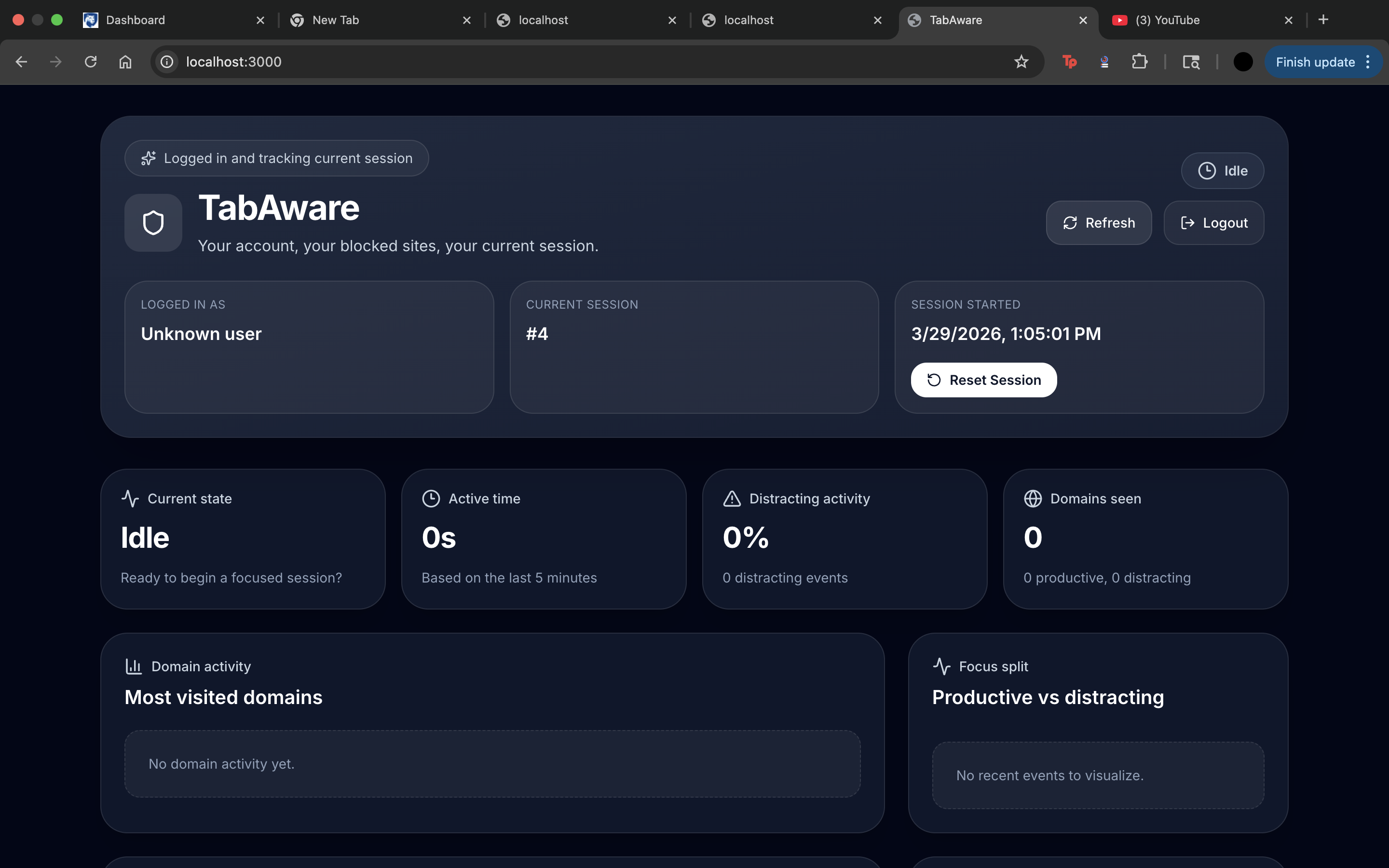
We built the system as a full-stack application with a strong focus on behavior modeling. A browser extension captures events such as URLs, timestamps, and tab activity, which are sent to a Node.js and Express backend. The data is stored in SQLite and processed in real time using a custom state engine that analyzes behavioral patterns and classifies user states as focused, drifting, or distracted. A React and Tailwind frontend displays these insights in a clean and intuitive dashboard.
Challenges we ran into
One of the biggest challenges was defining what counts as distraction, since intent cannot be directly measured and had to be approximated through patterns like time spent and tab switching. Ensuring real-time responsiveness was also difficult, as early versions of the system detected distraction too late to be useful. Additionally, transforming raw browsing data into meaningful insights required multiple iterations, and debugging the full pipeline from browser extension to backend to database proved to be complex.
Accomplishments that we're proud of
We are proud that we built a system that goes beyond traditional blockers by incorporating behavior awareness and real-time adaptation. The dynamic state classification and feedback loop allowed us to create something that actively responds to user patterns rather than passively enforcing rules. We also successfully integrated multiple components into a cohesive system and designed a clean interface that makes complex data easy to understand.
What we learned
Through this project, we learned that productivity is not a fixed concept but a dynamic system influenced by behavior over time. We gained a deeper understanding of how abstraction helps separate raw data from meaningful insights and how real-time systems require careful coordination across multiple layers. We also learned that even simple behavioral signals can become powerful when combined and interpreted correctly.
What's next for TabAware
Moving forward, we want to incorporate AI-driven intent detection to better distinguish between productive and distracting usage. We also plan to build personalized models that adapt to individual users, introduce features like “You vs Algorithm” insights to highlight addictive patterns, and expand the system to support cross-device tracking. Our goal is to evolve this into a fully adaptive productivity system that continuously learns and improves over time.

Log in or sign up for Devpost to join the conversation.