Inspiration
The idea for this project was inspired by the frequent sight of vehicles being driven rashly with deprecated or tampered number plates—plates that are faded, stylized, or non-standard, making it difficult for authorities to trace offenders. This issue not only puts the drivers themselves at risk but also endangers the safety of others on the road. While existing surveillance systems can track standard violations, vehicles with unreadable or altered number plates often escape detection. This project, Chaluu Plate, was developed as a step toward solving this problem by using AI to automatically detect such vehicles, match them with a database, and issue a challan directly to the owner's phone via SMS. The goal is to create a deterrent that encourages compliance and contributes to safer roads for everyone.
What it does
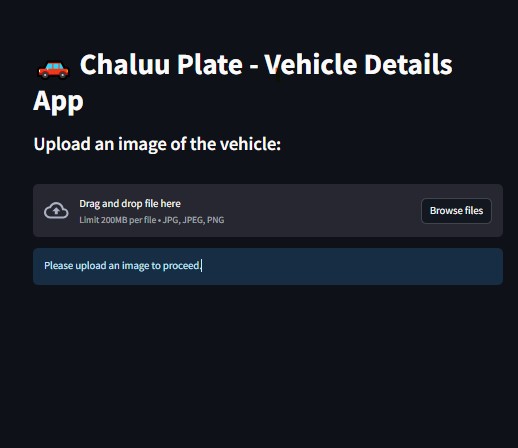
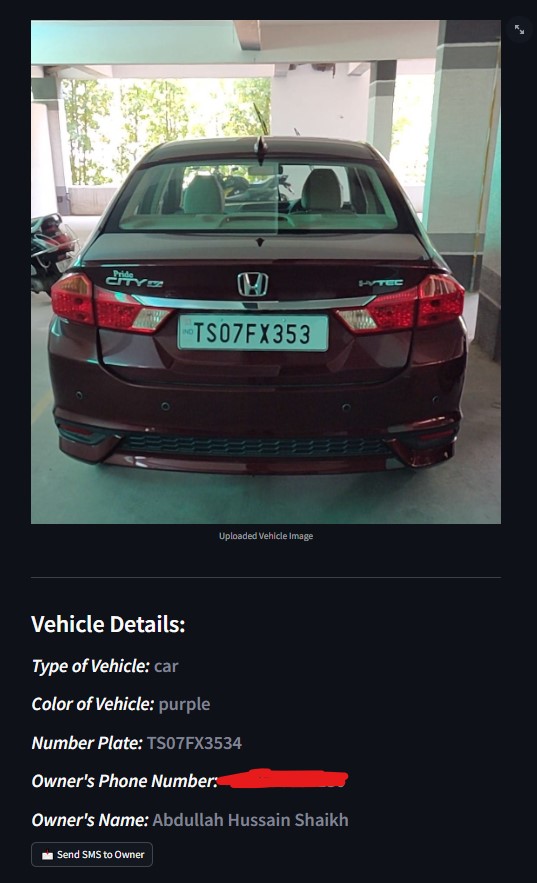
Chaluu Plate is an AI-powered system designed to identify and challan vehicles with deprecated or tampered number plates. Users upload an image of a vehicle, and the system processes it using YOLO and OCR to detect and extract the number plate. It also predicts the vehicle’s color and type using deep learning models. These three attributes — number plate text, vehicle color, and vehicle type — are matched against a database using fuzzy logic to accurately identify the vehicle owner, even when the number plate is partially degraded. Once a match is found, the system uses Twilio to automatically send a challan notification via SMS to the registered phone number of the owner, promoting accountability and helping deter future violations.
How we built it
We built Chaluu Plate by integrating multiple powerful technologies into a unified and user-friendly Streamlit web app. For number plate detection, we used YOLO (You Only Look Once), a real-time object detection model, and for text extraction from plates, we used Tesseract OCR. To determine the color of the vehicle, we trained a custom image classification model using TensorFlow,ScikitLearn, and for predicting the type of vehicle, we leveraged another YOLO model fine-tuned for vehicle classes. All processed data is cross-referenced with a MySQL database, where vehicle information is stored. Once a vehicle is matched based on its number plate, color, and type, a challan is issued, and an SMS is sent via Twilio to the owner’s registered phone number — all through an intuitive and interactive UI built with Streamlit.
Challenges we ran into
While building Chaluu Plate, one of the major challenges we faced was creating an accurate vehicle color classification model. Color prediction can vary greatly depending on lighting conditions, shadows, and image quality, which made model training and validation tricky. Additionally, the OCR performance using Tesseract posed a challenge, as it struggled with distorted or unclear number plates, leading to only moderate accuracy in some cases. Integrating Twilio for SMS notifications also came with a learning curve — from setting up a verified number to managing message delivery permissions and formatting. Despite these hurdles, we were able to build a working prototype that delivers on its core functionality.
Accomplishments that we're proud of
One of the biggest accomplishments we're proud of is successfully building a working prototype that brings our vision to life. Integrating multiple complex components — including OCR, object detection, custom classification models, database querying, and real-time SMS notifications — into one cohesive system was a major technical achievement. We're especially proud of developing and training the vehicle color classification model, which required careful tuning and experimentation. Additionally, working with databases like MySQL for the first time opened up an entirely new dimension of problem-solving and scalability that was previously out of reach. This project not only showcased what I could build, but also expanded my confidence in handling full-stack AI solutions.
What we learned
Through this project, I learned a lot about building and improving machine learning models, including techniques to increase their accuracy and robustness. I gained hands-on experience with OCR using Tesseract, understanding its functions and limitations in real-world scenarios. Working extensively with databases like MySQL was a valuable learning experience that opened up many new project possibilities that were previously out of my reach. Additionally, integrating the Twilio API for SMS notifications was initially confusing, but with time, I got comfortable with its setup and usage, expanding my skills in working with external APIs and cloud communication services.
What's next for Chaluu Plate
The next major milestone for Chaluu Plate is to enable it to work seamlessly with live video footage, allowing real-time detection and challaning of vehicles on the move. Another key focus is to expand and improve the accuracy of our models, especially the OCR component, to handle a wider variety of number plates under different conditions. Additionally, we plan to migrate the database to a cloud-based solution, making it easier for government agencies and other users to deploy the system at scale, ensuring accessibility, reliability, and easier maintenance across multiple locations.
Built With
- mysql
- python
- scikit-learn
- streamlit
- tensorflow
- tesseract-ocr
- twilio
- yolo-(you-only-look-once)
