-
-
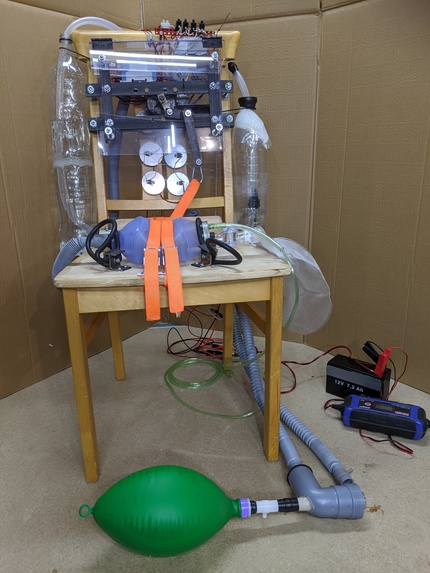
Ch(air) V2 prototype working
-

Link to share
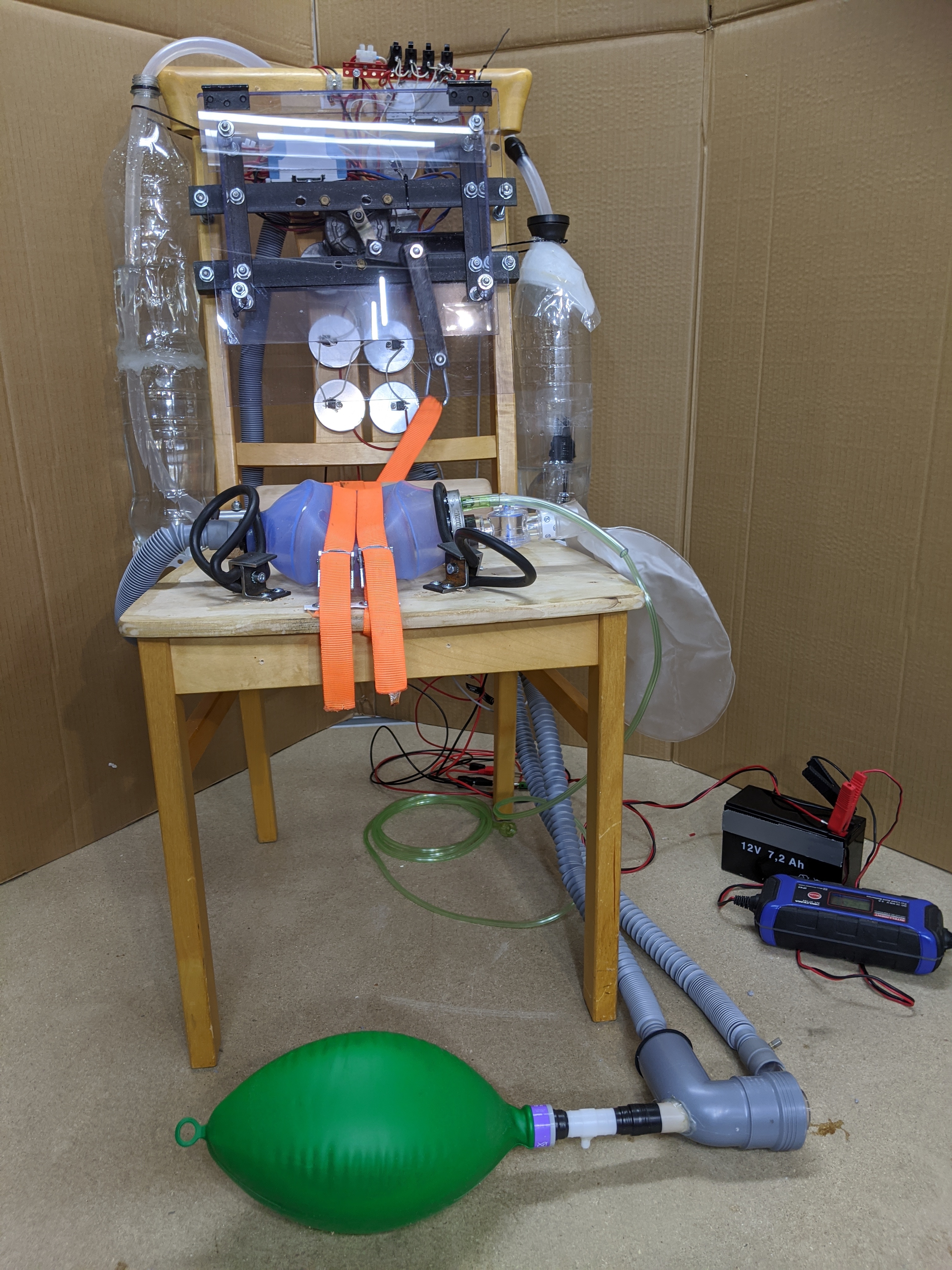

Inspiration
My friend Jonas Wahlfrid came to me (Morgan) with a chair, windscreen motor, and "ambu" bag, and asked me to join him to build a ventilator that should be easy to produce all over the world from simple parts plus an "ambu" bag. Crazy. So we started. :-) We got an early version into competition Agorize "Code Life Ventilator Challenge" And currently Ch(air) in its current design have advanced in Fraunhofer / Munich RE "Give-a-Breath-Challenge".
It also spread to local newspaper, radio, and Swedish television. So why not this competition too?
We are not in it to win, but to help out. Already other teams have started using bottles, from our tip.
What it does
Despite looking arcade, it really is a working ventilator good enough for covid-19 use. The technology is modular, and can be built really simple, and we can add Pause, Trig, and a reliable check that everything is OK, and alarm if not. It can be built in small simple shops all over the world, and easily mass produced too.
I recommend to browse our share in given link here (same as the QR code image) for videos and documents. Note: The Github repo is not readily populated yet.
Version 1
In short: a mechanically pumped manual resuscitator, where you can set PBM, volume per cycle, max pressure, and PEEP pressure.
In its simplest version the only electrical part is the motor. It pumps a standard manual resuscitator using straps. We have moved the non-rebreathing valve close to patient, so there is one tube air going to patient, an another for return to the PEEP device. Speed (BPM) is set by changing supply voltage or reconnect winding (windscreen motors have usually two speeds built in.) I.e use a variable benchtop supply, and use a standard office PC UPS for backup. Or use standard 12V battery and charger, and add the diode-and-switch solution described in build manual for version 2.
Maximum pressure and PEEP pressure are realised by bubbling into bottles of water.
Max volume per cycle can be set by changing strap tension. - Normally set this higher then needed, and let the excess bubble out by maximum pressure regulation.
Version 2 adds over version 1
- Timer to set expiration pause
- Trig functionality!
- Pressure monitoring at patient (An added tube from patient connector, into max pressure bottle to see resulting cm water pressure.)
Version 3 adds over version 2 (in progress)
Most importantly, it can sense if patient exhalation is strong enough , and if not, set off an alarm. This check catches all severe problems including the controller, power supply, motor, mechanics, bag, valves *), bottles, tubing, and connection to patient! (It miss a lot of less severe problems such as wrong frequency or just a bit too low flow or pressure, but should catch anything life threatening.)
*) Detail: to catch if the non-rebreathing valve is broken the signal evaluation is synchronised in phase with the squeezing of the bladder.
Controller circuit board
- Less wiring than version 2, easier and faster machine manufacture.
- Improved Trig implementation: sensing by cheap electrodes instead of level switch.
- Inspiration pause.
- Setting knobs and indicator lamps for both inspiration and expiration pauses.
- Soft but still quick start and brake of motor to prolong its life and minimise EMI.
- Warn on motor overload - while keeping pausing/retrying movement.
Alarm circuit board
- Alarms by sound and red blinking lamp.
- Warning by steady lamp, no sound.
- All individual sources of alarms and warnings have each a small lamp.
- Auto enables when motor runs (cant be forgotten).
- Disables only by two button press.
- Tells the controller to run full speed if exhale per cycle is faint.
- Power supplied from same source as Controller, and additionally have an onboard backup to alarm power loss. Battery is charged automatically. Test button to test load battery heavily.
- Alarms on: ** Faint expiration ** Power supply loss ** Motor overload
- Warns on: ** Low supply voltage (12V battery low) ** Low alarm backup battery voltage
Version 4 (plan)
Simplify mechanic and frame for mass production.
Mount motor directly to rotate what in earlier versions is a roller. (All crank mechanics is removed, and a lot of structure and casing) So the whole machine can be much more compact, mass produced like an open or closed frame box. (But can still be built on a wooden chair if you so wish) ;-) The controller board is changed to run motor back and forth (a bit more complicated) Inspiration stroke can be set by moving slider for position sensor.
Inspiration flow/time curve is handled by the form and eccentricity of the "roller", so inspiration starts quicker and declines in a better way towards end of stroke than with pre V4 design. That mean 1) Quicker response from trig to actual inspiration, 2) Less difference between peak pressure at machine and inspired pressure at patient. (By avoiding high flow near peak pressure.)
All circuit boards
- Can be heat sterilised in oven
- Are designed to use easily sourceable components, available now, since decades, and years to come. * No unusual device, no microcontroller, no display (except LEDs)
- Easily produceable in small scale on double sided copper using through hole components, or easily redesigned for partly surface mount technology for mass production.
- Clearly documented for easy production design tweaking and further development
How we built it
In my workshop, using common tools for wood and steel, plus hot melt glue (but please use silicon for production...)
Jonas and a friend made a logging system which displays curves of pressure, flow, and volume in lung, on a laptop, using sensors and an Arduino. This is used for internal verification. It may also be shipped as an add-on, but the problem is to source the sensors in large scale.
Challenges we ran into
Lack of time (started too late)
Accomplishments that we are proud of
- Parts are cheap and easily to source all around the globe
- - Specifically it avoids electronic sensors for pressure and flow, to avoid sourcing problems
- The machine is easy to manufacture in simple workshops
- For advanced versions, circuit boards can be manufactured in few sites and posted globally, while the rest of machine can be produced in local factories (i.e furniture makers) to avoid much transport.
- Easy to redesign for mass production
- Backup power easily solved
- Reliable solutions for maximum pressure and PEEP
- Nifty solution for Trig
- Solution for checking everything is OK (exhale strength)
What we learned
This is fun! I usually work with complicated mechanic, fluid, cirquit boards, programs. Such is not really needed :-)
What's next for Ch(air)
Whenever prototype it is not in rebuild, we keep it running. (Currently more than a week accumulated.)
Version 2
- Finish build instruction
Version 3
- Controller unit
- Alarm unit
- Documentation
Version 4
- Simplified mechanics build and test
- New controller for that
- Documentation
Built With
- hand-tools


Log in or sign up for Devpost to join the conversation.