-
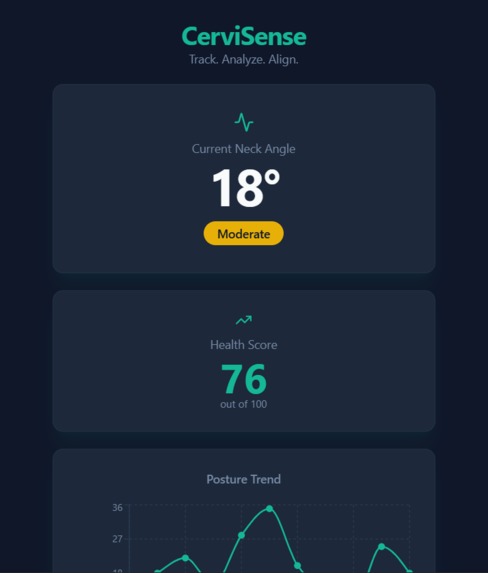
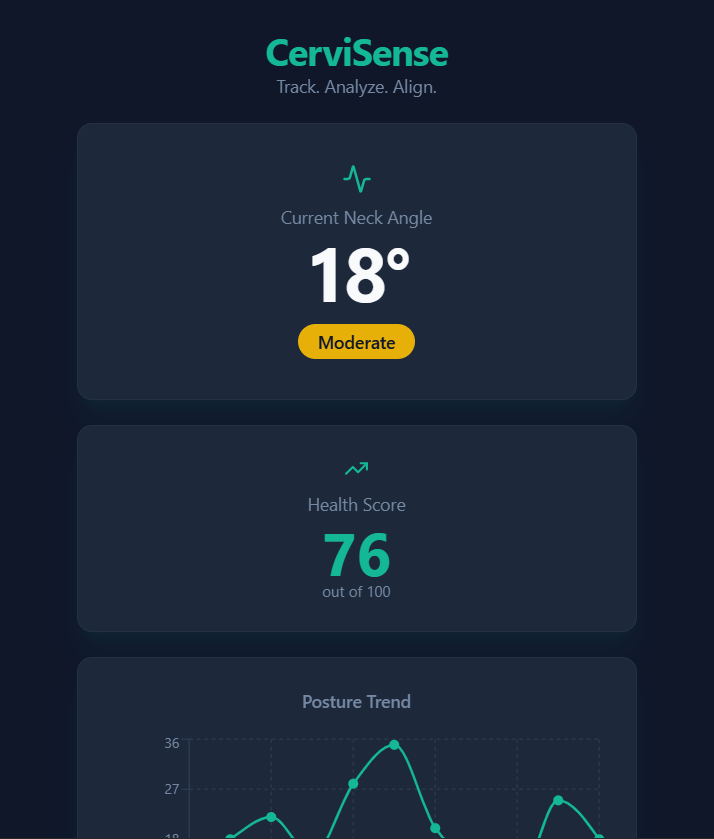
Real-Time Posture Monitoring Dashboard - Real-Time Posture Monitoring Dashboard
-
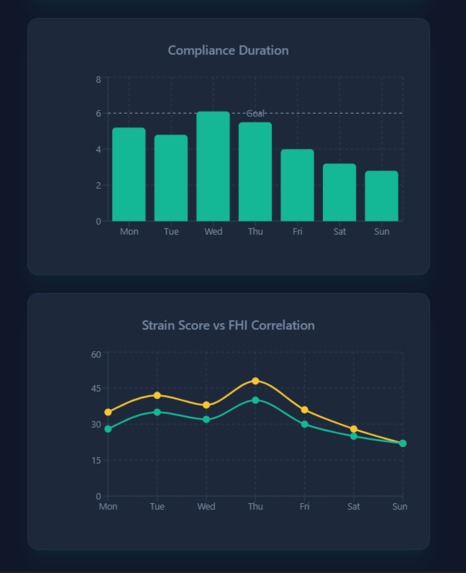
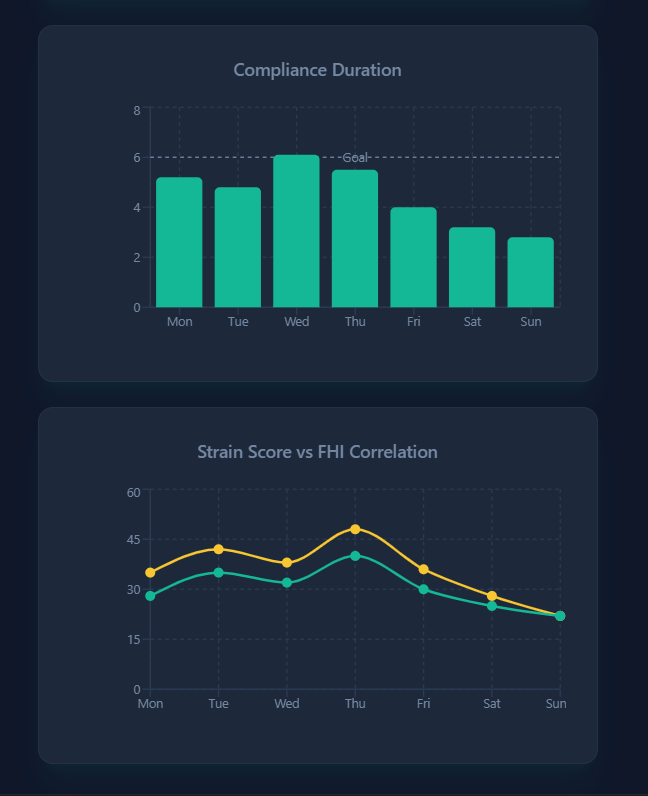
Behavioral Insights & Correlation Analysis - Correlation between strain score and posture health indicators
-
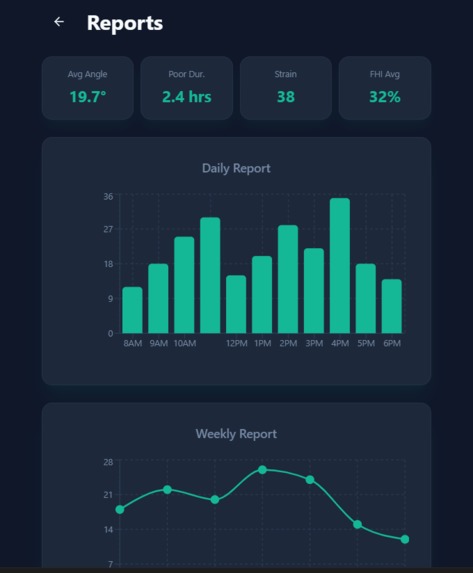
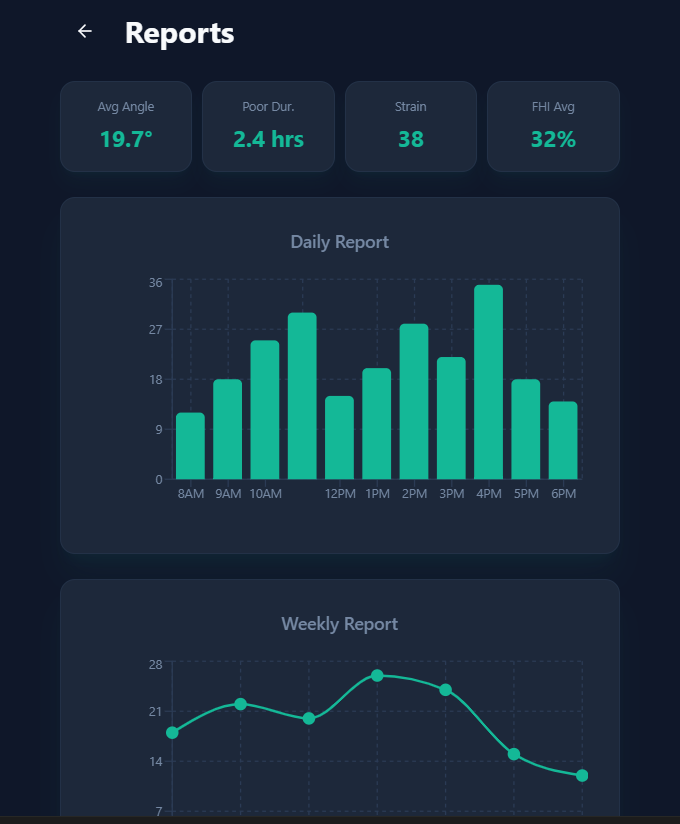
Detailed Posture Reports - Daily and weekly reports with posture patterns and performance metrics
-
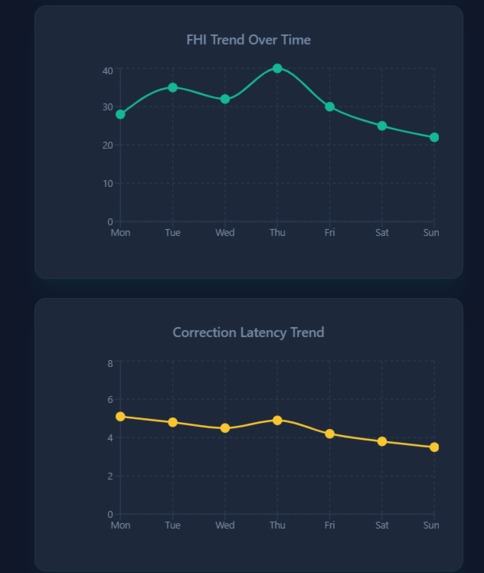
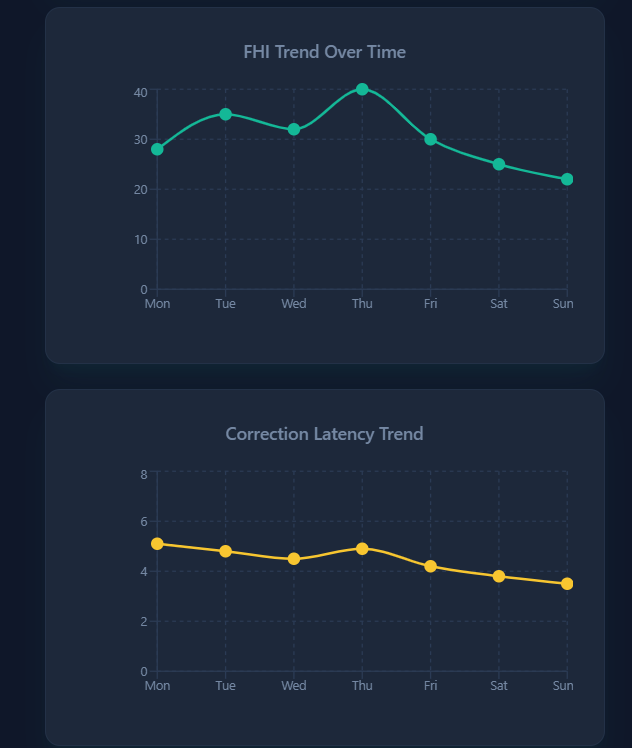
Long-Term Posture Trend Analysis - Visualization of FHI trends and correction latency over time
-
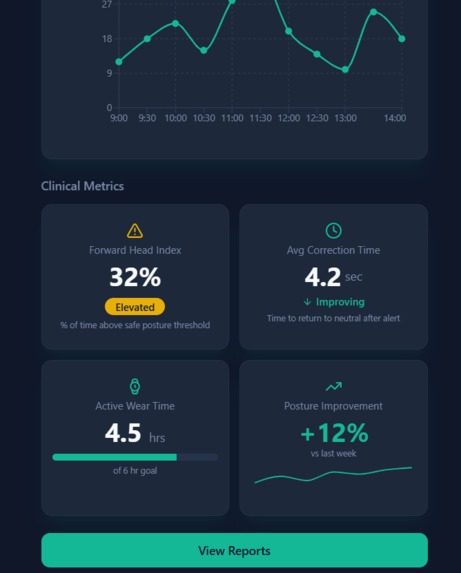
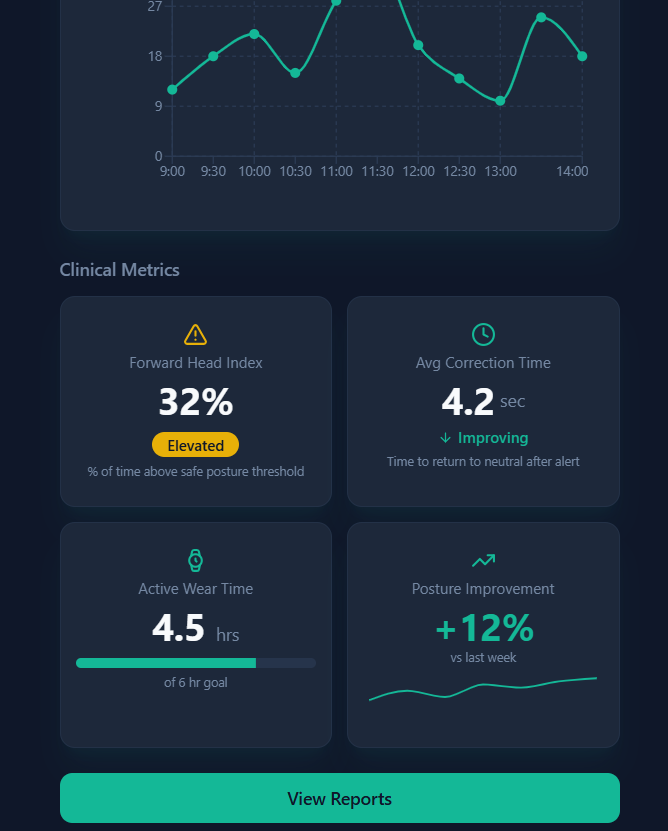
Posture Analytics & Clinical Metrics - Posture Analytics & Clinical Metrics
Inspiration
           ◉ In todays world sitting in front of screens for a long time has caused a lot of neck pain and bad posture especially for students and people who work on computers. Most solutions available today are, about fixing the problem after it happens not stopping it from happening in the place.

           ◉CerviSense was created because we needed something that can help people develop posture habits in real-time and prevent long-term neck and muscle problems before they start. We want to help users take care of their necks and bodies. CerviSense helps people be aware of their posture and take action to prevent pain.
What it does
CerviSense is a kind of wearable patch that you put on your neck. It does a things to help you with your neck posture.
           ➤ CerviSense continuously checks your neck posture using some sensors.
           ➤ It can tell away if your neck is not in the right position.
           ➤ The CerviSense patch figures out if your posture is good or bad.
           ➤ Then it uses a vibration to remind you to correct your posture.
           ➤ The CerviSense also keeps track of your posture habits over time. Gives you some personalized ideas on how to improve.
           ➤ You can see all the details about your posture on your phone or computer, with the CerviSense dashboard.
How we built it
The system puts together hardware and machine learning and software to make one solution:
🔹 Hardware
      • It has a MPU6050 IMU sensor that tracks movement
      • It has a ESP32 microcontroller that does things in real time
      • It has a vibration motor that gives you feedback away
🔹 Data & Model
      • We collected a lot of data that shows good posture and poor posture
      • We looked at things, like:
                  ◈ Neck angle when you lean forward
                  ◈ How much you tilt your head
                  ◈ How long you have poor posture
      • We made a simple machine learning model using Scikit-learn and TensorFlow
🔹 System Workflow
       1. The IMU sensor sees how you move your neck
       2. The ESP32 microcontroller looks at the data
       3. The machine learning model decides if your posture is good or bad
       4. It gives you feedback right away

       ➞ It sends the data to a dashboard so you can look at it later and see how you are doing with the system and the machine learning model and the hardware.
🔹Results:
      ➞ I was able to get the posture classification to work in time. It takes, than one second to do this.
      ➞ The system can successfully find when someones posture is not right.
      ➞ I tested it with some data and it worked pretty well.
      ➞ I made a working prototype that uses data from sensors.
Challenges we ran into
      ⋄ We have a problem with our posture classification system because we do not have a lot of labeled data.
      ⋄ The MPU6050 sensor is also giving us trouble because of noise and drift.
      ⋄ We need to make sure our system can process information quickly and in time.
      ⋄ The wearable device has to be comfortable and stable so people can wear it all the time.
      ⋄ We also have to be careful, with the power efficiency of the device so it can keep monitoring
      ⋄ The posture classification system and the wearable device are very important so we have to get this right.
      ⋄ We are working on the posture classification system and the wearable device to make sure they work together.
Accomplishments that we're proud of
      ⦿ Developed a system that includes hardware, AI and a user interface.
      ⦿ I achieved real-time detection of posture with feedback to the user.
      ⦿ The system uses a lightweight machine learning model that can run on edge devices.
      ⦿ An easy-to-use analytics dashboard was designed to display the data.
      ⦿ The system was. Validated using real data from sensors.

      • A solution was created that can be scaled up and is focused on preventing health problems.

      ➞ Developed hardware, AI and UI
      ➞ Achieved real-time posture detection
      ➞ Built a ML model
      ➞ Designed an analytics dashboard
      ➞ Validated the system
      ➞ Created a solution
What we learned
      ◈ Here is how edge artificial intelligence works in things we wear.
      ◈ It has to do with handling the information that sensors collect and making that information useful.
      ◈ We also have to make sure that the systems work quickly and do not waste time.
      ◈ The edge artificial intelligence has to work with the hardware, the artificial intelligence and the cloud platforms together.
                • Handling sensor information
                • Making the systems work quickly
                • Working with hardware and artificial intelligence and cloud platforms to make artificial intelligence work, in wearable devices.
What's next for CerviSense: AI Smart Neck Patch for Posture Correction
      ➞ Improve model accuracy with larger datasets
      ➞ Add adaptive learning for personalized posture correction
      ➞ Miniaturize hardware for better wearability
      ➞ Integrate with healthcare and physiotherapy platforms
      ➞ Enhance mobile app with advanced analytics
Built With
- arduino
- c/c++
- cloud
- esp32
- mpu6050
- node.js
- python
- react/flutter
- rest-apis
- scikit-learn
- supabase
- tensorflow


Log in or sign up for Devpost to join the conversation.