Inspiration
Projects rarely fail because information does not exist — they fail because the information is scattered, outdated, contradictory, or difficult to verify.
For the Loto-Québec NOVA challenge, we wanted to create more than a dashboard. Our goal was to build a reliable operational memory that lets someone take over a complex project and quickly understand what is true, what changed, what still needs attention, and why.
What it does
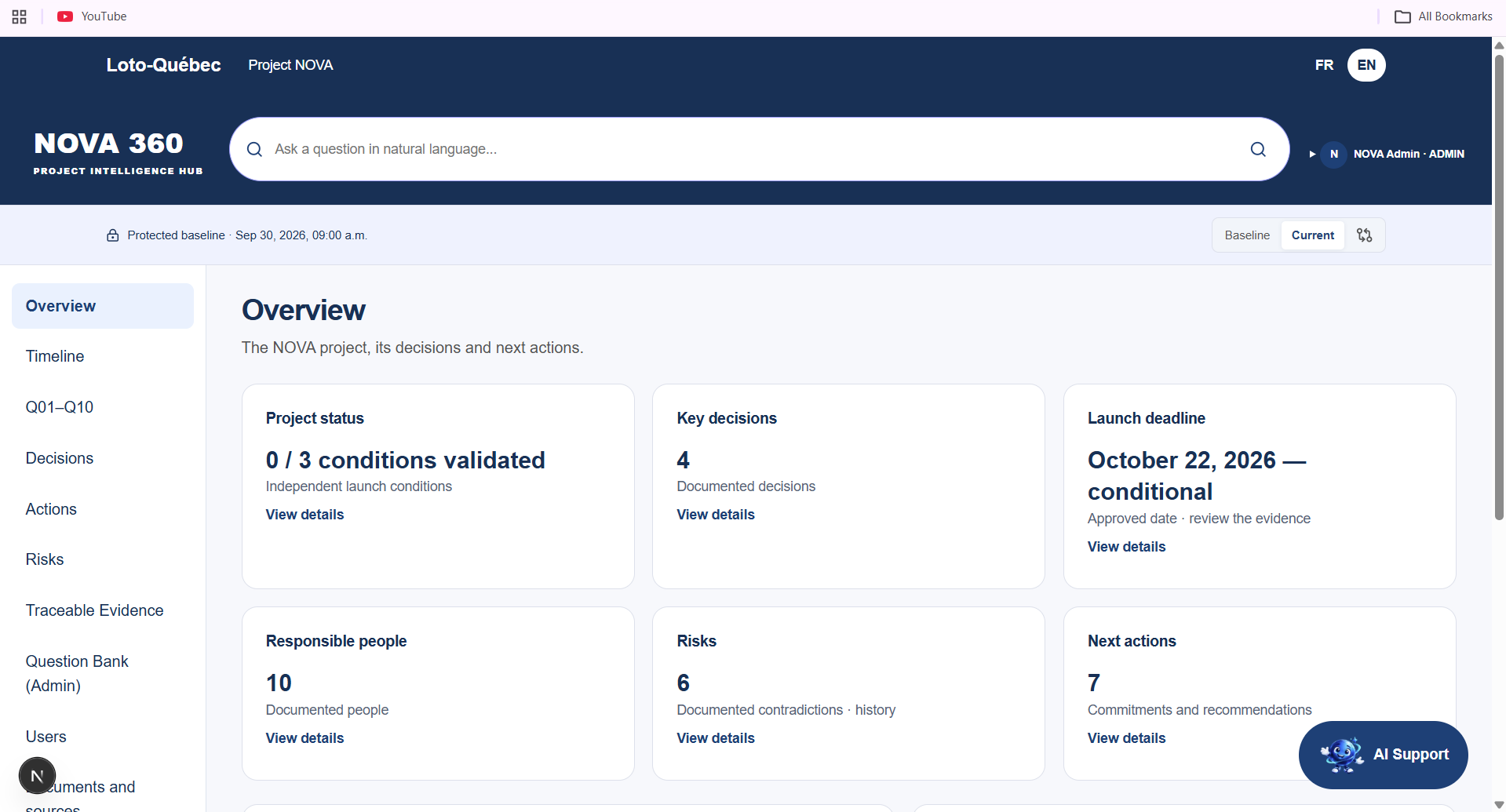
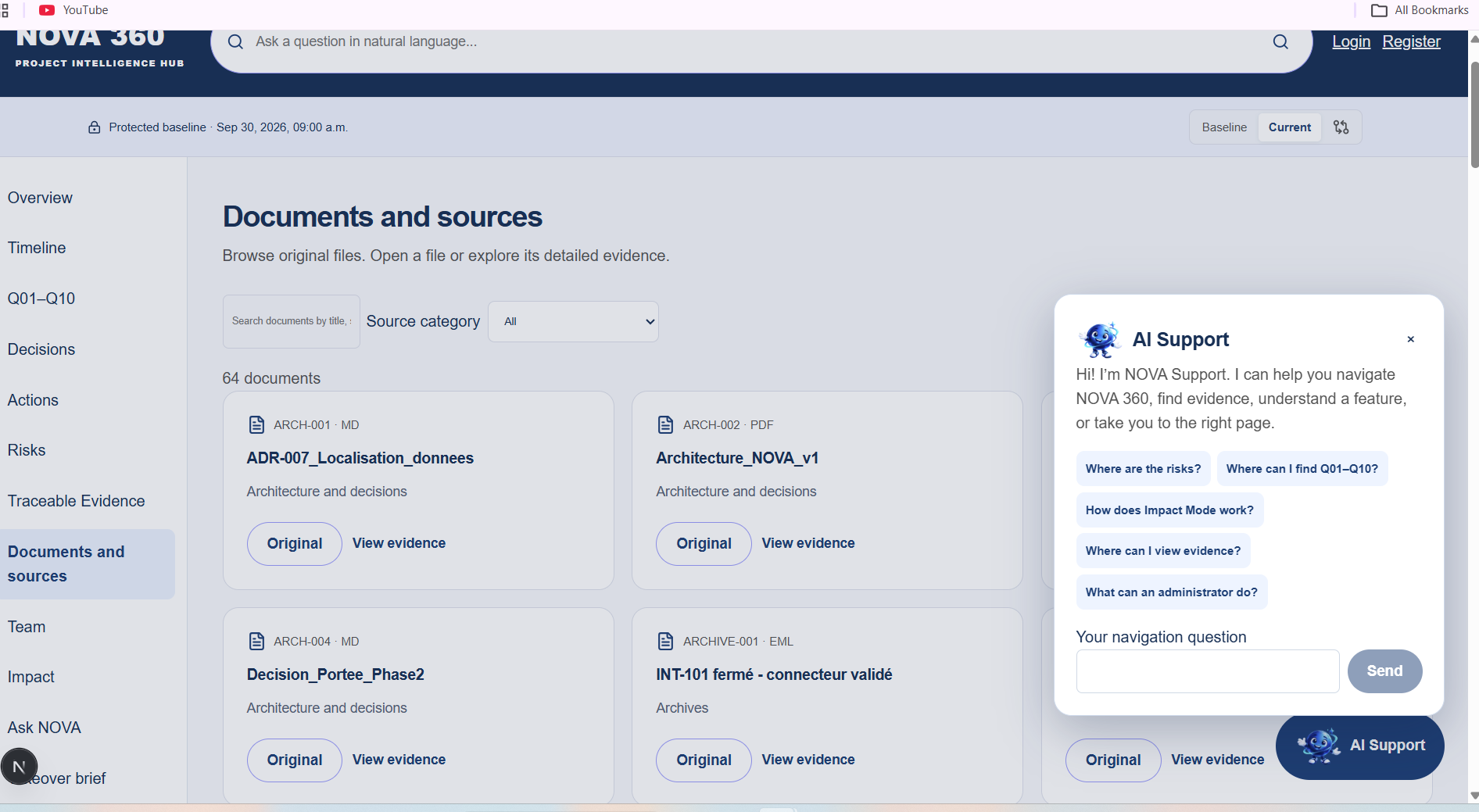
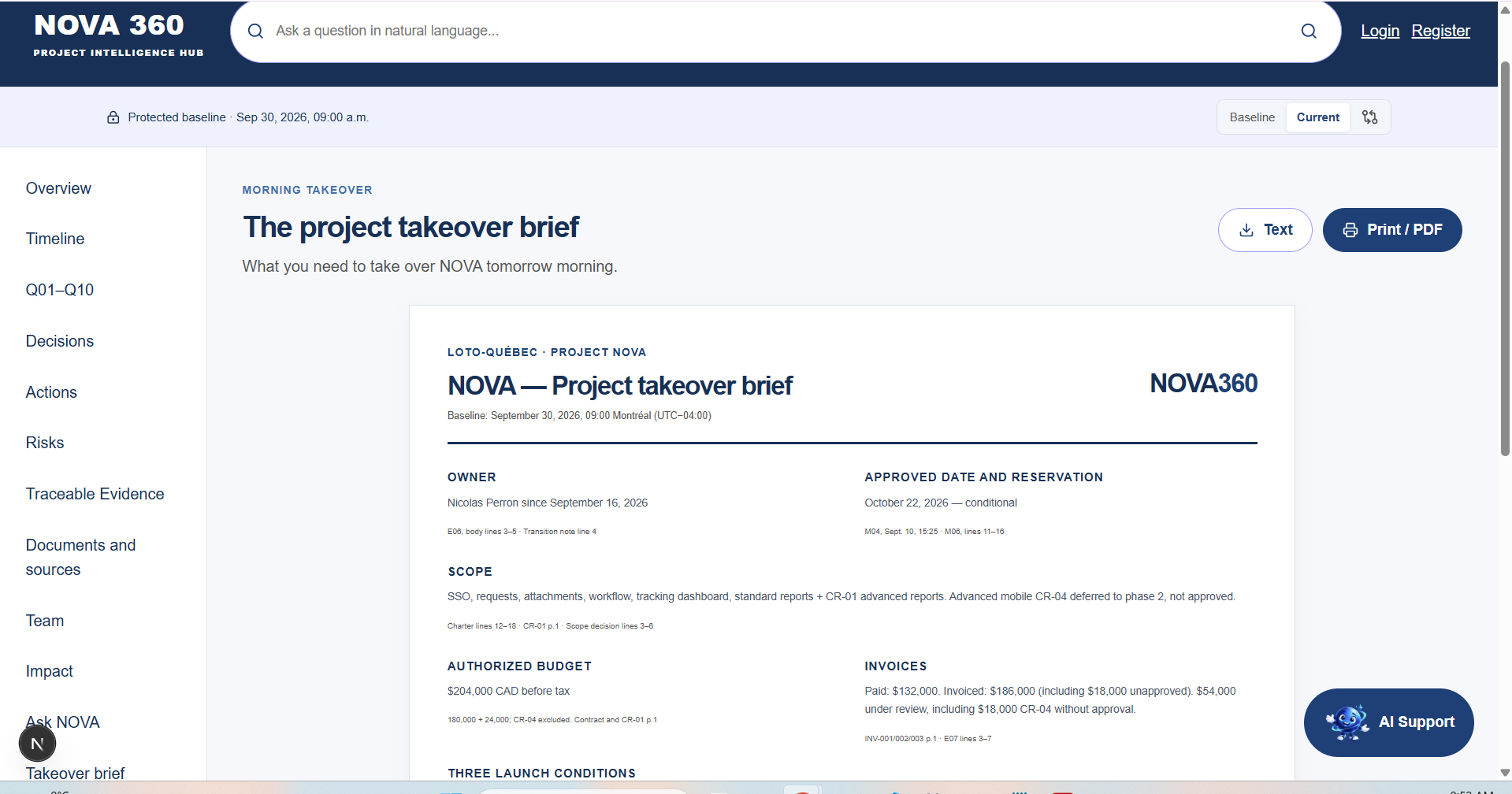
NOVA 360 turns fragmented project information from emails, meetings, tickets, contracts, invoices, plans, screenshots, and conversations into one clear and traceable source of truth.
The platform helps users:
- understand the current state of the project
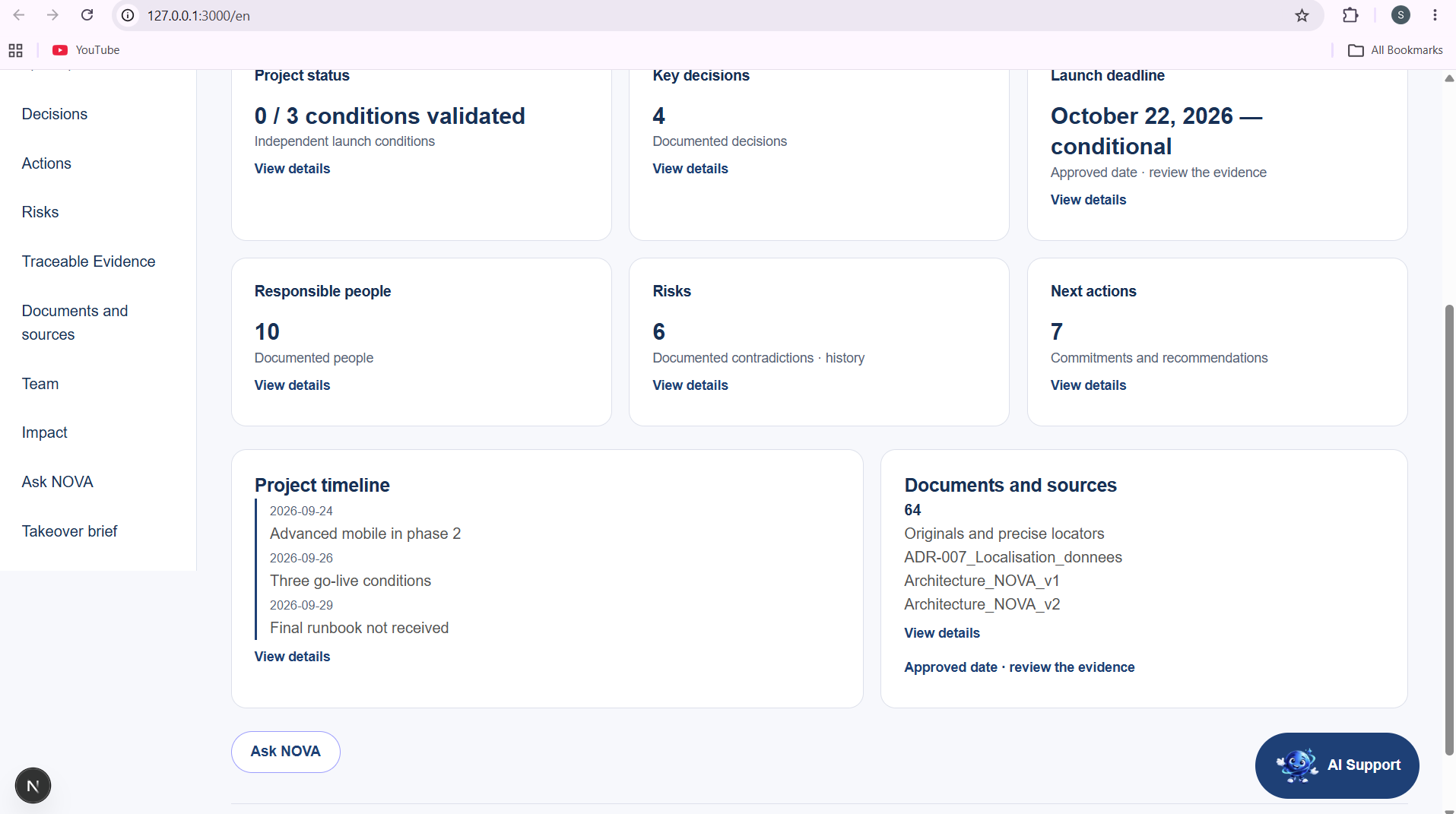
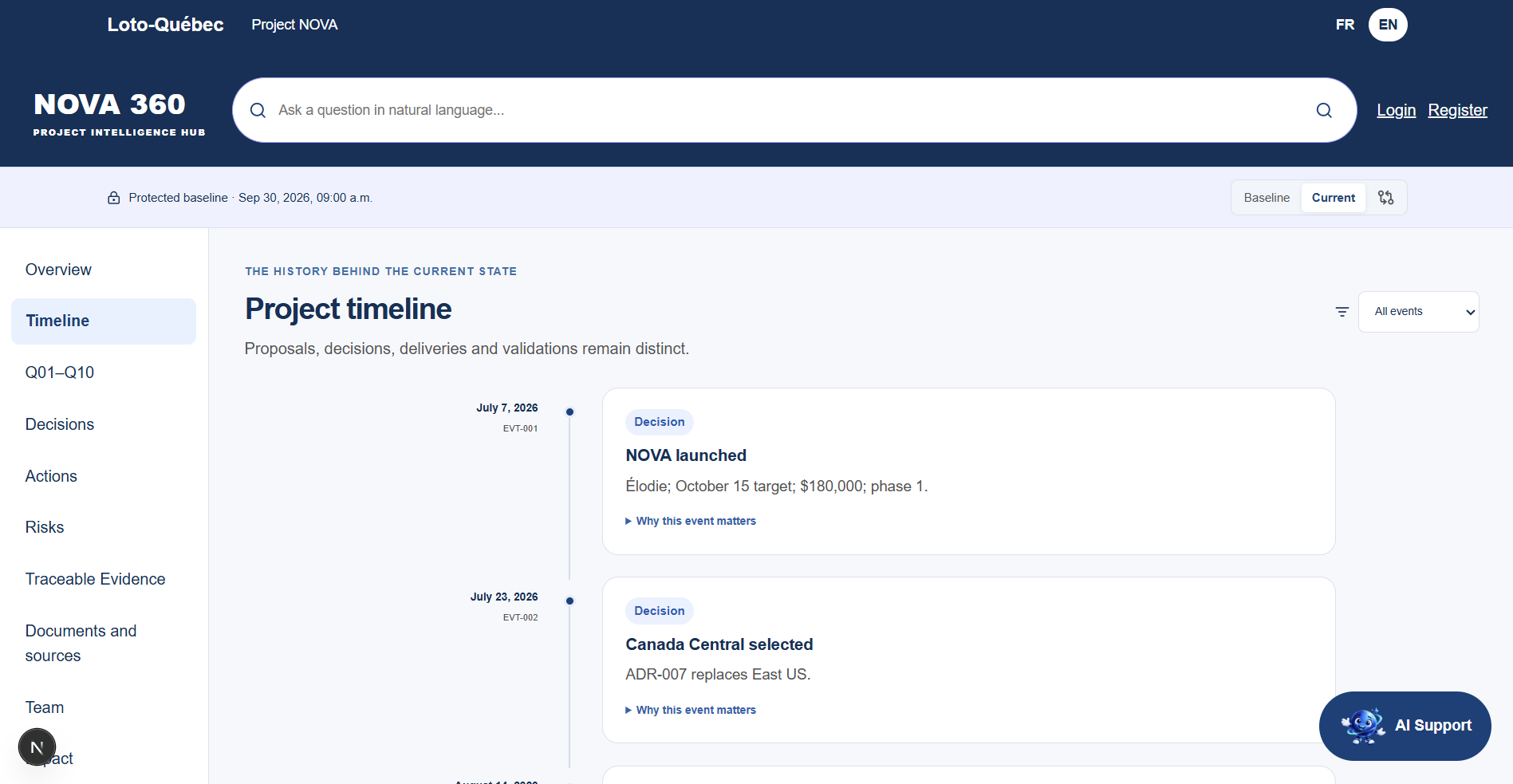
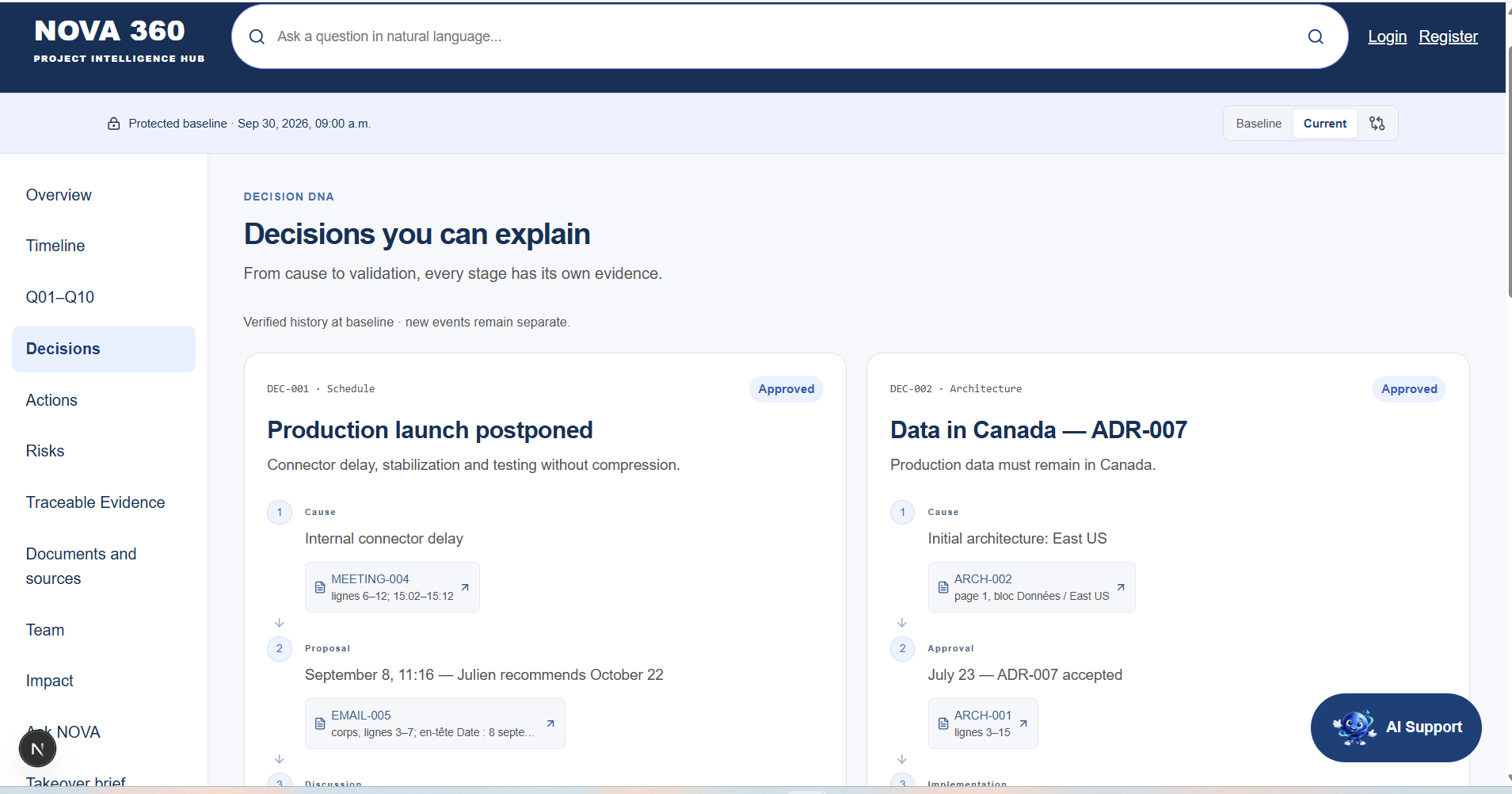
- review the project timeline and key decisions
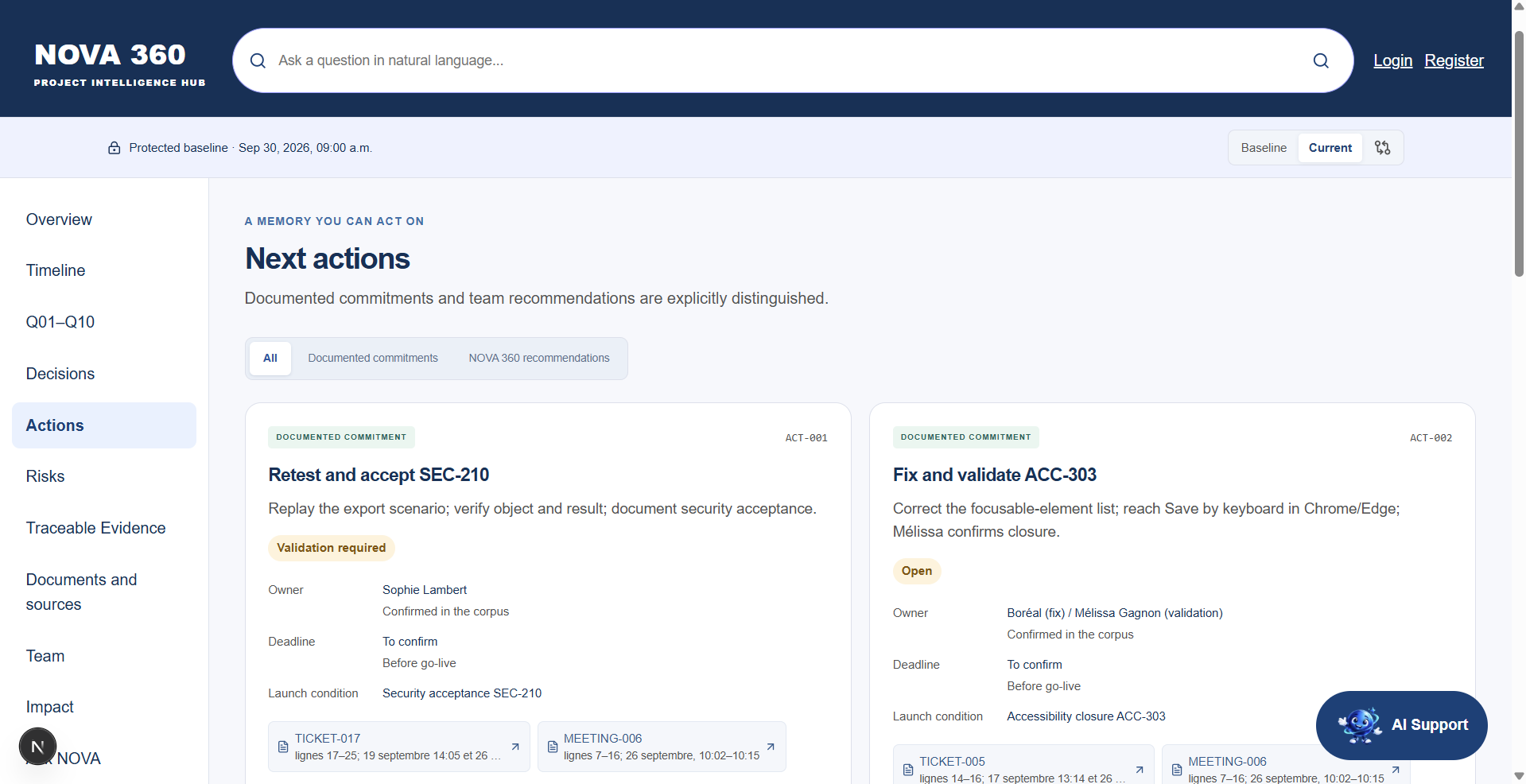
- distinguish proposals, approvals, delivery, validation, and historical information
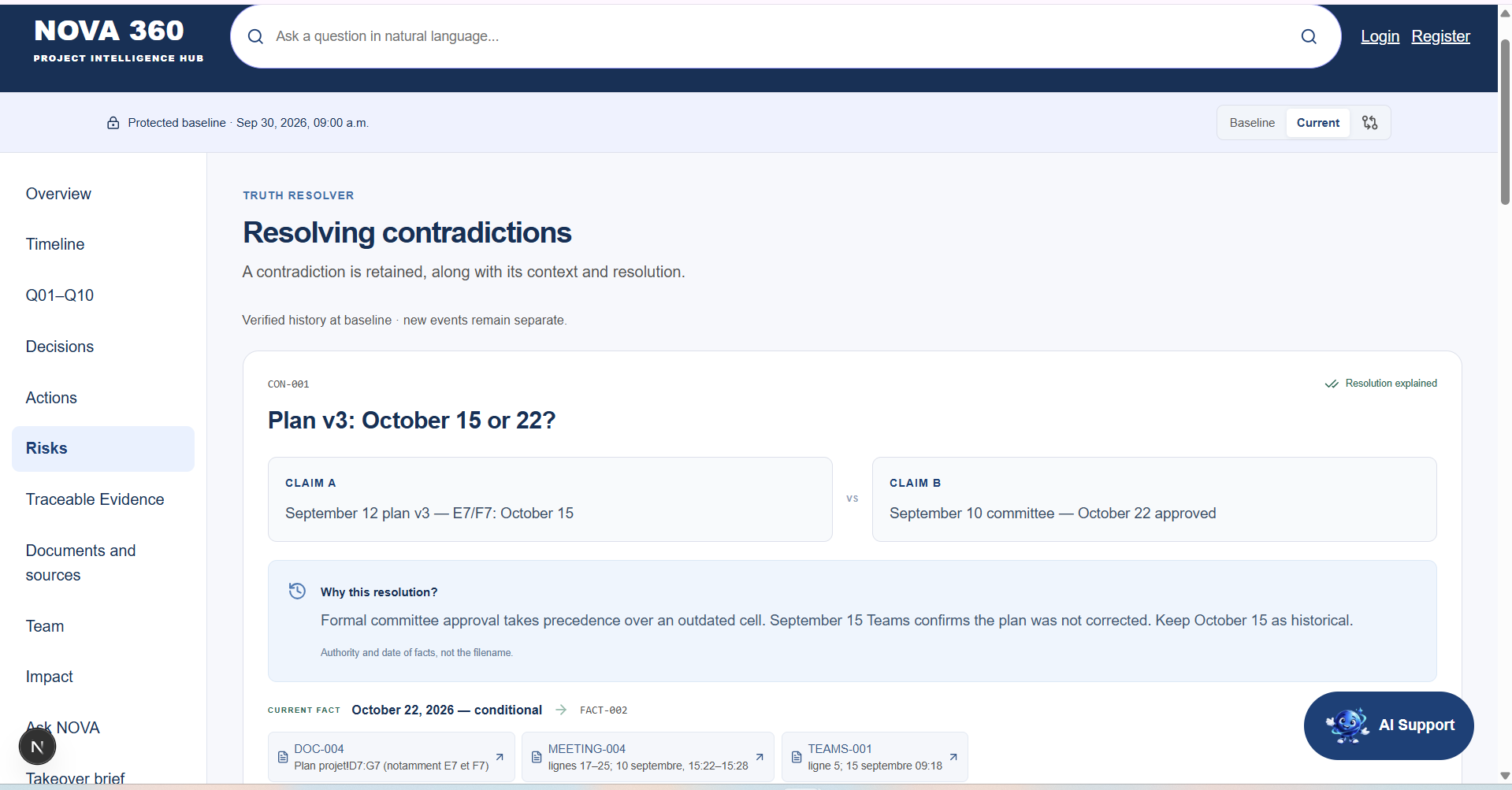
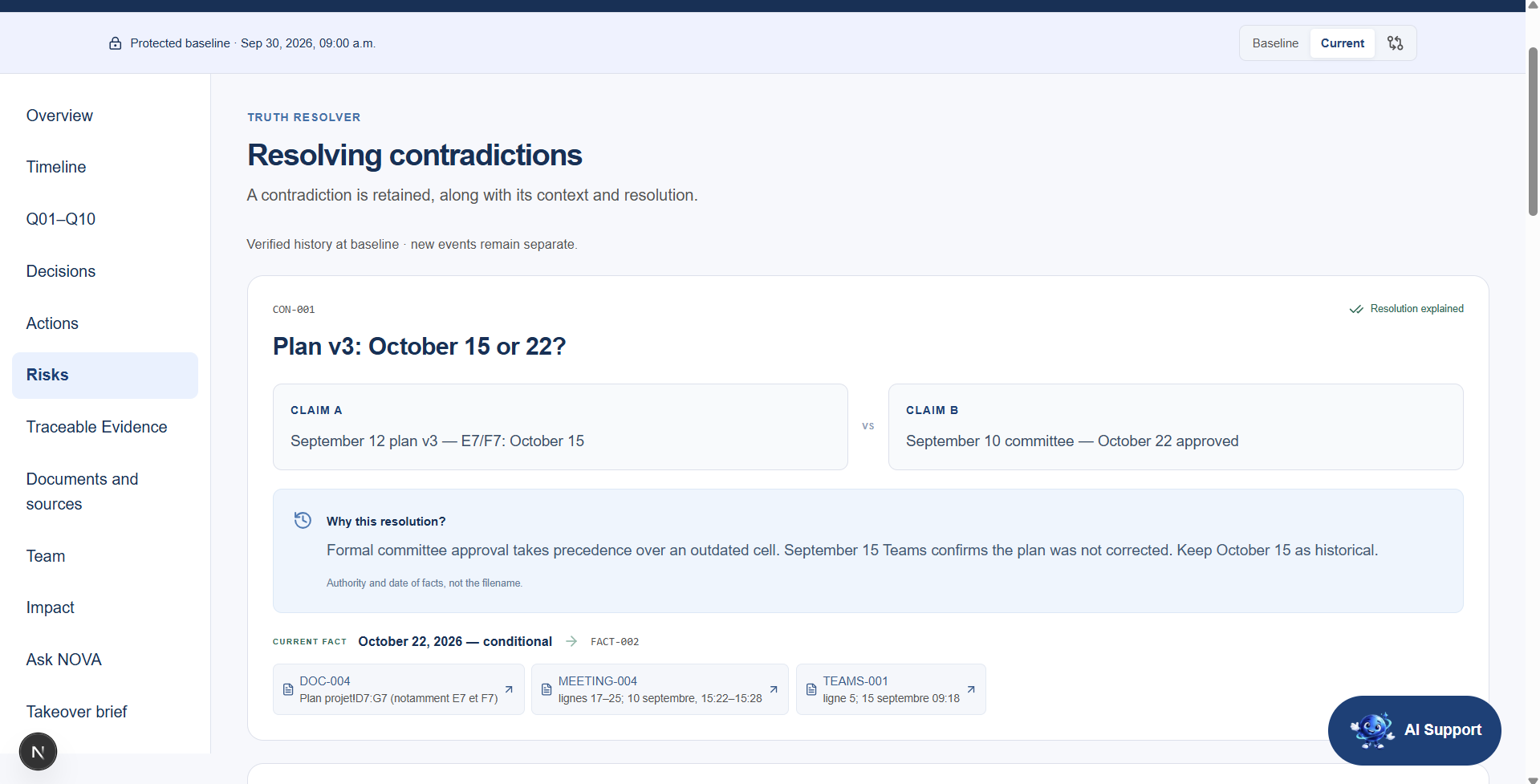
- identify contradictions and explain how they were resolved
- review actions, owners, deadlines, risks, budget, and go-live conditions
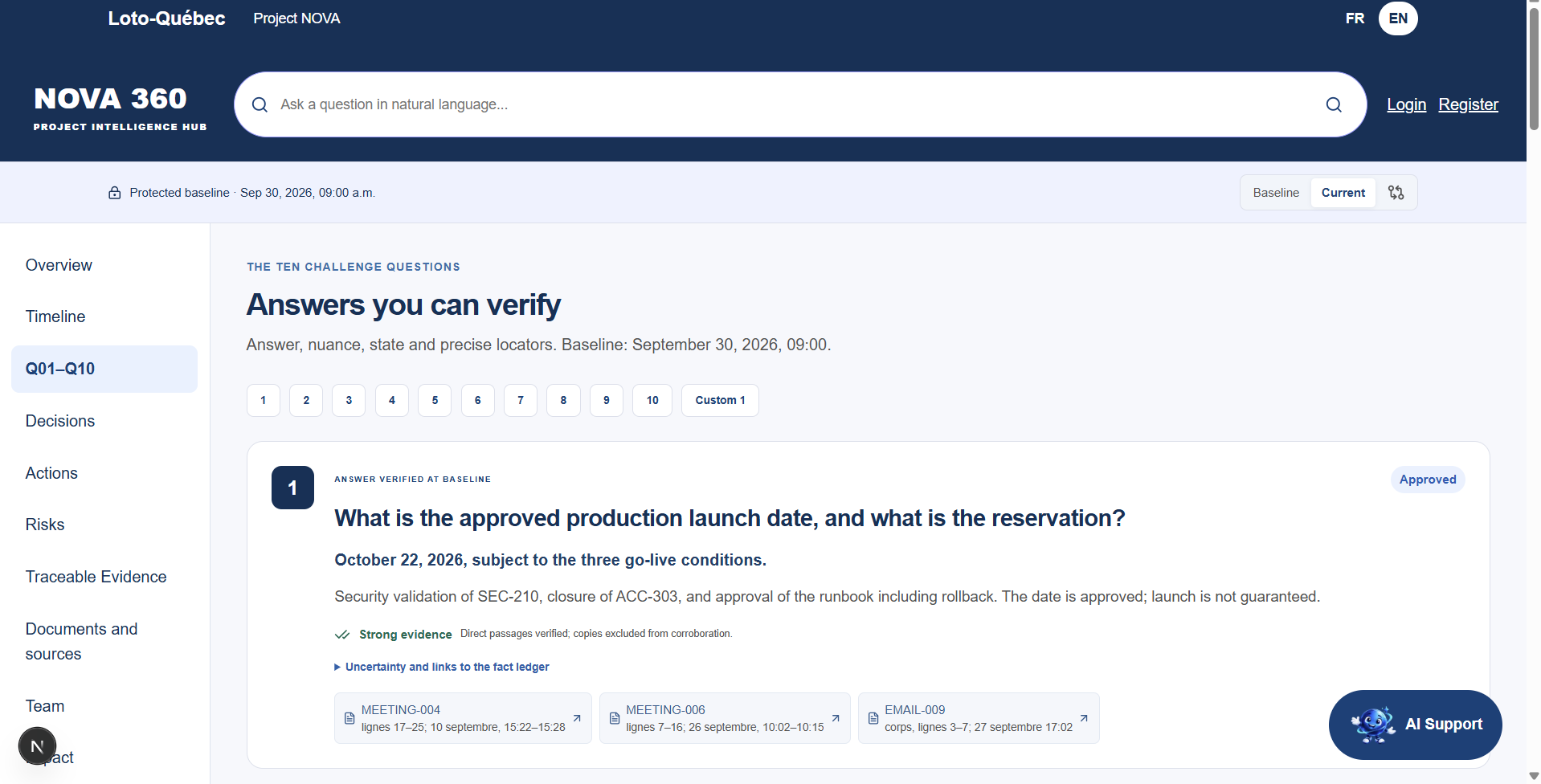
- answer the ten official challenge questions with precise supporting evidence
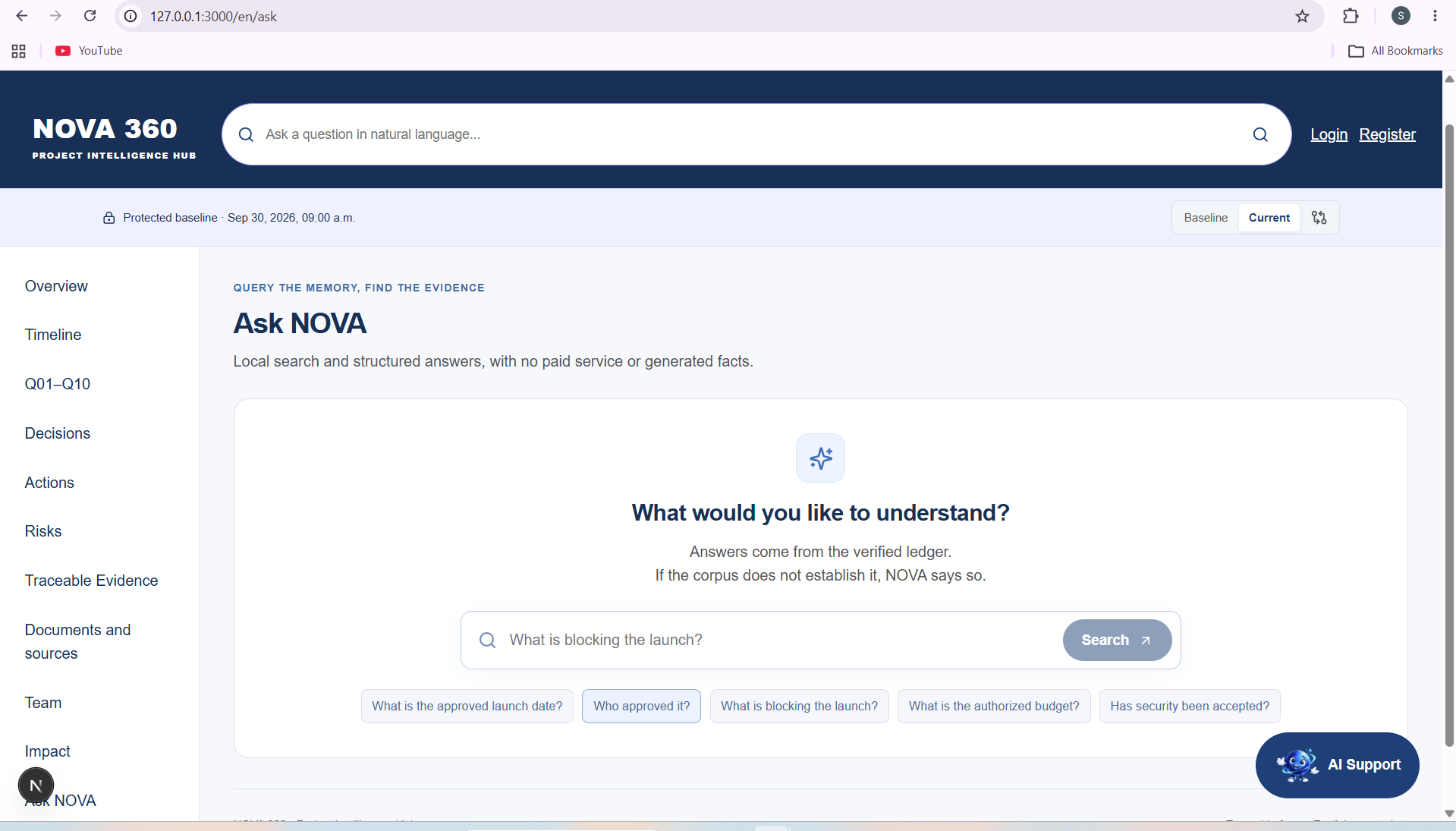
- search across project knowledge interactively
- compare the original baseline with the current state
- integrate a new event and immediately see its impact
- use the application in both French and English
- receive contextual help from the NOVA Support assistant
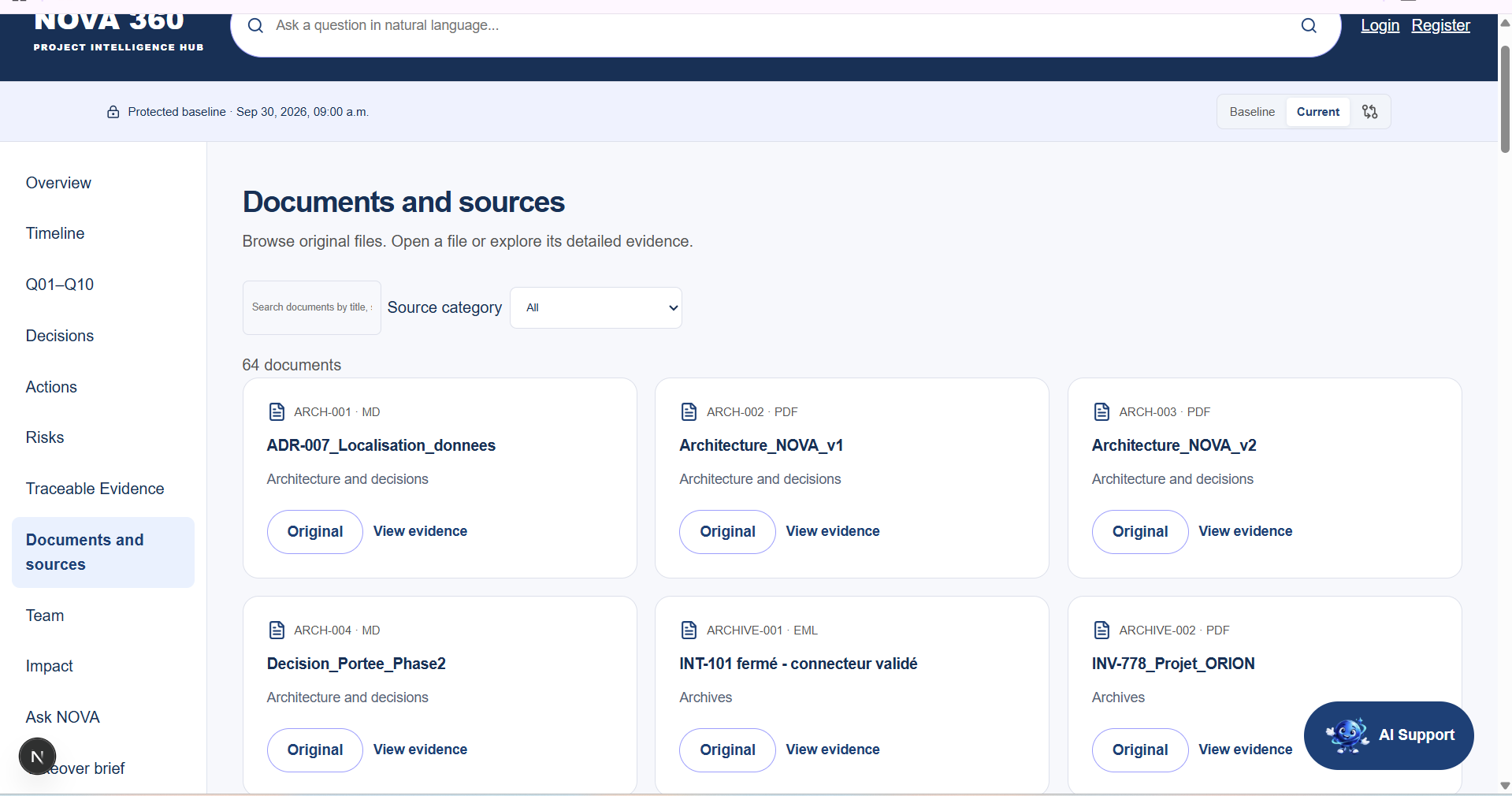
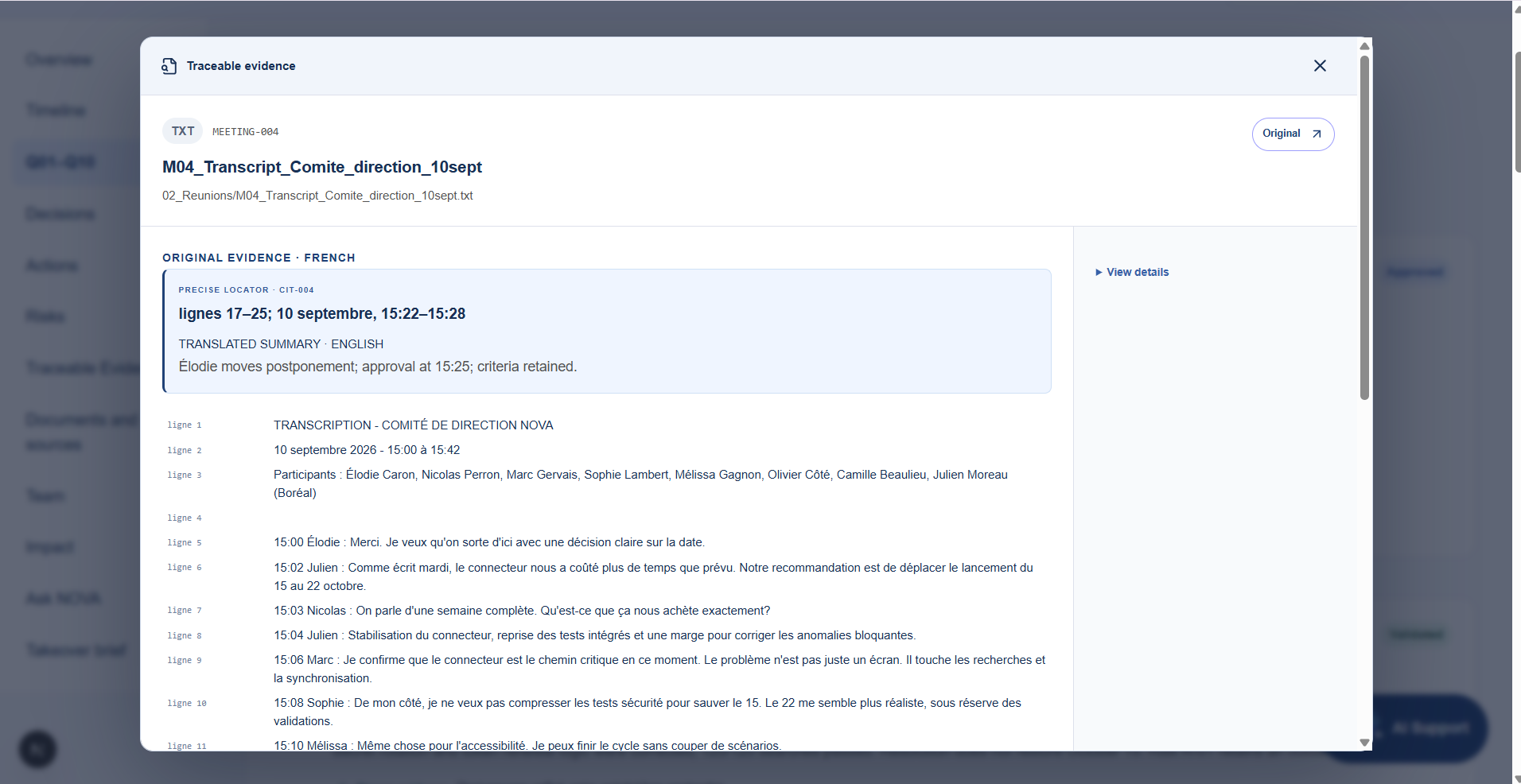
Every important conclusion remains linked to its original evidence.
How we built it
We built NOVA 360 as a full-stack Next.js and TypeScript application with a SQLite database managed through Prisma.
We first analyzed and normalized the challenge corpus while keeping all original source files unchanged. From that data, we created structured models for facts, sources, citations, decisions, actions, contradictions, timeline events, project snapshots, and questions.
The application includes:
- a bilingual French/English interface
- a simplified Loto-Québec-inspired dashboard
- database-backed project information
- traceable evidence and source locators
- interactive search
- baseline/current-state comparison
- Impact Mode for new project events
- role-based authentication with admin and user accounts
- an admin question bank and user management
- Ask NOVA for verified project information
- NOVA Support for contextual navigation help
- a local fallback so the support assistant remains usable even if the external AI provider is unavailable
We also built automated tests around factual consistency, authentication, role protection, localization, baseline preservation, search, and AI fallback behavior.
Challenges we ran into
The hardest part was not building the interface — it was deciding which information should be treated as current and authoritative.
The corpus intentionally contains outdated information, contradictions, duplicate attachments, proposals, approvals, implementations, and validations. We had to make sure the system never treated a newer file as automatically more trustworthy, or confused a proposed change with an approved decision.
Another major challenge was preserving the original project baseline while still allowing new information to be added later. Our Impact Mode had to show what changed without rewriting history.
We also spent significant time simplifying the user experience. A powerful evidence system can quickly become overwhelming, so we redesigned the interface around a simple question: “What does someone taking over this project need to understand first?”
Finally, integrating live AI support required resilient fallback behavior because external model requests can occasionally time out. The product therefore remains usable even when the AI provider is temporarily unavailable.
Accomplishments that we're proud of
We are especially proud that NOVA 360 combines a polished experience with strong traceability.
Some highlights include:
- all ten official challenge questions linked to precise evidence
- preservation of the original September 30 baseline
- explicit distinction between proposal, approval, implementation, and validation
- explainable contradiction resolution
- bilingual French and English support across the application
- role-based admin authentication and database-backed users
- a judge-friendly Impact Mode that shows exactly what a new event changes
- a support assistant with a deterministic local fallback
- automated validation that protects the verified project facts and original source hashes
Most importantly, the system is designed so users do not have to simply trust an AI-generated answer — they can inspect the evidence behind it.
What we learned
We learned that organizing information is not the same thing as creating trustworthy knowledge.
A useful project intelligence system needs to model time, authority, uncertainty, and evidence explicitly. The question is not only “What does this document say?” but also “Was this approved?”, “Is it still valid?”, “What did it replace?”, and “What source proves it?”
We also learned that AI works best here as an interface to structured knowledge rather than as the source of truth itself.
What's next for NOVA 360
Next, we would expand NOVA 360 beyond a single project.
Future improvements include:
- cross-project comparison
- reusable organizational knowledge
- richer automated document ingestion
- more advanced semantic retrieval
- production-grade rate limiting and monitoring
- email verification and password recovery
- stronger deployment and backup infrastructure
- deeper AI-assisted navigation and project analysis
- enterprise identity integration and permissions
The long-term vision is to make NOVA 360 a reliable project memory that helps teams understand not only where a project is today, but how and why it got there.

Log in or sign up for Devpost to join the conversation.