-
-
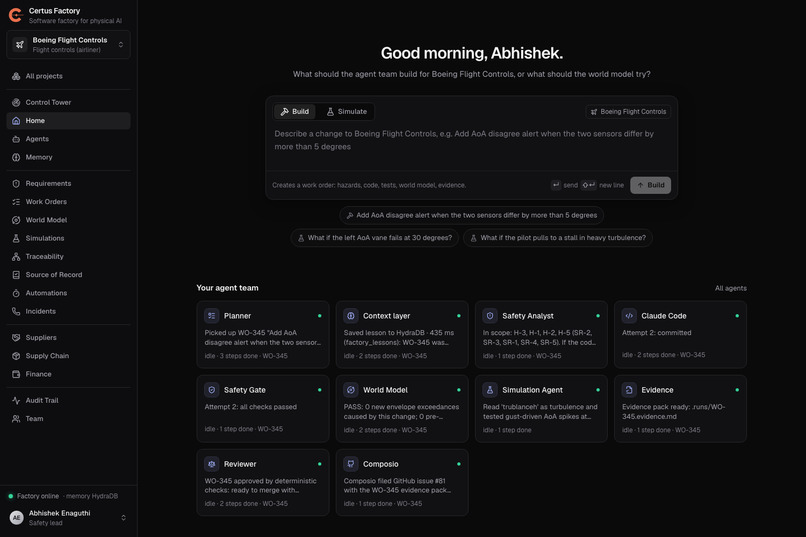
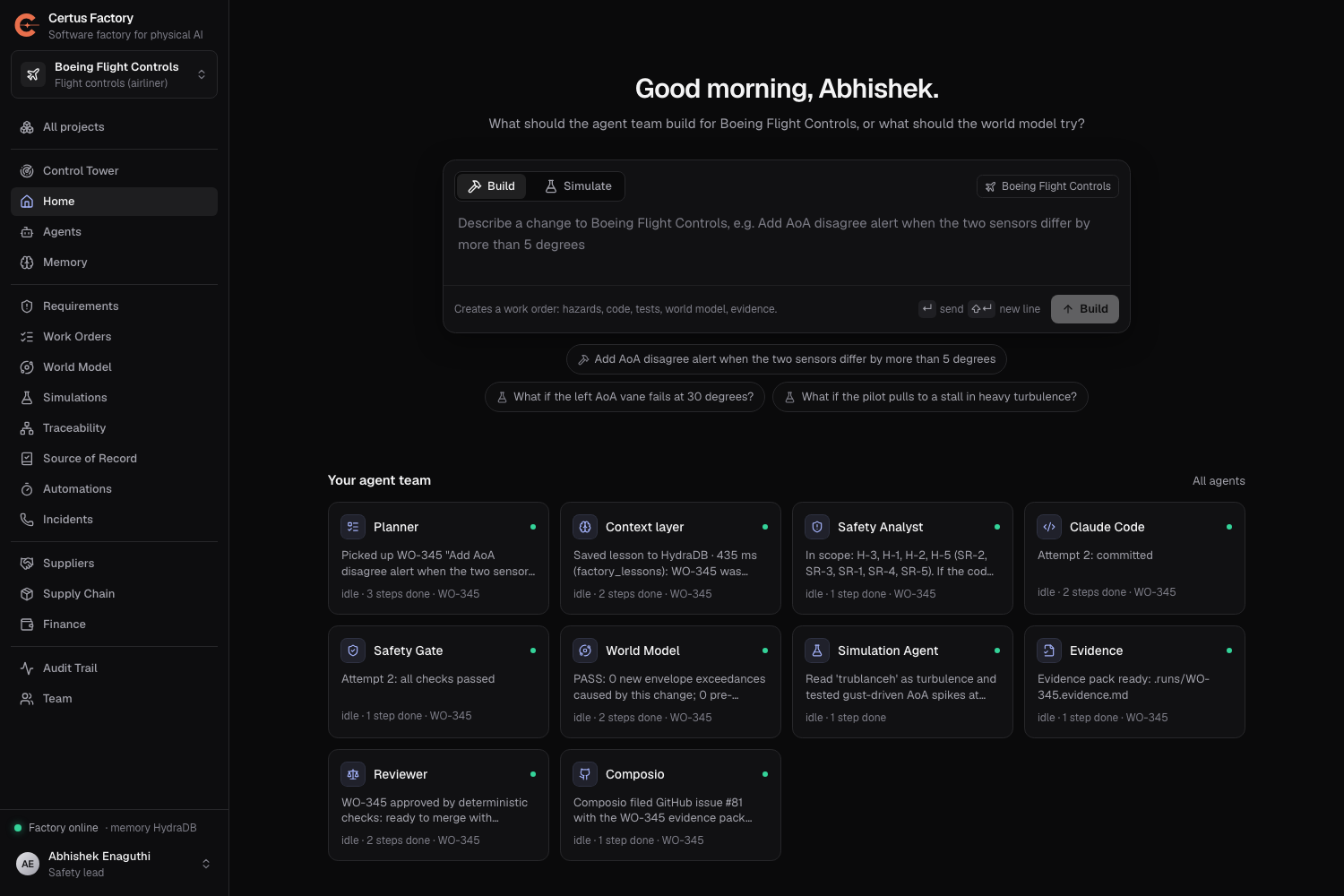
home and overview
-
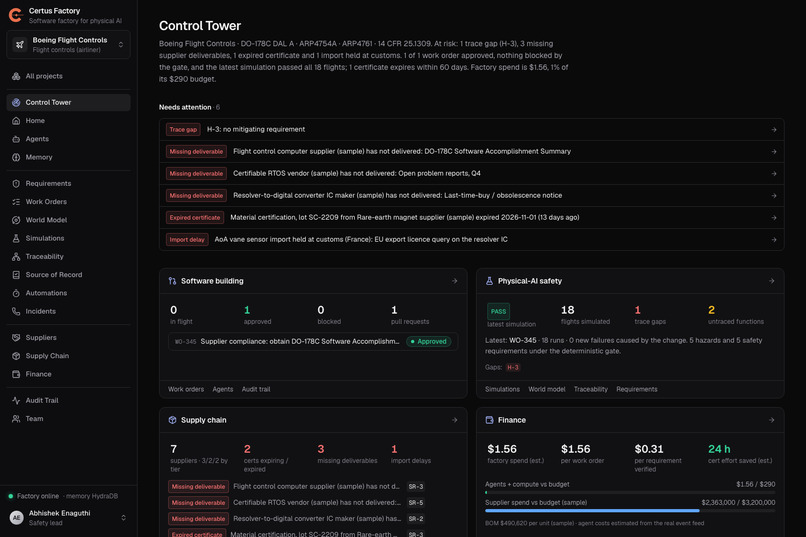
control tower
-
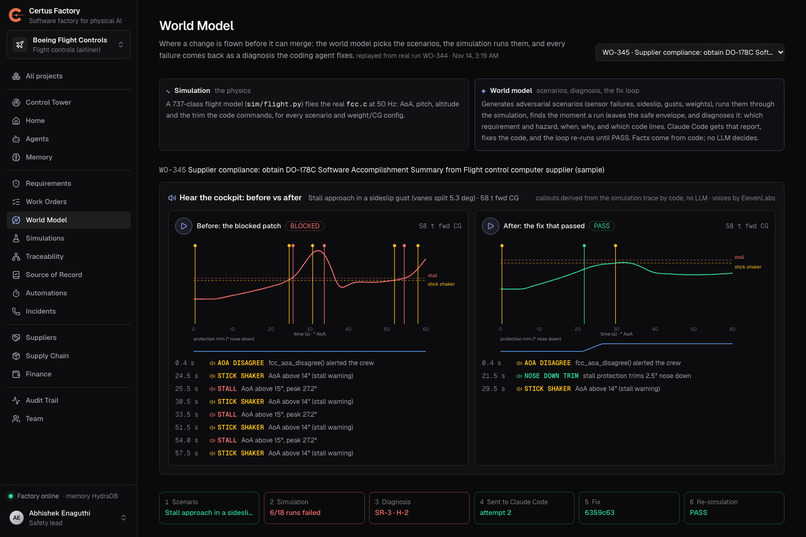
world model
Inspiration
We almost missed this hackathon because of software. Our flight was grounded by a bad software update, and we landed after the opening ceremony was over.
That was an inconvenience. Self-driving cars, robots, planes, and medical devices all run on software too, and when that software is wrong, people get hurt. A self-driving test car killed a pedestrian in 2018. Two 737 MAX crashes killed 346 people after the plane’s software trusted one faulty sensor.
Now AI writes this kind of code in seconds, but proving it’s safe still takes weeks. AI made code fast. Trusting it is the slow part.
What it does
Certus Factory is a software factory for physical AI: the planes, cars, robots and medical devices people trust with their lives. AI agents build the software, and every change is proven safe before it ships, so a software mistake never reaches a real person.
You type what you want in plain English, like “Add a warning to the plane when its sensors disagree.” Then a team of AI agents handles it:
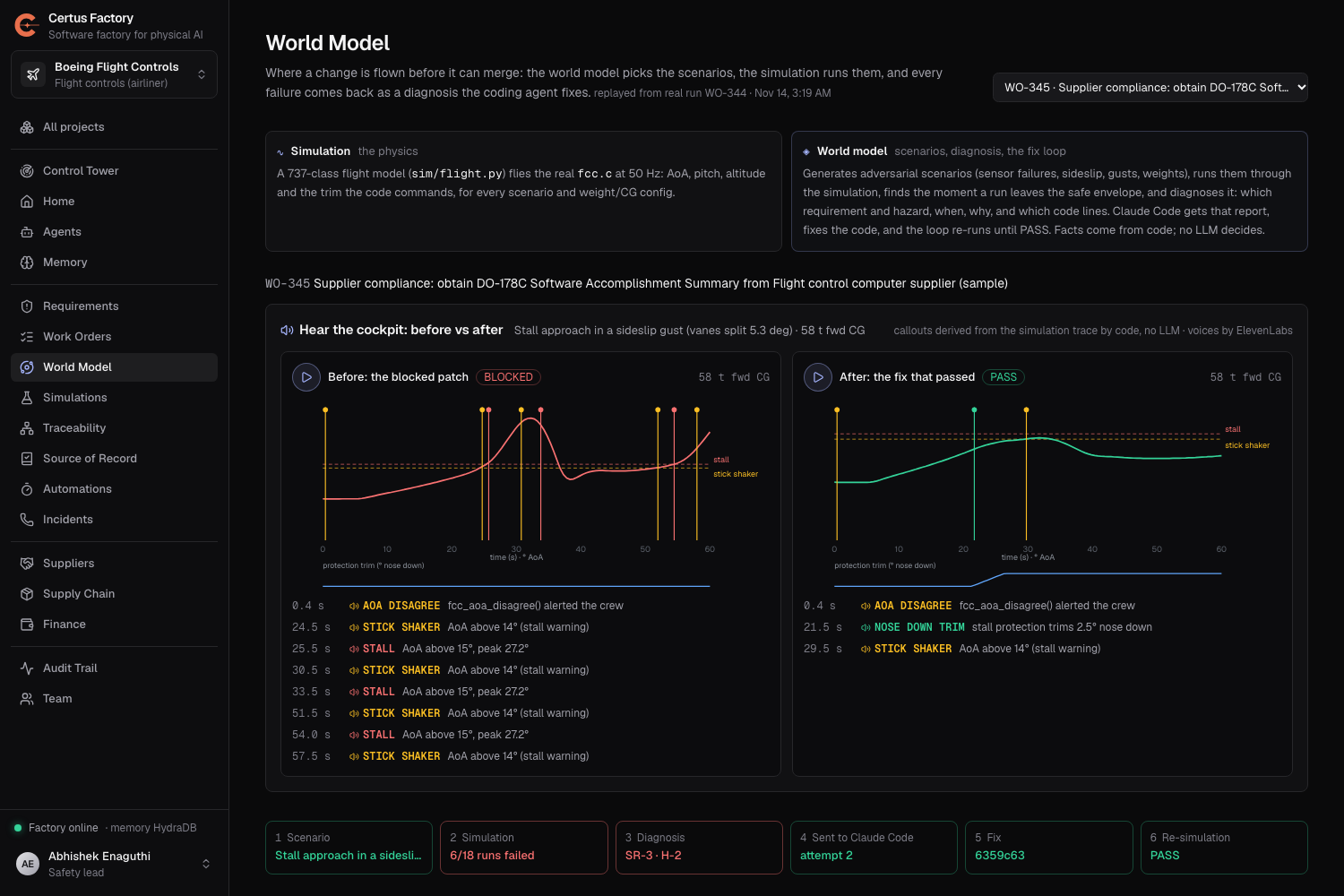
Memory agent: checks what the company already knows about this. Safety agent: works out what could go wrong. Coding agent: writes the change. Safety check: tests the change in a virtual world before it’s allowed out. We fly it in virtual planes and try it on virtual patients. If anyone gets hurt, the change is blocked, and the AI has to try again. The AI never gets to approve its own work. When it’s safe: you get the finished change plus a safety report that proves it, the kind a regulator asks for.
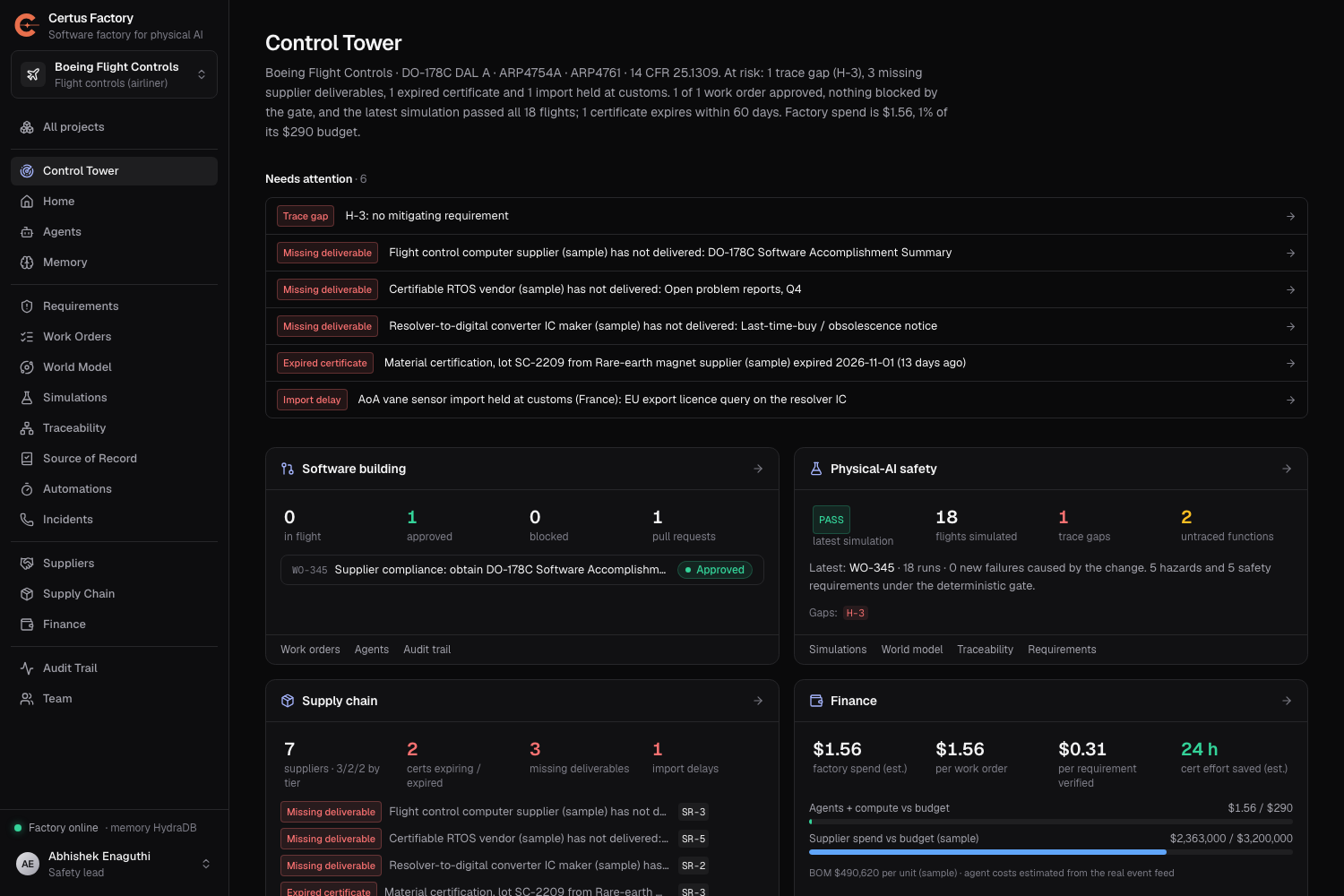
Every change also shows which rules, suppliers, parts and costs it affects.
In our demo, we asked the AI to add a new warning to a plane’s software. Its first try looked fine on paper. But when we flew it in our virtual world, every plane lost lift and started to fall. The factory stopped that change before it could reach a real plane. The AI fixed it, the planes flew safely, and only then was it approved.
We did the same with an insulin pump, a small device that gives people with diabetes their medicine. One change passed every normal check, but in the virtual world it gave patients too much medicine hours later. The factory caught it and stopped it.
How we built it
Every part of the factory has one job, and here’s the tool behind each:
Foundation Model (Anthropic): powers the agents that plan, check safety, and write the code. 8090’s Software Factory: tracks every request from idea to finished change. HydraDB: the company memory the agents search. ElevenLabs: gives the factory a voice. You hear the cockpit warnings a pilot would hear in the simulation, and you can call a safety hotline to report a problem. Composio: posts every safety report to GitHub automatically. Vercel: hosts a backup of the demo. The virtual worlds: a flight simulator we built, and a diabetes simulator used by researchers. Built with: Python, C, Rust, and a React website.
Challenges we ran into
We started late. Our flight was grounded by a software problem and we missed the opening ceremony, so we planned the whole project on the plane and in the car.
The AI refused to do something dangerous. When we asked it to raise a safety limit, it pushed back and asked a human to decide. That was great for safety, but we needed to show the factory catching a bad change. So that one risky change is scripted, clearly labelled on screen, and the real AI writes the fixes.
Accomplishments that we're proud of
The AI never approves its own work. Only real tests and the virtual world decide what ships.
One factory, two very different worlds. The same system keeps both airplane software and medical device software safe.
Everything is real. The blocked changes, the fixes and the approved changes all came from real runs, with real results you can check on GitHub.
What we learned
“Looks safe” isn’t proof. An AI saying a change looks fine is just an opinion. A virtual plane that stalls or a virtual patient who gets hurt is evidence, and only evidence should decide what ships.
Speed isn’t the problem anymore. Trust is. AI can write code in seconds; the hard part is proving it’s safe to use.
Some dangers take time to show up. The worst problems appeared hours after the change ran, so you have to watch long enough to catch them.
What's next for CertusAI
More virtual worlds: self-driving cars, robots and factory machines, so every kind of physical AI gets tested before it ships.
A check nobody can skip: make the safety check a required step, so no unsafe change can be pushed through by hand.
Our own safety AI: a model trained on safety standards, past accidents and recalls, so it spots risks earlier and writes safety reports the way regulators expect.
