Inspiration
The idea for CertFlow AI came from a real problem I saw through a friend who works as a certification engineer in aerospace. When he comes home, he often talks about how much of his day is spent on manual tracking, document follow-ups, evidence checking, approval coordination, and trying to understand where a certification case is blocked.
What surprised me was that a lot of this work felt very different from what he studied in aerospace engineering. Instead of spending most of his time on engineering judgment, he had to deal with scattered documents, unclear ownership, repeated follow-ups, and manual workflow tracking.
When I looked deeper into the workflow, I realized that many parts could be converted into clear, structured steps. The final certification decision still needs human judgment, especially for high-risk cases, but evidence checks, routing, escalation, audit history, and case tracking can be automated and made much easier to manage.
That is why I built CertFlow AI.
What it does
CertFlow AI is an enterprise aerospace certification workflow system for long-running, exception-heavy certification cases.
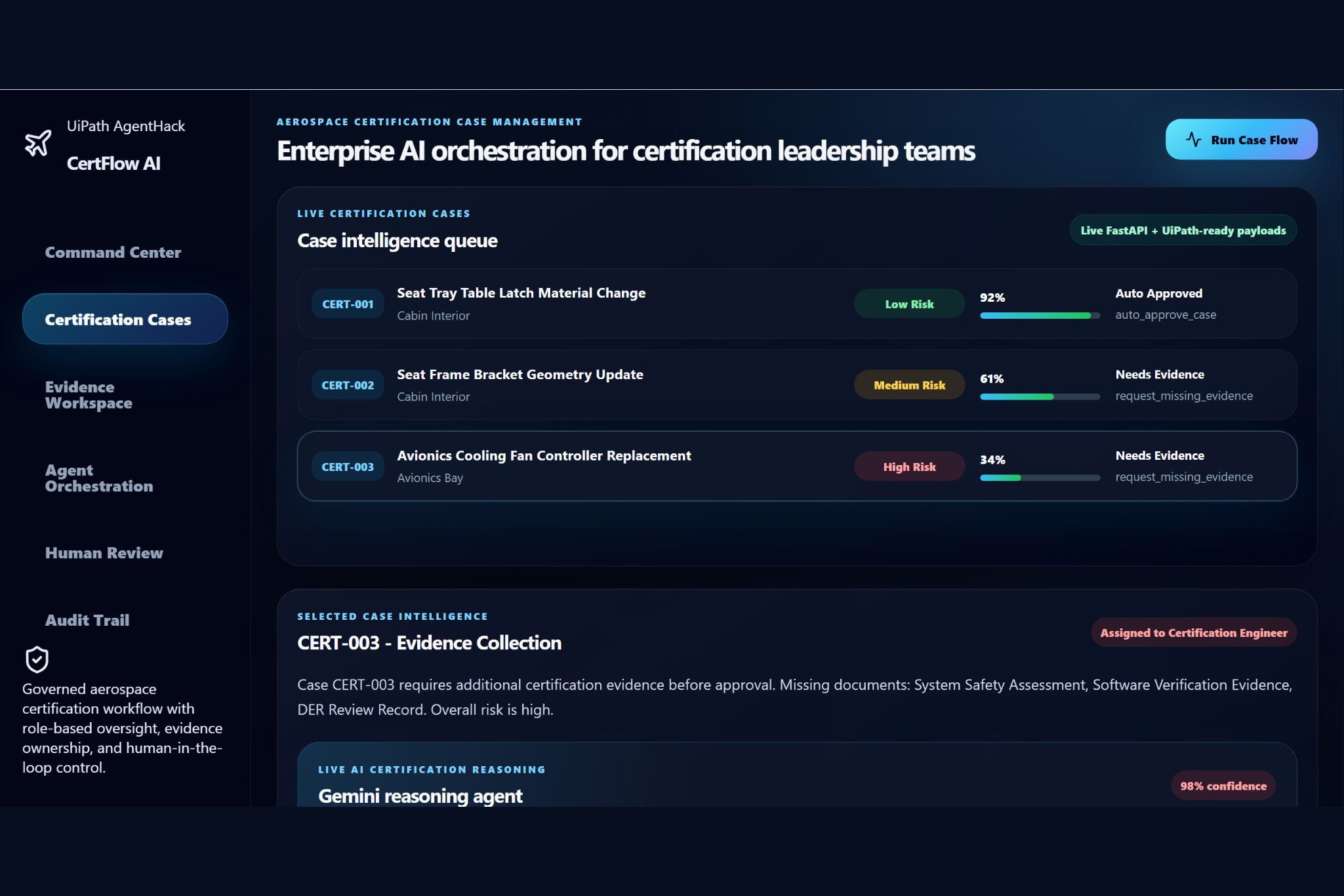
Every aircraft design change becomes a certification case. CertFlow AI checks the affected system, change type, required evidence, missing documents, risk level, AI reasoning, and the next action that should happen in the workflow.
The system includes:
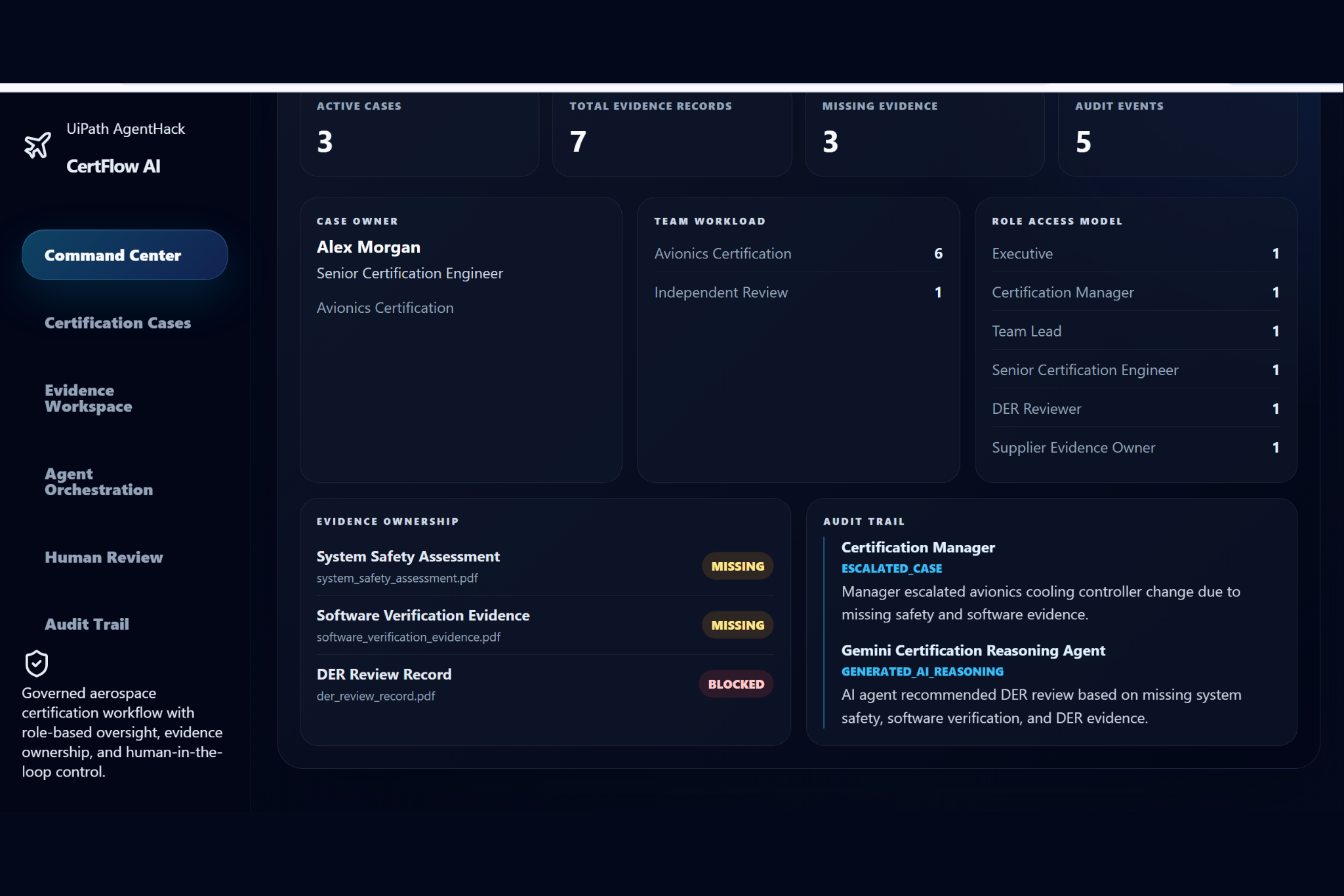
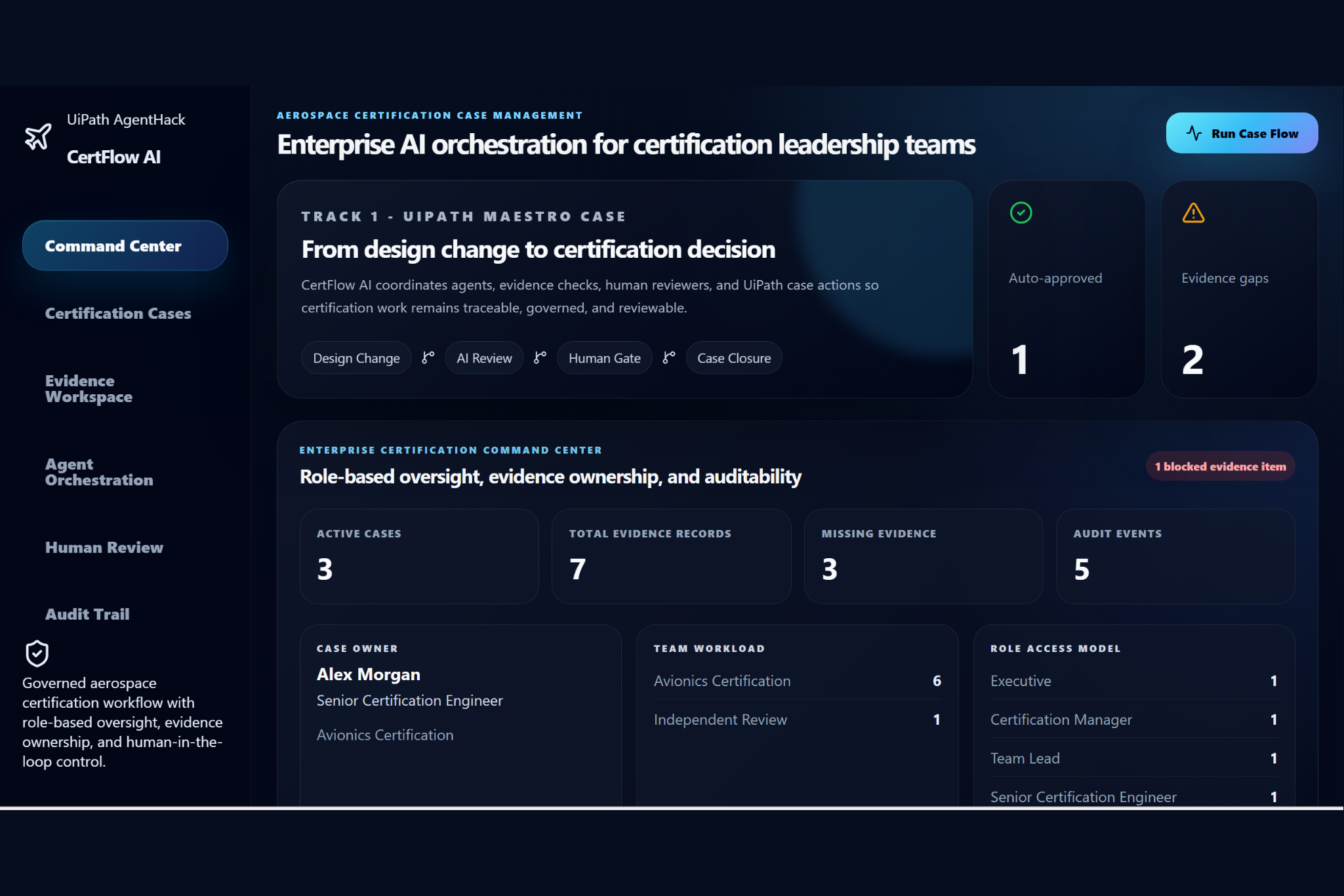
- A Command Center for certification leaders
- A Certification Cases page with low, medium, and high-risk case classification
- A Decision Basis panel that explains why a case is classified a certain way
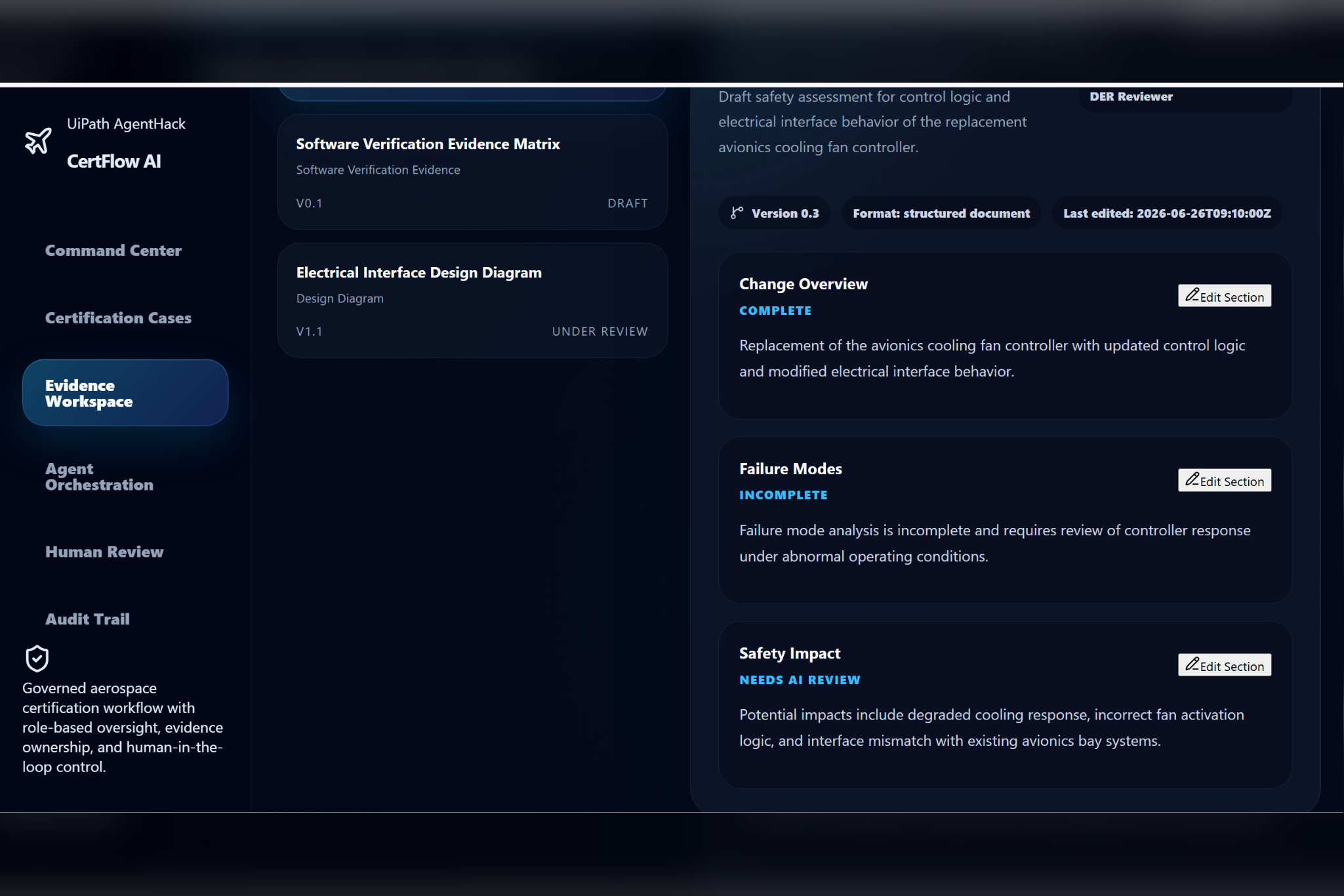
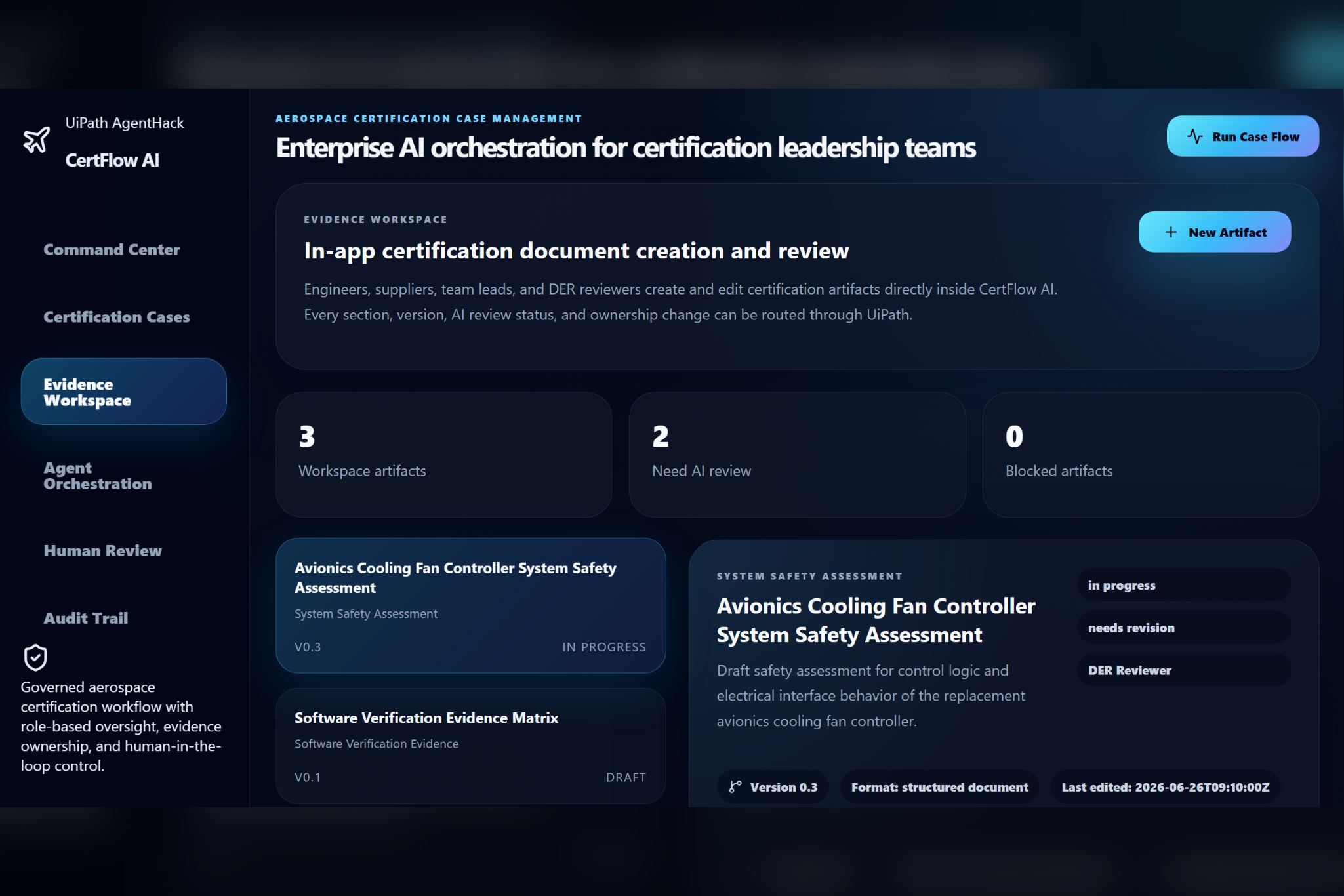
- An Evidence Workspace where employees can create and edit certification artifacts inside the application
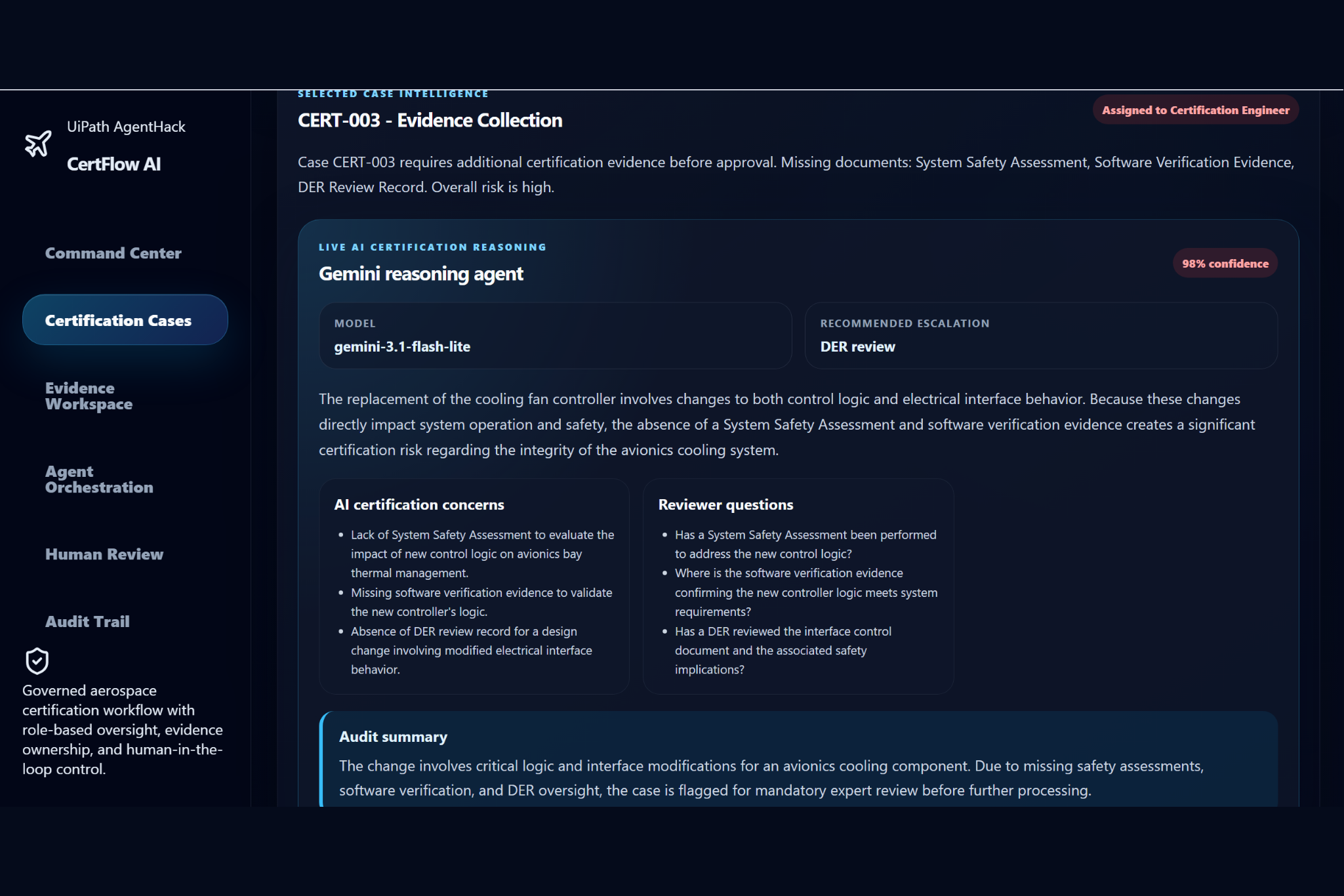
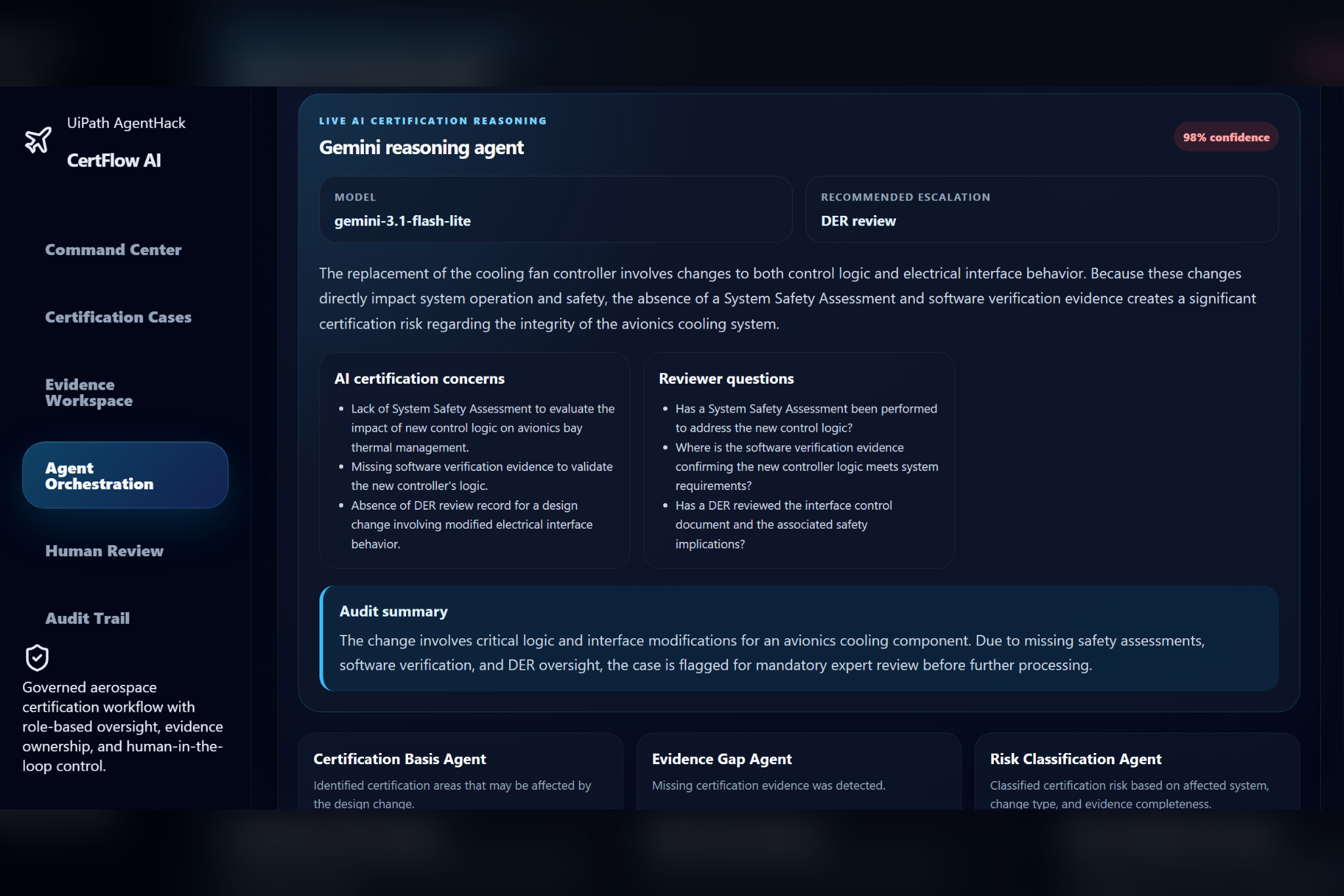
- Gemini AI reasoning for high-risk or incomplete cases
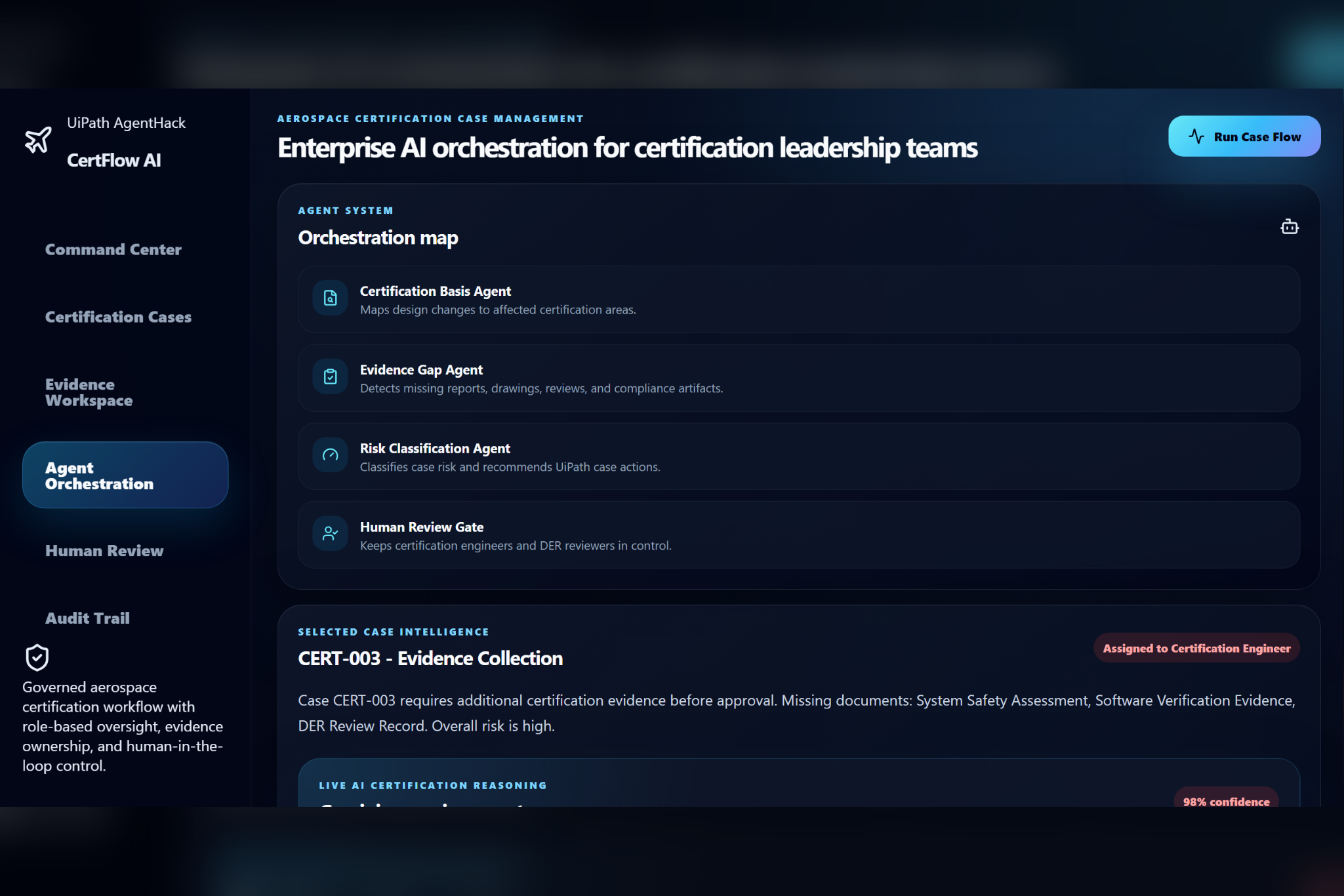
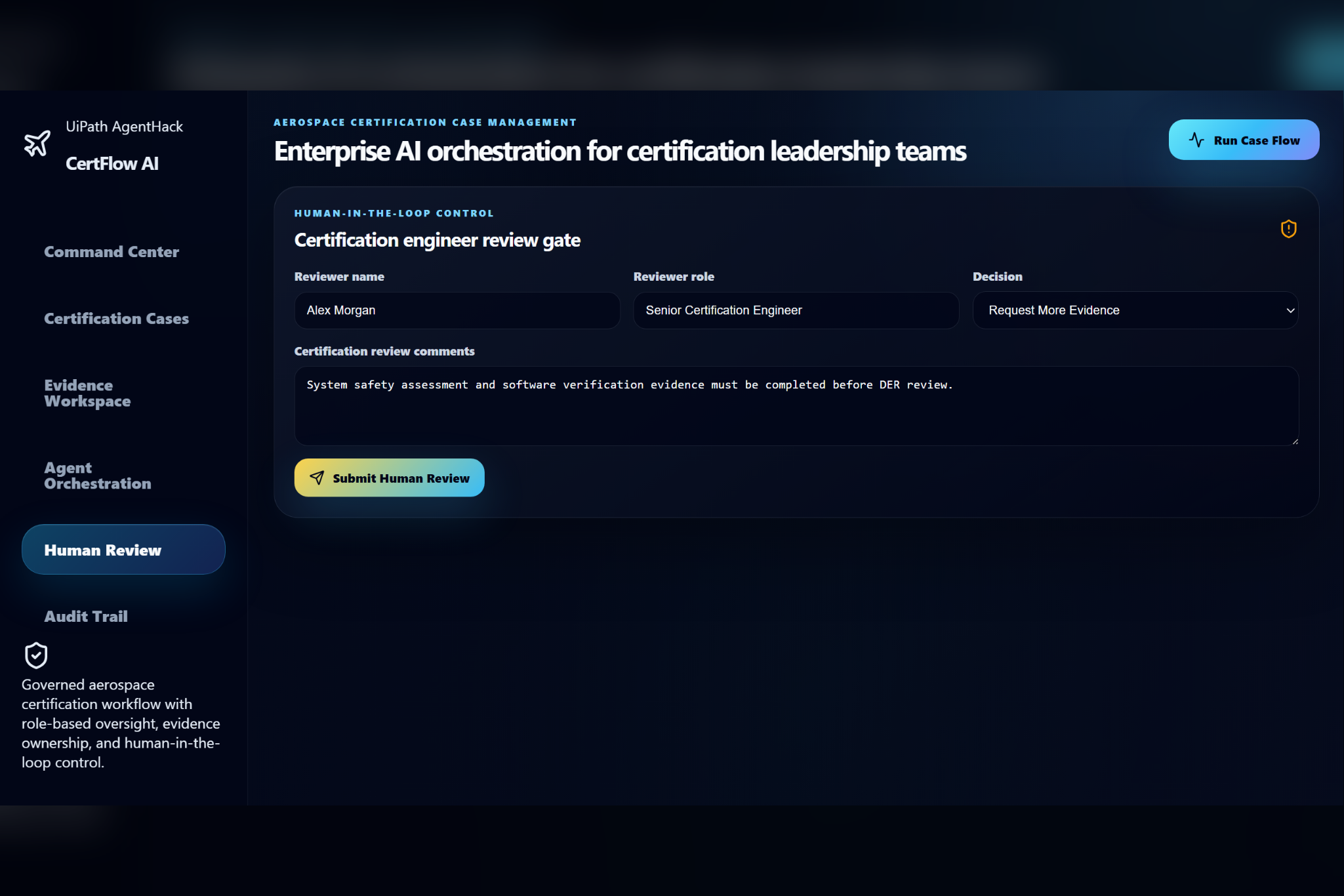
- Human review gates for certification engineers and DER reviewers
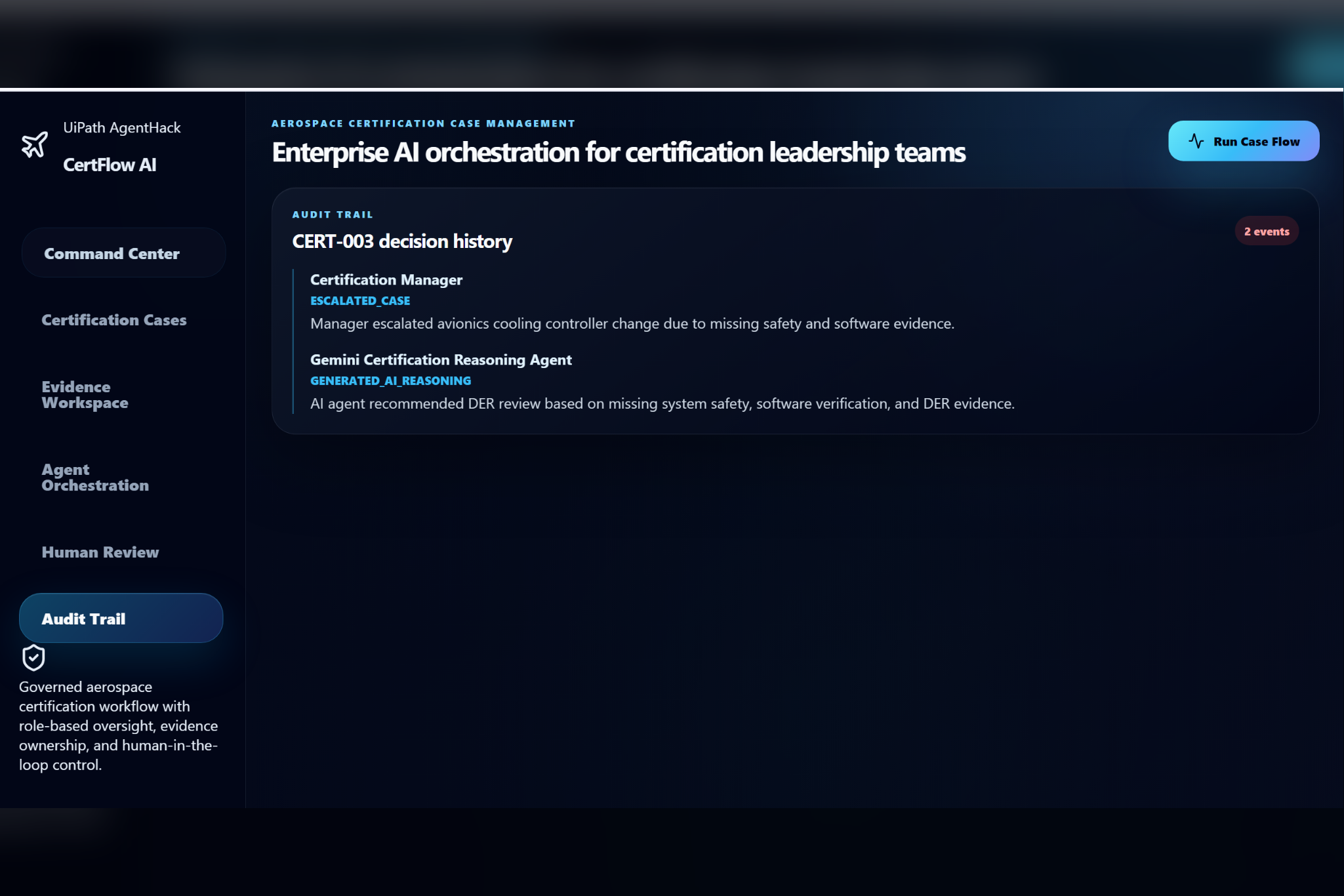
- An Audit Trail that records important workflow actions
- UiPath-ready routing endpoints for Maestro-style orchestration
CertFlow AI does not let an LLM make certification decisions by itself. A deterministic rule engine identifies missing evidence, risk level, and workflow routing. Gemini is used to explain the risk, generate reviewer questions, and summarize concerns for human reviewers.
At a high level, the workflow is:
Design Change
→ Evidence Check
→ Risk Classification
→ AI Reasoning
→ Human Review
→ UiPath Routing
→ Case Closure
The risk score is based on factors such as system criticality, change type, missing evidence, and whether human review is required:
$$ Risk = f(SystemCriticality, ChangeType, EvidenceCompleteness, HumanReviewNeed) $$
This makes the workflow structured, explainable, and auditable.
How we built it
The frontend is built with React and Vite. It includes multiple enterprise-style pages: Command Center, Certification Cases, Evidence Workspace, Agent Orchestration, Human Review, and Audit Trail.
The backend is built with FastAPI. It handles certification case logic, evidence checking, risk classification, Gemini reasoning, document workspace updates, audit events, human review, and UiPath-ready API responses.
We built several workflow components:
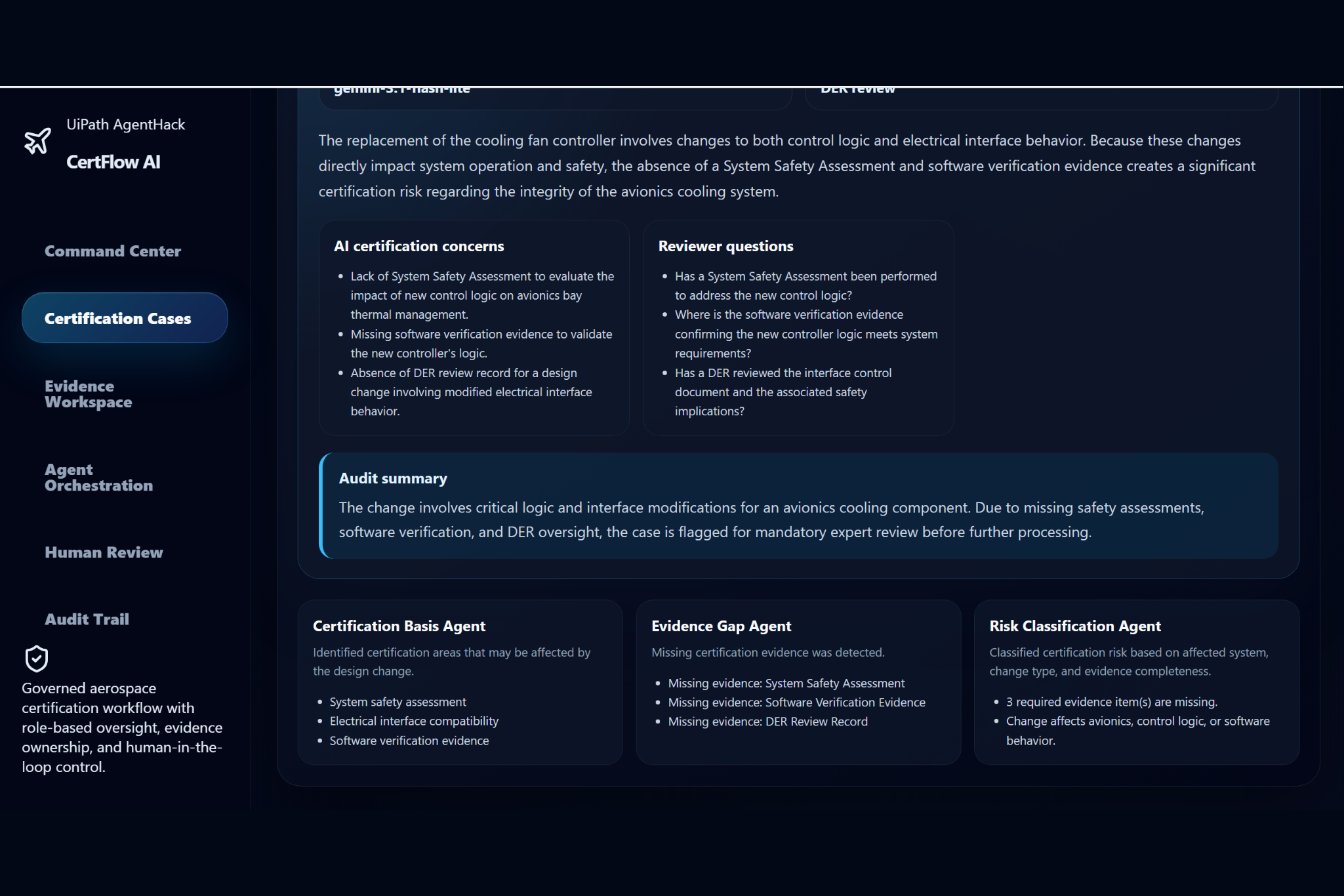
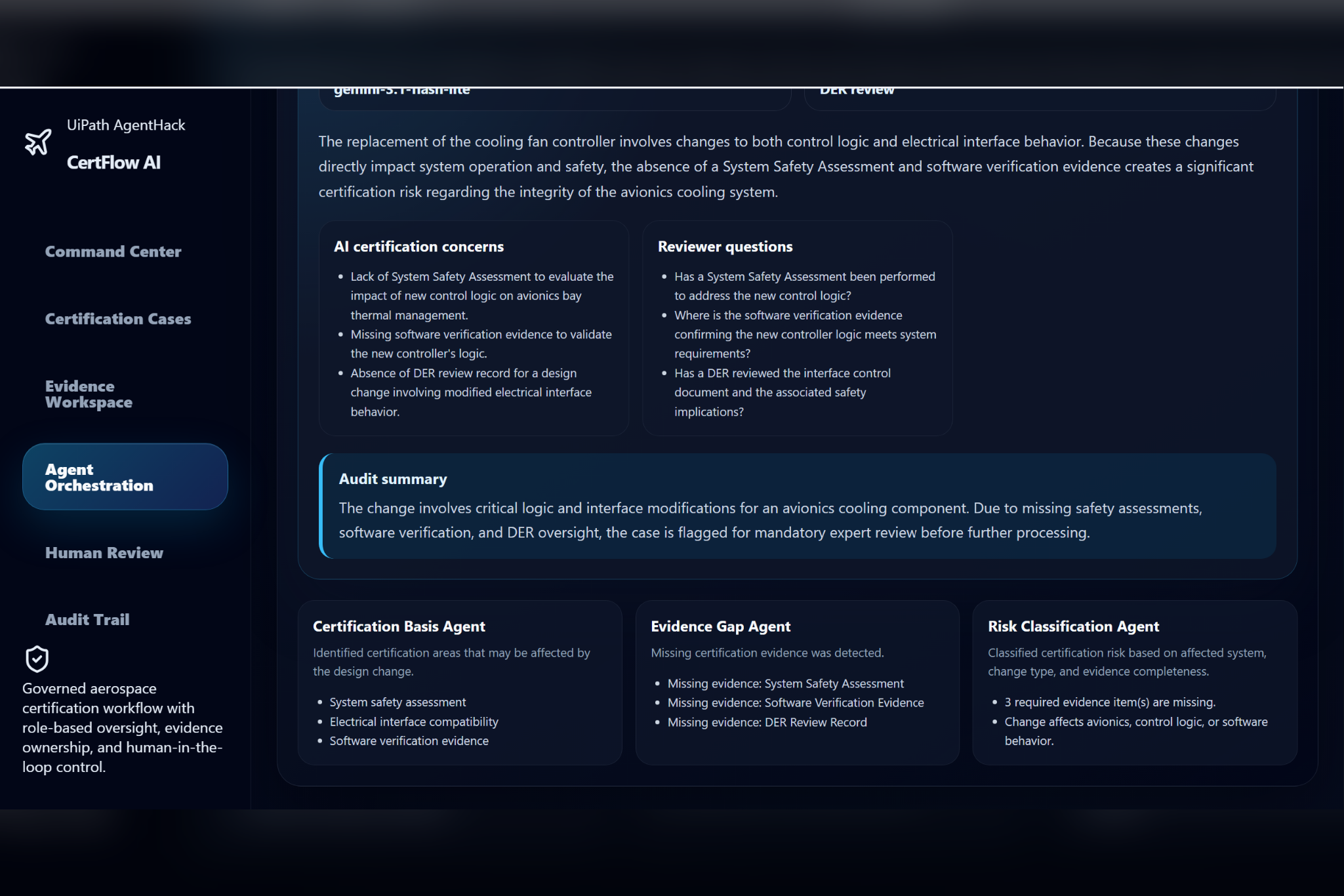
- Certification Basis Agent
- Evidence Gap Agent
- Risk Classification Agent
- Gemini Reasoning Agent
- Evidence Workspace Actor
- Human Review Actor
- UiPath Maestro Case Orchestrator contract
The Evidence Workspace was a key part of the build. Instead of making employees create Word documents outside the system and upload them manually, CertFlow AI lets users create and edit certification artifacts directly inside the app.
Each artifact tracks:
- Owner
- Current editor
- Version
- Status
- AI review status
- Required reviewer
- Case linkage
- Section-level content
- Audit history
When an engineer edits evidence, the document status updates, AI review status resets to needs_revision, an audit event is created, and the UiPath-ready routing endpoint returns the next workflow action.
The backend is publicly deployed on Render, and the frontend is deployed as a public website so reviewers can test the workflow directly.
Challenges we ran into
One major challenge was making the project feel like a real enterprise workflow rather than just a dashboard. Aerospace certification is complex, so the UI had to explain not only the result, but also why the system made each decision.
Another challenge was deciding how to safely use AI. In a high-trust domain like aerospace, it would be risky to let an LLM directly approve certification decisions. I solved this by using deterministic workflow rules for routing and using Gemini only for explanation, reviewer questions, and audit summaries.
We also had to make the workflow traceable. If an engineer edits evidence, that change should not disappear. It should update the document state, reset AI review status, create an audit event, and route the case to the right reviewer.
Another challenge was deployment. The frontend and backend had to work publicly, not just on localhost, so reviewers could test the project through a live website and API.
Accomplishments that we're proud of
I am proud that CertFlow AI became more than a simple AI chatbot or dashboard. It is a full case workflow prototype with evidence ownership, document editing, risk classification, human review, audit history, and UiPath-ready orchestration.
The strongest parts are:
- A realistic aerospace certification use case
- Clear low, medium, and high-risk case classification
- A visible Decision Basis panel that explains risk and missing evidence
- An in-app Evidence Workspace for creating and editing certification artifacts
- Automatic audit events after document edits
- Gemini reasoning for high-risk cases
- Public UiPath-ready endpoints for workflow routing
- Enterprise-style UI with role-based visibility and case tracking
The project shows how AI can support certification teams without removing human responsibility from high-risk decisions.
What we learned
I learned that enterprise automation is not just about calling an AI model. The hard part is designing the full workflow around the AI: who owns the task, what evidence is required, when a human must review, what should be audited, and how the system should route exceptions.
I also learned that explainability matters. It is not enough to say a case is high risk. The system must show the risk drivers, required evidence rule, available evidence, missing evidence, and routing reason.
Another important lesson was that document workflows should not be treated as simple uploads. In real enterprise settings, documents are living artifacts. They are created, edited, reviewed, versioned, and audited over time.
What's next for CertFlow AI
The next step for CertFlow AI is to make it a production-grade certification operating system for certification engineers, DER reviewers, suppliers, managers, and engineering teams.
In the real world, certification work does not stop at identifying missing documents. Engineers need a system that helps them create evidence, collaborate with suppliers, review diagrams, track versions, understand why a case is blocked, and know exactly what action is needed next. CertFlow AI can grow into that system.
Future improvements include:
Real document and diagram intelligence: Automatically read certification documents, safety reports, verification matrices, engineering drawings, and design diagrams, then extract key evidence, missing sections, affected systems, and compliance gaps.
A full evidence lifecycle: Support creating, editing, reviewing, approving, versioning, and locking certification artifacts directly inside the platform instead of relying on scattered Word files, emails, and spreadsheets.
Role-based certification workflows: Give certification engineers, DER reviewers, managers, suppliers, and executives different views, permissions, tasks, and approval responsibilities.
Deeper rule engines for certification logic: Expand the decision basis engine so risk classification and evidence requirements are mapped to real certification standards, aircraft systems, change types, and company-specific approval policies.
Collaboration and supplier portals: Allow suppliers and internal engineering teams to submit evidence, respond to reviewer questions, update sections, and resolve blockers in one shared workspace.
Predictive certification planning: Use historical cases to estimate which design changes are likely to be delayed, which evidence will probably be missing, and which teams may become bottlenecks.
Enterprise integrations: Connect with PLM, ERP, document management, quality systems, engineering change management tools, and UiPath workflows so certification work fits into the company’s existing operations.
Stronger audit and compliance reporting: Generate complete traceability reports showing every decision, document change, AI recommendation, human approval, escalation, and evidence update.
The long-term vision is for CertFlow AI to reduce the manual burden on certification engineers and let them spend more time on engineering judgment instead of chasing documents and tracking status manually. It can help certification teams move faster while keeping the process transparent, governed, and human-controlled.

Log in or sign up for Devpost to join the conversation.