-
-
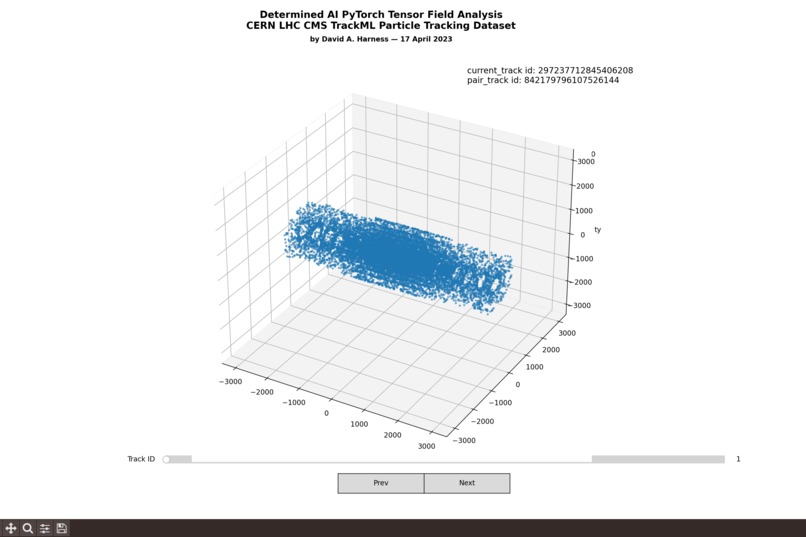 GIF
GIF
Determined AI PyTorch TrackML selects tensor curvatures entangled pair-production decays of interest to plasma, fusion, astrophysicists.
-
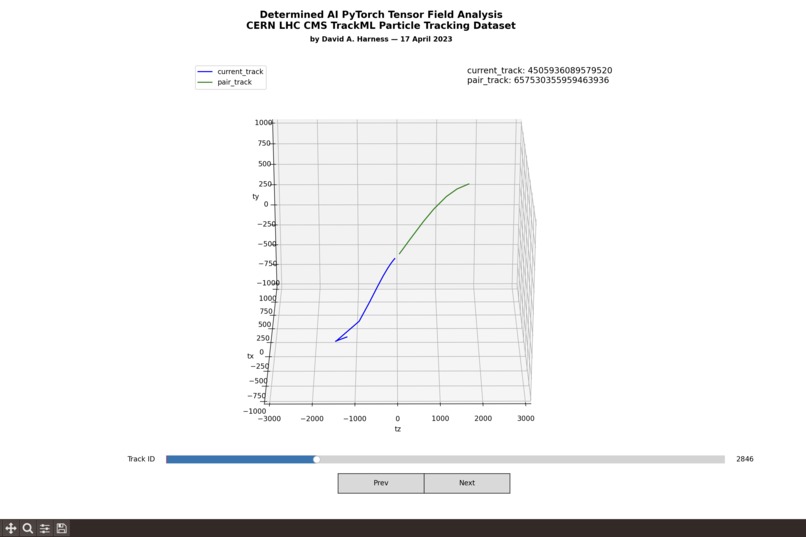
Determined AI ML selects tensor_track curvatures indicating entangled pair-production decays of interest to plasma, fusion, astrophysicists.
-
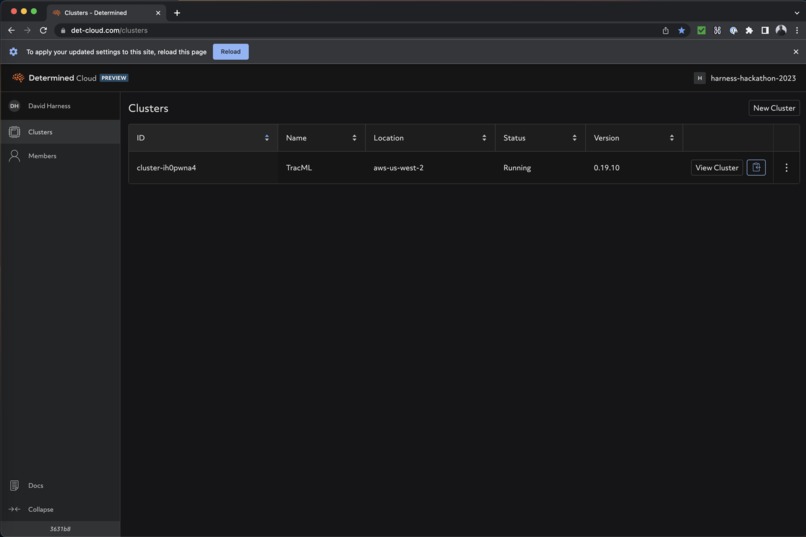
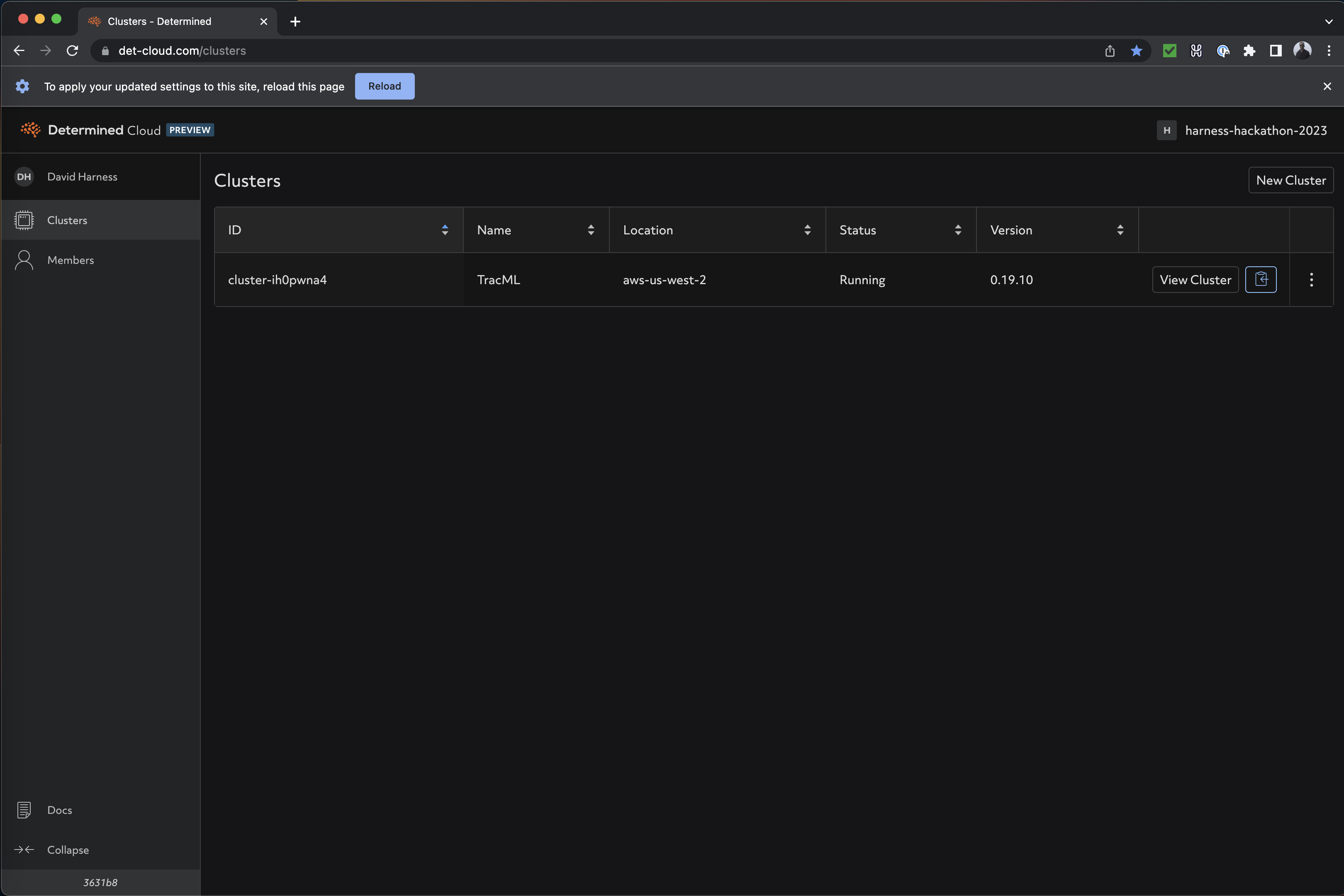
Determined AI Cluster running


Inspiration
This Determined AI Hackathon project CERN TrackML particle tracking training model is inspired to tackle the CERN LHC data deluge to solve the Crisis in Particle Physics wherein the 10,000 physicists are attempting to process billions and billions of collisions per second.
"The National Academies of Sciences, Engineering, and Medicine are conducting a study to assess key science questions that will drive research in the field of elementary particle physics for the next decade and beyond. The study, called Elementary Particle Physics: Progress and Promise (EPP-2024), will examine existing and envisioned approaches and tools used by particle physicists, as well as nascent technological developments and potential crossovers from other areas of science."
Prof. Maria Spiropulu co-chair of the study committee and one of the world’s top modern physics experimentalists says “We’re going into the unknown.”
The EPP-2024 Committee put out a Call for Vision Papers to which the author responded with a vision paper titled:
Greek Natural Philosophy 300BC–2022AD Resolved: Particles are Fields.
What it does
This project has code will travel into said unknown starting wherein the objective of the present training model experiment is pattern-matching the entangled pair-production particle tracks of every collision track by track, to identify their decay path integrals back to their low-energy physics stable states.
Determined AI PyTorch MatchModel training model converts trackml tracks to PyTorch tensor_tracks to calculate tensor_track and reflective anti_tensor_track towards selecting a closest-matching pair-production pair_track out of tensor_tracks based on tensor_track and anti_tensor_track begin and end points to least error match minimizing EUCLIDEAN DISTANCE between beginning ending coordinates of anti_tensor_short_track and tensor_short_tracks selecting the closest matching pair_track generating tightest_index basis for MatchModel ACCURACY.
Accordingly, in the code the "accuracy" metric is thus calculated based on the Euclidean distance between the beginning and ending coordinates of anti_tensor_short_track and the corresponding beginning and ending coordinates of tensor_short_tracks selecting the closest matching pair_track. This calculation is performed in the create_experiment() function, where the accuracy value is assigned to the "metric" key in the det.Evaluator object.
The theoretical basis for which is any deviations in the entangled pair-production tracks from the known entangled quantum electrodynamic forces in the CMS detector could be interpreted as discoveries of complex hidden dimensional unknown physics dark matter and supersymmetry forces for which the CERN LHC was built to detect.
How we built it
This Determined AI Cluster Experiment MatchModel training model builds on the CERN TrackML Particle Tracking Challenge CMS Detector Dataset by converting to PyTorch tensor_tracks since we have all the high-energy and low-energy quantum electrodynamic field theory physics information in tensor tracks: time, energy, momentum, curvature, and mass.
For each tensor_track, we create an anti_tensor_track reflection to search for matching pair-production pair_track.
Figure 1 shows the current_track in blue and closest matching end points entangled pair-production pair_track shown in green.
Hence the project has established the tensor basis to analyze the full dataset track curvatures, recalling the objective of discovering unknown force deviations.
Challenges we ran into
Looking at the full collision dataset, it seems there’s a huge trade-off in signal noise going on. Meaning, if it were technically possible, just two photons colliding, say 4 collisions per second vs 40 billion or so collisions per second of opposing colliding particle-wave packets of some 100 billion protons in each opposing particle-wave packet, would generate far less noise. So that even if only capable of less energy LHC CMS Detector single proton-to-proton collisions would generate far more reliable information perhaps of interest to plasma, fusion, and astrophysicists, among others.
Accomplishments that we're proud of
This initial Determined AI PyTorch TrackML experiment set-up establishes a strong analytical domain basis for discovering evidence of the Crisis in Particle Physics postulates of hidden-dimensional physics forces. The project MatchModel training model converts the CERN LHC CMS Trackml dataset particle tracks to tensor_track and reflective anti_tensor_track beginning and endpoint pairs from which the model searches to find a pair-track match to anti_tensor_track indicating a trackml dataset match between tensor_track and pair_track entangled pair-production qubits.
Hence the basis for full tensor curvature tensor_track and pair_track matching is established.
What we learned
Determined AI PyTorch tensor tooling is a good match for investigating CERN TrackML Particle Tracking Challenge Datasets.
What's next for CERN TrackML Dataset Determined-PyTorch Tensor Analysis
Now that the basis for full tensor curvature tensor_track and pair_track matching has been established the Crisis in Particle Physics theoretical objectives of discovering conjectured hidden dimensional unknown force deviations have the present tensor field analysis tooling for said computational machine learning investigations.
We want to know the elementary physics truth - to the extent which it can be known - with the objective of determining the ultimate computation upon which to replicate a proper ai_worldview.

Log in or sign up for Devpost to join the conversation.