-
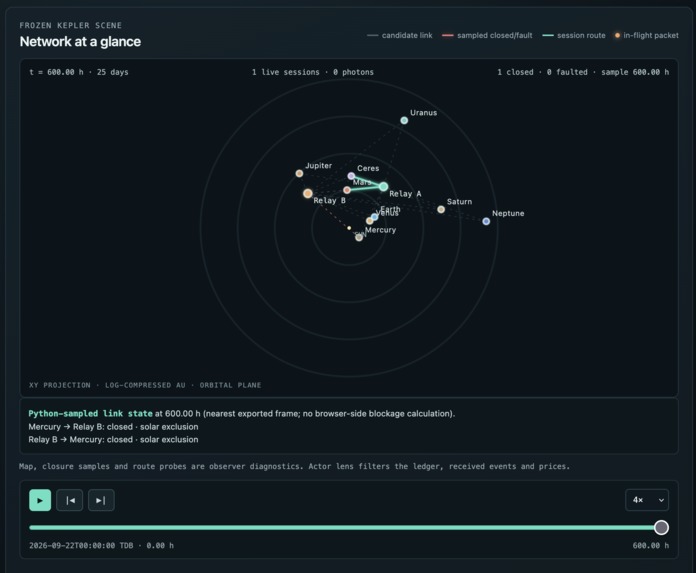
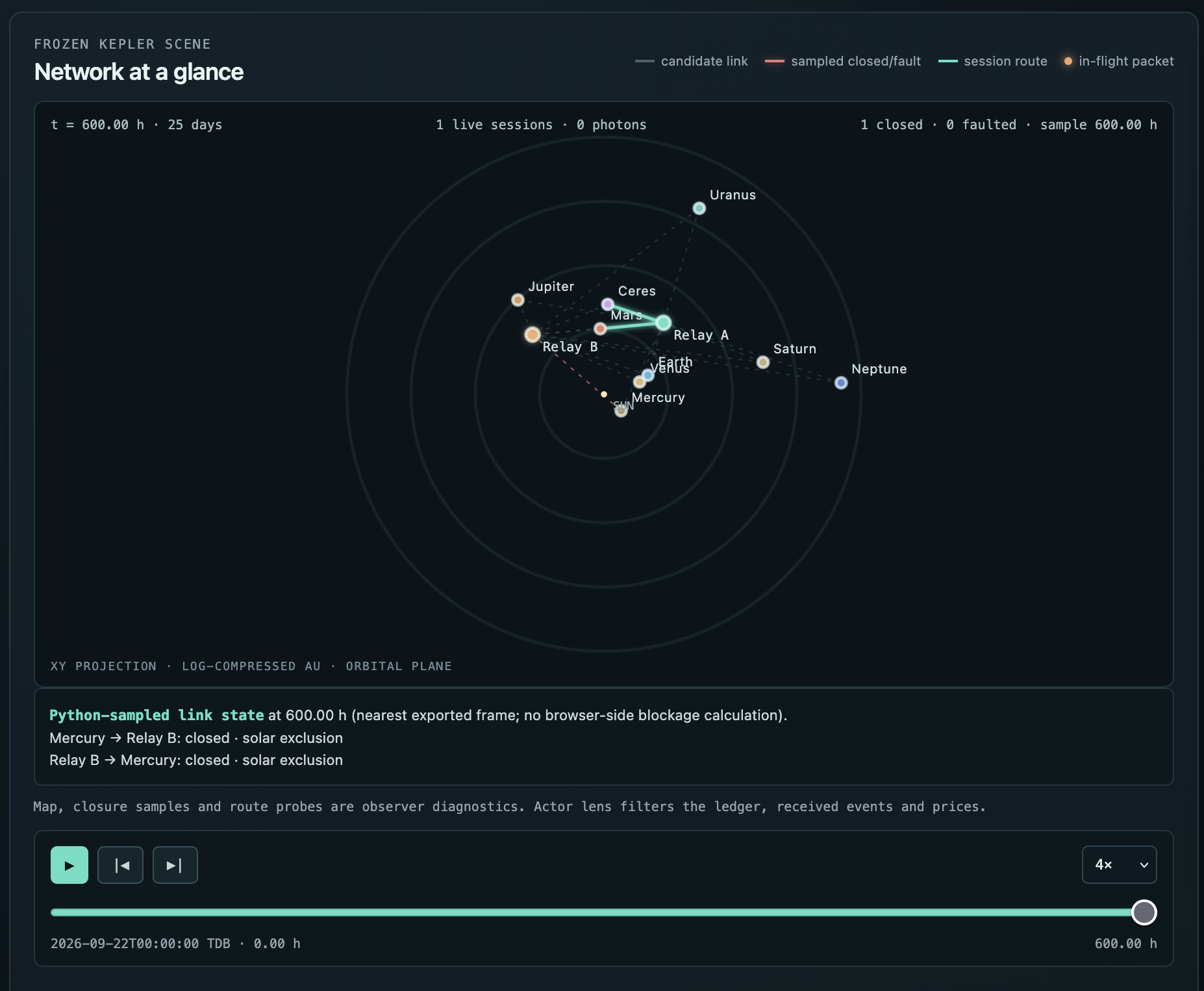
Web visualizer of planetary motion and exchange interactions
Trading across the solar system creates a problem that faster software cannot solve: information takes time to travel. An investor on Earth cannot instantly confirm what a seller on Neptune owns, and a lost message can leave both parties uncertain about a transaction.
We designed Ceres Exchange around that uncertainty. Nine settlement operators maintain local custody ledgers, while a clearing authority on Ceres coordinates cross-settlement decisions. The system supports two products: fully funded share trades and capped forwards whose maximum losses are collateralized before the contract opens.
Our central rule is that communication failure never creates permission to spend committed assets. Reservations remain backed until an authoritative decision reaches the responsible ledger. Durable records and unique transfer identities allow recovery after delayed messages, duplicates and endpoint resets without debiting or crediting the same transfer twice.
We built a Python simulator combining frozen orbital data, moving-receiver light-time calculations, network restrictions and exact asset accounting. We tested rising and falling price paths, distant settlements, insufficient collateral and a gateway isolation timed to disrupt settlement. We also examined later starting dates and sampled network geometry over 200 years.
A browser replay makes the results inspectable. Users can follow recorded packets, view ledger snapshots, compare routes and explore how failures delay settlement. It displays measured simulator outputs, with assumptions and sampling limits stated explicitly.
The completed prototype passes 52 tests, with independent reconciliation of 39 financial runs. Our biggest lesson was that asset protection and timely access are separate goals: keeping an obligation funded can preserve safety while leaving capital unavailable for longer.
Future work would strengthen authentication and storage resilience, explore alternative clearing arrangements, and expand the product set. The current prototype remains a simulation under an explicit honest-operator model.


Log in or sign up for Devpost to join the conversation.