-
-

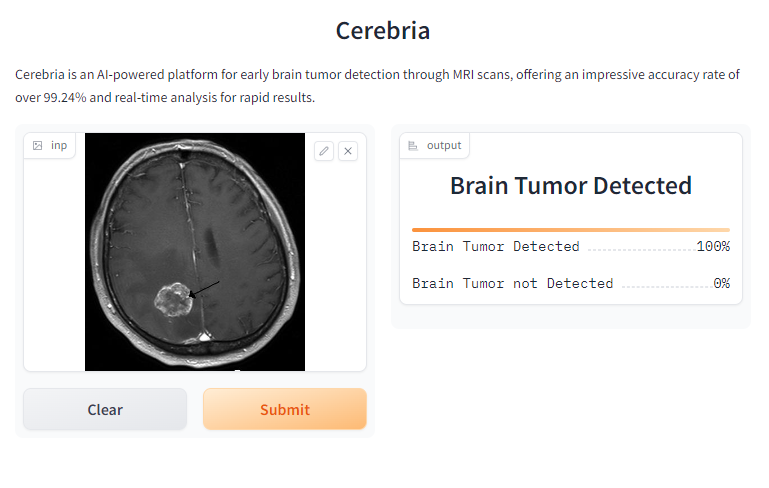
Deployed model
Inspiration
The inspiration behind developing Cerebria was to use modern machine learning techniques and computer vision to help improve the early detection and diagnosis of brain tumors. Brain tumors are a critical medical condition, and timely detection is crucial for effective treatment and patient outcomes. By utilizing MRI images and deep learning, Cerebria aims to provide accurate and efficient brain tumor detection, assisting medical professionals in making informed decisions and potentially saving lives.
What it does
Cerebria is a brain tumor detection system that takes MRI brain scans as input and employs a pre-trained VGG16 neural network model for feature extraction. The system then uses a custom classification head on top of VGG16 to distinguish between two classes: 'tumor' and 'non-tumor'. The output of the system is a binary prediction indicating the presence or absence of a brain tumor in the MRI scan.
How it was built
Cerebria was built using Python and TensorFlow/Keras libraries. The main steps involved in building the system are as follows:
Data Preparation: MRI brain scan images were collected and organized into the appropriate directory structure. ImageDataGenerator was used from TensorFlow to load and preprocess the images in batches.
Model Architecture: A pre-trained VGG16 model as a feature extractor and removed the fully connected layers from the model. Custom dense layers were added on top of the VGG16 to build the classification head. The final layer is a softmax activation to predict the probabilities of the 'tumor' and 'non-tumor' classes.
Model Compilation: The model was compiled with the Adam optimizer and categorical cross-entropy loss function and 'validation accuracy' was selected as the metric to monitor during training.
Transfer Learning: To leverage the knowledge learned by VGG16 on ImageNet data, the layers of VGG16 were frozen so that only the custom classification head would be trained on our specific brain tumor dataset.
Training: The model was trained using the MRI brain scan images with the help of
ImageDataGenerator. Necessary parameters were set up for training, including the number of epochs, batch size, and steps per epoch.
Model Checkpoint: A ModelCheckpoint callback was used to save the best model based on the validation loss during training.
Challenges
Limited Dataset: Obtaining a diverse and sufficiently large dataset of labeled MRI brain scan images was challenging. The quality and diversity of the dataset directly impact the model's performance and generalization.
Model Hyperparameter Tuning: Selecting appropriate hyperparameters, such as the learning rate, number of hidden units, and layers, requires careful experimentation and tuning to achieve optimal results.
Interpretability: Deep learning models like VGG16 can be challenging to interpret, making it essential to provide some form of explainability to medical professionals using the system.
Accomplishments
Building a Functional Brain Tumor Detection System: We successfully developed Cerebria, a functional brain tumor detection system that utilizes state-of-the-art deep learning techniques to analyze MRI brain scans and provide binary predictions.
Utilizing Transfer Learning: Leveraging the pre-trained VGG16 model allowed us to benefit from its feature extraction capabilities and focus on training the custom classification head on our brain tumor dataset.
Enhancing Medical Diagnosis: Cerebria has the potential to assist medical professionals in the early detection of brain tumors, enabling faster and more accurate diagnoses, leading to better patient outcomes.
Learnings
Developing Cerebria taught valuable lessons in both the technical and medical domains:
Deep Learning and Transfer Learning: We gained experience in using pre-trained models and implementing transfer learning to tackle complex tasks with limited data.
Medical Imaging Challenges: Working on a medical imaging project helped us understand the challenges and ethical considerations related to developing AI systems for healthcare applications.
What's next for Cerebria
Cerebria is just the beginning of the journey to revolutionize brain tumor detection
Dataset Expansion: We will continue to collect and curate a more extensive and diverse dataset of MRI brain scans to enhance the model's robustness and generalization.
Model Fine-Tuning: We will explore fine-tuning strategies for the VGG16 layers to adapt the model better to the specific characteristics of brain tumor images.
Interpretability: Developing techniques for model interpretability is essential in medical applications. We will work on explaining the model's predictions to provide confidence to medical professionals.
Clinical Validation: To ensure Cerebria's safety and effectiveness, we will collaborate with medical experts to conduct extensive clinical validation and integrate feedback from healthcare practitioners.
Deployment and Integration: Our ultimate goal is to deploy Cerebria in real-world medical environments, integrated with existing medical systems, to provide reliable and efficient brain tumor detection support to healthcare providers.

Log in or sign up for Devpost to join the conversation.