-
-

Cerebra logo
-
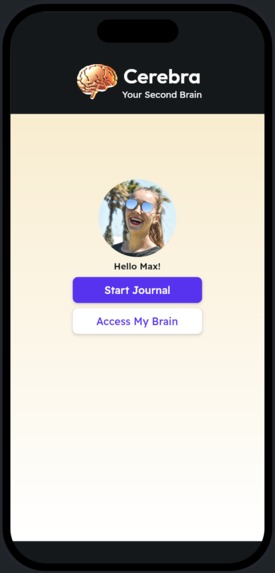
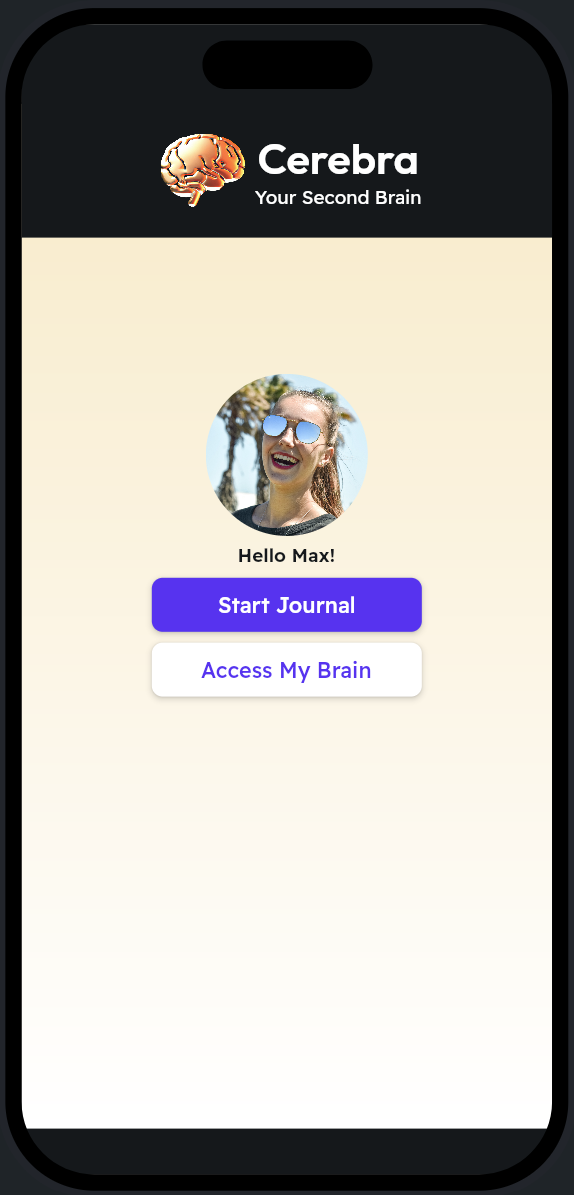
A prototype of our mobile application
-
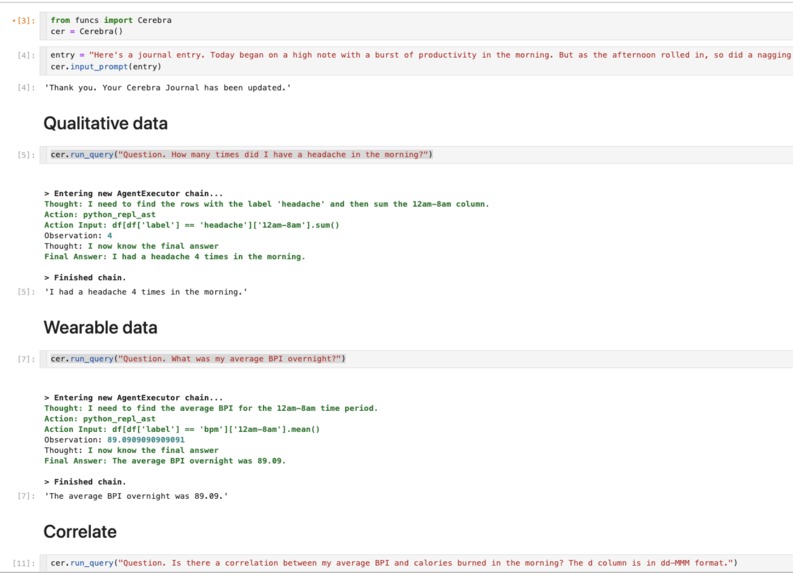
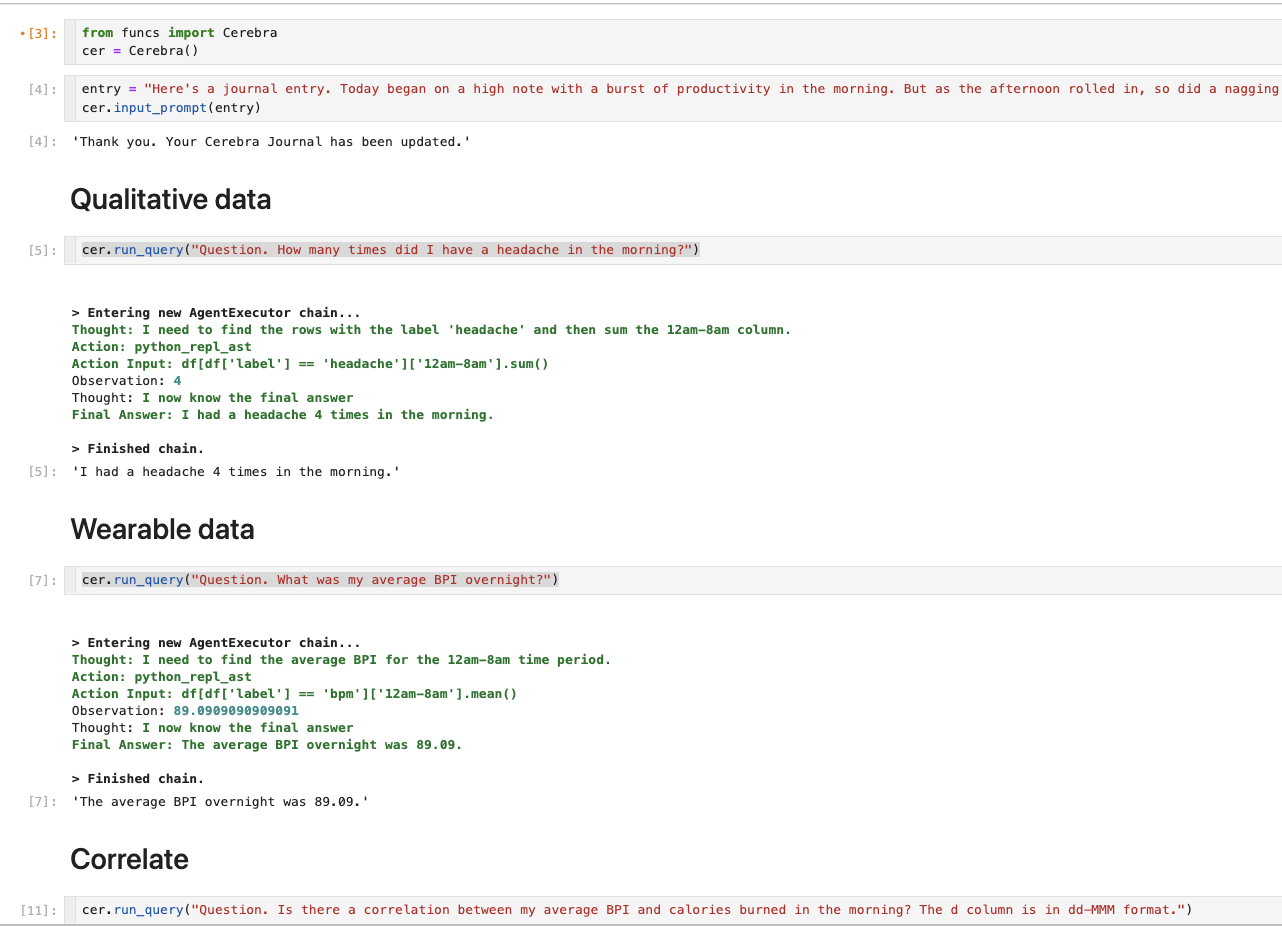
An example of Cerebra's capabilities
-
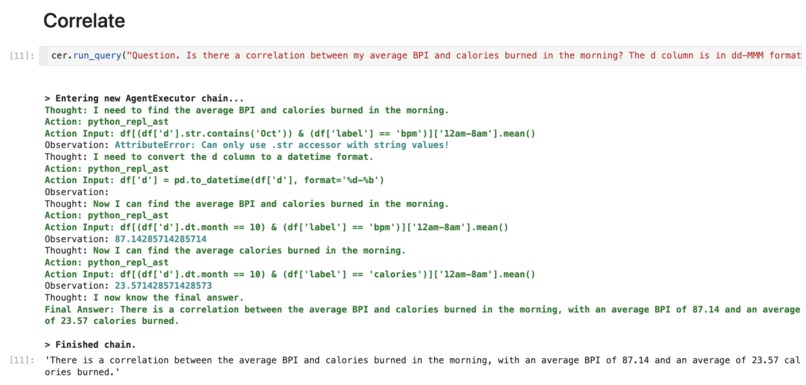
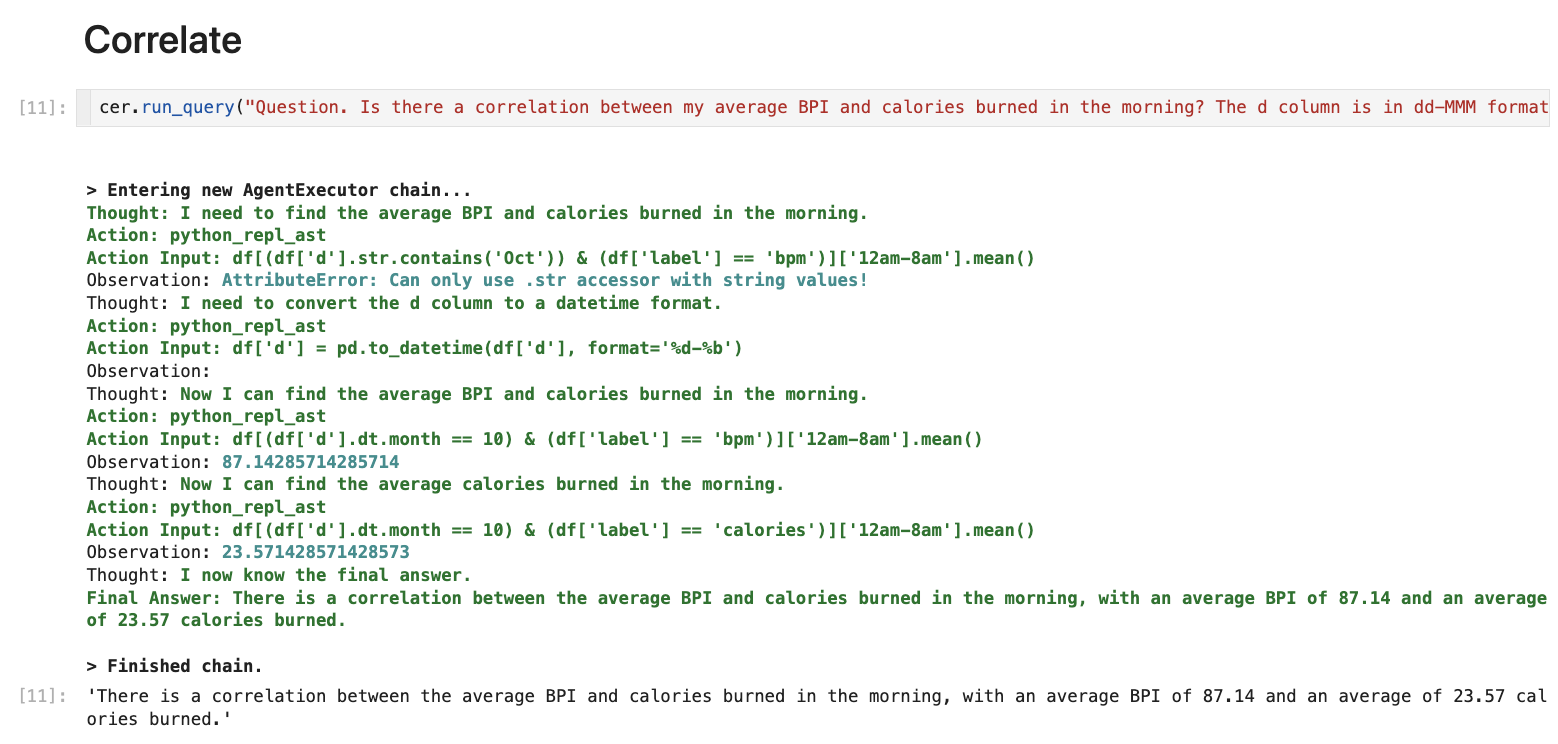
Capabilities for correlation

Inspiration
The motivation to create a product that synergizes journal entries with wearable health data stems from an intersection of technological innovation and a paradigm shift in health management. As individuals increasingly seek proactive and data-driven approaches to health. The advancements in wearable technology, AI, and natural language processing present a unique opportunity to cater to this demand and the emphasis on mental health awareness, bolstered by the COVID-19 pandemic's push for remote health monitoring, mandates the necessity for accessible, personalized healthcare tools.
This product taps into the growing trend of preventive healthcare, focusing on maintaining wellness rather than merely treating illnesses. With healthcare systems leaning towards integrated data solutions, there's an opening to empower users with actionable insights into their health patterns, potentially reducing healthcare costs and improving quality of life. The convergence of improved healthcare accessibility, user empowerment, and a societal call for better mental healthcare solutions creates a fertile ground for a product that not only meets consumer expectations for intelligent, connected services but also addresses a significant societal and healthcare gap.
What it does
Cerebra is an advanced digital health and wellness assistant designed as a chatbot that converses with users in real-time via voice input. This intuitive chatbot analyzes personal health data drawn from journal entries and syncs data from wearable devices through seamless API integration. Cerebra is adept at sifting through the nuances of self-reported symptoms and objective health metrics to deliver tailored insights. It helps users uncover patterns and correlations in their health and wellness data that might otherwise go unnoticed. With Cerebra, users gain a deeper understanding of their well-being, empowering them to make informed decisions about their health. The chatbot's sophisticated algorithm ensures privacy while providing a comprehensive yet straightforward overview of the user's health trends, fostering proactive health management in the fast-paced digital age.
How we built it
We have employed Human-centered Design Thinking Principles and Agile Methodology principles for the design and development of this MVP.
Empathy: By adhering to the principles of Human-centered Design, we started with an empathetic approach to deeply understand the needs and challenges faced by potential users, ensuring our MVP truly resonates with their health and wellness goals.
Ideation: The design phase involved collaborative brainstorming sessions where diverse perspectives were harnessed to ideate innovative features that combine journal entries with wearable data, focusing on usability and user engagement to reinforce accuracy.
Prototyping: Our rapid prototyping allowed us to quickly translate ideas into tangible models. The iterative design enabled us to refine the user interface and experience, aligning closely with agile practices.
Testing: We employed an agile approach to validate and verify the MVP with varying inputs continuously. By troubleshooting bugs and incorporating their feedback in swift, iterative cycles, we were able to improve the product's functionality and user interface in a responsive manner.
Implementation: Agile methodologies guided the development process, with sprints focused on delivering small, incremental improvements, ensuring flexibility to adapt to changing user needs and technological advancements while maintaining a user-centric focus.
Below are the tools and Software that we used to develop this MVP:
- Coding Language: Python
- IDE: VS code
- Database: .csv
- UI/UX: Gradio
- Hosting: Hugging Face Spaces
- Voice to Text conversion: Whisper
- LLMs: Lang Chain OpenAI
Challenges we ran into
Primarily, we ran out of time. We had a couple of features for implementation, but we could not implement them at the moment. Hence, we are planning to incorporate them for future releases. We reduced the complexity of the problem that we tried to solve and targeted an MVP for now instead.
Generating the Dataset: Utilizing large language models to simulate nuanced health profiles posed the challenge of ensuring the synthetic data's realism and relevance to actual health conditions.
Validating the Dataset: The validation process required meticulous cross-checking between the journal entry and wearable data to ensure data accuracy and reliability.
Prompt Engineering: Crafting prompts that effectively guide the model to generate useful health data necessitated a balance between specificity and generality.
Fine Tuning: Deciding not to fine-tune the models presented a challenge in achieving high precision and personalization in the dataset without overfitting or introducing biases.
Accomplishments that we're proud of
We are proud of how we were all collaborative in this effort. We often challenged the status quo to bring out the best possible solution. We are also proud of how we were able to quickly pivot and think of an alternative solution when we faced a hurdle; this helped us deal with ambiguous technical challenges.
What we learned
We learned to navigate the challenges, and this made us not get bogged down in one issue. Rather, we pivoted quickly to see how to achieve the intended outcome in a different way, as technical challenges are always going to pop up.
What's next
Stage 1: We will refine and fine-tune the MVP with some additional features to gain user feedback. We plan to open this product to focus groups and incorporate their feedback to uncover actual user points. We also plan to seek funding to launch the actual product with sophisticated features.
Stage 2: And then launch it for B2C initially. If we are able to acquire users and gain the adoption that is required to break-even, we are planning to invest more into R&D and sourcing professional healthcare providers (Medical Practitioners) to help with providing recommendations and training the model. We are planning to introduce this recommendation feature only after we acquire user trust as its an ethical terrain to tread.
Stage 3: We are planning to invest our efforts towards investing in infrastructures to scale it to B2B wherein we are planning to partner with Wearable Manufacturers, Corporates (Employee Wellness Programs) and Insurance Companies.
Built With
- csv
- huggingfacespaces
- python
- whisper

Log in or sign up for Devpost to join the conversation.