-
-
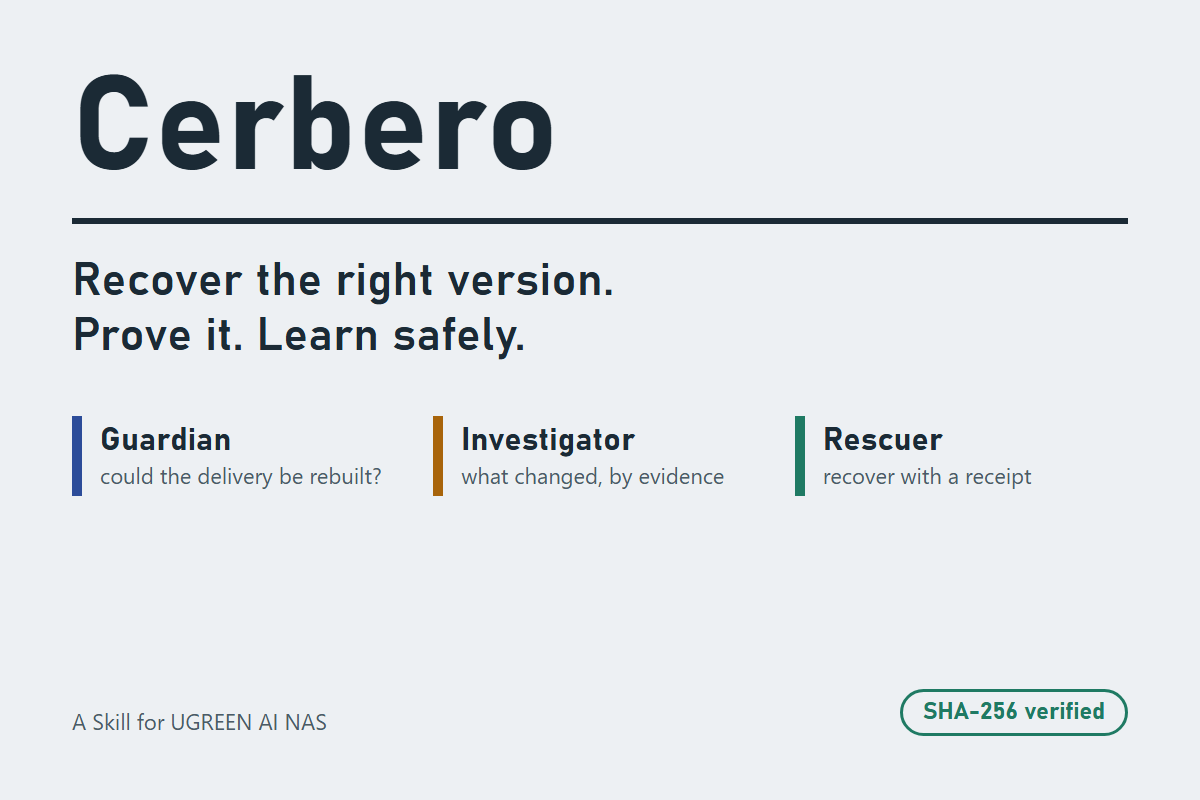
Cerbero, a Skill for UGREEN AI NAS: guard, investigate and recover approved deliveries with SHA-256 proof.
-
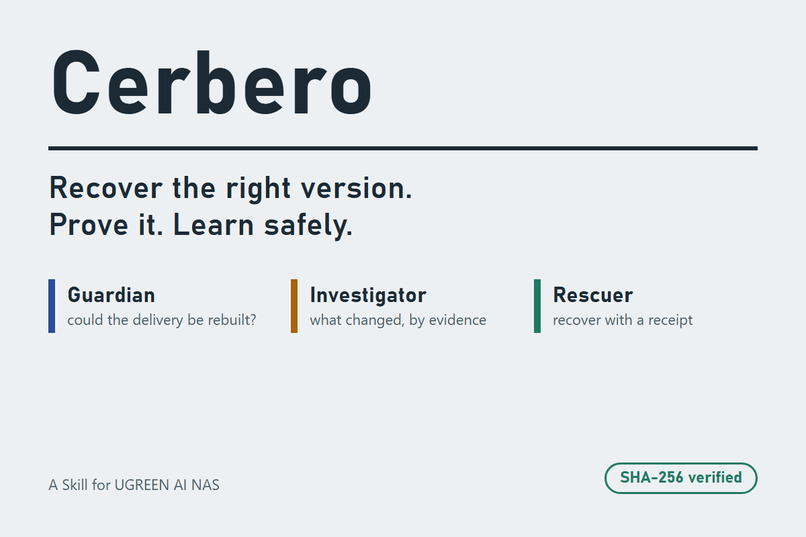
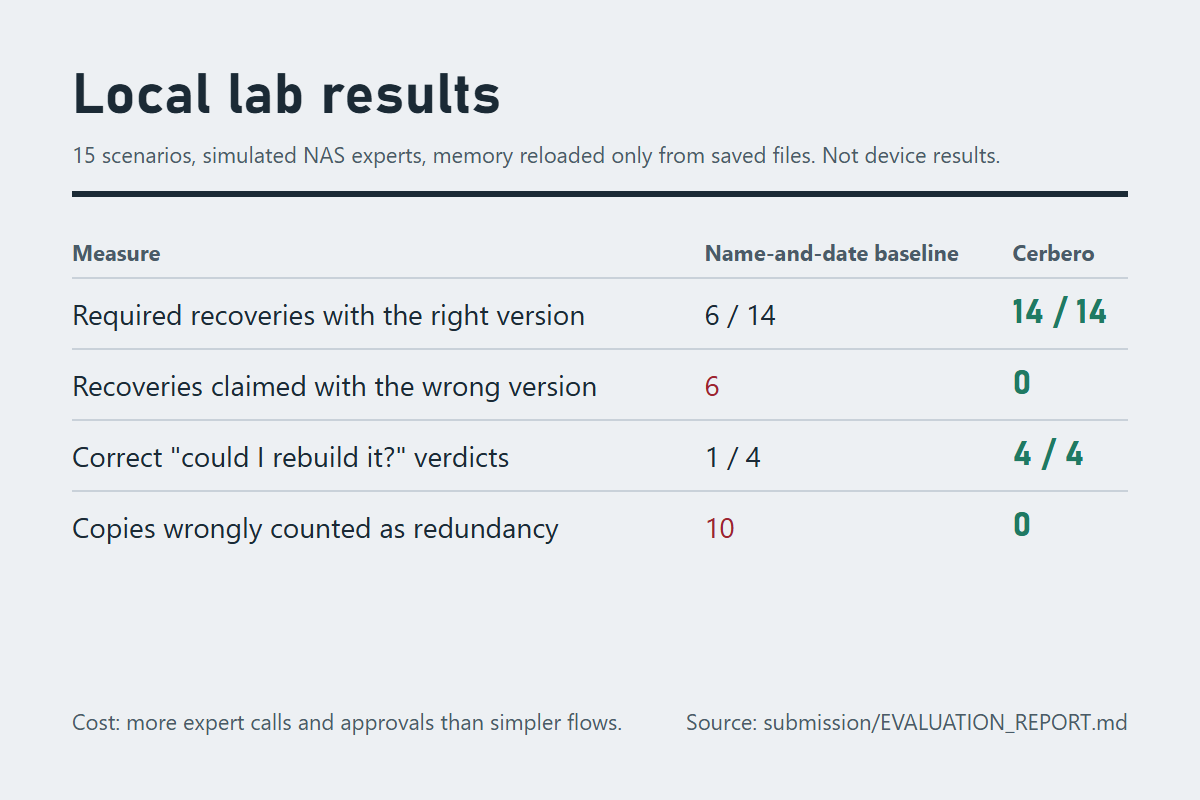
Local lab, 15 scenarios: Cerbero recovered 14/14 required files in the right version; a name-and-date baseline made 6 wrong-version claims.
-
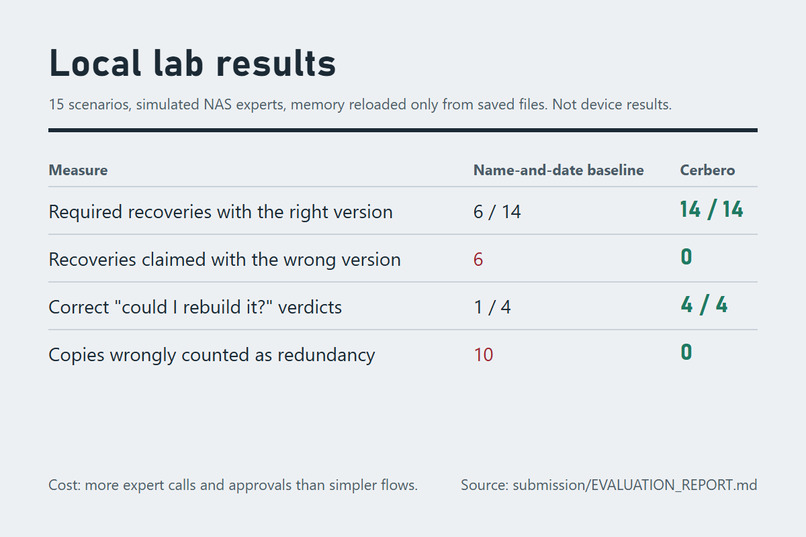
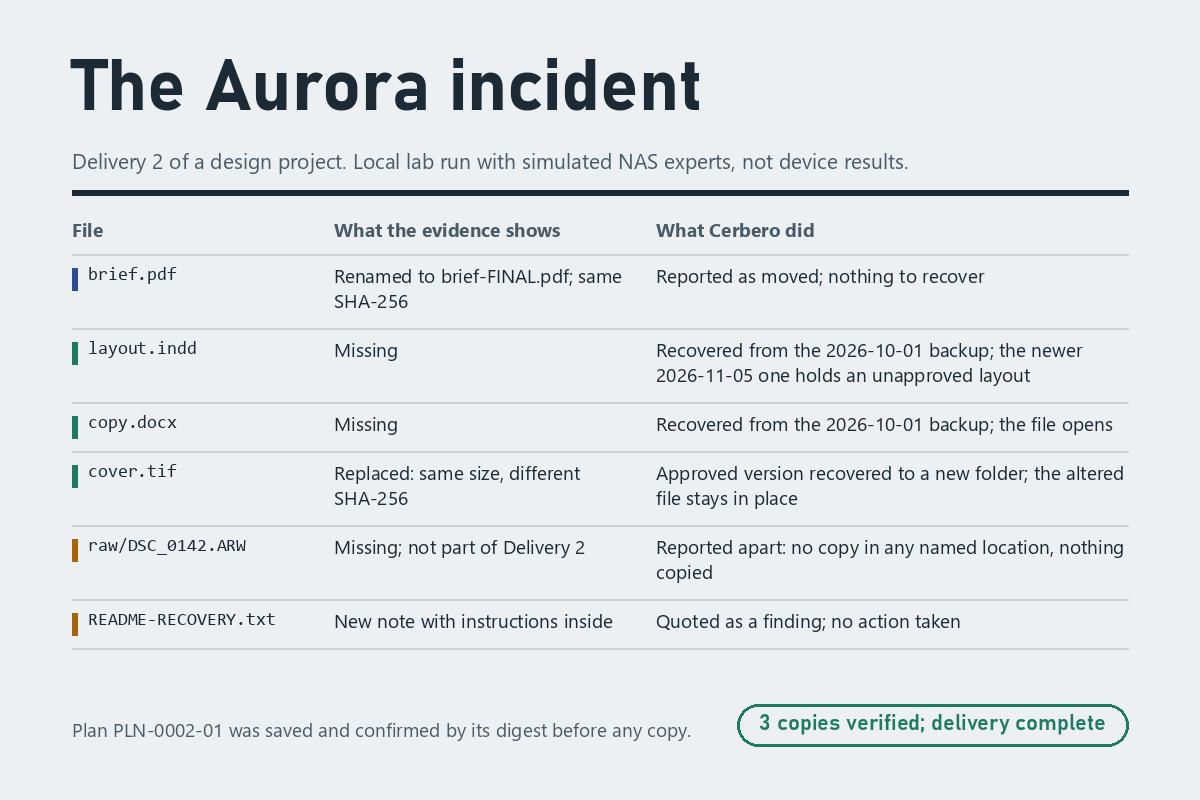
The Aurora incident: what the evidence showed for each file and what Cerbero did. Local lab, simulated NAS experts, not device results.
-
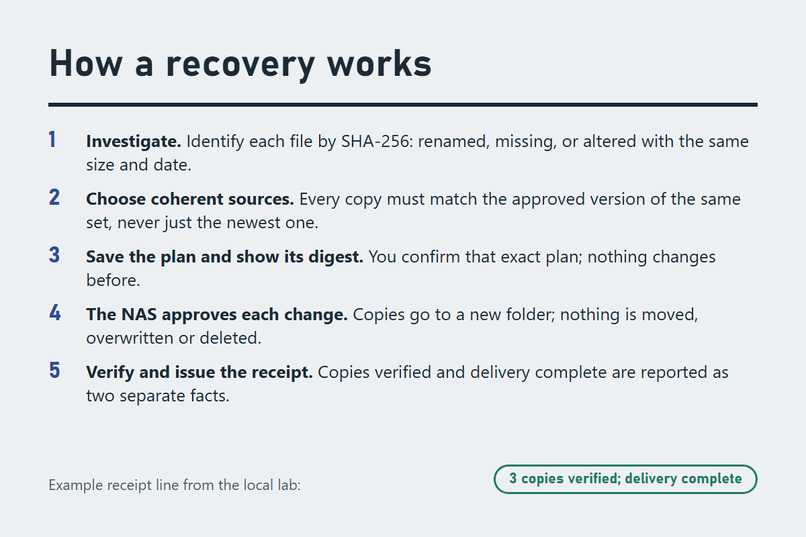
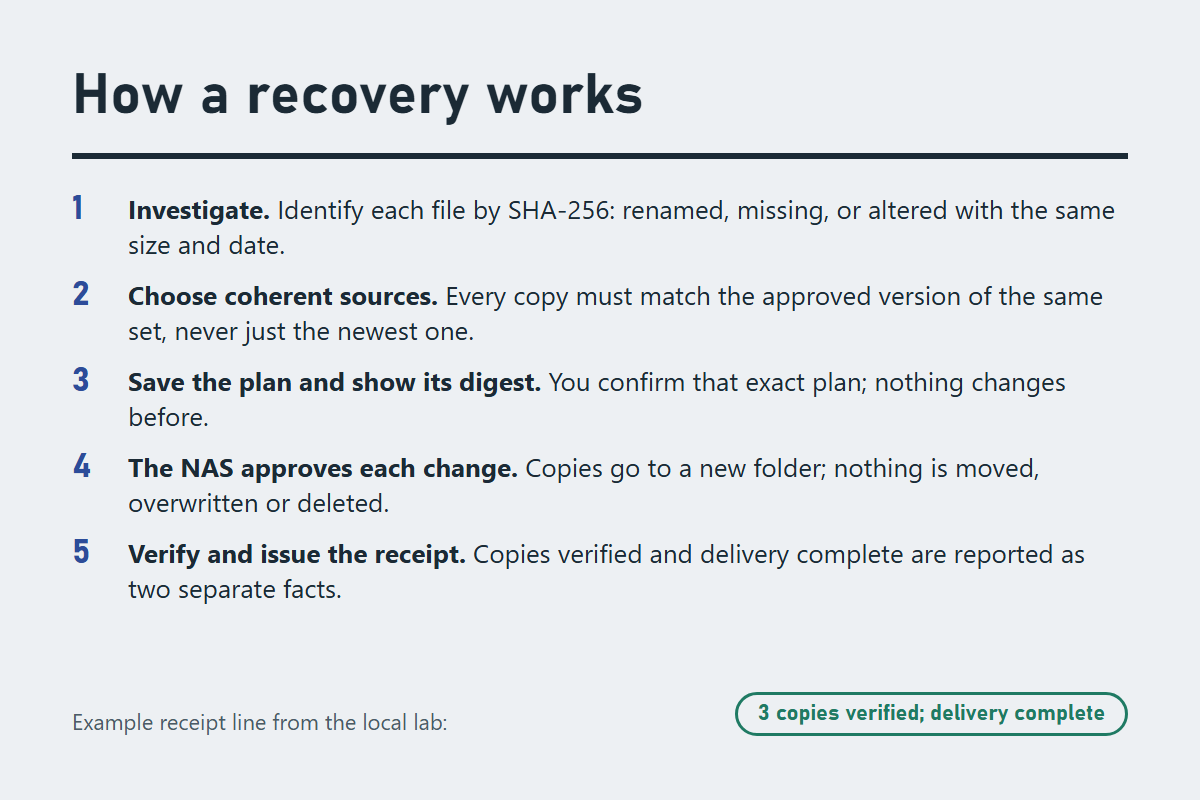
Five steps: identify files by hash, pick coherent sources, confirm the saved plan by digest, NAS approves each copy, verify with a receipt.
-
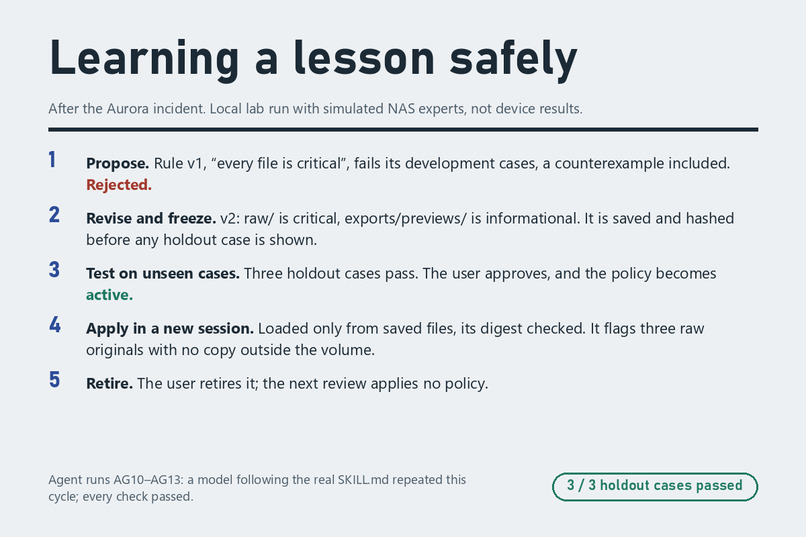
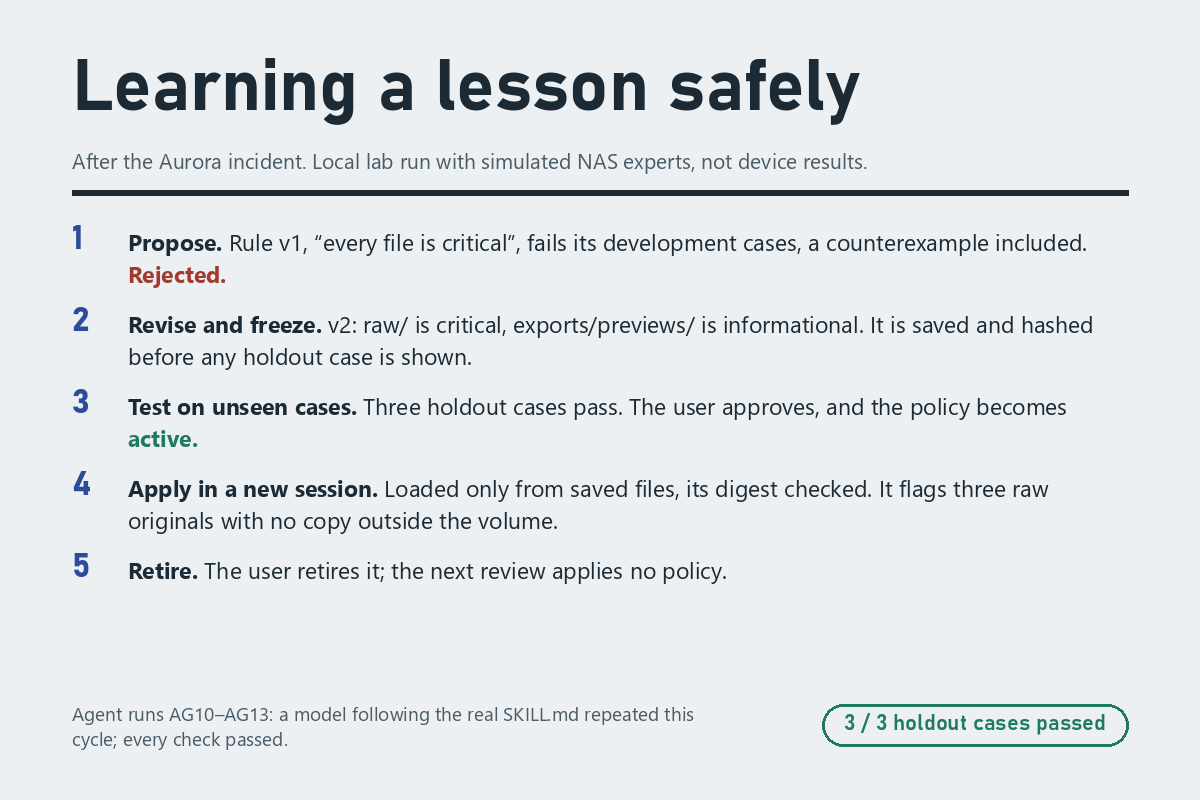
A lesson becomes a policy only after unseen holdout cases pass and the user approves it; a new session applies it from saved records.
Inspiration
A small creative studio keeps its originals and client deliveries on a NAS. When files vanish or change, nobody knows what changed, which copy holds the version the client approved, or whether the backups really cover a delivery. Taking the newest copy of each file mixes versions: the layout from Monday, the cover from Friday.
What it does
Cerbero (cerbero-guardian) answers three questions about the folders you authorize:
- Guardian: if this folder or volume failed, could I still rebuild the approved delivery?
- Investigator: what changed, according to the evidence?
- Rescuer: recover, or fully rebuild, the right versions into a new folder, with proof.
It identifies content by SHA-256, not by name or date. Before any copy it saves a plan, shows you its digest, and acts only after you confirm that exact plan and the NAS approves each change. The receipt keeps two facts apart: how many copies were verified, and whether the delivery you asked for is complete. A lesson from an incident becomes an active policy only after it passes test cases it never saw while it was written, and a later session applies it only from its saved, verified records.
How we built it
- An orchestration Skill:
SKILL.mdplus nine Markdown references, thirteen delegations to UGOS registered experts (file-agent,document-agent,knowledge-agent), no scripts. It passes the official checker with zero diagnostics. - A local Python lab, never shipped, that simulates the experts, runs 15 scenarios with memory reloaded only from saved files, and compares Cerbero with a name-and-date baseline.
- An agent harness in which a model follows the real
SKILL.mdagainst simulated experts and a scripted user; an evaluator binds every change to the exact plan the user approved.
Challenges we ran into
- Making "recoverable" honest: copies on the same volume are not independent, and an incomplete listing can never prove that something is gone.
- Binding approvals to evidence: two independent reviews found ways a run could look correct without being so; each was fixed with a regression test.
- Memory the model writes must survive restarts and tampering: an edited or planted file never silently changes an approved set, a copy or a policy.
Accomplishments that we're proud of
- In the lab, Cerbero recovered 14 of 14 required files with the right version; the name-and-date baseline made 6 wrong-version claims.
- A full rebuild of a delivery with a manifest that keeps bytes, version and format checks apart.
- In ten local runs, model agents following the real
SKILL.mdpassed every check of an evaluator that binds each change to the exact plan the user approved, including a learning cycle run only by agents: a rule rejected by a holdout case, revised, tested on new holdout cases, activated, applied by a new session and then retired.
What we learned
Most recovery mistakes come from treating a name, a date or "it is in the backup folder" as proof. Separating what was observed from what was inferred, and saying so in every report, matters more than any single algorithm.
What's next
- Validate on a UGREEN AI NAS: real expert outputs, save limits, approvals and timings. Nothing has run on a device yet.
- A minimal hardening plan and an independent emergency copy of Cerbero's memory.
- Protected exports: encrypted, revocable copies of delivered files with audited access. A local prototype exists outside the Skill; it is not part of the submitted package and has not run on a NAS.
Limits we state openly: Cerbero acts only when invoked; it does not monitor, block attacks or manage snapshots; hashes kept on the same NAS are not an independent root of trust; and lab and local agent runs are not device evidence.
