-
-
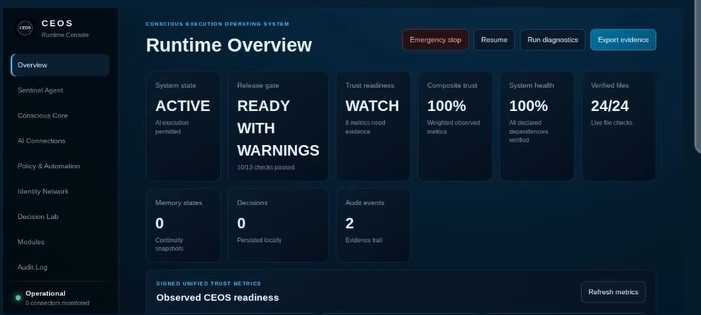
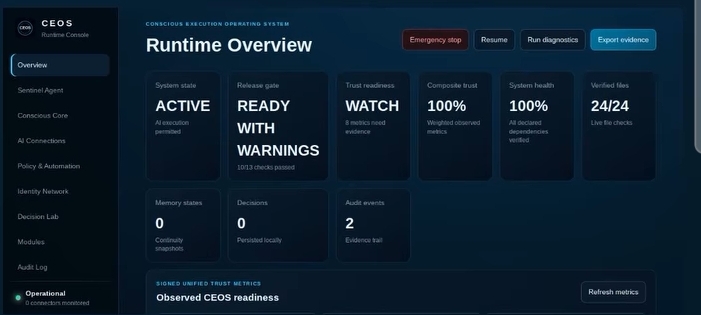
CEOS Runtime Console showing system status, governance controls and active AI components.
Inspiration
I started building CEOS because one question kept bothering me. Just because an AI system can do something, does that mean it should be allowed to do it?
I wanted a system that pauses before execution and checks the basics first. Who authorized the action? Why is it needed? How risky is it? Can it be reversed? Was the decision made with enough information, or under pressure?
What it does
CEOS checks proposed AI actions before they are executed.
It looks at human authority, operational risk, reversibility, policy rules and optional decision context. Based on those conditions, it returns one of three outcomes: APPROVED, REVIEW or BLOCKED.
It also keeps an audit trail, runs diagnostics, exports evidence, manages AI connections and includes emergency stop and resume controls.
The purpose is not to replace human judgment. It is to make important AI decisions easier to understand, review and question.
How I built it
I built CEOS as a browser based application with a Python backend and JavaScript runtime logic.
It runs on Google Cloud Run and connects to Gemini through the Google Gen AI SDK.
Gemini can help with reasoning, but it does not make the final governance decision. That part remains separate and rule based.
The current version includes the Decision Lab, Human Decision Context, Audit Log, AI Connections, Policy and Automation, Identity Network and runtime diagnostics.
Challenges I ran into
The main challenge was keeping the system clear while adding several layers of control.
I had to make sure that AI reasoning remained separate from permission to execute. I also wanted the Human Decision Context feature to add useful safeguards without pretending to diagnose anyone.
Another challenge was preparing a public version of the project without exposing API keys, private files or development data.
Accomplishments I am proud of
I am proud that CEOS is not only an idea. It is a working system with a public deployment, a usable interface, decision results, audit records, diagnostics and a live Gemini connection.
I am especially proud of the Human Decision Context feature because it considers pressure, missing information and understanding of consequences without judging or labelling the person.
What I learned
I learned that AI governance is more useful when it is part of the runtime, not something added later as a policy document.
I also learned that an AI model should not be responsible for deciding whether its own action is authorized.
The biggest lesson was that responsible AI is not only about what a model says. It is also about who gave permission, whether the action can be undone and whether it should happen at all.
What's next for CEOS
The next step is to turn CEOS into a complete governance platform that can support multiple AI systems, not just one model or one workflow.
I want to expand the governance engine with richer policy rules, stronger identity verification, better evidence collection and long term audit storage.
Another goal is to support more AI providers while keeping the governance layer independent from any single model.
I also plan to add collaborative reviews, approval workflows for organizations and dashboards that make governance decisions easier to understand.
My long term vision is for CEOS to become a practical layer that organizations can place between AI systems and real world actions, helping people use AI with greater transparency, accountability and trust.


Log in or sign up for Devpost to join the conversation.