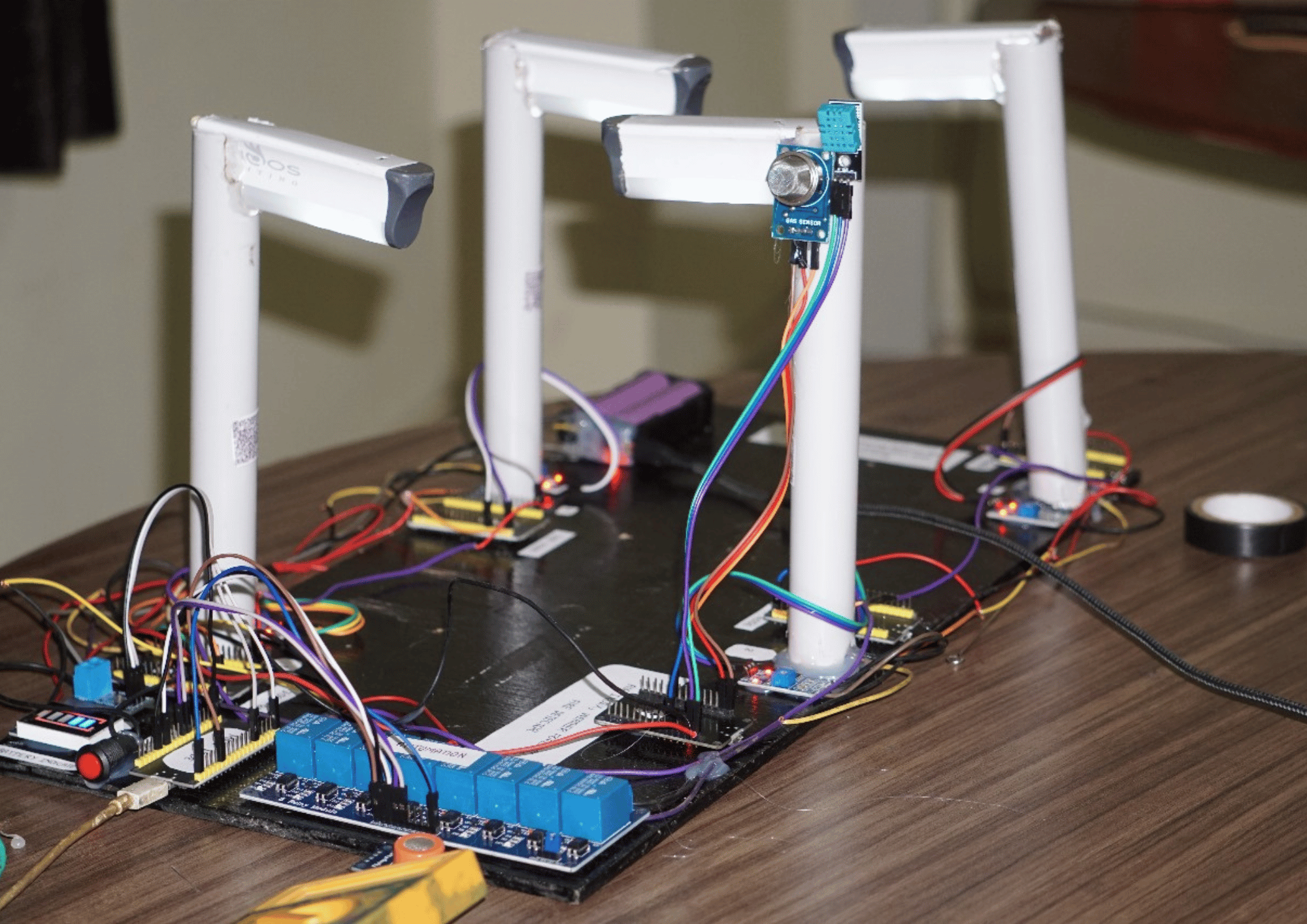
Inspiration The foreground for this project was derived from the increasing problems associated with street light maintenance across many of the Indian cities. When we noticed that some of the street lights have been off and are either not fixed for some time or their faults are taken so long to detect as this is normally caused by the existing centralized manual system for the detection of the faulty street lights. The deteriorating safety standards, escalating energy costs, and the mundane approach that requires citizens to report problems were some of the factors that led us to design this enhanced, live, intelligent system that can detect faulty equipment and facilitate efficient management of streetlight systems by city authorities.
Our aim was to establish a system that quickly detects street light faults but at the same time implement environmentally friendly practices including; dimming the lights, during certain environmental conditions and saving energy.
What it does The Centralized Street Light Monitoring & Fault Detection System is a system that makes identification and / or location of fault implement streetlights. Here's how it works:
• Real-Time Fault Detection: Through voltage, current and ambient sensors the system can instantly identify faulty street lights. • Unique ID for Location Tracking: Every street light has an identification number so whenever there is a fault, it is easily identified to the point of repair. • AI-Powered Camera Monitoring: In the case of the street luminaires, object identification along with the detection of abnormalities in the area surrounding the lights is facilitated by the ESP32 Camera and AI (YOLO). • Environmental Sensors: Devices such as MQ, DHT11, LDR measure weather and conditions in the vicinity by changing the light intensity of the environment. • Heat Maps and Data Visualization: The system gives the authorities the ability to view heat maps of bad street lights so they can know where they need to focus more. • Predictive Maintenance: Employing the requisite history, the system is able to ascertain potential failures for efficient early maintenance. • Notifications: Maintenance teams are immediately notified once a particular fault is identified, hence minimizing on time wastage.
How we built it It took us time to create the system where we implemented IoT, AI, and machine learning as tools. Here’s the breakdown:
• Hardware: We employed ESP32 WROOM 32 microcontrollers for multiple street lights communication through the ESP-NOW protocol (In this street light hierarchy, sub-nodes do not require Wi-Fi or internet). The central unit can be connected to WIFI to support backend monitoring and visualization. • Sensors: In this system, the following sensors have been employed: LDR for light detection, IRR for distance detection, voltage and current sensors for power meters, MQ series sensors for air quality measurement and DHT11 for measuring temperature and humidity. • ESP32 Camera: Takes pictures and stores the frames that a pre-trained YOLO model can classify objects and possible abnormalities. • Software: The back end part is developed by Flask or Node.js to store data, make analysis, and visualization. We incorporated AI/ML features as an additional sub-module for processing sensor data and providing main outputs in the form of predictive maintenance. • Visualization: We employed data visualization tools and libraries to develop a live dashboard with heat maps and fault analysis accompanied by the ID of each streetlight.
Challenges we ran into Building this system came with its own set of challenges:
• Reliable Communication: ESP-NOW used in the communication of nodes necessitated a careful tuning for balance so as to make the transmission occur without interruption. • Fault Detection Accuracy: Adjusting the sensors for perfect accuracy in detecting faults which don’t return false alarms was some of the complexities involved when other issues like varying environmental conditions were incorporated. • AI Model Integration: Combining YOLO object detection with ESP32 camera was not straightforward due to processing constraints of the microcontroller. • Energy Efficiency: Achieving power supply along with the real-time sensing and data acquisition of the system presented a challenge in the corresponding power and efficiency of the hardware and software subsystems. • Predictive Maintenance: When applying predictive maintenance models, training them on datasets was not always easy since the historical data were, mostly, lacking.
Successes that aren’t negotiable and one has no regret working on them We are particularly proud of:
• Achieving Real-Time Fault Detection: Realization of a system that would help early detection of faulty street lights hence shortening the maintenance response time. • Sustainability Focus: Including environmental sensors and using the street light energy as per the condition prevailing in the environment. • AI-Powered Monitoring: Therefore introducing YOLO AI model into a cost efficient IoT solution with ESP32, which further bonded powerful surveillance and monitoring features to the project. • Community Engagement: Creating a blueprint to foster the use of a citizen reporting app on proper use and ensuring street light structures’ integrity. • Heat Maps and Visualization: Designing a simple layout of the heat map on the dashboard and enable authorities to easily determine the fault distribution by location in the city.
What we learned Throughout the development process, we learned:
• The Importance of System Optimization: When designing IoT systems it is important to pay close attention to their performance – more particularly when dealing with complex sensor networks and real-time data. One of the main memories extracted from this exercise is that of the degree of accuracy that has to be achieved for data whilst not burning a hole in the pocket. • Data Integration: The process of combining data from LDR, IR, MQ, DHT11 sensors as well as using AI models into one system presupposes not only the technical preparations but also the comprehension of how external factors are connected on the conceptual level. • The Power of Predictive Analytics: Exploring machine learning models in the area of predictive maintenance gave our eyes an eye-opener regarding data-driven maintenance systems in infrastructures for the urban areas. • Scalability: Through experimenting with the concepts of power loss with distance, network expandability while preserving accuracy and power efficiency, we discovered important lessons in how to construct an IoT system and scale out its network.
What's next for Centralized Street Light Monitoring & Fault Detection System
Moving forward, we have several exciting plans to further enhance the system:
• Scaling the Deployment: The system is to be developed further for larger areas, implying that the number of street lights covered by the system is to be substantially higher, with the data accuracy and the reliability of the communication channels remaining unchanged. • Blockchain Integration: Its application will help maintain the transparency and security of records of maintenance work, which will be stored in a distributed database, protected by blockchain technology. • Smart City Integration: We plan to connect our system to other smart city projects so the street lamps, traffic lights and other structures will be able to freely communicate. • Enhanced AI Models: Our future work involves custom training of AI models to enhance fault diagnosis and adding new features to the identification of objects in a camera feed. • User Feedback Loop: Extending the current manual based online reporting system to include a mobile application for citizens to report faults and make feedback, thus enhancing the efficiency of the system. • Solar-Powered Street Lights: Investigating among others the option of making the system solar power lit to reduce the energy consumption as well as making the parts where the street lights are not often used to be solar powered. • Energy Management System: Applying dynamic energy management to energy usage in the feeder level and also the substation level according to usage behavior and weather data.


Log in or sign up for Devpost to join the conversation.