Inspiration
Every year, thousands of university students receive a bank-issued card, the problem isn't acquiring customers—it's activating them, students remain credit invisible, missing the opportunity to build healthy financial habits from day one, Kivo was inspired by Ana, a 19-year-old student who represents this underserved sector. Our mission is to become the bridge between these two worlds: helping banks increase activation and helping students develop healthy financial habits before their first credit card. To encourage real adoption, Kivo introduces a reward-based ecosystem that motivates students to actively use their university card through personalized offers, achievements, and financial milestones,
What it does
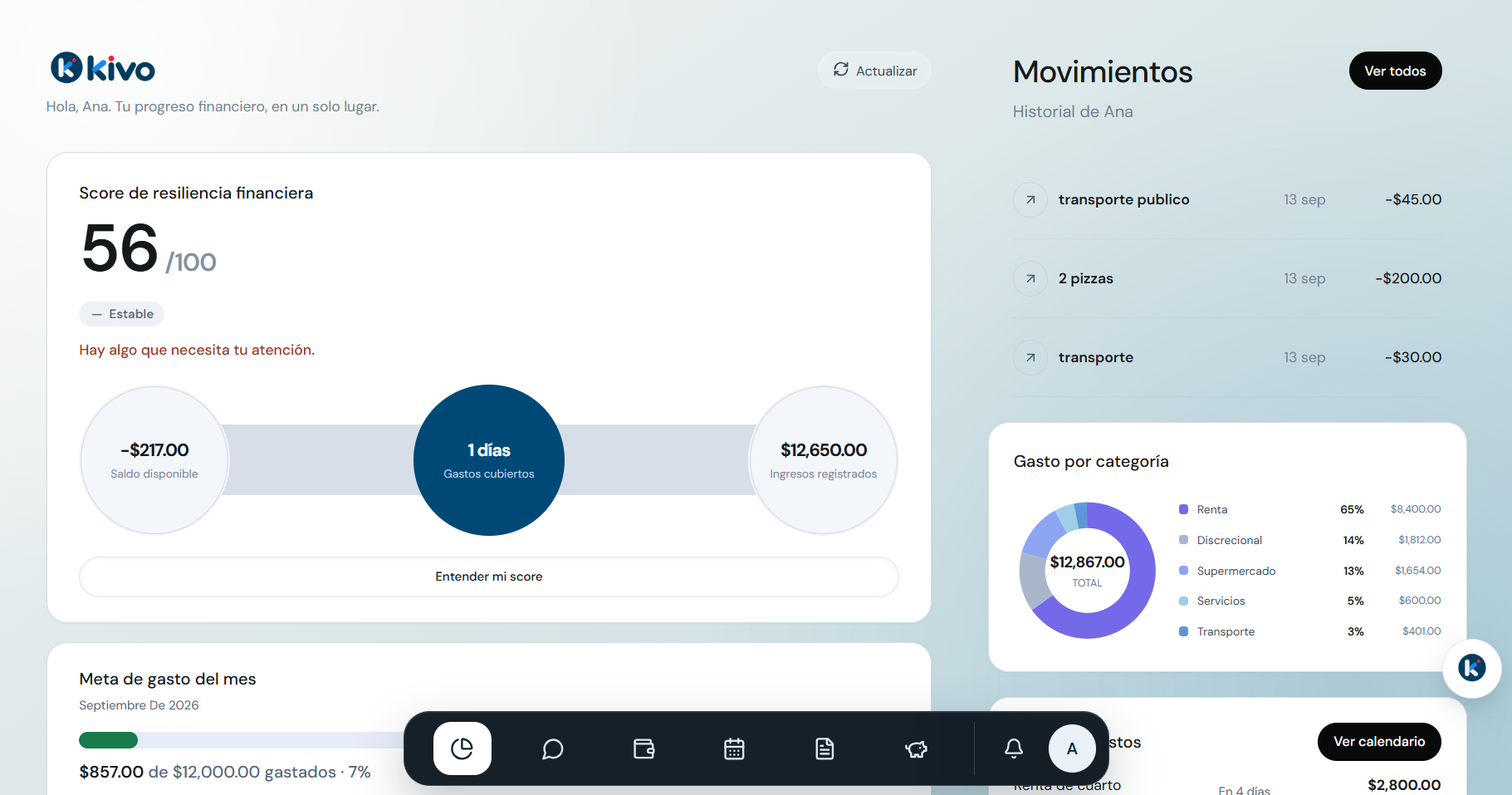
Kivo is an AI-powered financial companion designed specifically for high-school & university students.
Instead of showing confusing banking data, Kivo analyzes spending, recurring payments, income patterns, and cash flow to generate a Cash-Flow Resilience Score. It detects subscription leaks, predicts upcoming expenses, automatically organizes savings, and educates students through conversational simulations like "What happens if I cancel this subscription?"
For banks, Kivo creates something even more valuable: a measurable activation signal that transforms dormant university accounts into potential & financially responsible customers.
How we built it
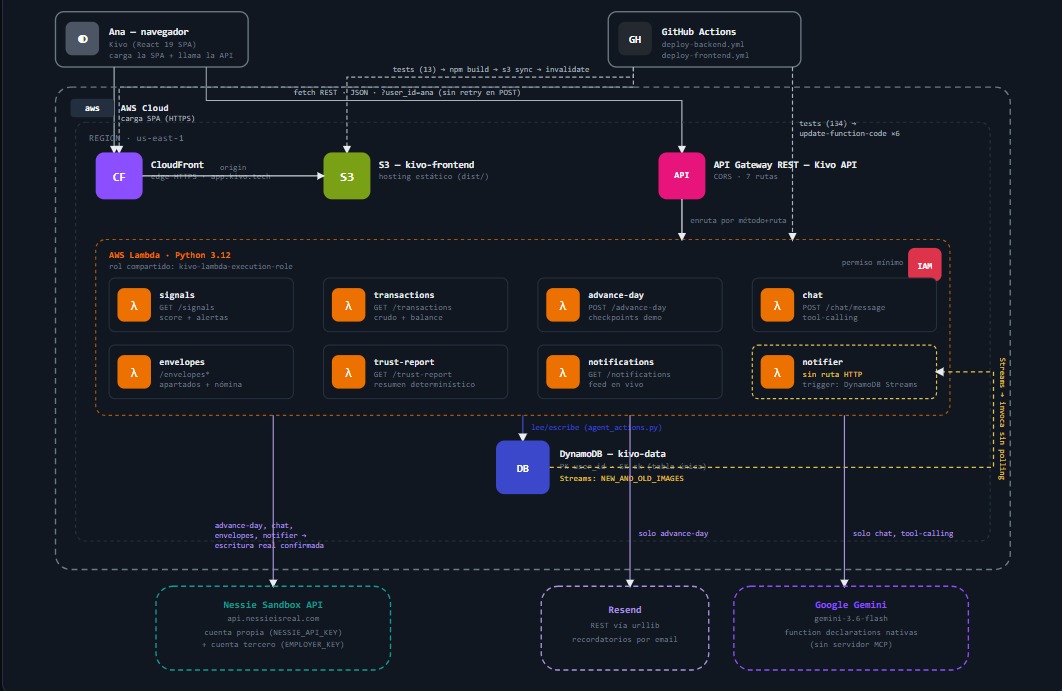
We built Kivo on a serverless microservice architecture using AWS and Capital One's Nessie API.
The platform mirrors real banking activity into DynamoDB, where our deterministic scoring engine calculates financial resilience. An AI agent powered by Gemini performs secure tool-calling, but every financial action is verified before execution through anti-hallucination guardrails. Real transactions—such as moving money to savings or cancelling recurring charges—are executed in Nessie, while DynamoDB Streams trigger real-time notifications across the app.
Tech stack: React, AWS Lambda, DynamoDB, API Gateway, Gemini, and Capital One Nessie.
Challenges we ran into
The hardest challenge wasn't building AI—it was making it trustworthy enough for financial decisions.
We had to solve inconsistent behavior in the Nessie sandbox, create our own balance ledger because account balances don't update automatically, prevent the language model from inventing financial amounts, and thanks to this architecture it's scaleable. Every recommendation had to be backed by real data, not generated assumptions.
Accomplishments that we're proud of
Built a working AI financial agent that performs real verified actions, not just recommendations.
Created an explainable credit-building score for students without requiring bureau history.
Connected real Nessie transactions, DynamoDB Streams, and conversational AI into one end-to-end experience.
Pivoted our product during the hackathon from a freelancer assistant to a solution that directly addresses a real banking KPI: university card activation.
What we learned
We learned that financial inclusion isn't only about giving someone a bank account—it's about giving them the confidence to use it.
By combining deterministic financial models, secure AI tool-calling, and explainable decision-making, we discovered that the best fintech experiences don't replace human judgment—they empower it with clarity, transparency, and trust.
What's next for Kivo
Our next step is turning Kivo into the default onboarding experience for university banking programs.
We're expanding the activation engine, integrating personalized card-linked offers, measuring student engagement through activation signals, and helping banks identify when a student is ready for their first credit product—creating long-term value for both the financial institution and the student.

Log in or sign up for Devpost to join the conversation.