-
-
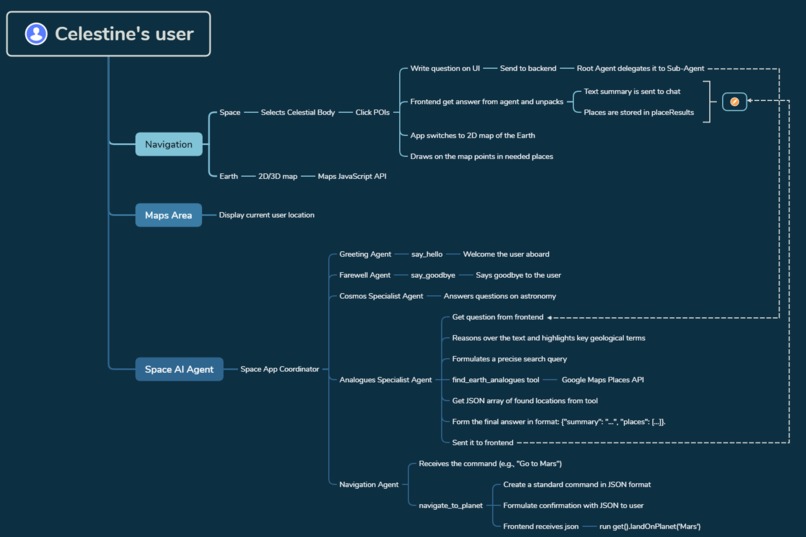
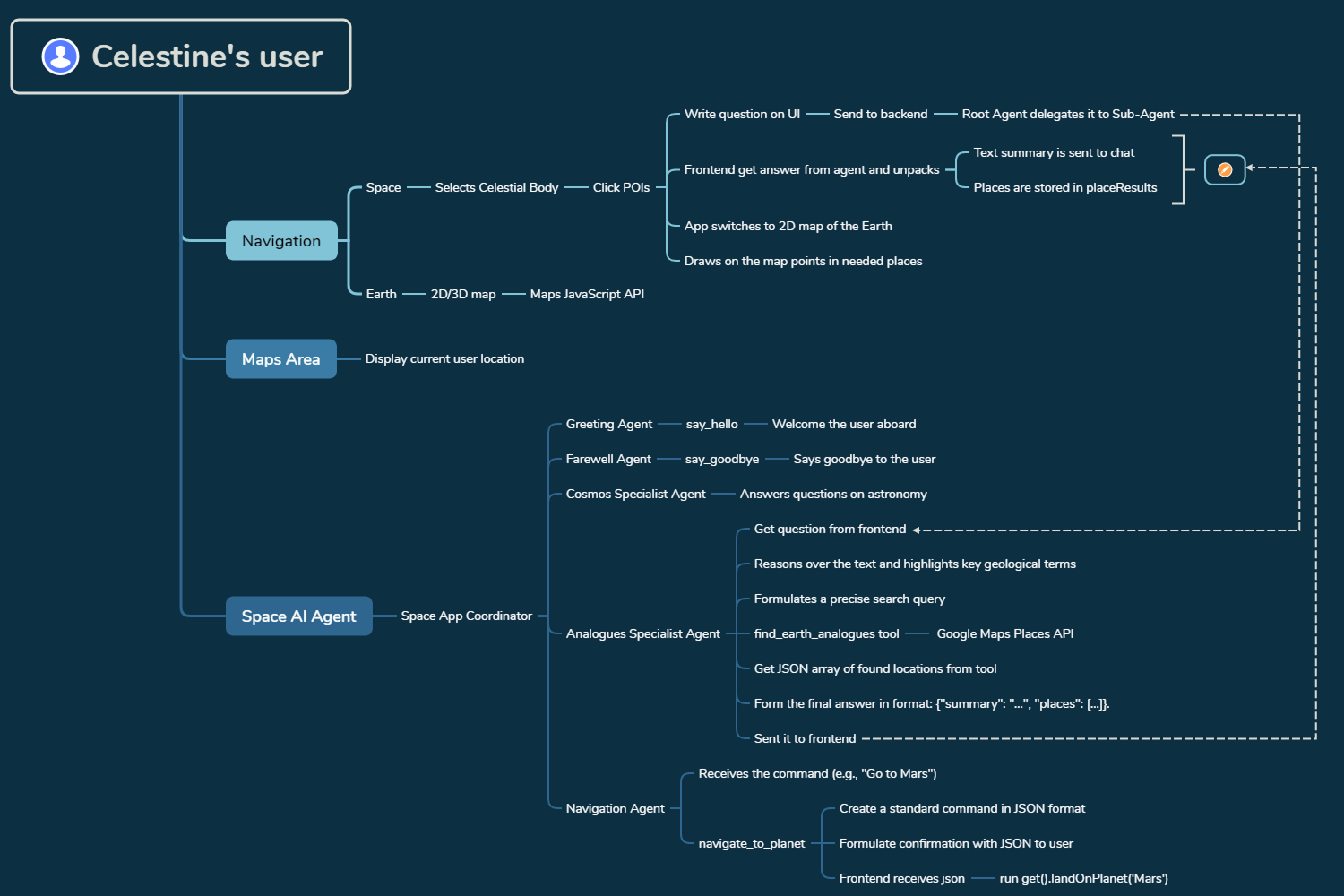
Architecture
-
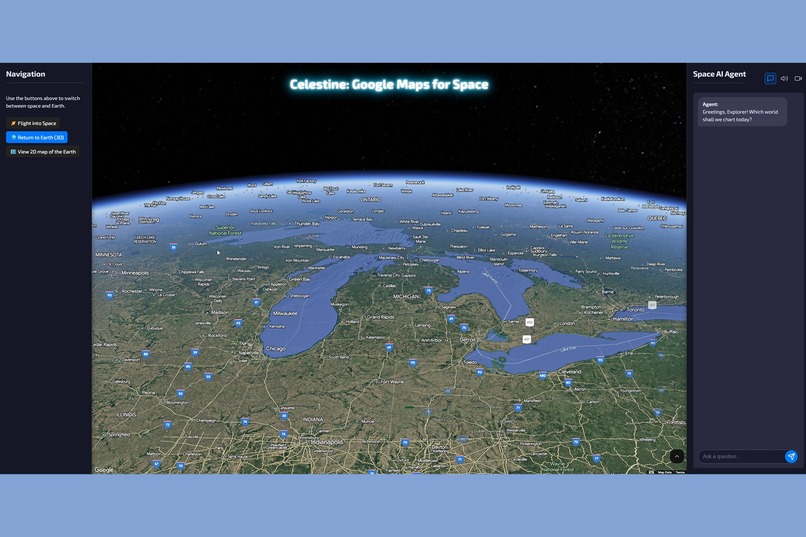
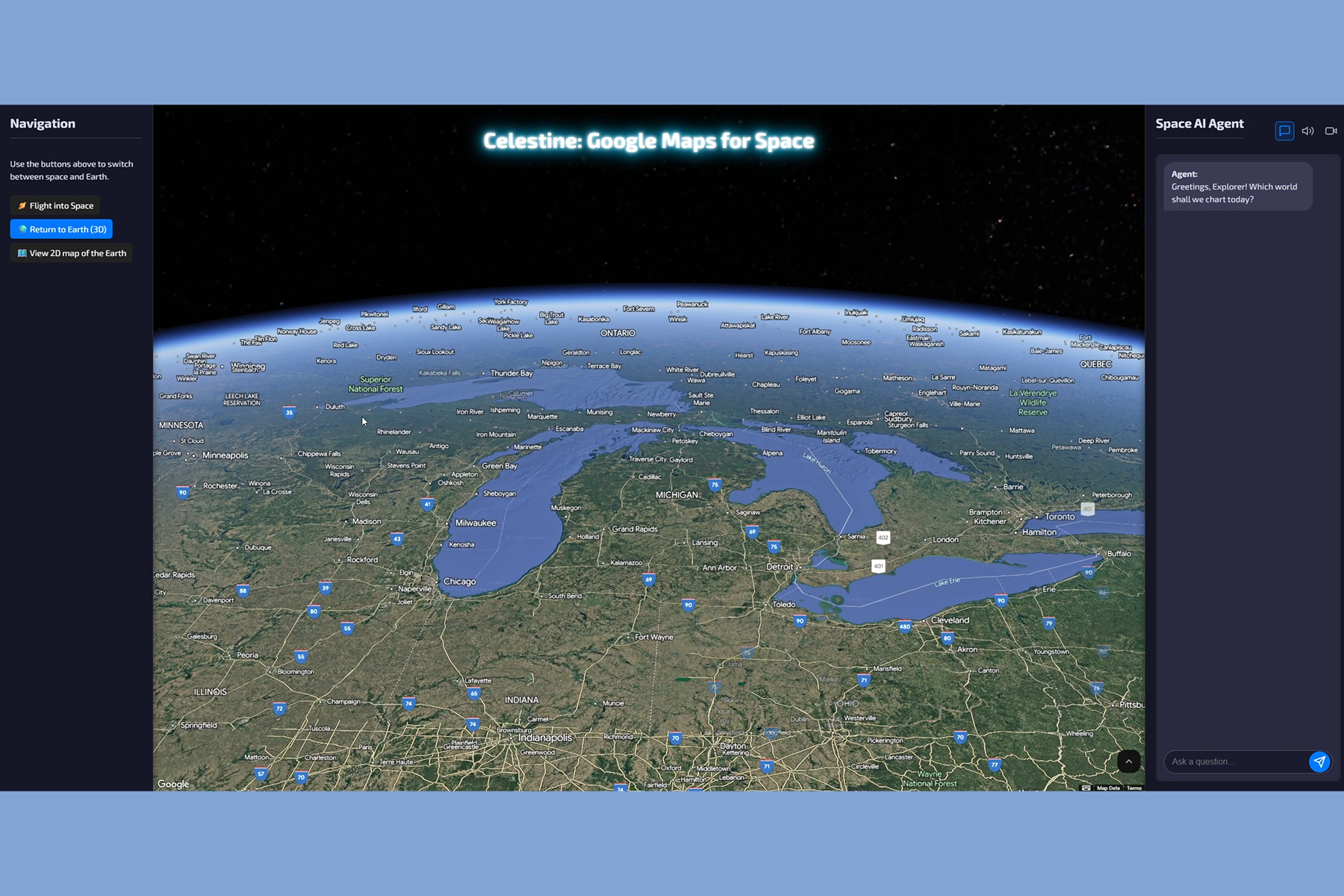
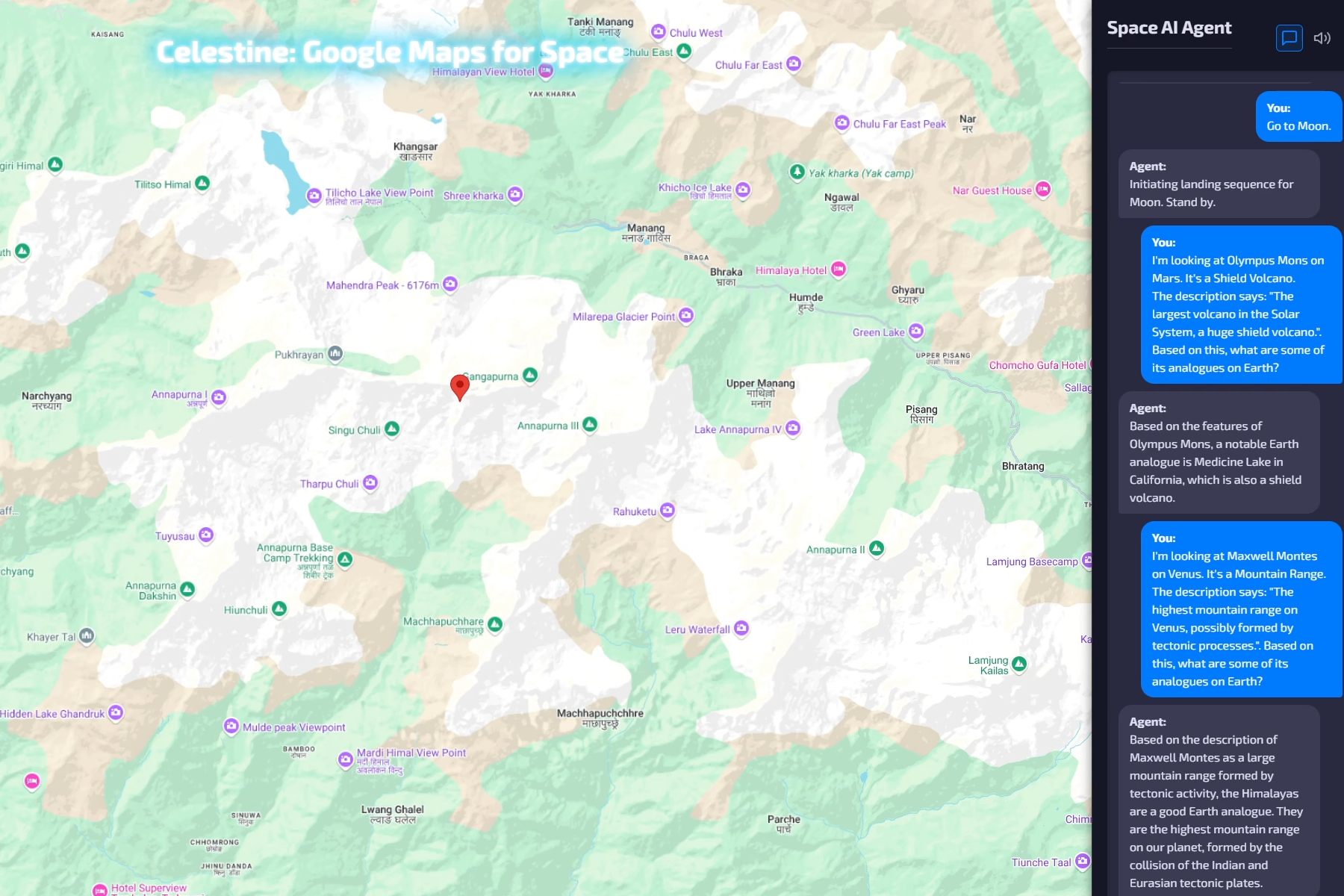
Earth 3D Map
-
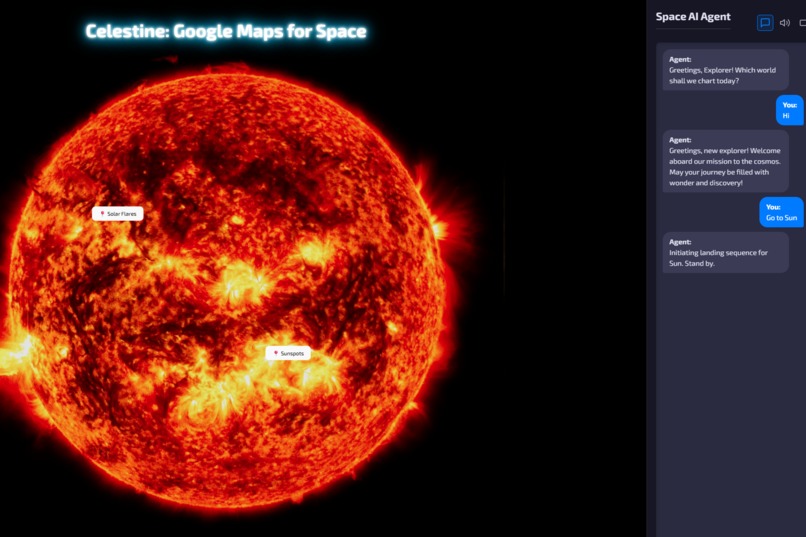
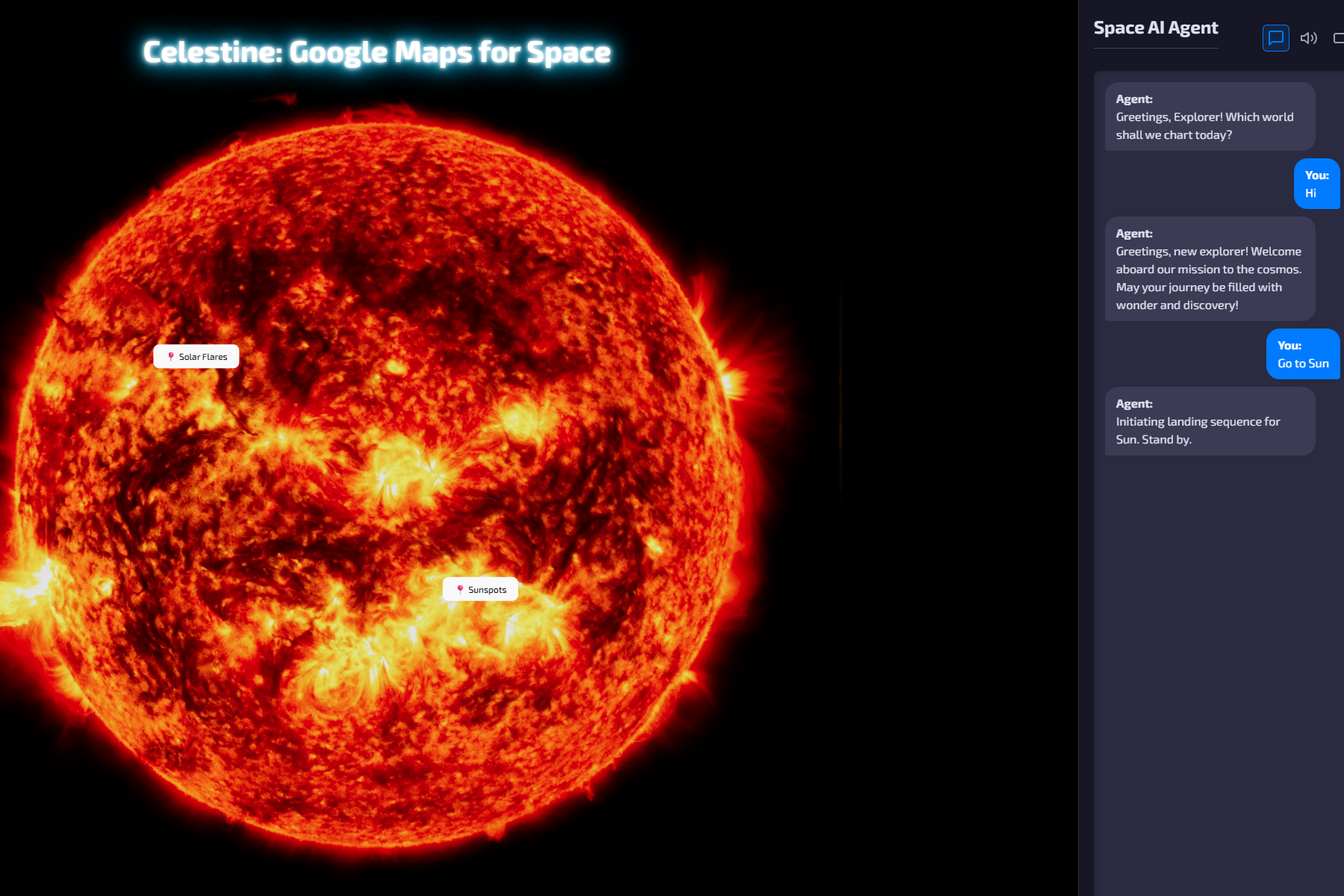
Flight to the Sun
-
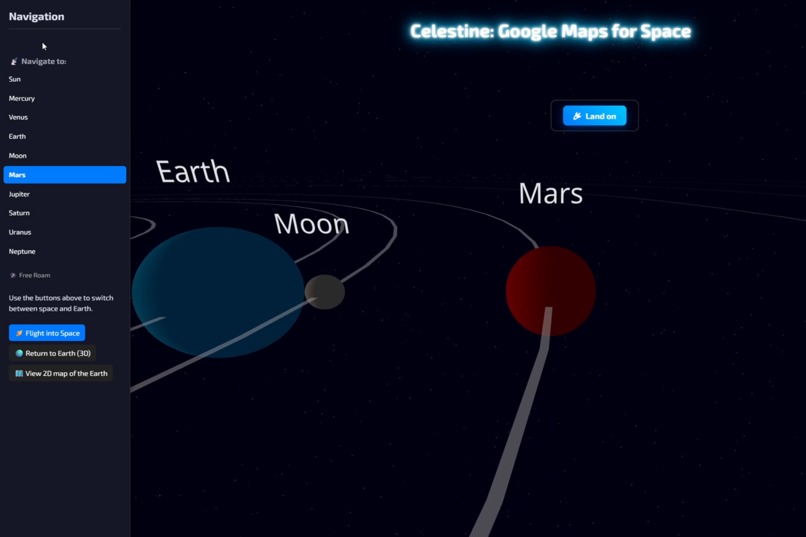
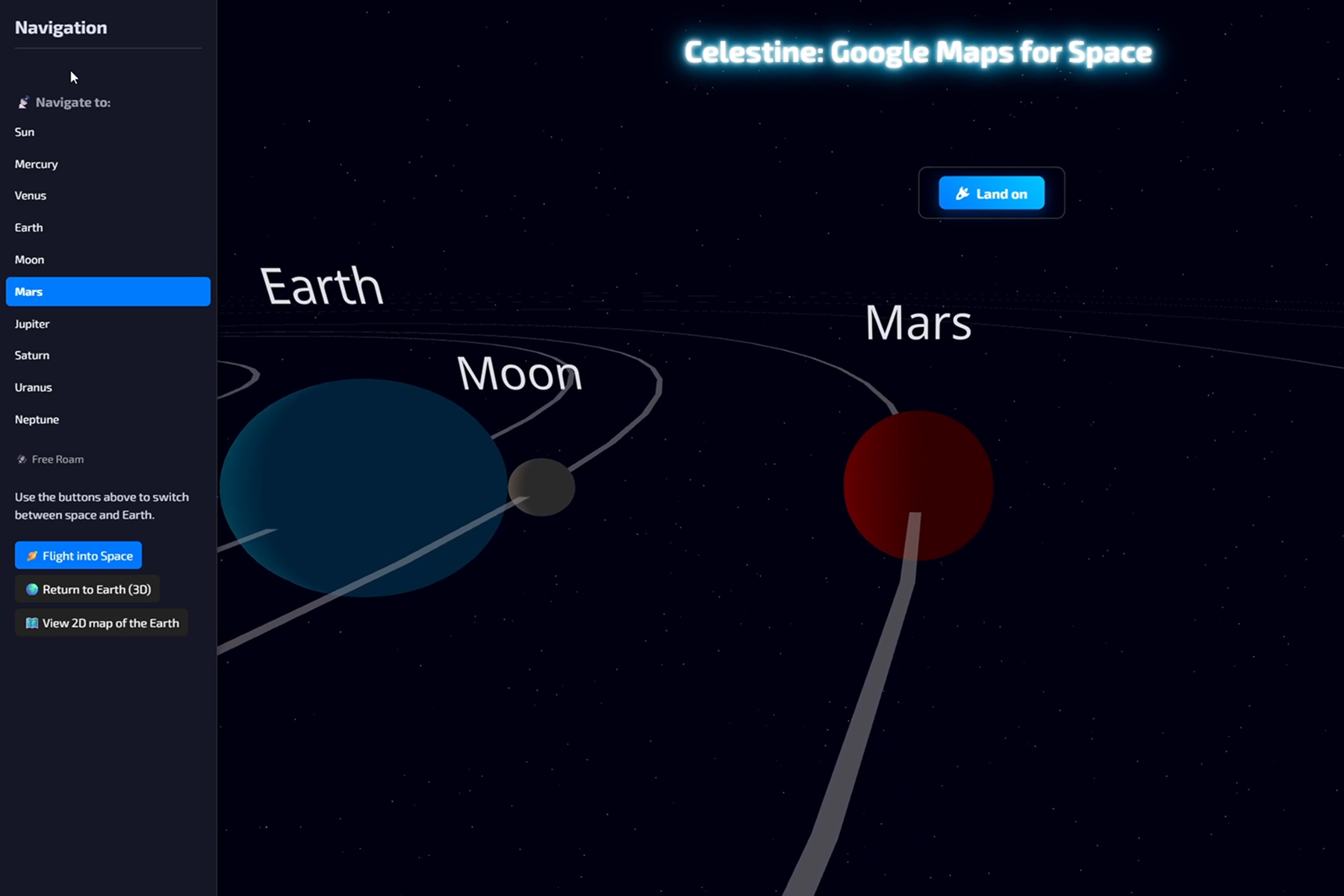
Traveling in Orbit
-
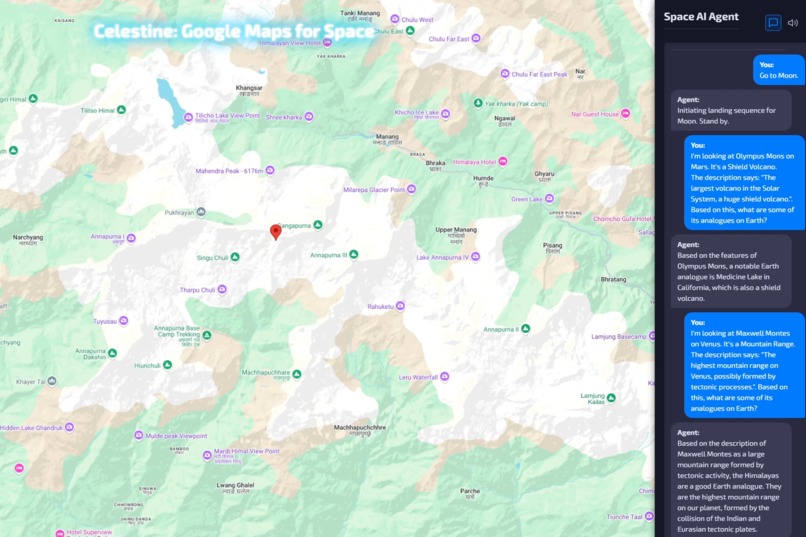
Venus's Maxwell Montes = Himalayas on Earth
-
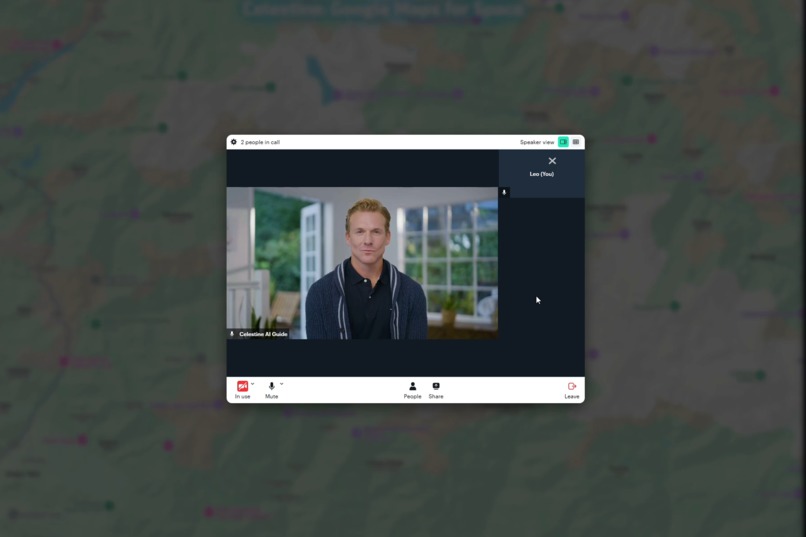
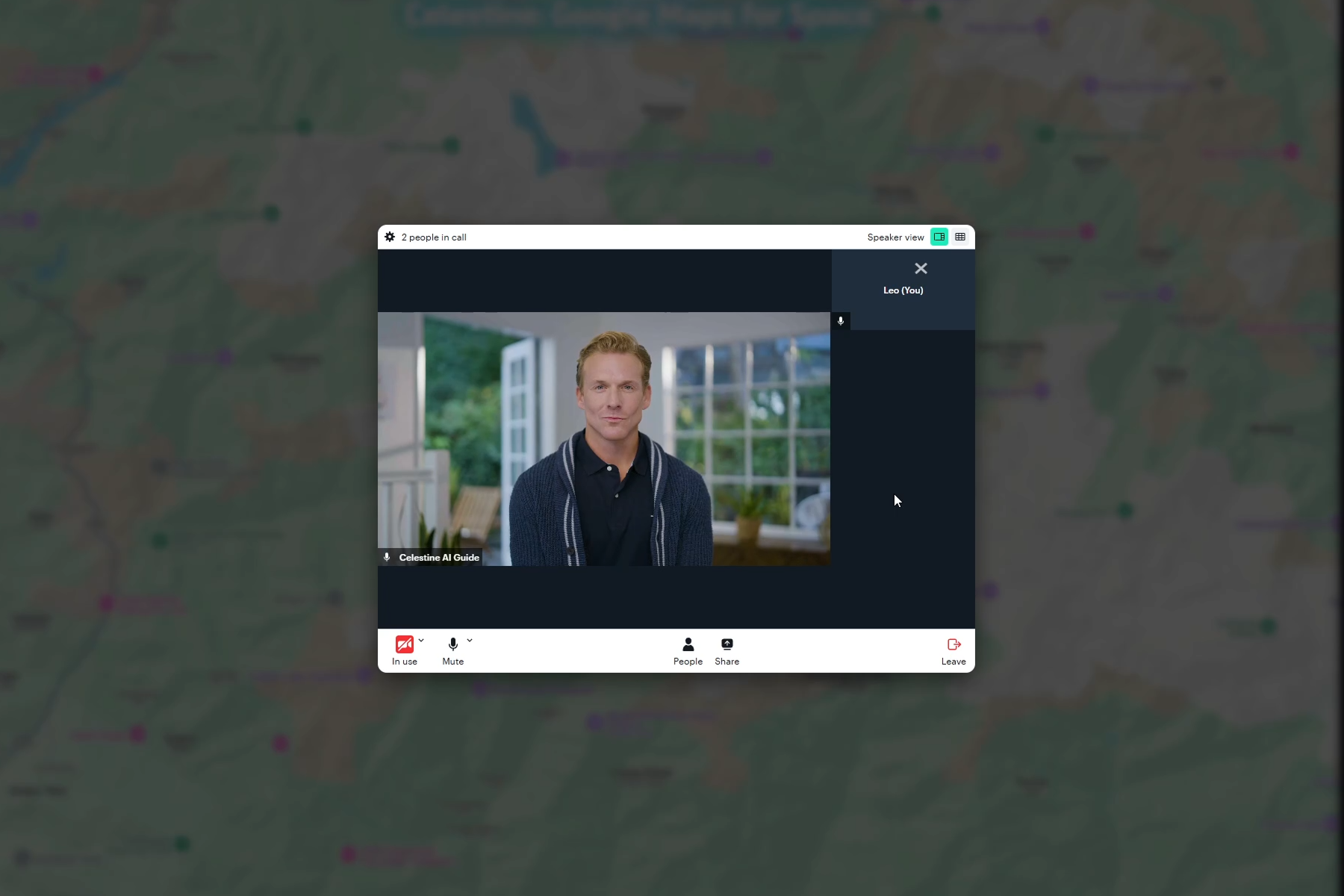
Video Conversation
Inspiration
Google Maps Platform mastered the navigation of Earth — but what if we could extend that intuitive experience across the entire Solar System?
While Google once experimented with a "Space Mode" — letting users explore planets and moons in Maps or Earth — the feature has since faded, leaving behind static images and forgotten dreams. You can still visit Google Maps — Space Mode, but all that's left is a simple snapshot. No interactivity. No journey.
That’s where Celestine begins.
I wasn’t just inspired to recreate a “Google Maps for Space” — I wanted to revive the dream and push it further: to build an intelligent co-pilot.
Celestine doesn’t just show you the universe. She talks to you. Guides you. Connects alien worlds back to your reality through AI conversations and meaningful discoveries.
This project is my first step toward making cosmic exploration deeply personal, interactive, and intelligent — not just visual.
It’s a map. It’s a guide. It’s the start of humanity’s new interface with the cosmos.
What it does
Celestine began as a 3D solar system viewer but quickly evolved into a multi-modal, AI-driven exploration platform. At its core, it's an intelligent navigator that bridges the gap between space and Earth.
The application allows users to:
- Navigate a 3D model of the solar system.
- "Land on" planets to view their surfaces, complete with notable points of interest (POIs).
- Engage with an AI agent through text, voice (ElevenLabs), or a live video avatar (Tavus).
The most innovative feature is how the AI agent uses Google Maps Platform as a tool. When a user clicks a POI, like the Caloris Basin on Mercury, the AI doesn't just recite facts. It forms a natural language query, understands the geological context ("impact basin"), and then uses the Places API to find real-world analogues on Earth, like Meteor Crater in Arizona. The results, including coordinates, are then sent back to the frontend, where the Maps JavaScript API dynamically places markers on an interactive 2D map of Earth for the user to explore. This creates a seamless, AI-driven loop from a crater on Mercury to a real location on Google Maps.
How I built it
Celestine is a full-stack application built with React (react-three-fiber for 3D scenes) on the frontend and Python/FastAPI on the backend.
The AI is the heart of the project. I implemented a sophisticated Coordinator-Agent architecture using Google's Agent Development Kit (ADK) and Gemini 2.5 Flash/Pro. A central SpaceAppCoordinator agent analyzes user intent and delegates tasks to specialized agents:
Greeting & Farewell Agentfor cosmic greetings and farewells.Cosmos Specialist Agentfor general space questions.Analogues Specialist Agent, the most complex one, which reasons about celestial features and uses the Places API as a tool to find and return data on terrestrial counterparts.Navigation Agentto fly the user to different planets.
The entire backend is containerized with Docker and deployed on Google Cloud Run, with all API keys and secrets securely managed by Secret Manager. The CI/CD pipeline is fully automated with Cloud Build, which builds and pushes the backend image to Artifact Registry and deploys it, while the frontend is hosted on Firebase.
Challenges I ran into
Turns out, building a space AI is easier than teaching it to wait for Google Maps to load. 😅
One of the biggest challenges was going beyond a basic chatbot. I wanted Celestine to act like an intelligent multi-agent system — where agents could delegate tasks and use tools smartly. That took a lot of prompt tuning and logic design.
A sneaky bug was a race condition, where the UI tried to render a Google Map before the API script was ready. The fix? A singleton loader that made sure the script loaded only once — and just in time.
And finally, wiring up deployment with Cloud Build, Cloud Run, and Secret Manager was a crash course in DevOps — but seeing it all come together was worth every headache.
Accomplishments that I'm proud of
I'm incredibly proud of building a functional, multi-agent system that does more than just talk—it acts. The fact that my AI can intelligently decide to use the Google Maps Places API as a tool to connect two different worlds is the accomplishment that best represents my vision. Integrating three different modes of interaction (text, voice, and video) and deploying this complex, full-stack application to the cloud as a solo developer under a tight deadline is something I'm also very proud of.
What I learned
The real magic happened when I combined that AI reasoning with real-world data from the Google Maps Platform. That pairing opened my eyes to how powerful and flexible these tools can be when working together.
Previously, I had only embedded Google Maps into websites. But during this project, I truly got to know the API — and joined the Google Maps Platform Innovators Program, which helped me explore its full potential.
What's next for Celestine
The agent-based architecture is incredibly scalable. The next step is to give the agents more tools from the Google Maps Platform. I plan to integrate the Routes API so the agent can create “geological tours” between discovered Earth analogues on the 2D map. I also want to bring in the Street View Static API to show visual previews of those locations right in the chat — deepening the emotional connection between the user’s space journey and the real world.
Looking forward, I’d love to keep evolving this project in collaboration with Google Cloud, because I truly see its potential not just as a technical platform, but as a creative catalyst for making cosmic exploration accessible, personal, and intelligent.
Built With
- artifact-registry
- cloud-build
- cloud-run
- docker
- elevenlabs-api
- fastapi
- firebase-hosting
- gemini-api
- google-agent-development-kit
- google-cloud
- google-maps-platform
- maps-javascript-api
- places-api
- python
- react
- react-three-fiber
- secret-manager
- tavus-api
- vite

Log in or sign up for Devpost to join the conversation.