Inspiration
Many aerospace and mission-analysis tools are either expensive professional software or highly technical research tools that require significant experience to use effectively. While powerful, they can make spacecraft design and mission analysis difficult to approach for students, hobbyists, and newcomers.
We wanted to create something that lowers that barrier instead of switching between multiple tools, datasets, and calculations
What it does
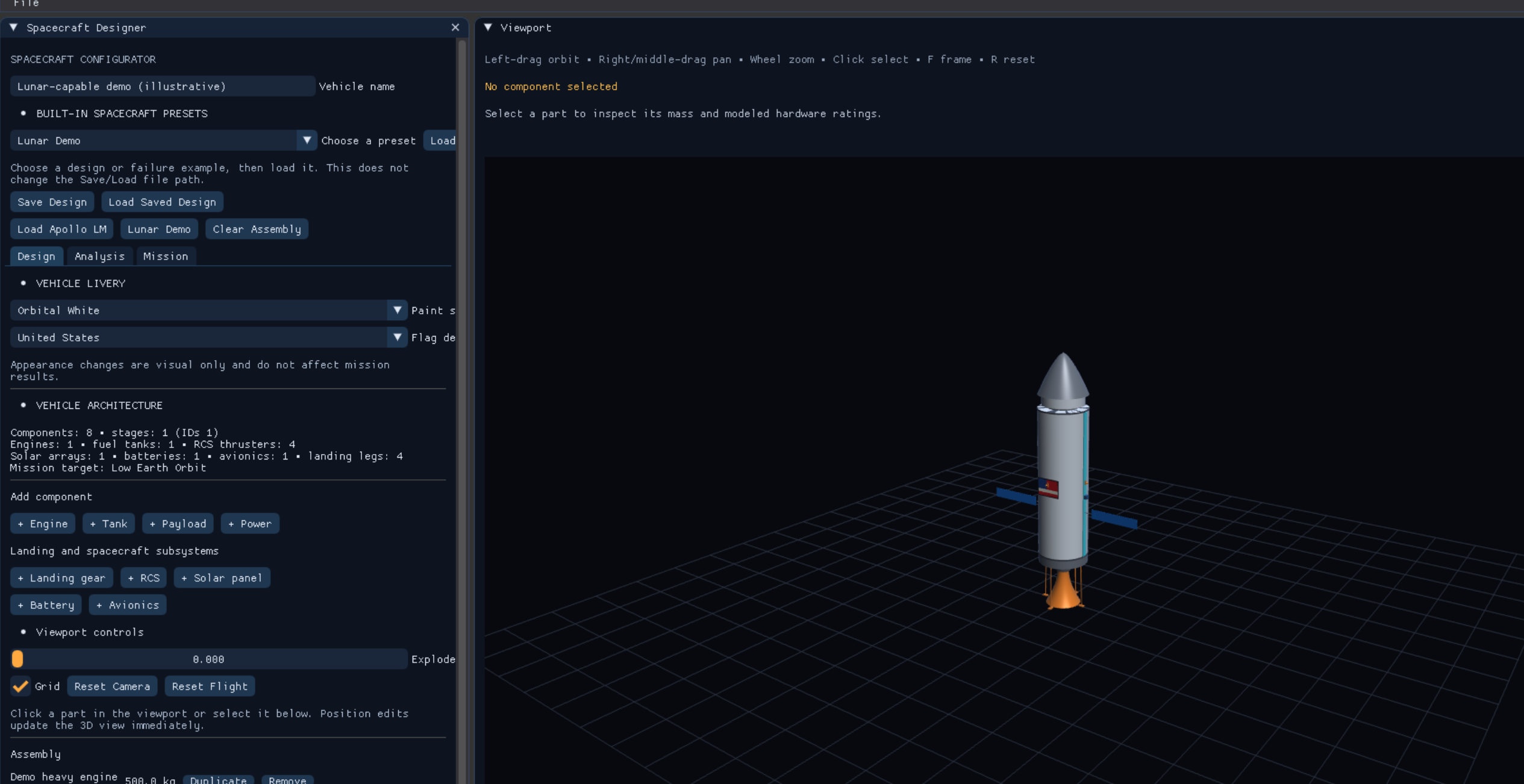
Celeste SpaceWorks is an interactive spacecraft mission-design and analysis platform.
Users can:
- Assemble a spacecraft from modular components including engines, propellant tanks, payloads, landing gear, power systems, avionics, and reaction-control systems.
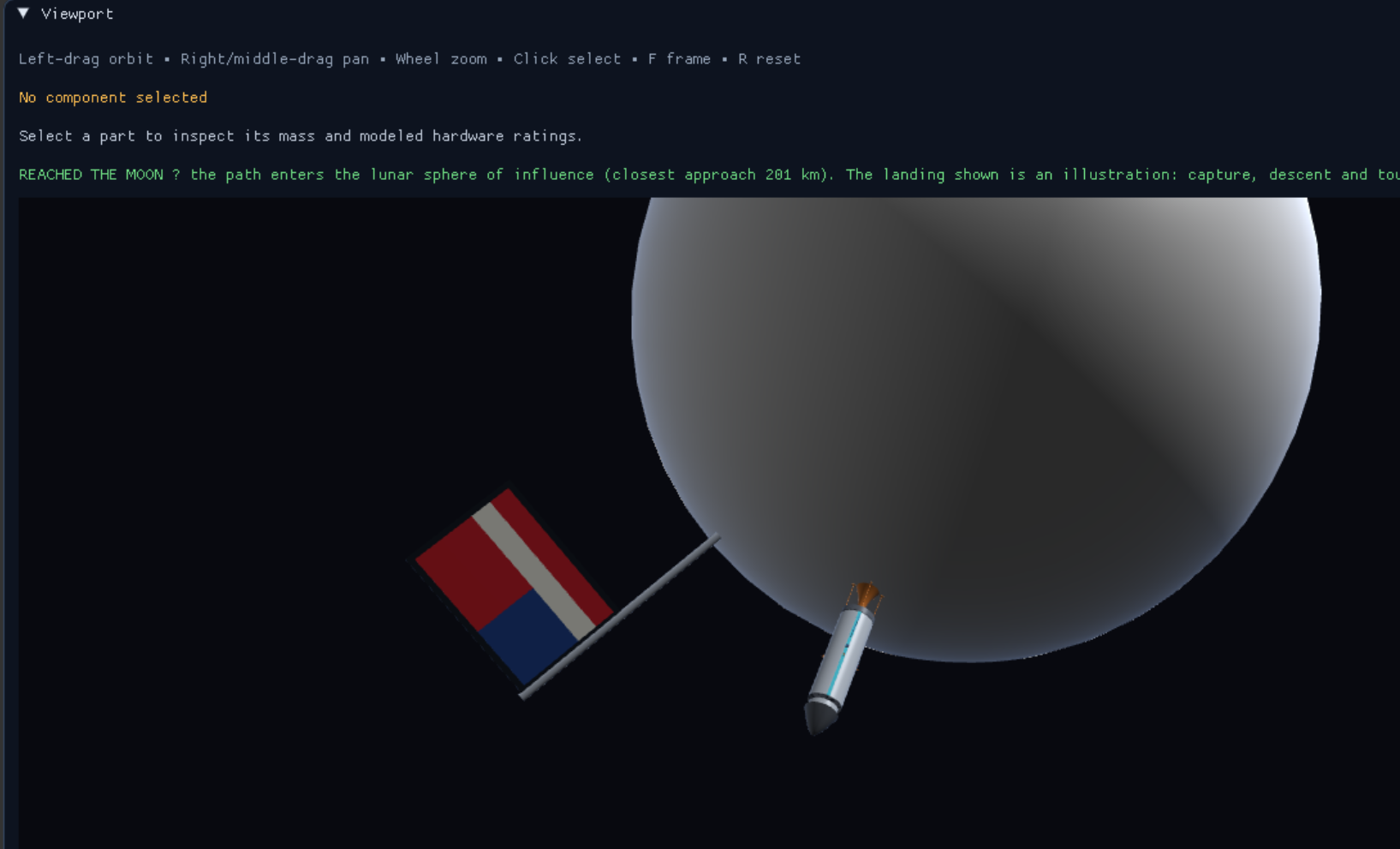
- Visualize the spacecraft in a live 3D environment and inspect how components fit together.
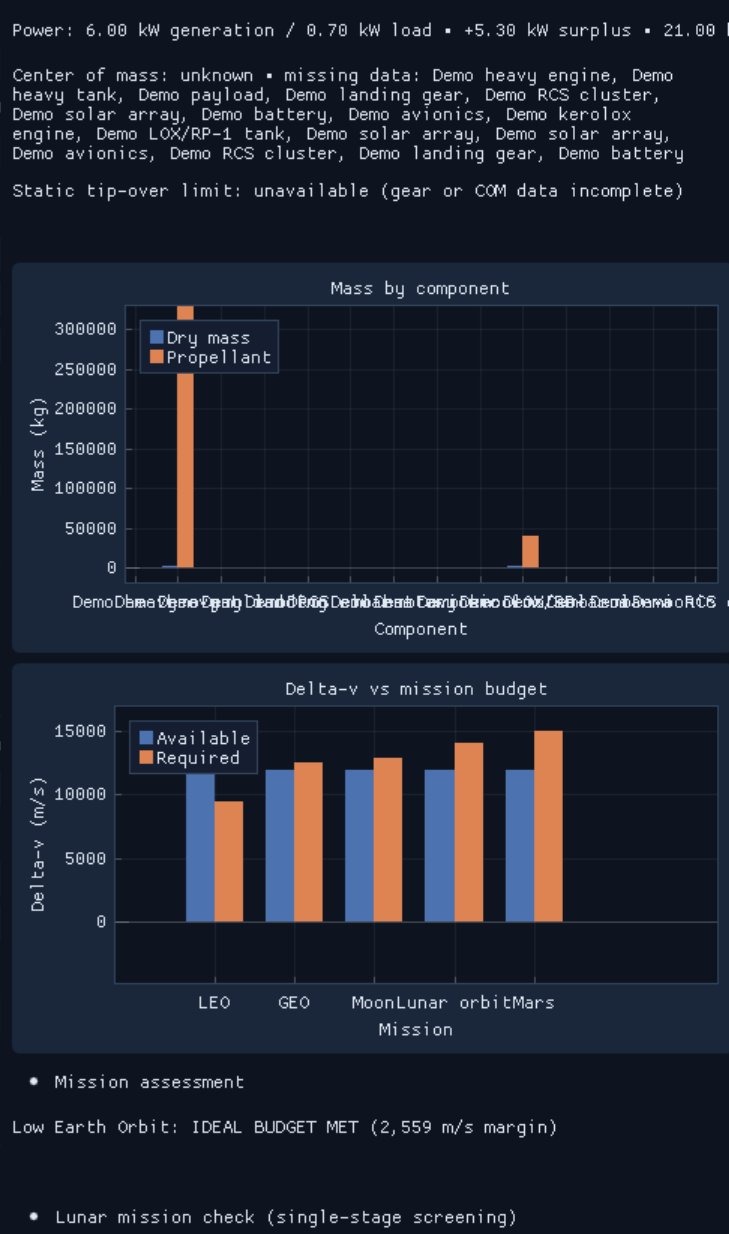
- Analyze engineering metrics such as mass, thrust-to-weight ratio, delta-v, burn time, power balance, stability, and data readiness.
- Compare spacecraft performance against mission requirements.
- Run a modeled Earth-to-Moon mission analysis using real astronomical data from JPL DE440 ephemerides.
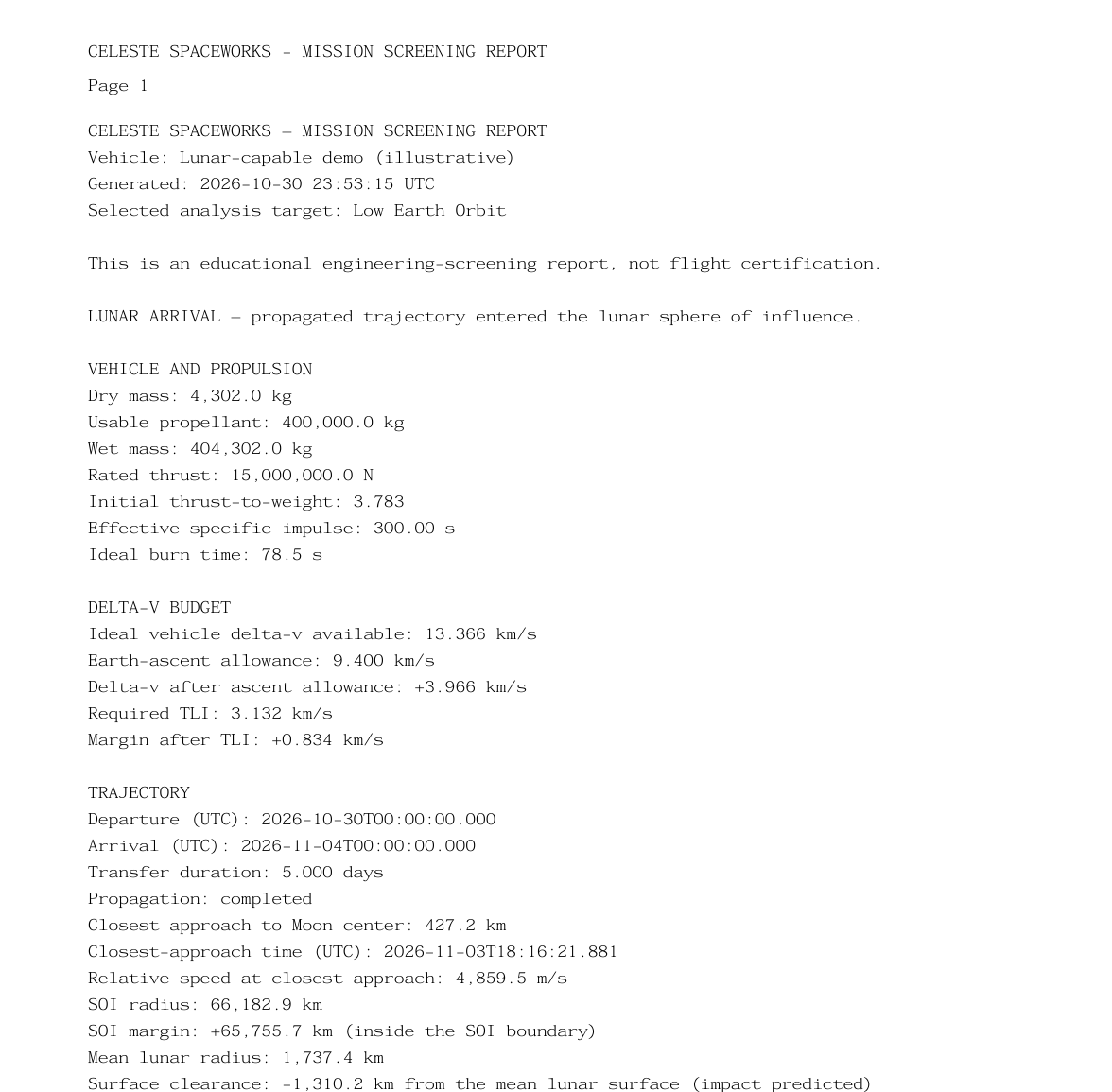
- Review detailed mission reports explaining why a design succeeds or fails.
- Receive ranked engineering recommendations through the built-in Mission Design Advisor.
- Export mission results and recommendations as PDF reports.
Rather than only reporting success or failure, Celeste SpaceWorks helps users understand the engineering tradeoffs and mission constraints behind the result.
How we built it
We built Celeste SpaceWorks in Python using:
- DearPyGui for the desktop user interface.
- ModernGL and OpenGL for real-time 3D visualization.
- SciPy for numerical propagation and integration.
- Astropy and JPL DE440 ephemerides for astronomical data.
- Custom spacecraft-design, mission-analysis, reporting, and advisory systems.
The mission-analysis pipeline combines:
- Tsiolkovsky rocket-equation calculations for delta-v.
- Thrust-to-weight screening for launch feasibility.
- Lambert transfer solutions for Earth-to-Moon transfers.
- Numerical trajectory propagation.
- Earth, Moon, and Sun gravitational modeling.
- Historical Apollo mission reference data.
We also developed a Mission Design Advisor that interprets simulation results, identifies mission constraints, ranks engineering concerns, and provides recommendations for further investigation.
Challenges we ran into
One of our biggest challenges was connecting spacecraft design, engineering analysis, and mission evaluation into a single workflow.
We needed to:
- Balance physical realism with usability.
- Integrate real astronomical datasets while keeping the software accessible.
- Calculate engineering metrics instantly as designs changed.
- Build a trajectory-analysis pipeline that remains understandable to non-experts.
- Explain mission outcomes in plain language instead of only reporting pass/fail results.
- Distinguish educational mission screening from real-world flight certification.
We also spent significant effort creating reporting and advisory tools that help users understand why missions succeed or fail.
Accomplishments that we're proud of
We're proud that Celeste SpaceWorks combines multiple traditionally separate activities into a single platform:
- Spacecraft design
- Real-time 3D visualization
- Engineering analysis
- Mission screening
- Historical mission references
- Automated reporting
- Engineering recommendations
We're especially proud of integrating real astronomical data through JPL DE440 ephemerides and building a mission-analysis workflow that remains approachable for newcomers.
The Mission Design Advisor and PDF reporting system transformed the project from a simulation into an engineering decision-support tool that helps users understand the reasoning behind each result.
What we learned
This project taught us how interconnected spacecraft systems are.
A change to a single component can affect:
- Vehicle mass
- Launch capability
- Delta-v margins
- Power balance
- Transfer feasibility
- Overall mission success
We also gained experience with:
- Orbital mechanics
- Lambert transfer solutions
- Numerical trajectory propagation
- Scientific computing
- Real-time 3D visualization
- User-centered engineering software design
- Software engineering and collaboration
What's next for Celeste SpaceWorks
Future development could include:
- Multi-stage spacecraft and launch vehicles.
- Lunar orbit insertion analysis.
- Powered descent and landing simulation.
- Additional destinations such as Mars and near-Earth asteroids.
- Expanded libraries of historical and modern spacecraft.
- Advanced mission optimization and trajectory-planning tools.
- Improved mass-property and stability analysis.
- Collaborative and cloud-based design workflows.
- More advanced mission-advisor capabilities.
Our long-term goal is to evolve Celeste SpaceWorks into an accessible mission-design environment that helps students, hobbyists, and aspiring aerospace engineers explore the engineering tradeoffs behind real space missions.

Log in or sign up for Devpost to join the conversation.