-
-
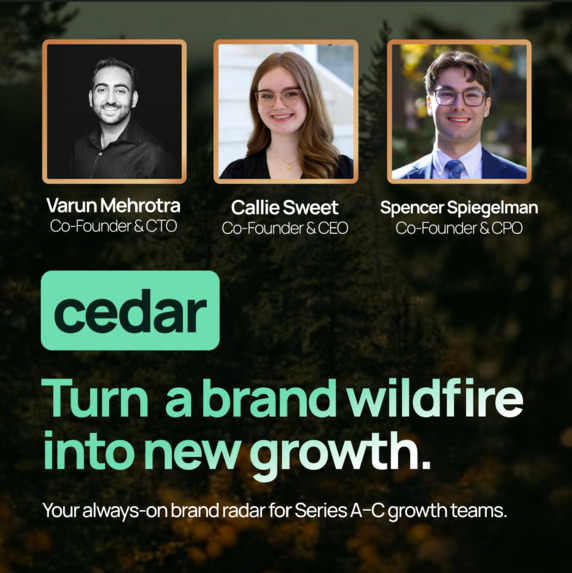
Founding Team, Cedar Intelligence
-
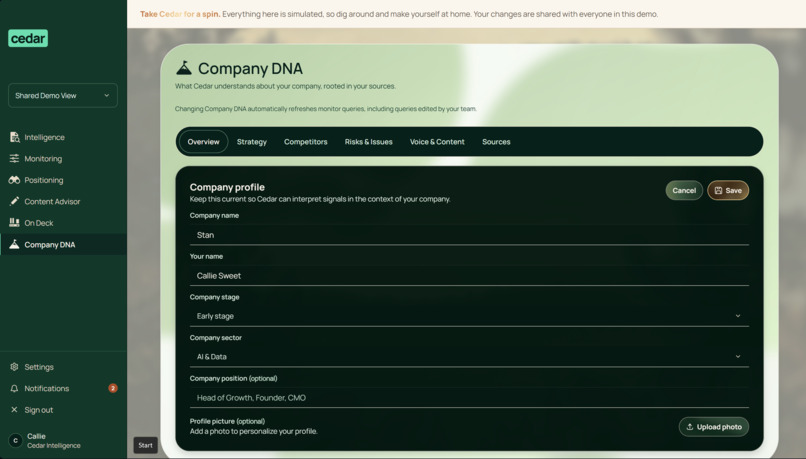
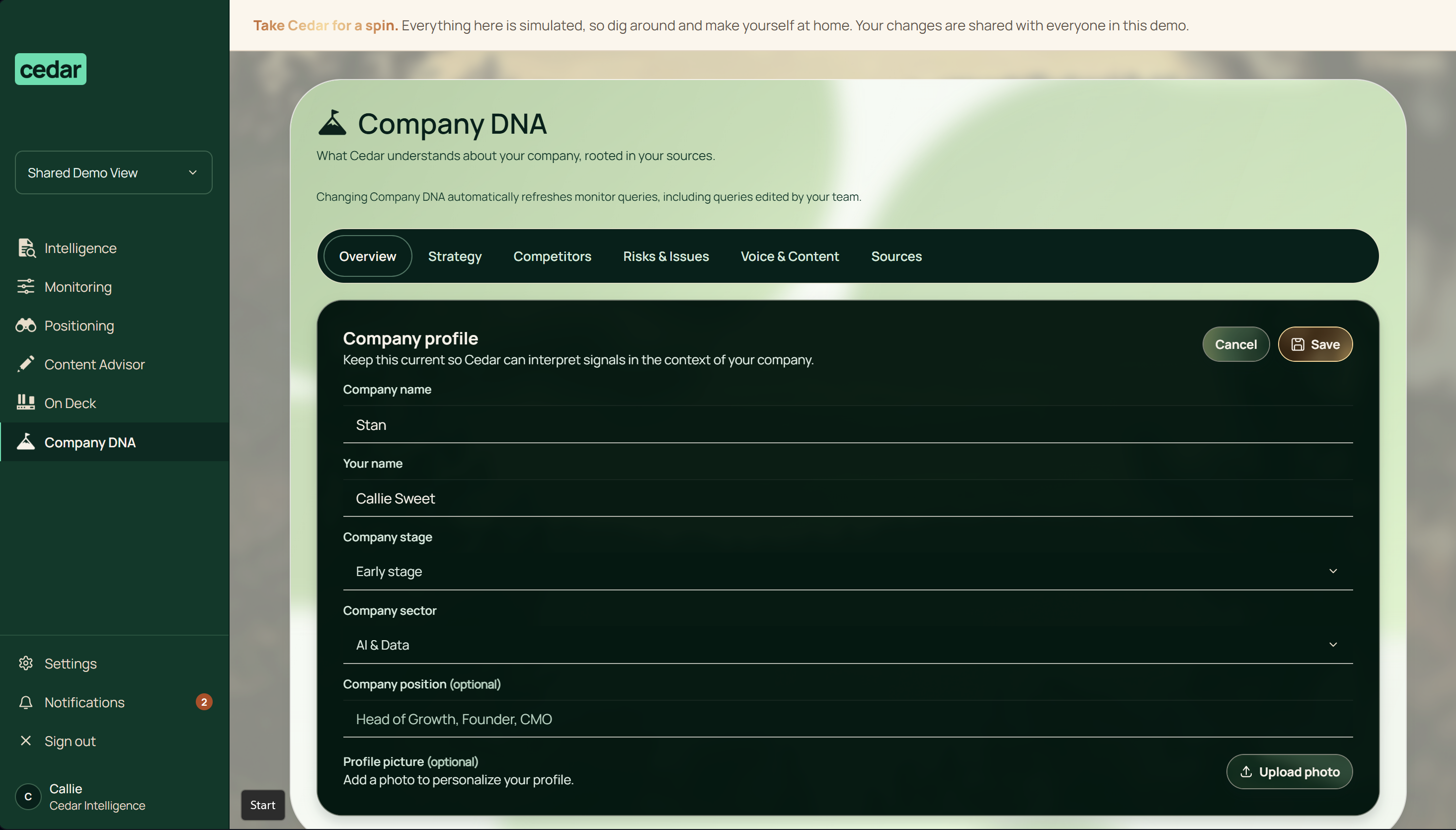
Cedar - Company DNA
-
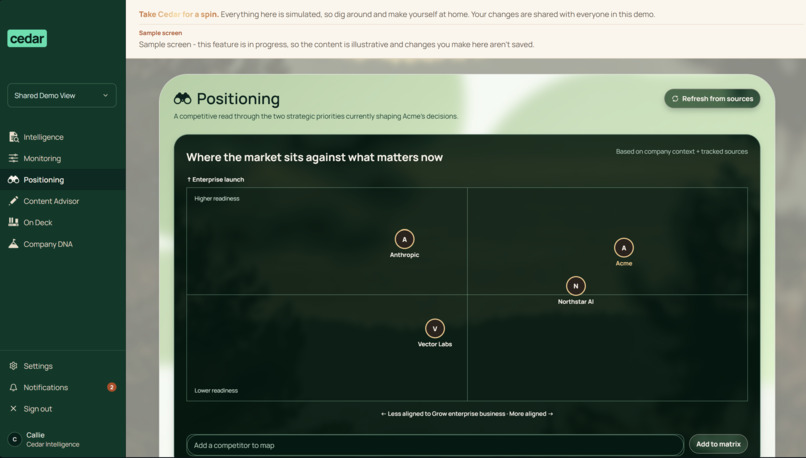
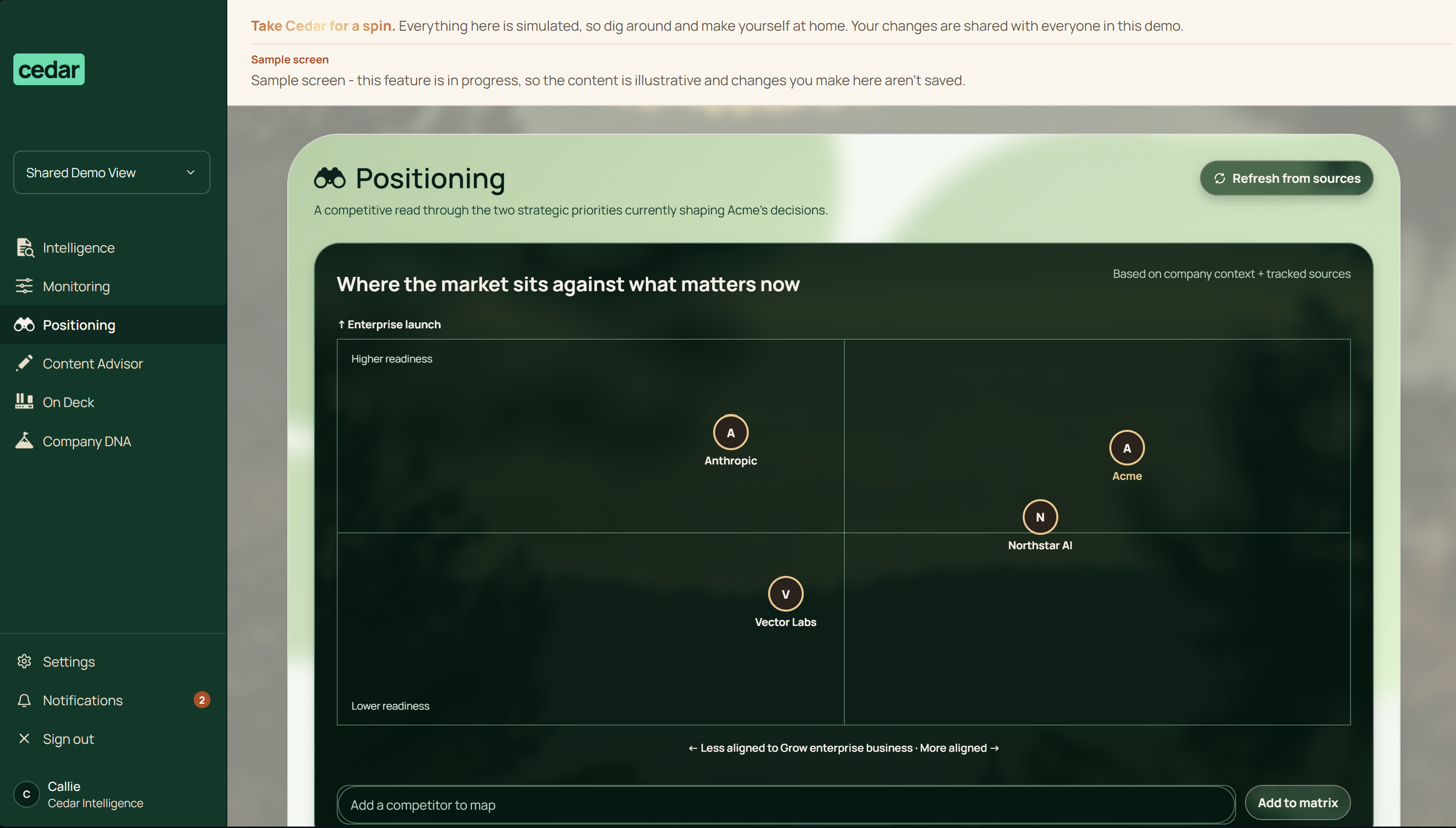
Cedar - Positioning
-
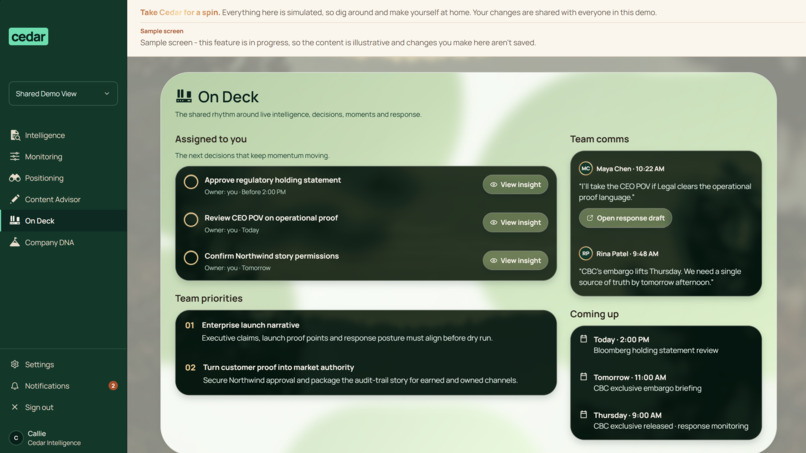
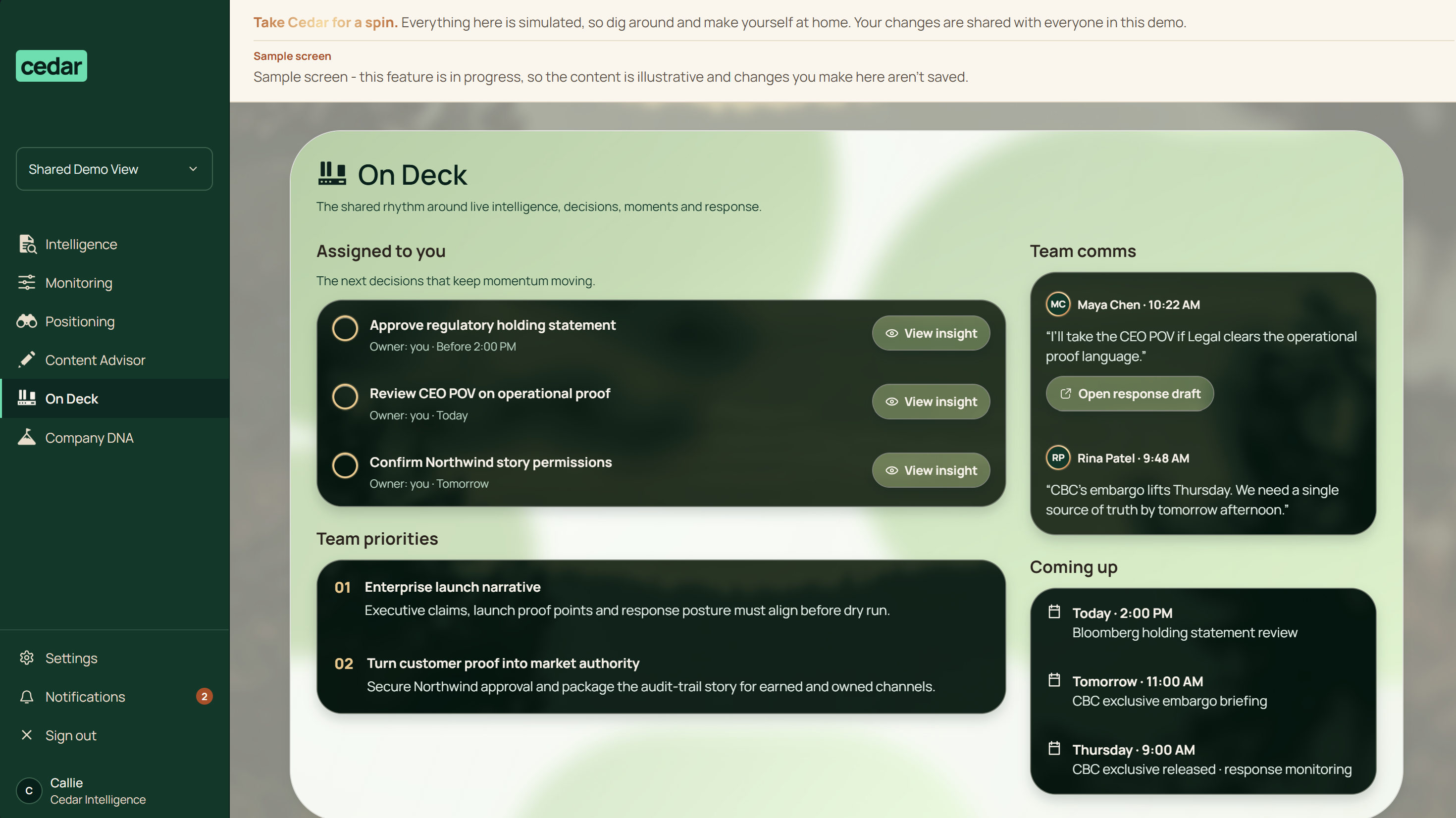
Cedar - On Deck
-
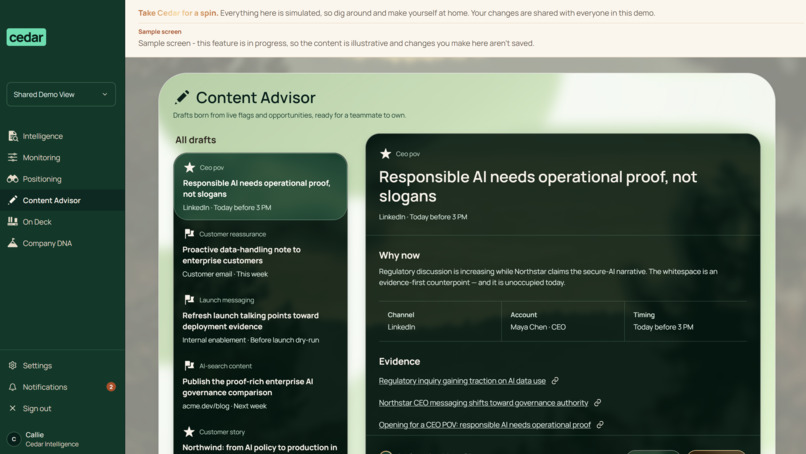
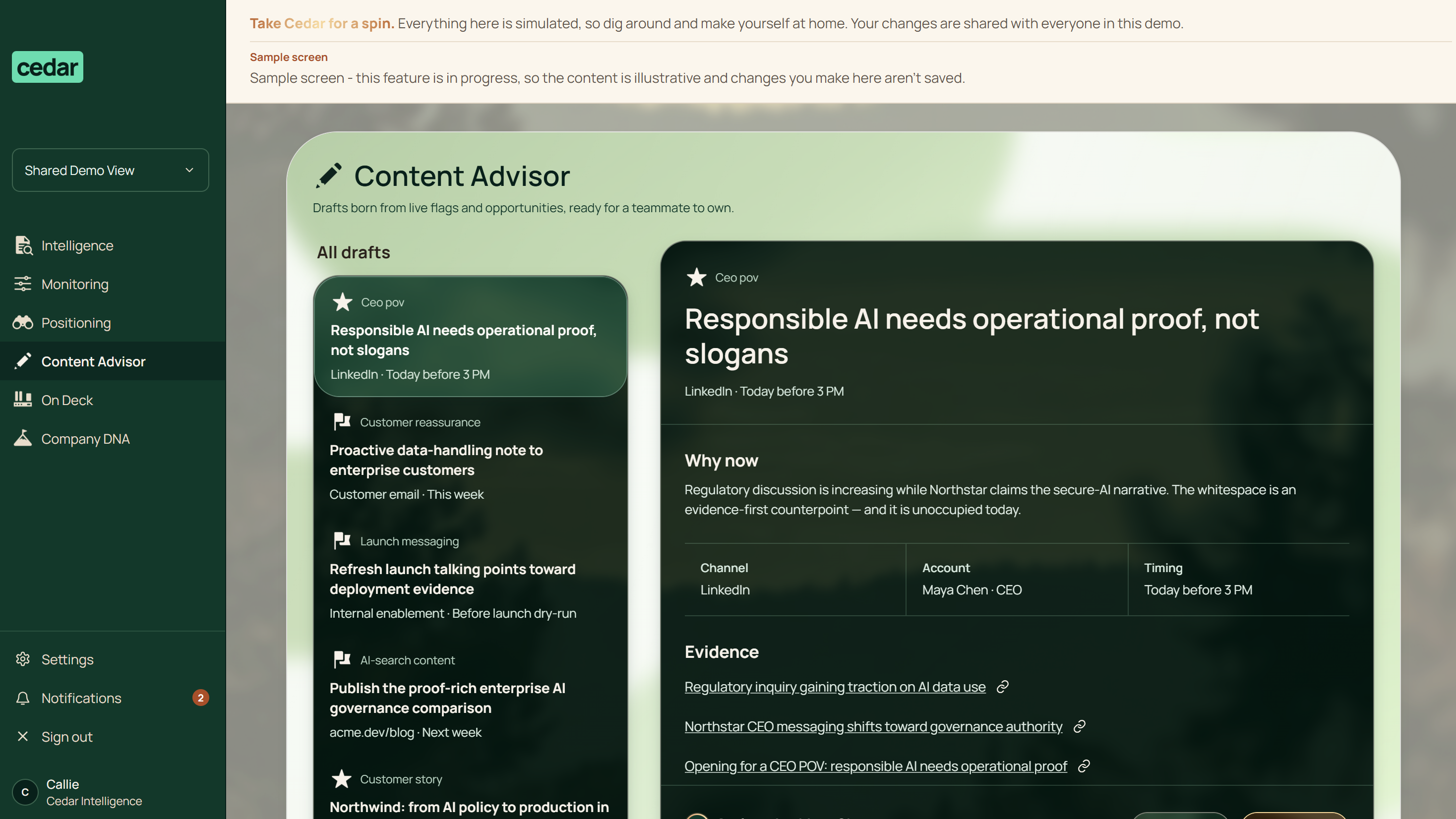
Cedar - Content Advisor
-
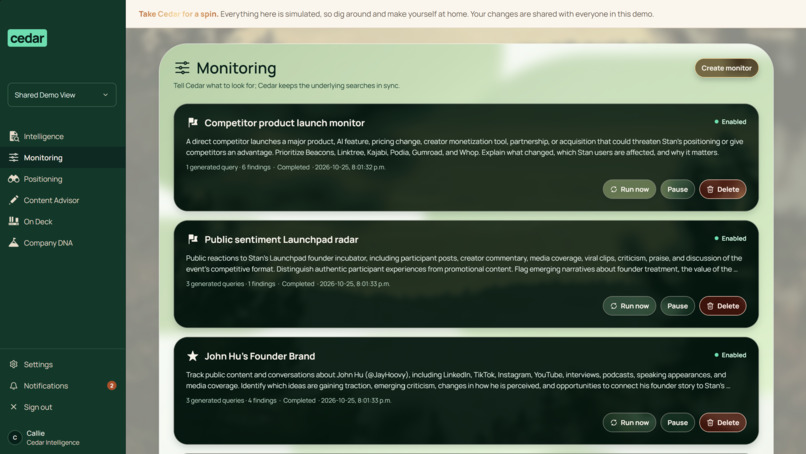
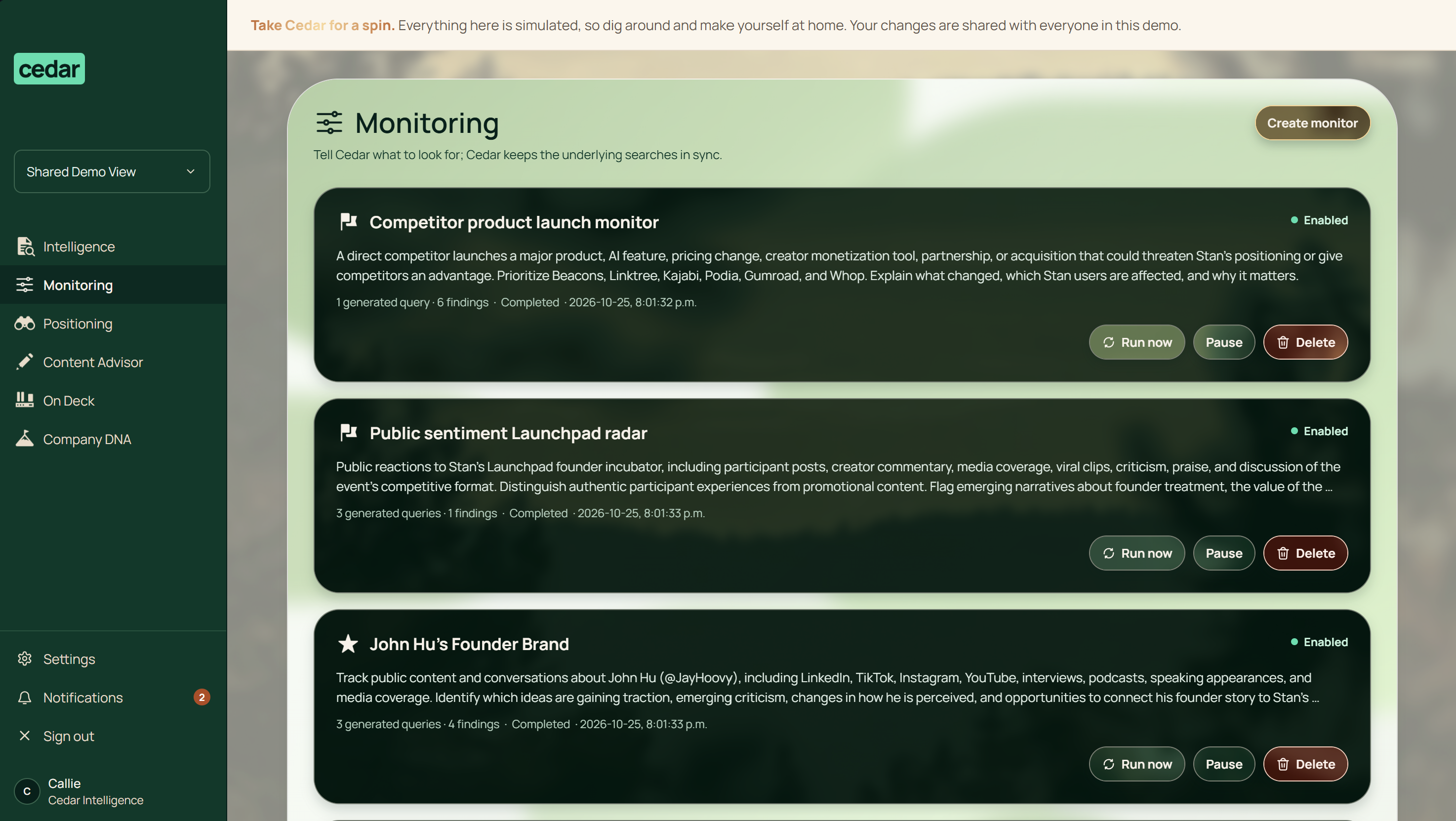
Cedar - Monitoring
-
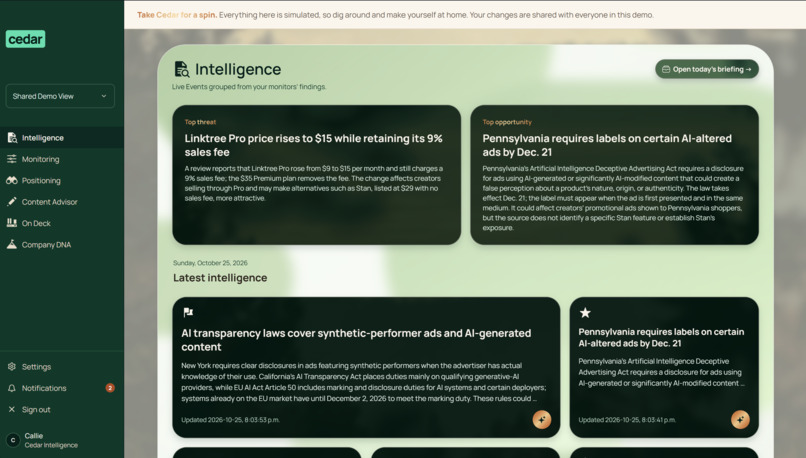
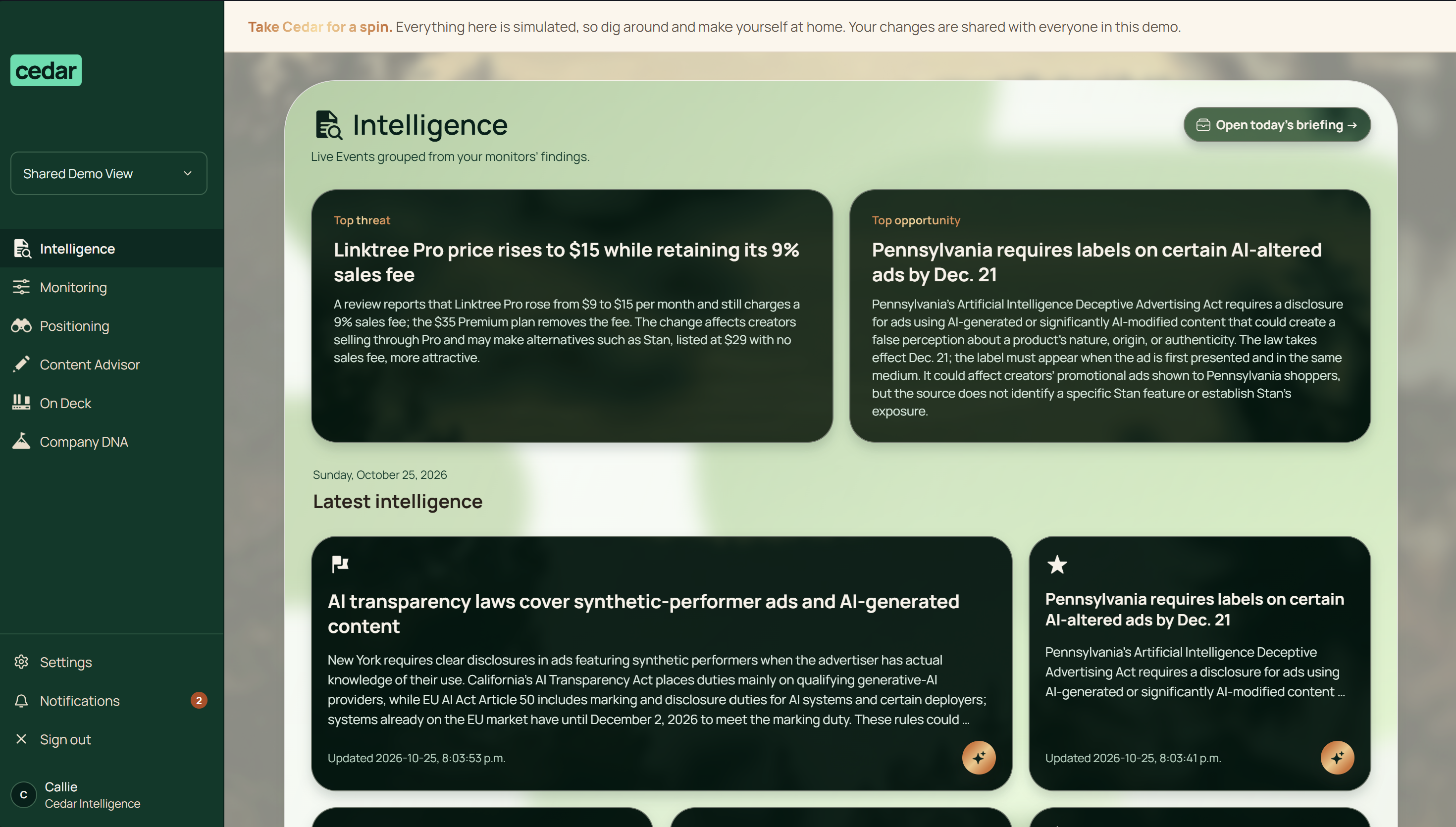
Cedar - Intelligence
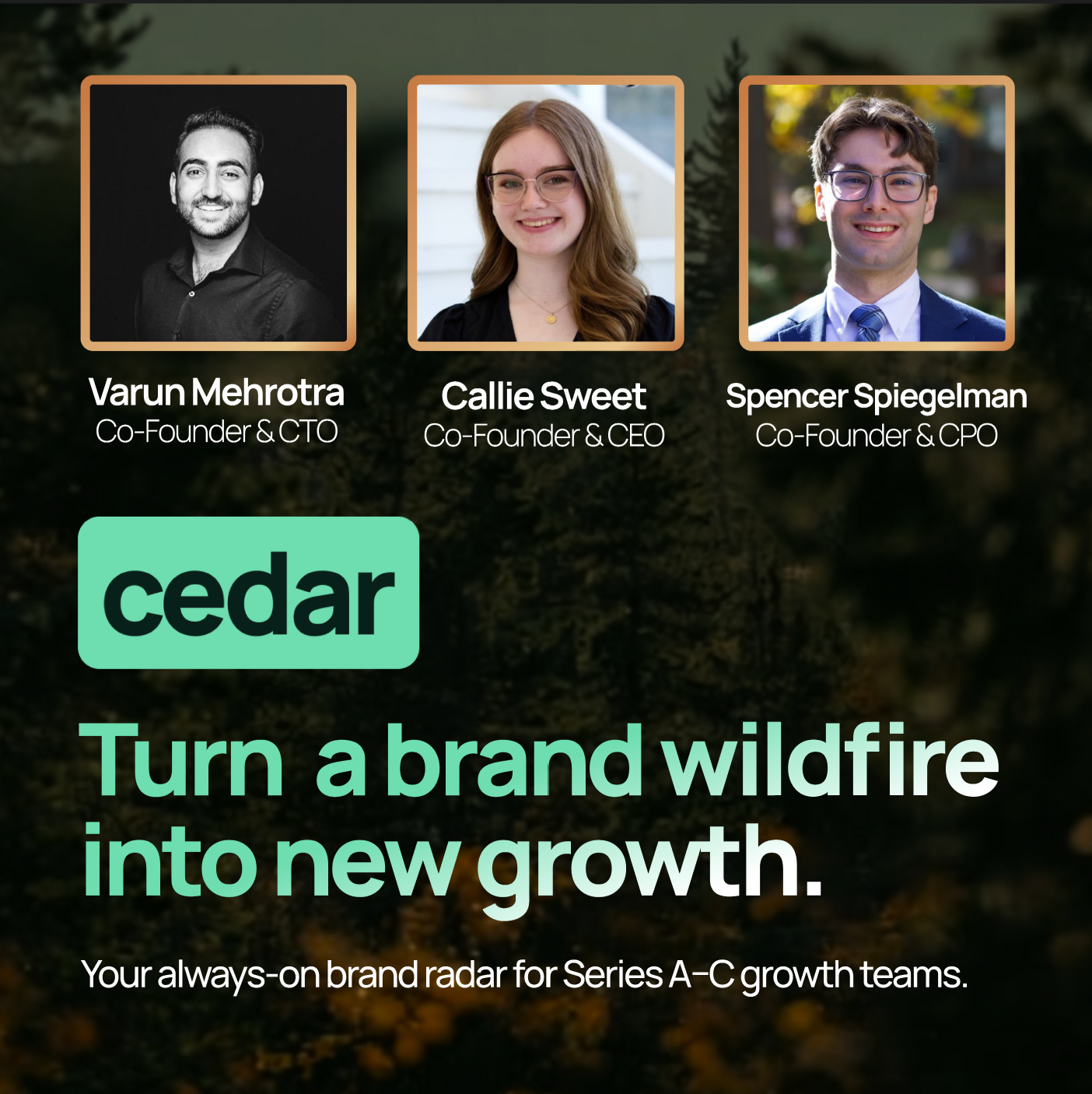
Cedar Intelligence: Your always-on brand radar for Series A–C growth teams 🌲
Public GitHub repo: https://github.com/smspiegel/Cedar-Intelligence
Live link: cedarintelligence.io
1. What We Built and Why
Our Co-Founder, Callie, is an executive communications and growth operator, working on everything from multibillion-dollar public relations cases and reputational disputes in AI and professional services to startup product launches and VC platform.
Along the way, she noticed a huge problem space in brand reputation intelligence and always-on monitoring.
In giant enterprises, tens of millions of dollars are invested annually into technologies like Cision, Meltwater, Hootsuite, and Signal AI, but the ROI often isn't realized. 83% of professionals in growth and communications regularly work overtime (PRII 2025 Census Report). Not only is business value left on the table, but manual work still has to get done.
It's similar on the startup side. Seed through Series C growth teams often build proprietary in-house tools, but with lean, generalist-focused teams, the time invested in building these tools doesn't always translate into the depth of intelligence they need.
Introducing Cedar, your always-on brand radar for Series A–C growth teams.
These teams are lean enough to need specialized capabilities, but late enough to be all in on scalability. They need to catch every opportunity, prevent brand threats and flags from taking over, and turn potential brand wildfires into opportunities for new growth.
Cedar is a healing, deeply rooted tree with a long history. So is the vision behind Cedar Intelligence.
2. How Cedar Works
Cedar Intelligence combines robust Company DNA with always-on Monitors to surface crisp, actionable intelligence about threats, flags, and opportunities for your brand.
Company DNA: Your Organization's Brain
Company DNA brings together the context that makes intelligence meaningful: historical competitive insights from legacy platforms, brand voice, crisis plans, known-issue management, reputational risks, and business strategy.
It's the foundation that helps Cedar understand not just what's happening in the world, but what actually matters to your company.
Monitors: Your Always-On Brand Radar
Monitors continuously search for developments relevant to your business and strategic priorities.
You don't miss a competitor's raise, product launch, security breach, or regulatory update. But Cedar also looks for the upside: an event with your ICP, a natural integration opportunity for an upcoming brand campaign or partnership, or a reason to go all in on founder brand on LinkedIn.
Monitors generate three types of Findings:
- Threats: Developments that could materially impact your business or reputation.
- Flags: Relevant changes and signals that deserve attention.
- Opportunities: Developments your team could capitalize on for growth.
And because context matters, every Monitor draws on Company DNA to filter out noise and surface findings that are actually relevant to your organization. No false alarms or accidental wakeup calls.
From Intelligence to Action
Here's the thing: Cedar isn't another dashboard.
One of the biggest problems with existing tools is that they give you the intelligence, and then leave you asking, “How is that relevant?” and "Now what?"
With lean teams, time is money. Speed to action, and speed to value, are what matter when investing in new technology.
Cedar is built to close that gap. Drawing on Callie’s experience building communications intelligence systems, closing millions of dollars in sales from long-term reputation and brand building, Cedar brings that fuel into an always-on platform built for lean teams. Businesses need more than an agency retainer. They need to make the most of their existing talent and capital.
Cedar combines proprietary communications frameworks with an agentic Content Advisor, using company-specific intelligence to help teams move from insight to action, from crisis communications and founder brand on LinkedIn to traditional media pitching, product development, and events. With Cedar AI’s simple drag-and-drop prompting, teams can access tailored guidance when they need it, at a fraction of the cost of traditional agency support, with their unique company context at the core.
Cedar also has an on-call notification system designed for lean teams. Toggle on in-app, Slack, Teams, email, or phone notifications depending on the severity and priority of a finding. Phone notifications coming in the next iteration powered by ElevenLabs.
The next regulatory update could make or break your Series B defence company? Configure threat notifications to call the relevant on-call team member or escalate the finding to the right person.
The goal is simple: less time sifting through information, more time doing something with it.
3. What's Next: Building Cedar Beyond the Hackathon
We've built the foundation for a truly intelligent brand radar, informed by your company's priorities. And we're serious about building and scaling Cedar beyond this hackathon.
Three features are next on our wishlist:
1. Positioning
Materially map where you stand relative to competitors across the two strategic priorities that matter most to your business, and swap those priorities anytime as your strategy evolves.
2. Content Advisor
Bring Callie's robust communications frameworks, the kind she sells for tens of thousands of dollars, into Cedar and embedded via Cedar agents at no extra charge. From crisis response to founder brand, the goal is to level up speed to value and make high-quality strategic guidance accessible to lean teams.
3. On Deck
Assign relevant flags to people on your team, see what's been escalated to Legal, get C-suite approvals, and assess your priority list for growth, all within the app.
Because when you're a lean growth team of two to ten people with your toe in multiple buckets, coming back to Cedar should feel like stepping into the grounding serenity and certainty of a forest. Healing, like the cedar.
4. Our Tech Stack
We’re all in on data sovereignty. Right now, we’re running gpt-6-luna on OpenAI, but beyond this hackathon, we plan to invest in deployable, on-prem hardware solutions.
The real value is from the proprietary framework, intelligence layer, and methodology that turn those models into actionable insights. That’s where Cedar’s edge lies, and it’s what makes an on-prem approach viable as the technology continues to evolve.
Render
We use Render for our overall hosting. Render allows us to use a lot of serverless paradigms so we’ve chosen to go all in on microservices, using almost every Render service type. We leverage Static Sites and Web Services to host our frontend with Expo and Backend with Fastify, respectively. Render allowed us to have a purely dynamic and isolated environment to run our Monitor and Company DNA jobs with Render Workflows while still executing and building in record time. Render’s CRON Service was also paramount in ensuring our services were able to auto-heal and work as the crux of our Monitoring queue.
We also configured Render to deploy on each and every commit to the main branch, allowing us to move extremely quickly with Trunk-based Development strategies. Render’s Blueprints formed our Infrastructure-as-Code strategy, and Environment Groups made it simple to define our configuration once and reuse it as needed.
Render’s TypeScript library was also extremely useful while creating our microservices, as it allowed us to keep a consistent language throughout our platform.
SurrealDB
SurrealDB is the brain of Cedar. SurrealDB’s persistent Database forms the classic underlying data layer for our application. It was extremely simple to integrate locally and on Render.
Most notably, we used SurrealDB Agent Memory as the main knowledge layer of all our Agentic workflows. Company DNA is loaded directly into the Agent Memory for the organization and can be accessed from any context in that organization. Monitors persist memory from run to run, paving the way for user-feedback based fine tuning and context on events. It also is primed with our own proprietary knowledge to provide our end-users a true, experienced-based level of intelligence.
Clerk
Clerk is how we ensure that information is secure yet accessible throughout Cedar. There are numerous organizations beyond the Demo tenant. These are invite-only and show how we can easily expand this to a true multi-tenant solution for potential clients, all fueled by Clerk’s Organizations and User management systems. We’re also using Clerk for authentication and JWT verification on the backend as we foresee this becoming a more guarded system.
Expo
We used Expo to create our entire frontend. It provided extensive flexibility in the future depending on how we wanted to serve this application to our users. As public relations and growth operations are typically conducted on a phone (think LinkedIn, Instagram, news feeds, etc.) we know that this may be a way we want to move in the future. Expo allowed us to build a web app out while still providing the runway for these future product features.
Fastify API
Choosing Fastify allowed us to get our backend framework off the ground extremely quickly. As we chose to take on microservices approach, Fastify provided a way where we weren’t burdened by a lot of overhead in creating new endpoints and features, while being able to trigger Render workflows performantly.
Posthog
All our logs go directly to Posthog providing a single pane of glass for all of us founders. We have the typical backend and frontend logs, errors and web analytics, but we’ve also included a truly important piece of visibility for us, the AI Telemetry system, which provides us an area to see how our queries are forming and ensures we don’t have any unexpected rampant AI usage.
Eon Era
We chose not to integrate Era by Eon at this stage of Cedar’s development. Our current architecture uses backend agents to power Cedar’s internal processes, rather than agents deployed directly into a company’s existing workflows. As the product evolves, we see potential for Era to support broader integration and testing across a wider suite of users, beyond our initial ICP.
Exa
For our Monitoring searches, we use Exa to search, specifically using “lite” mode for lower priority Monitors, and “Auto” for our higher ones. When Monitors are created, queries filter over the past 72 hours, and then subsequent runs filter to check since the last run. We did investigate Brave’s search API, but Exa provided cheaper execution to start, and seemed more built out for our specific use case.
5. Cedar’s Architecture
Company DNA
The Company DNA is a document store that is backed by SurrealDB’s Agent Memory. It stores the complete context of the company’s business strategy to inform the Monitors.
When Company DNA is updated, it runs a full recreate of each Monitor’s queries so they are hydrated with the most up to date information.
Monitors
Monitors are the definition of what you’re trying to look out for. These generate Findings, and are assigned a priority, either “Threat”, “Flag” or “Opportunity”.
Currently all Monitors run every 6 hours and on demand, but once we’ve validated this with a true client, we plan to refactor so Threats are searched for every 15 minutes, Flags are searched for every hour, and Opportunities are searched for every 12 hours.
On creation, our agent creates a set of Exa queries using the Company DNA and the context of the monitor to build on top of.
When they run, a monitor executes the Exa search queries to pull a large list of links. An agent then, using the definition of the Monitor in conjunction with the Company DNA, filters these and surfaces relevant Findings.
Findings
Findings are tangible outcomes of a Monitor. They typically include a timestamp and a link to a tangible source, for example, Linkedin or an article feed. These form the basis for future user notifications.
Findings are grouped into Events based on relevance. When a Finding surfaces new information, they are marked as a Development.
Events
Events are specific to a group of Findings that are grouped together. The idea is that when an Event is surfaced, additional Findings are put into a single event that are related to it. This provides a single spot to be notified of changes, effectively de-duplicating information than strictly the specific articles.
When a Finding is related to an Event, but it provides new information, it’s marked as a Development so it’s clear that it has provided something new. Eventually, we’d like users to be able to subscribe to notifications for Developments of Events.
Multi-tenancy
Our multi-tenancy strategy is highly informed by Clerk. Currently, there is a demo environment that all users are able to access, but there are other environments which are invite-only, with tenant-scoped data isolation across our application, database, and Agent Memory.
Ask Cedar
You can Ask Cedar selected Findings and Company DNA, which opens a chat interface that is directly connected to your organization’s Company DNA information via SurrealDB Agent Memory, providing a place where you can interactively work on responding to Events with the full context of your organization.
6. Our Team
Our team ideated, built, designed and deployed all elements of Cedar Intelligence from Monday, October 19 onward.
Callie Sweet: Co-Founder & Chief Executive Officer
Callie has worked as a senior issues management and executive communications advisor at EY for three years, navigating complex trade and tariff issues and AI alliances, and now advises some of Canada’s top funds and startups on growth operations. As Cedar’s ICP herself, she brings firsthand insight into the problem and the GTM rigour to scale the business, having helped Waterloo Venture Group portfolio founders drive $13.9M in pre-seed funding through thoughtful growth strategy and contributed to work at EY supporting over $50M in revenue.
Varun Mehrotra: Co-Founder & Chief Technology Officer
Varun is a Senior Software Engineer at Xanadu, founder of WebGuru, and a former Physics and Astronomy student at the University of Waterloo. With over six years of experience building and scaling cloud infrastructure and software platforms in the industry, he specializes in cloud architecture, developer tooling, and automation, having designed and implemented platforms serving millions of users. At Cedar, he combines his scientific background, technical expertise, and entrepreneurial experience to turn complex AI systems into scalable, production-ready products.
Spencer Spiegelman: Co-Founder & Chief Product Officer
Spencer is a University of Waterloo MSc researcher and machine learning engineer focused on interpretability and explainability, with the end user always in mind. His work includes ML systems supporting cancer diagnosis in as little as 10 seconds. As an ML Research Lead at WAT.ai, VC Ops Lead at Waterloo Venture Group, and former Google Futures Lab UX and AI Fellow turned Mentor, he brings a rigorous technical product mindset and a research-driven builder’s lens to Cedar. He pairs deep technical precision with commercial pragmatism, having built a product in just one month that saved $400K in recurring annual operating costs in an industry entirely new to him.
7. Tags
TypeScript, JavaScript, React, React Native, Expo, Expo Router, Node.js, Fastify, Clerk, SurrealDB, SurrealDB Agent Memory, Render, Render Workflows, Exa, OpenAI API, PostHog, OpenTelemetry, Vitest
Built With
- clerk
- exa
- expo-router
- expo.io
- fastify
- javascript
- node.js
- openai-api
- opentelemetry
- posthog
- react
- react-native
- render
- render-workflows
- surrealdb
- surrealdb-agent-memory
- typescript
- vitest


Log in or sign up for Devpost to join the conversation.