Here is the complete, submission-ready project writeup structured for your Devpost hackathon submission:
Inspiration
Every Tech Lead and engineering manager knows the dread of the "Wednesday 2 PM Crisis": standing 48 hours away from a critical launch with zero days of slack, discovering a key task is blocked, and realizing the entire downstream release chain is at risk.
When teams turn to traditional AI chatbots for help, they get text advice like "Prioritize the critical path" or "Fast-track QA". But advice is not action. Traditional chatbots cannot see the live project state, cannot validate hard organizational constraints, and cannot execute changes.
Conversely, giving an autonomous agent direct, unchecked write access to modify a production workspace is reckless. We built Cadence AI to solve this exact dilemma: transforming AI from a passive advice-giver into a verified project operator that can safely understand, simulate, and stage changes directly inside the browser workspace under strict human control.
What it does
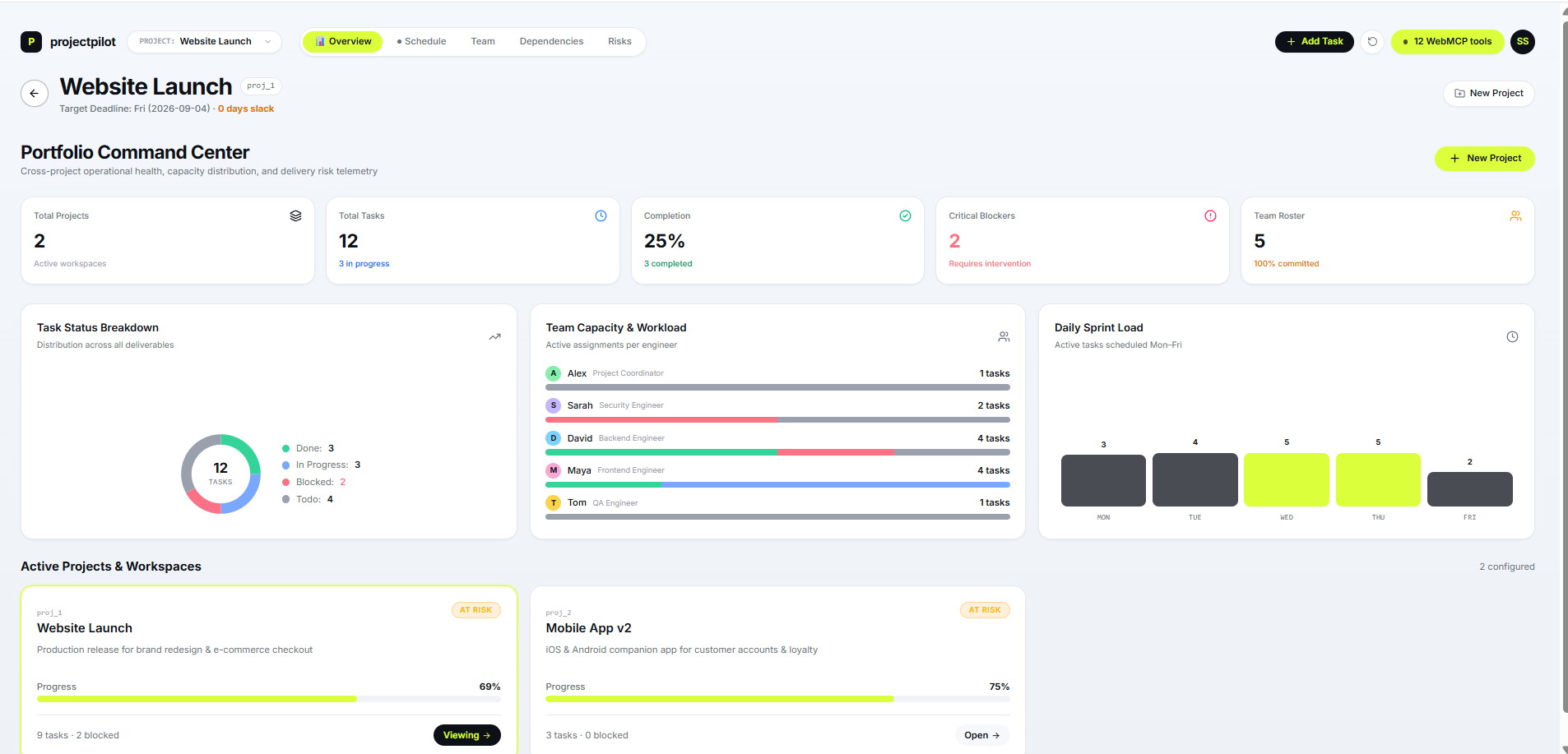
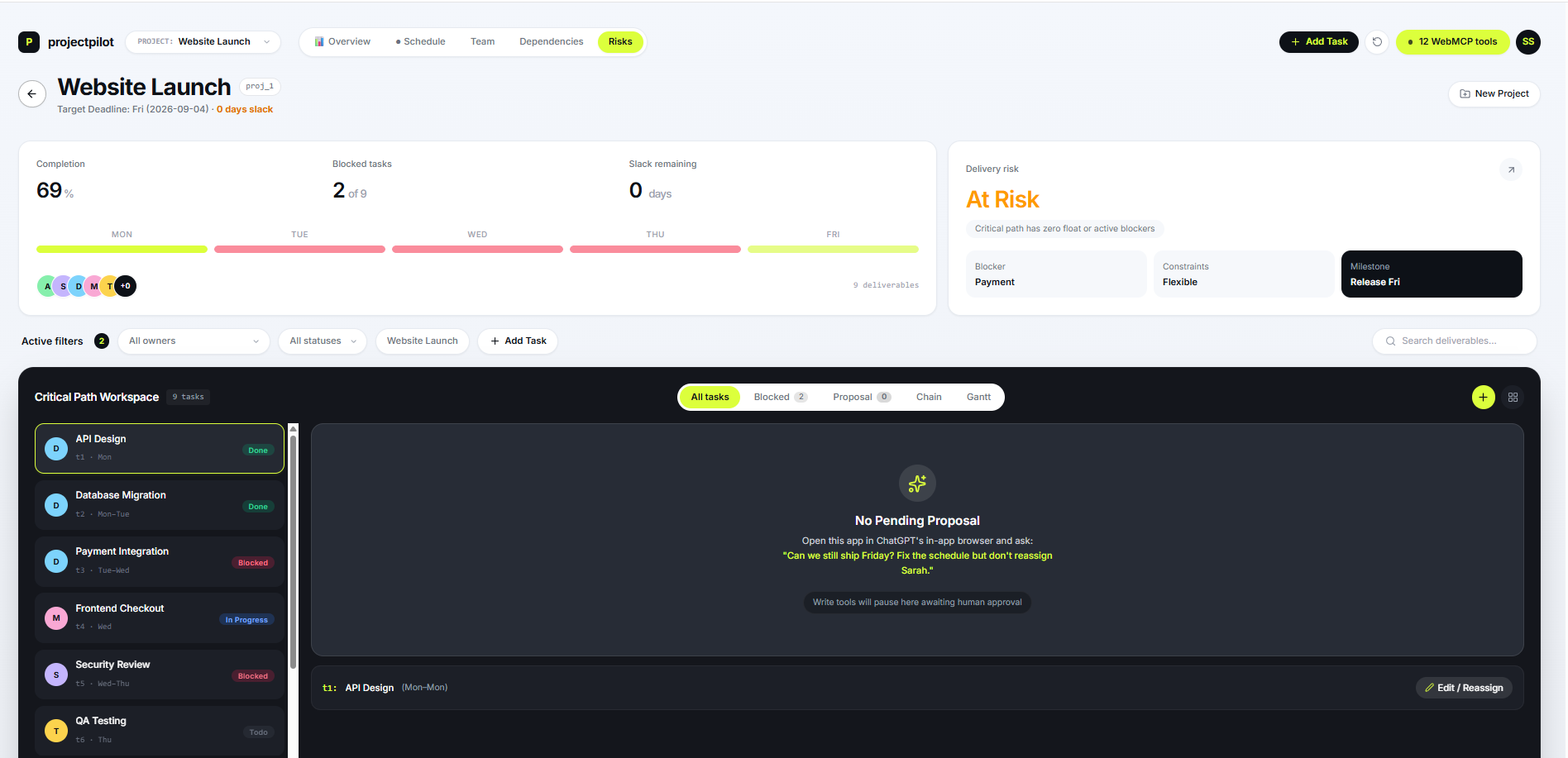
Cadence AI is a WebMCP-native project coordination workspace that connects directly with browser-based AI agents to diagnose critical bottlenecks and execute recovery plans.
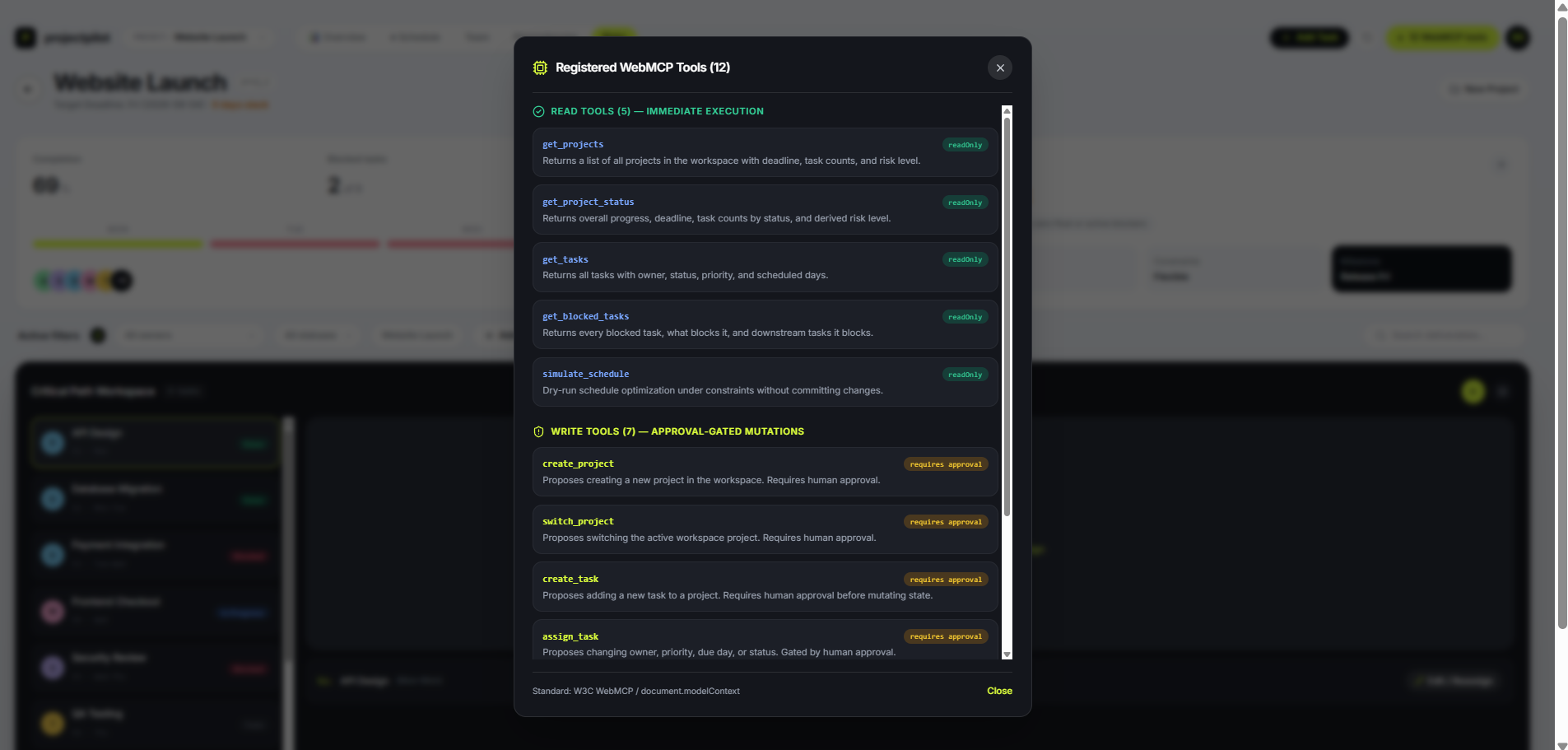
Live Workspace Inspection: Exposes structured read tools that allow the agent to inspect the reactive dependency graph, identify blocker cascades, and assess slack buffers in real time.
Mathematical Schedule Simulation: Uses a dry-run simulation engine to test schedule permutations and verify whether a recovery plan is mathematically feasible before touching anything.
Negative Constraint Reasoning: Honors human instructions (such as "Optimize schedule, but don't reassign Sarah") by locking assigned tasks and finding alternative parallelization paths without breaking team rules.
Zero-Unchecked-Mutation Gate: Write operations never modify the project state silently. The agent creates a transparent, staged Proposal Card showing an exact before-and-after diff (
AT RISK ➔ ON TRACK).One-Click Human Approval: The human in the loop reviews the proposed changes and clicks Approve to commit the updates atomically to the live Gantt timeline with instant visual pulse feedback.
How we built it
Cadence AI is engineered as a lightweight, zero-backend, client-side web application designed to run natively inside any agent-enabled browser session:
- Frontend & UI: Built with Next.js (App Router), TypeScript, and Tailwind CSS, featuring an interactive Gantt timeline, blocker dependency graph, and real-time telemetry log.
- Reactive State Layer: In-memory Zustand store acting as the single source of truth for all tasks, dependencies, active proposals, and agent telemetry (requiring zero external databases or API keys for 100% reproducible deployments).
- WebMCP Adapter Layer: Implemented a standard-compliant WebMCP integration supporting both
navigator.modelContextanddocument.modelContextwith double-registration guards to safely expose tools to AI agents. - Deterministic Graph Engine: Built an in-browser topological sorting algorithm with cycle detection, transitive blocker traversal, slack calculation, and negative constraint parsing.
Challenges we ran into
- Client-Side Tool Gating: Ensuring that write tools could not bypass the UI. We had to design an atomic staging system where write tool executions create pending proposal objects in the Zustand store and return a
"pending_human_approval"status back to the agent without mutating the underlying task array. - Negative Constraint Parsing in Natural Language: Interpreting nuanced user constraints (like "don't move Sarah" or "never touch security") and reliably translating those modifiers into hard boolean locks (
locked: true) inside the topological scheduler. - WebMCP Protocol Alignment: Handling client-side lifecycle timing so that WebMCP tools are properly registered and discoverable the instant an agent session attaches to the browser DOM.
Accomplishments that we're proud of
True Human-in-the-Loop Architecture: Proving that an AI agent can execute complex, multi-step project graph mutations safely without risking unverified state destruction.
Deterministic Simulation Engine: Building a real-time scheduling engine in pure TypeScript that calculates critical paths and resolves parallel workflows instantly on the client side.
Seamless Visual Telemetry: Creating an intuitive visual experience where every tool call, dry-run simulation, and approved proposal provides immediate visual feedback across the timeline and agent activity log.
What we learned
Advice vs. Execution: We learned that the true bottleneck in AI productivity is not the quality of the model's textual reasoning, but the absence of safe, standardized interfaces to turn reasoning into structured execution.
Power of In-Browser MCP: WebMCP opens a massive frontier for web applications by turning DOM-level state into first-class tool interfaces for browser agents, eliminating the need for bulky server-side intermediary APIs.
What's next for Cadence AI
- Two-Way Issue Tracker Sync: Adding WebMCP connectors for GitHub Issues, Jira, and Linear so approved proposals can synchronize directly back to enterprise tracking systems.
- Multi-Resource Workload Balancing: Extending the engine to calculate individual developer capacity curves, vacation constraints, and cross-team skill tags during topological recovery.
- Autonomous Telemetry Webhooks: Enabling ambient background monitoring where Cadence AI proactively flags newly introduced blocker cascades and prepares staged recovery proposals before a Tech Lead even asks.

Log in or sign up for Devpost to join the conversation.