-
Game Logo
-
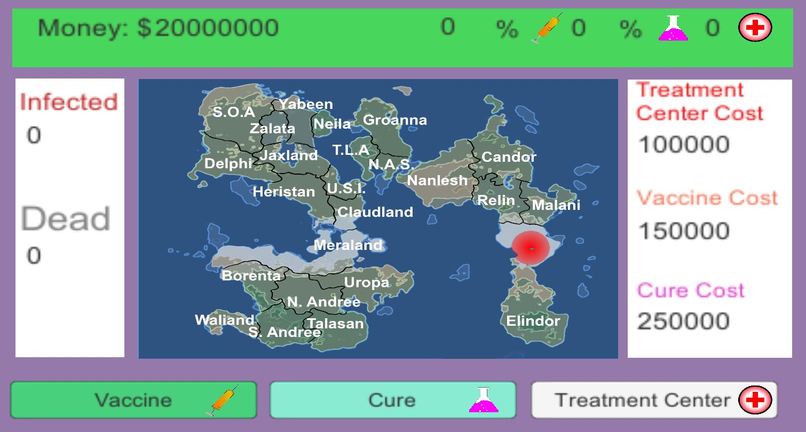
Gameplay
Inspiration
While discussing various social issues which plague us today, we stumbled across the Coronavirus (Recently named COVID-19). Although we couldn't initially find an area which we could help solve with software, we eventually decided on the difficulties of actually curing COVID-19. Although many politicians and world leaders tell us things like We are working on a cure and Don't worry about COVID-19, we will solve it. We wanted to dive into what working on a cure actually means, and if its as simple as world leaders make it. By making this game, we hope to raise people's levels of knowledge about how hard it is to actually cure a virus, and understand that it might not be as simple as it seems.
What it does
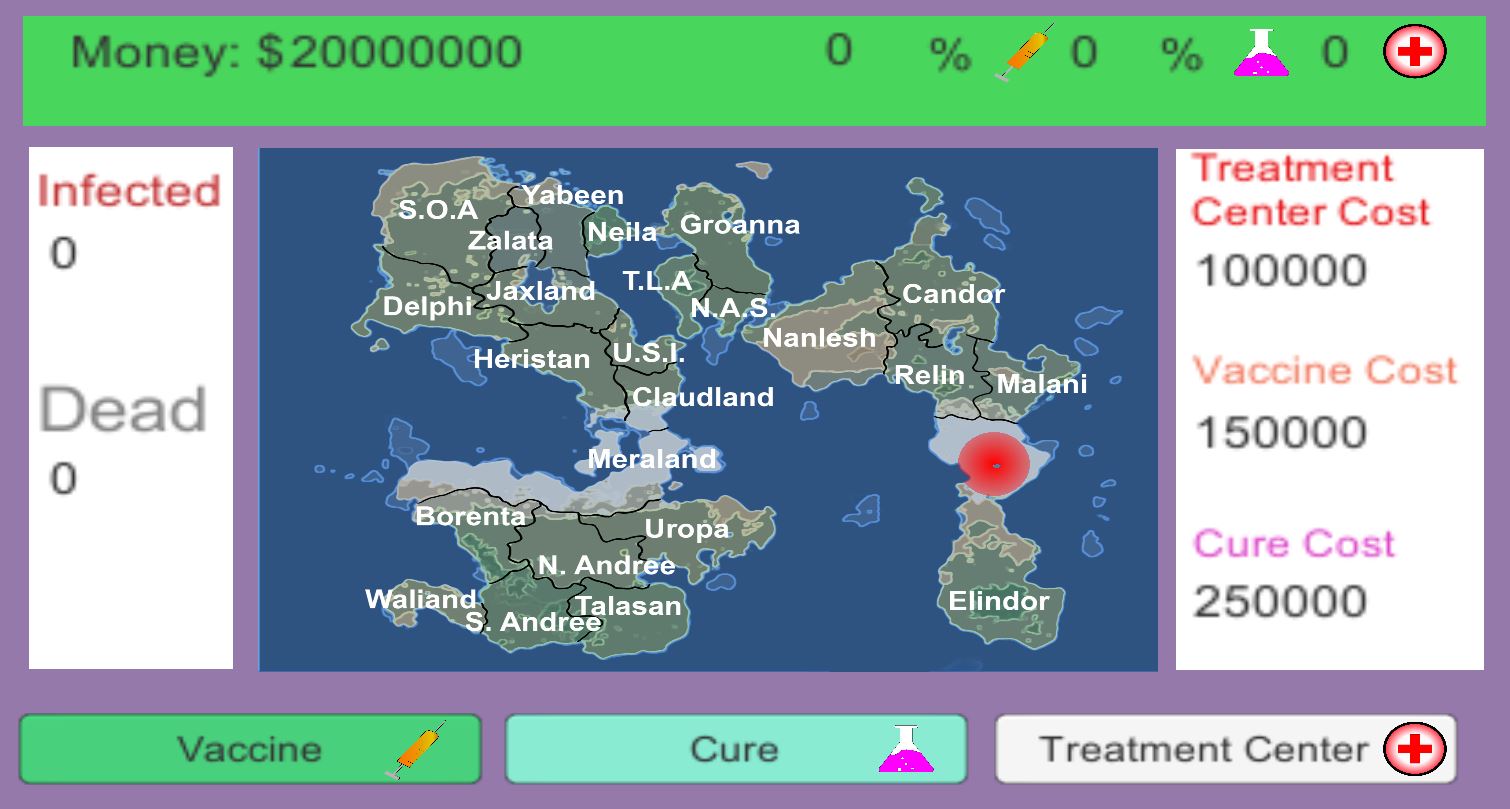
As you play through our short game, you will be given three options per turn. You can build Treatment Centers, slowing the mortality rate and spread of the virus. You can research a cure, ultimately stopping the virus. Finally, you can research a vaccine, which after done, will dramatically decrease the virus's spread rate. The ultimate goal is to create a cure before the virus infects everyone. The game is intentionally hard, and often frustrating, meant to simulate the number of variables which aren't in scientist and doctor's hands. By making this an exaggeration of how hard curing and worldwide disease would be, we aim to create a level of respect for doctors and scientists who combat this disease.
How I built it
We developed this project using Unity, linking buttons and text fields to various C# scripts.
Challenges I ran into
Throughout the process, we ran into various challenges including the actual spread of the virus, how each button affects the game, and the visualization of the infection. In general, we attempted to solve these issues in more creative ways, rather than actually solve it the exactly way we wanted.
Accomplishments that I'm proud of
Throughout the game, various numbers represent realistic exponential curves, affected by the treatment centers and vaccines. These come incredibly close to being a somewhat accurate model of a small scale virus. We also included a map which updates with a visualization of the virus's spread.
What I learned
Many small skills were learned along the way in terms of C# and Unity. Aside from those, our more general takeaways were to be adaptable in the game design, especially when on a time constraint, and to put thought into the mechanics of the game before jumping into the actual coding.
What's next for CDC Simulator
CDC Simulator will ideally develop by increasing the options which the user has, increasing the length of games, and more integration of the map into the game's mechanics.

Log in or sign up for Devpost to join the conversation.