-
-
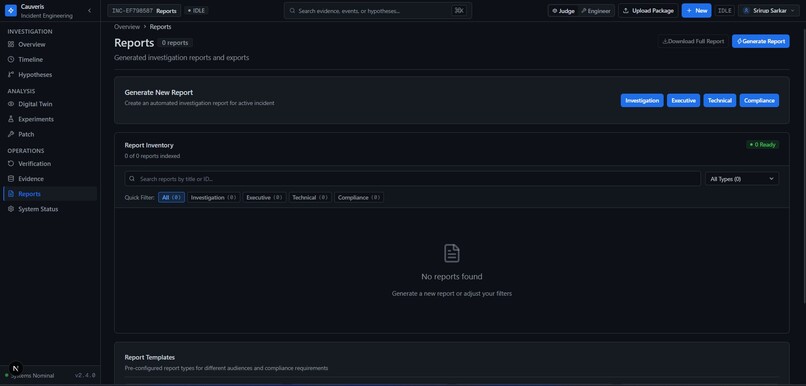
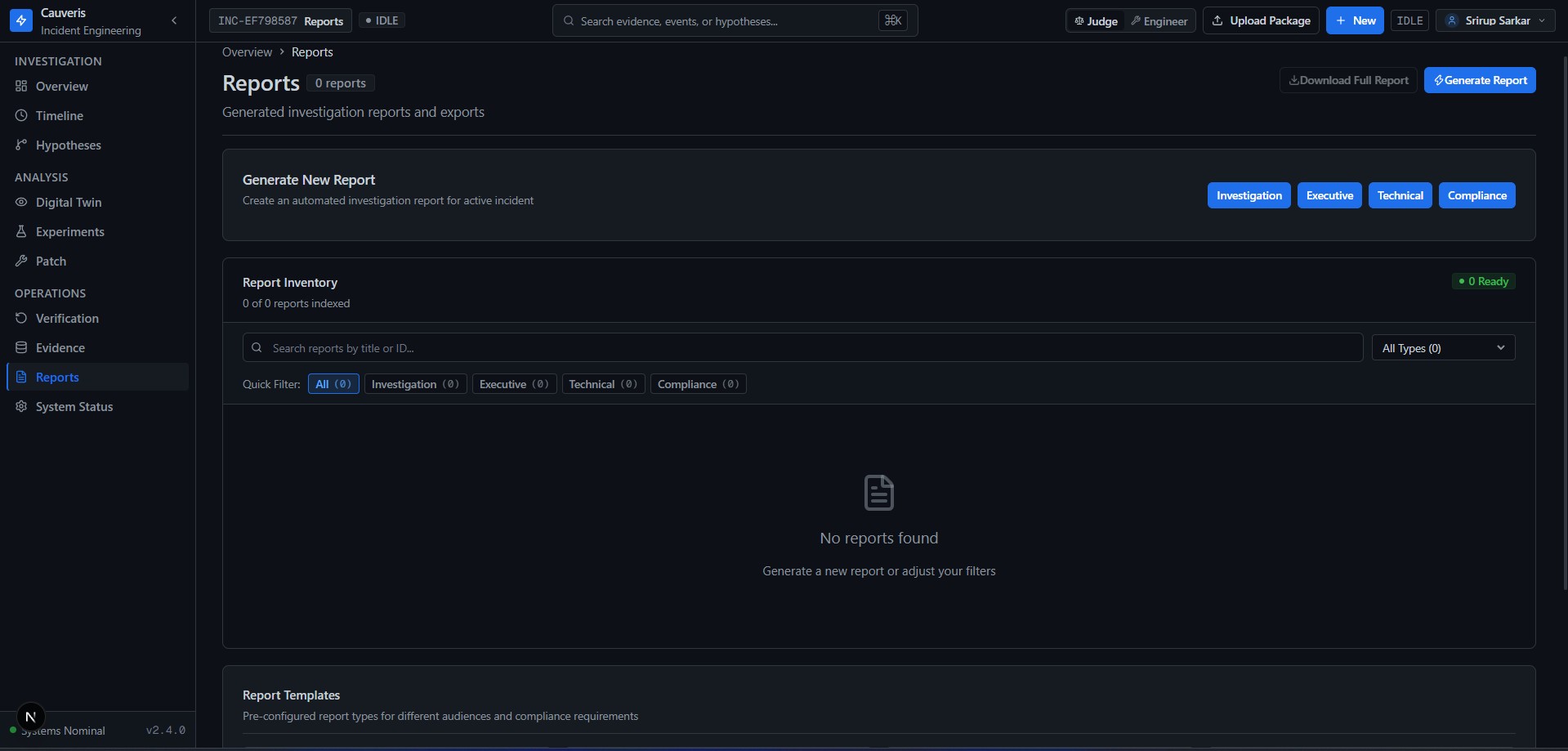
Report
-
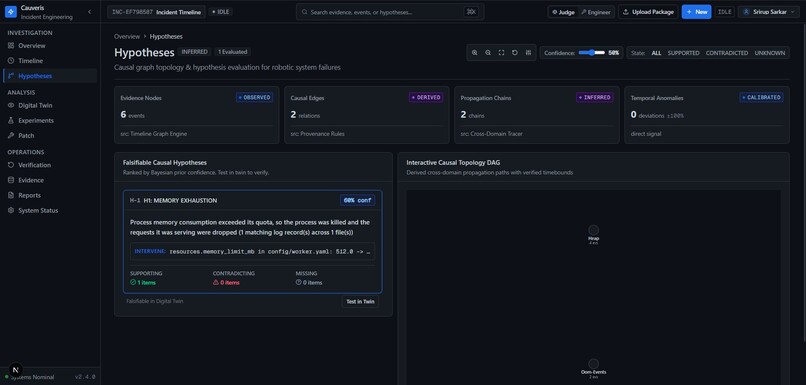
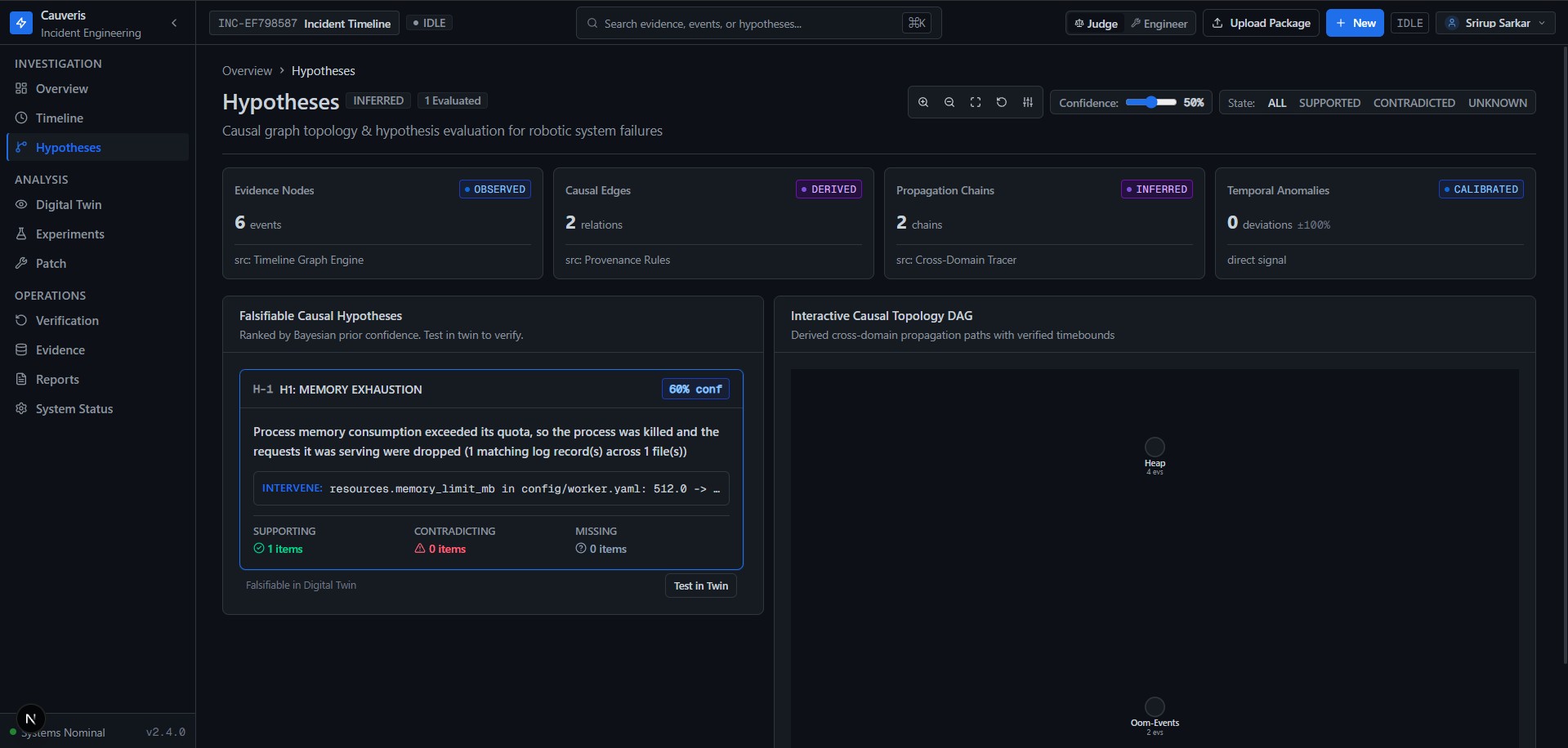
Hypothesis
-
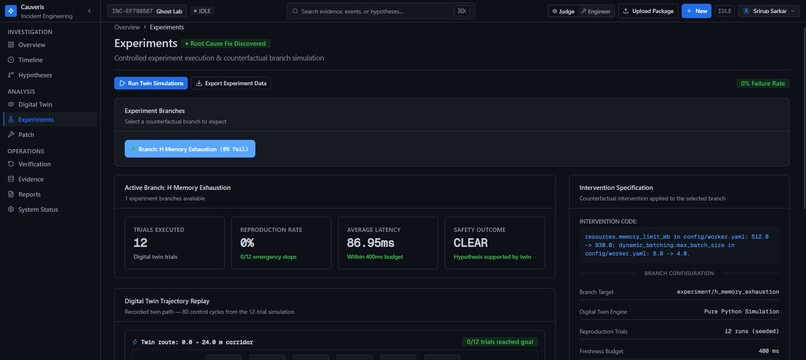
Experiment Lab
-
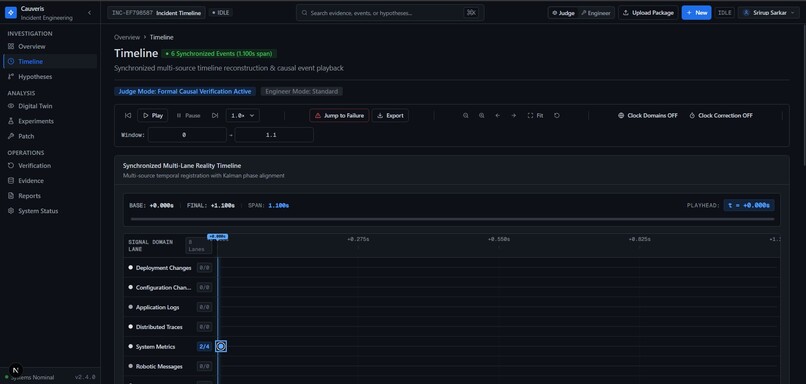
Timeline
-
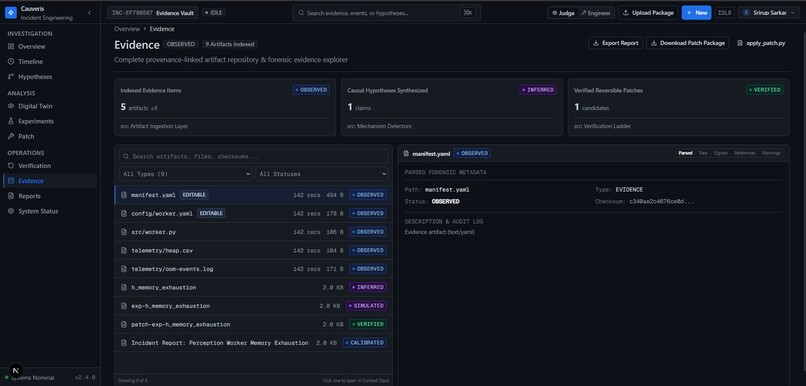
Evidence
-
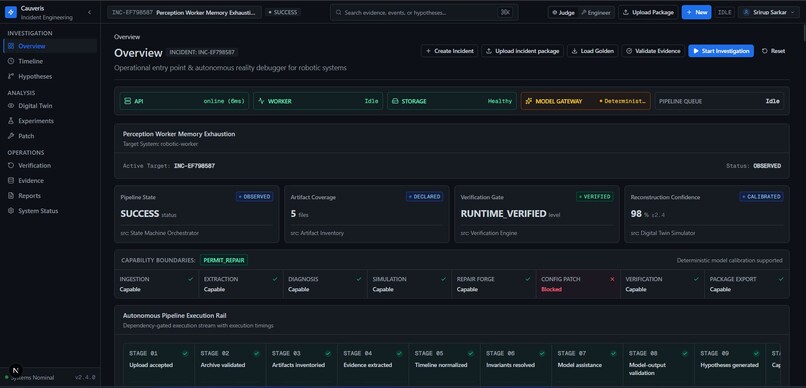
Dashboard
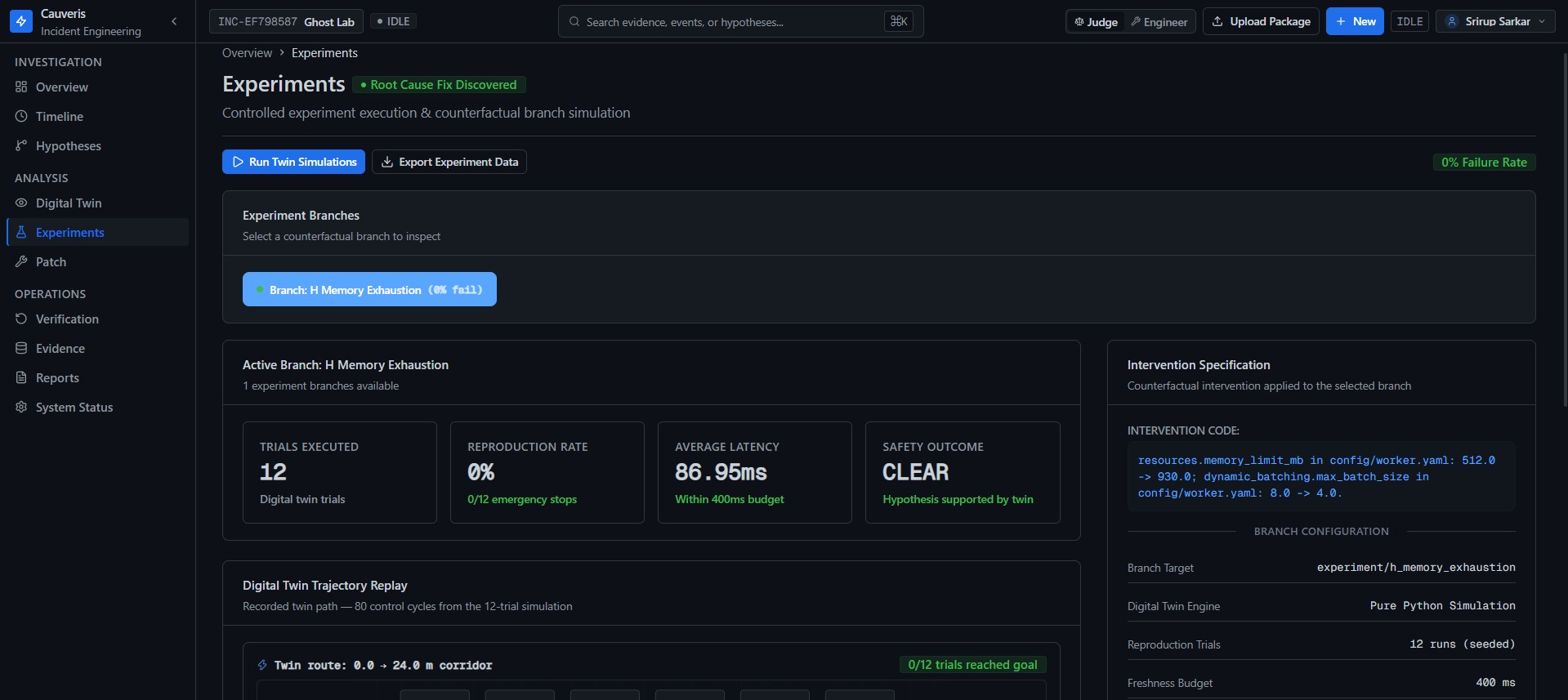
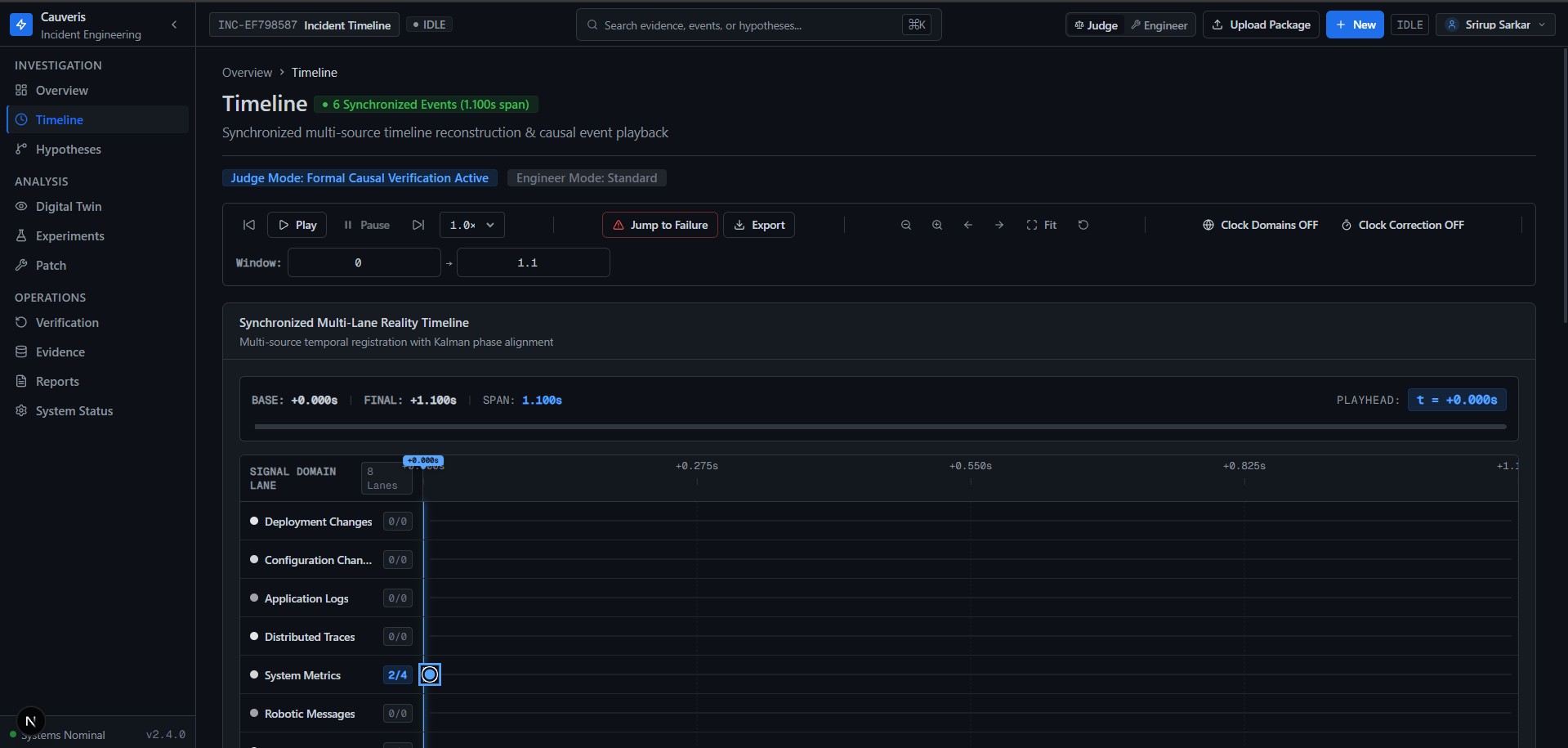
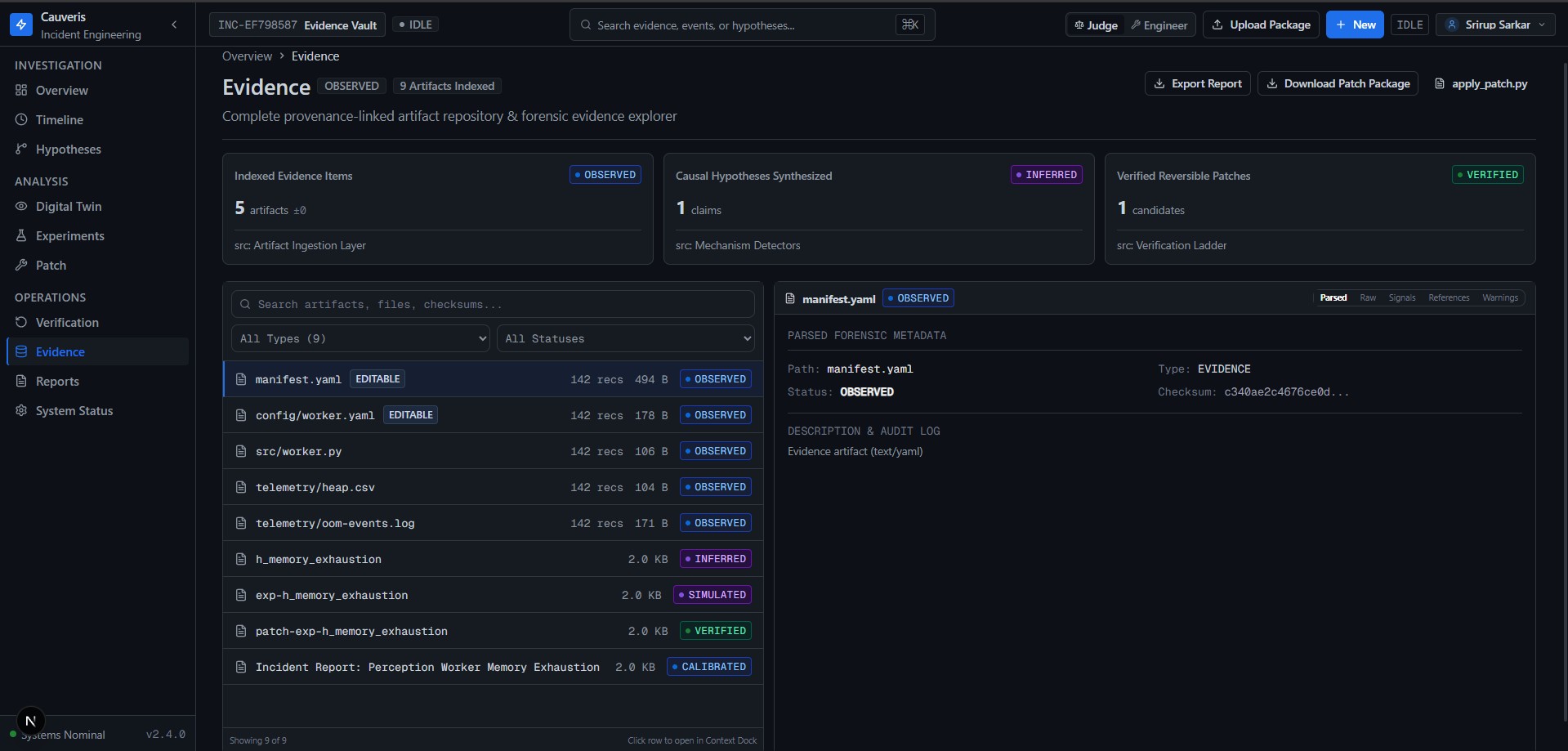
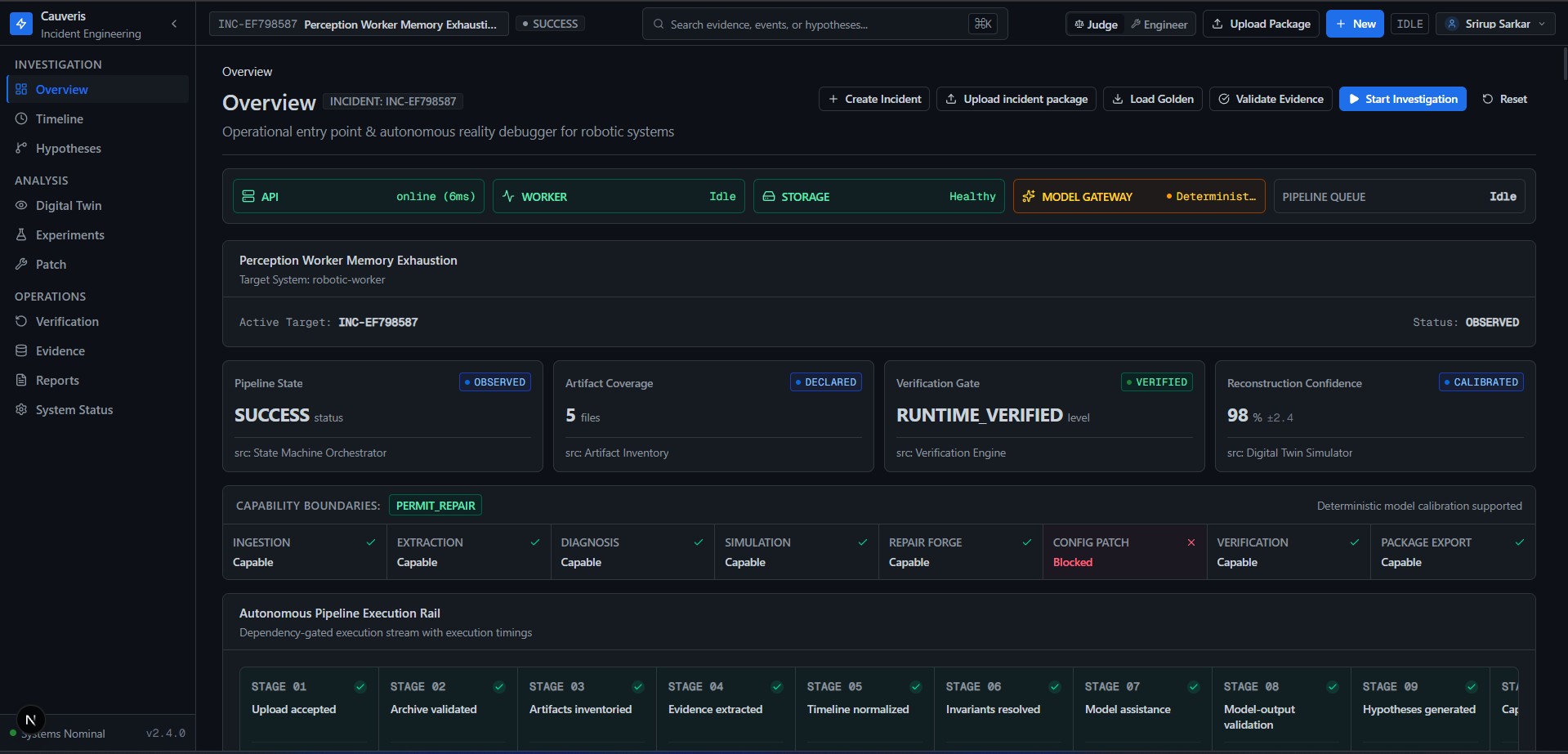
Cauveris: Autonomous Reality Debugger for Cyber-Physical and AI-Powered Robotic Systems
By: Cauveris Engineering Team Repository: https://github.com/the-srirup/cauveris.git
Abstract
When artificial intelligence transitions from manipulating digital pixels to actuating physical machines, software latency couples directly to mechanical momentum. In distributed robotic systems, a minor tail-latency spike or configuration drift in an off-board inference pipeline can cause emergency braking violations or physical collisions.
We present Cauveris, an autonomous reality debugging platform that unifies multi-modal observability telemetry (ROS 2/MCAP logs, OpenTelemetry traces, kernel diagnostics, and time-series metrics) using boundary-bulk holographic dualities. Cauveris maps boundary observations to Holographic Evidence Units (HEUs), solves a regularized convex inverse problem using causal Green's function propagation kernels, validates counterfactual hypotheses in an ISO 3691-4:2023-compliant digital twin, and synthesizes structure-aware patches enforced through a four-tier atomic verification engine.
Inspiration and Motivation In cloud-native enterprise software, an unoptimized thread pool or dynamic batching queue manifests as an elevated P99 latency metric or an HTTP 504 timeout. In embodied AI and Autonomous Mobile Robots (AMRs), however, software latency couples directly to physical kinematics governed by Newton's laws of motion.
Consider an industrial AMR traversing a warehouse at forward velocity v = 1.5–2.0 m/s. The robot offloads deep perception models to edge GPU servers across wireless links. If a cloud service deployment increases dynamic batching windows to maximize GPU throughput, the delay introduces stale perception detections. When a perception frame exceeds the robot's freshness budget (t_freshness <= 120 ms), the robot experiences sensory blindness. To avoid hazard collisions, the onboard safety supervisor triggers an emergency stop (e-stop), halting factory operations.
Diagnosing these failures post-mortem is challenging due to three core realities:
Telemetry Fragmentation: The incident signature is fractured across ROS MCAP logs, Prometheus metrics, distributed OpenTelemetry traces, network packet logs, and host kernel rings. Unobserved Internal States: Internal queue backlogs, thread contention, and memory stalls cannot be directly instrumented without invasive probe effects. Clock Skew and Causality Inversion: Telemetry streams originate from disparate local clocks with variable drift, often making an effect appear in logs before its root cause. The Holographic Principle as a Computational Metaphor
Cauveris was inspired by the Holographic Principle and the AdS/CFT correspondence in theoretical physics. In quantum gravity, bulk volume dynamics within an Anti-de Sitter space are mathematically equivalent to conformal field interactions encoded on its lower-dimensional boundary.
We applied this conceptual duality to distributed systems:
The Bulk (V): The unobserved internal physical and computational states (thread contention, memory barriers, queue saturation, and mechanical inertia). The Boundary (∂V): The discrete observability emissions (logs, metrics, traces, and packet headers).
By modeling boundary evidence as interference patterns generated through causal transfer operators (Green's functions), Cauveris formulates diagnostic root-cause analysis as an inverse holographic reconstruction problem.
Theoretical and Mathematical Formulation 2.1 Boundary Layers and Holographic Evidence Units (HEUs) Observability data are parsed into standardized data structures denoted as Holographic Evidence Units (HEUs). Every unit captures an observation across seven distinct boundary layers: application logs, infrastructure logs, distributed traces, metric exports, network flows, configuration states, and deployment events.
Each layer possesses a characteristic temporal response factor (tau_layer) and component time constant (tau_comp), establishing a baseline time constant:
tau_local = tau_0 * alpha_comp * beta_layer
where tau_0 = 10.0 ms is the base propagation parameter in the policy registry.
2.2 Causal Green's Function Propagation Kernels
Internal system states propagate to boundary sensors according to impulse response functions (Green's functions). For a component with characteristic decay time tau, the local causal kernel K_local(t) is:
K_local(t; tau) = (1 / tau) * exp(-t / tau) * Theta(t)
where Theta(t) represents the Heaviside step function. For cross-component propagation across a network topology edge (i -> j) with transport latency delta_net and queueing delay delta_queue:
K_cross^(i, j)(t) = Integral from 0 to t of: K_local^(i)(s) * K_local^(j)(t - s - delta_net - delta_queue) ds 2.3 The Holographic Inverse Optimization Problem
Let b in R^m denote the observed boundary telemetry vector, and let M in R^(m x n) denote the assembled causal propagation matrix. Determining the internal bulk state vector x in R^n is formulated as a regularized convex optimization program:
min_{x >= 0} (1/2) * ||M*x - b||_2^2 + lambda_entropy * S(x) + lambda_temporal * ||x - x_prior||_2^2 + lambda_physics * ||C(x)||_2^2 + lambda_sparsity * ||x||_1
where:
S(x) = Sum_{i=1}^n [x_i * log(x_i + epsilon)] is the entropy regularization penalty that prevents artificial single-point overconcentration. ||x - x_prior||_2^2 preserves continuity with pre-incident baseline state distributions. C(x) enforces physical admissibility (e.g., monotonic queue dissipation and service capacity bounds x_i <= C_max). 2.4 Robotics Kinematics and ISO 3691-4:2023 Safety Budgets
In the physical domain, an AMR's safety envelope is bounded by its stopping distance S_0. Under ISO 3691-4:2023 safety specifications:
S_0 = v * (t_reaction + t_perception) + (v^2) / (2 * a_eff) + B_margin
where:
v is operational speed, t_perception is the end-to-end perception age, a_eff = mu * g * eta_brake is effective braking deceleration, B_margin is the mandatory clearance margin.
If perception delay exceeds the safety budget:
t_perception = t_sample + t_batch + t_inference + t_transport > t_budget
the kinematic stopping trajectory violates clearance zones, enforcing an immediate safety controller trip (e-stop).
System Architecture and Implementation Cauveris is built as a modular architecture comprising Python 3.11+, hardware-accelerated C++17/CUDA extensions, and a Next.js/React Three Fiber 3D spatial interface.
3.1 Hardware Acceleration Core: CUDA Kernels
To avoid computational bottlenecks during large-scale matrix convolution, Cauveris compiles native CUDA acceleration routines in the cpp/ directory, exposed via the cauveris_kernels_py extension:
build_local_kernels: Evaluates exponential and gamma decay kernels over discretized temporal grids. build_cross_kernels: Computes edge-delayed causal convolutions on GPU tensors. solve_cg_csr and solve_rls: Executes sparse Conjugate Gradient and recursive ridge regression using Cholesky factorizations. Numerical Parity: Fast-math approximations (-use_fast_math) are disabled to preserve strict IEEE 754 precision parity between the host CPU reference and GPU targets. 3.2 Digital Twin Simulation Engine
The simulation engine (cauveris/simulation/runner.py) pairs discrete-event perception pipelines with a 2D planar kinematic simulation. For every candidate hypothesis intervention, the twin runs N = 12 independent Monte Carlo trials subjected to stochastic network jitter and sensor frame arrivals, recording mean perception latency and emergency-stop event frequencies.
3.3 Four-Tier Atomic Verification Engine
To guarantee zero hallucinations in autonomous remediation, all proposed patches must clear a strict hierarchy of atomic verification checks:
Verification Level Mandatory Invariant Assertions UNVERIFIED Initial synthesized patch candidate. MODEL_VERIFIED Regression fails on unpatched workspace; Digital twin resolves emergency stops; Latency remains within safety budget. STAGING_VERIFIED Clean patch merge with zero syntax errors; Passes all unit, integration, and security checks; Byte-for-byte reversible rollback confirmed. RUNTIME_VERIFIED Live canary deployment verification; Telemetry metrics strictly within invariants.
Key Challenges Surmounted 4.1 Ill-Conditioned Inverse Matrices Collinear telemetry metrics (e.g., CPU load rising alongside queue saturation) caused high condition numbers in M, leading standard least-squares estimators to produce unstable, oscillatory solutions.
Resolution: We combined Von Neumann entropy regularization with Sequential Least Squares Programming (SLSQP), penalizing non-physical variance and constraining the state space strictly to non-negative domain boundaries.
4.2 Causality Inversion via Clock Drift
Variances in NTP sync and microcontroller clock oscillators across physical AMR modules and remote cloud servers caused cases where effects were logged before causes (Delta t < 0).
Resolution: We developed a cross-correlation and change-point analysis module (cauveris/analysis/statistics.py) that estimates inter-host clock offset delta_skew directly from matching request-response round-trips before populating the causal DAG.
4.3 Cross-Platform IEEE 754 Parity
Compiler floating-point reordering between host x86 CPU calculations and CUDA kernels introduced divergence in Cholesky matrix factorizations at the 6th decimal place, failing automated validation tests.
Resolution: We centralized physical parameters in a single Python configuration authority and enforced strict IEEE 754 arithmetic flags in CMake, supported by comprehensive dual-path verification tests (tests/holographic/test_gpu_kernels.py).
What We Learned Software Latency is Physical Distance: In robotics, software reliability is indistinguishable from functional mechanical safety. Distributed systems debugging must be physically grounded. Telemetry is Holographic: Exhaustive distributed tracing on every software instruction is unnecessary. When boundary transfer functions are mathematically modeled, external telemetry emissions contain rich, decodable signatures of internal state dynamics. Deterministic Verification Trumps Generative Speculation: Automated repair agents must never operate on unconstrained prompt outputs. Patch acceptance must depend on deterministic verification checks, sandbox reproduction, and mathematical proofs of safety invariant preservation. Reproducibility and Execution The pipeline can be verified locally using standard project build tools:
bash
Install dependencies uv sync && cd apps/web && npm install && cd ../..
Build CUDA C++ Kernels (Optional for GPU execution) cmake -S cpp -B cpp/build -G Ninja && cmake --build cpp/build
Start dev server (API backend and Web UI) make dev
Execute the Golden Incident pipeline (CAU-0001) uv run cauveris --golden
Conclusion Cauveris demonstrates that boundary-bulk holographic principles provide an effective framework for autonomous root-cause analysis in complex cyber-physical environments. By coupling regularized inverse problem solvers with physical kinematic digital twins and atomic verification guarantees, Cauveris provides a grounded, mathematically rigorous foundation for autonomous debugging in modern robotics.
References ISO Standard 3691-4:2023, Industrial trucks — Safety requirements and verification — Part 4: Driverless industrial trucks and their systems, International Organization for Standardization, 2023. J. Maldacena, "The Large-N Limit of Superconformal Field Theories and Supergravity," International Journal of Theoretical Physics, vol. 38, no. 4, pp. 1113–1133, 1999. ISO Standard 13849-1:2023, Safety of machinery — Safety-related parts of control systems — Part 1: General principles for design, ISO, 2023.
Built With
- c++
- cmake
- cuda
- fastapi
- nextjs
- python
- typescript

