-
-
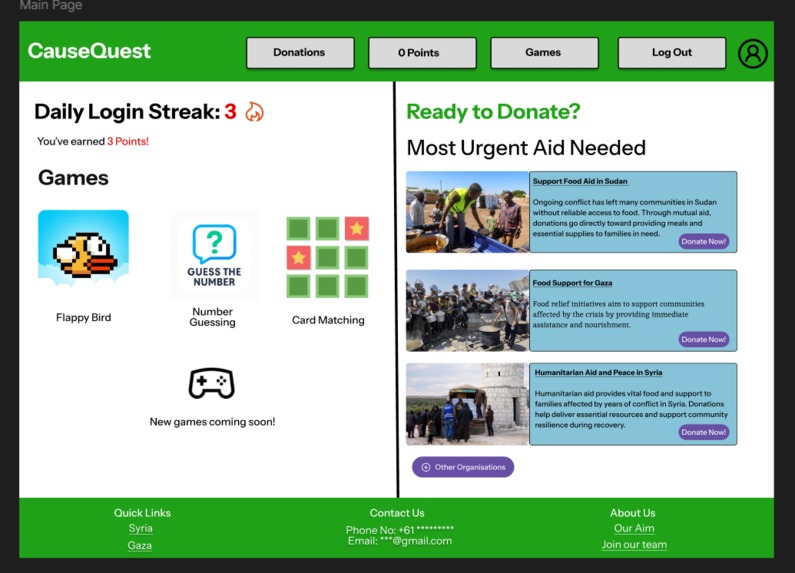
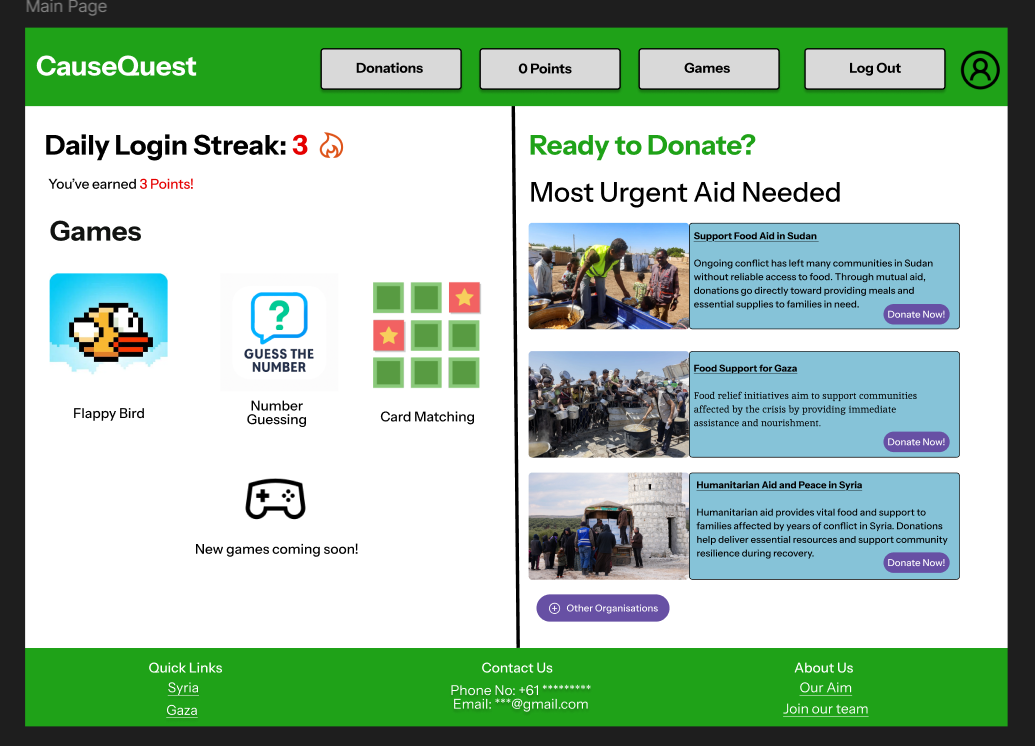
Main page of the project CauseQuest prototype
-
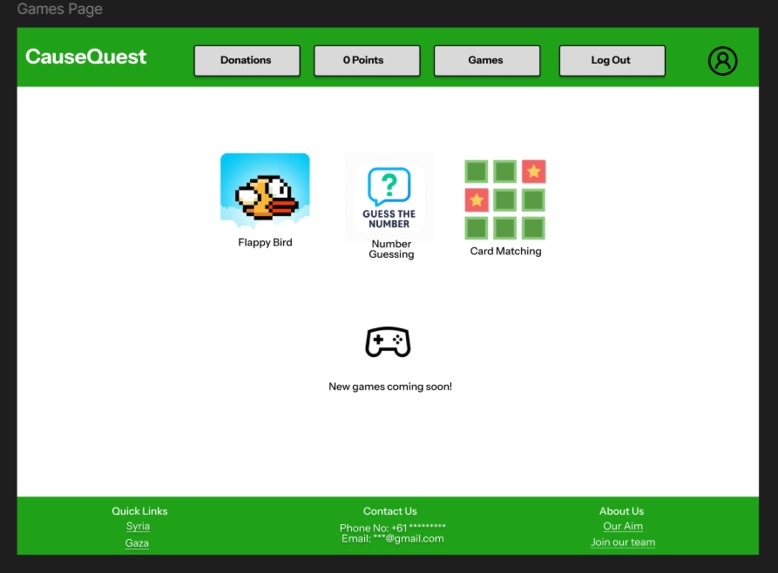
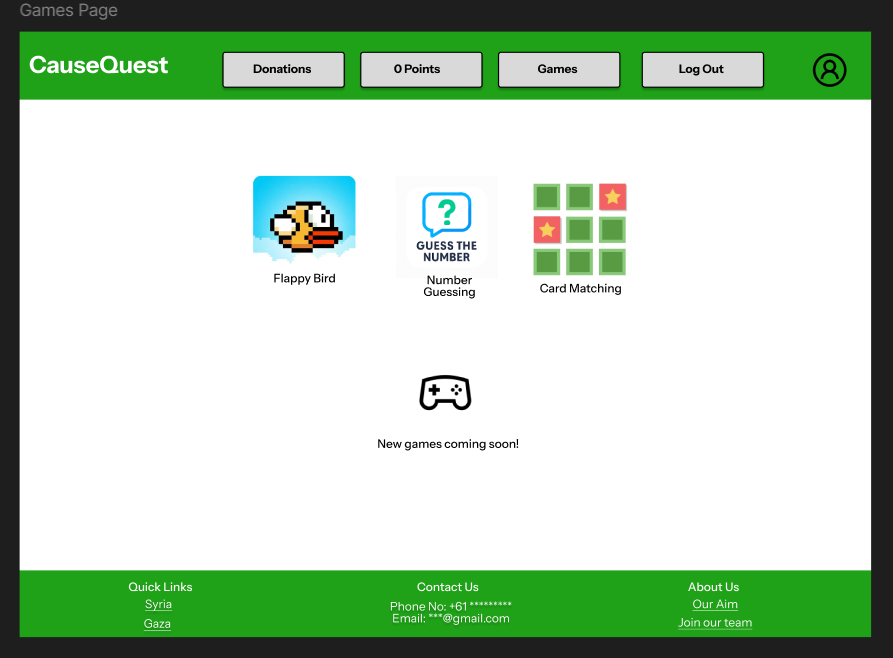
Prototype of page showing games available
-
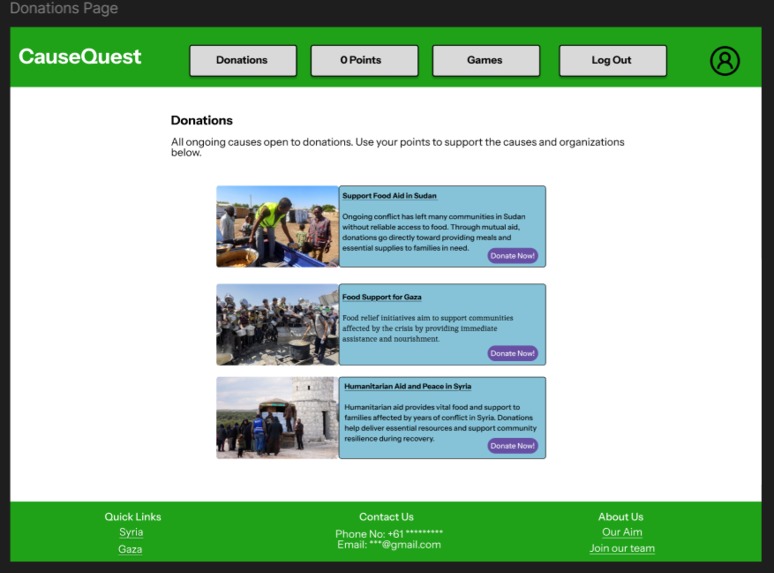
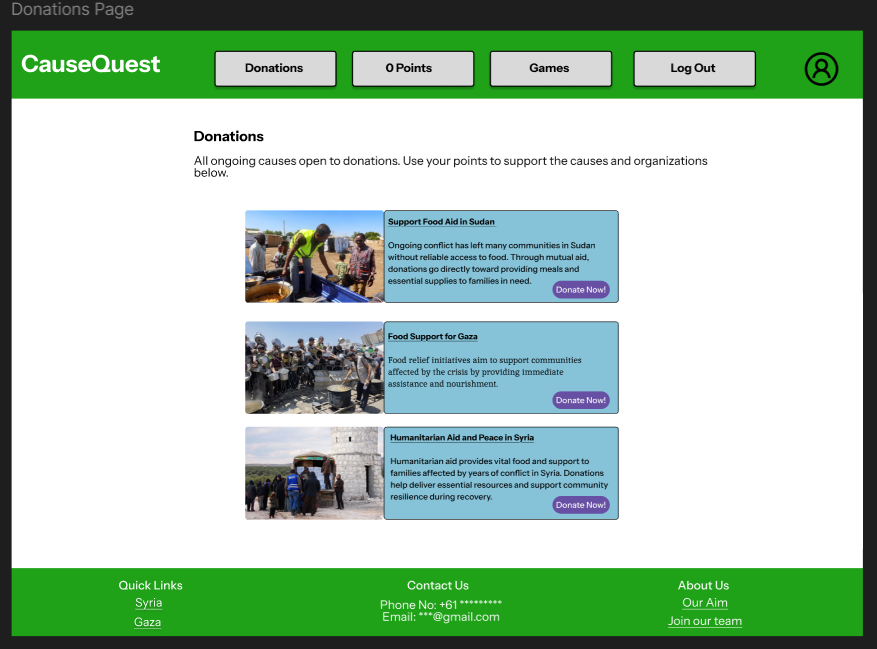
Prototype of page showing donations and causes with descriptions
-
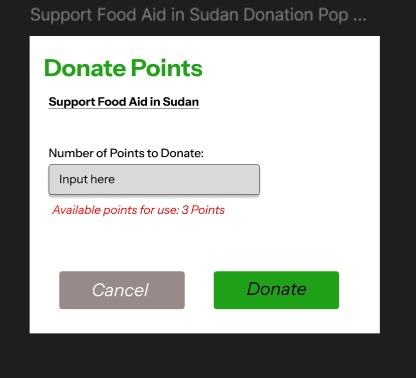
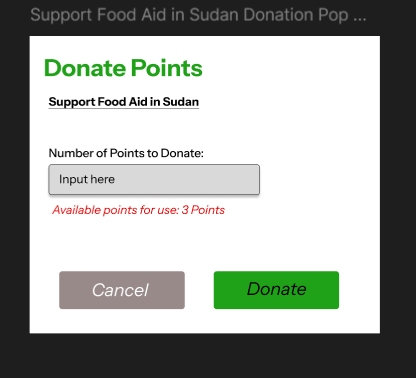
Donation pop-up prototype
Project Story – CauseQuest
About the project
CauseQuest was created from a simple question: how can we make learning about global challenges more engaging while encouraging people to contribute to positive change?
In a world that is increasingly connected and transparent, people are more aware than ever of issues such as climate change, access to education, and global health challenges. However, awareness alone does not always translate into action. Many people, especially younger audiences, may feel disconnected from how they can meaningfully contribute.
CauseQuest explores the idea of turning engagement into awareness and action through interactive experiences.
The platform introduces users to different global causes through simple mini games and interactive content. By playing games and interacting with the platform, users gain points that represent symbolic contributions toward various causes such as sustainability, education, and healthcare.
The goal is not to treat the system as a form of monetary reward, but rather to gamify engagement with real-world issues. Points act as a representation of support and awareness rather than direct financial value. This allows users to learn about important topics in a fun and accessible way while reinforcing the idea that small actions can collectively create impact.
In the future, this concept could connect to real-world initiatives where organizations sponsor campaigns or match user engagement with actual donations. In this way, the platform could transform player participation into measurable social impact without directly involving financial transactions by the users themselves.
How we built it
Due to the limited time frame of the hackathon, our project focuses on demonstrating the core concept through a functional frontend prototype.
We first designed the user interface and user journey through Figma prototypes, allowing us to quickly iterate on the layout and experience before implementing the platform.
The frontend of the website was then built using React and CSS, enabling us to recreate the interface and interactions shown in the prototype. We used tools such as Cursor to help accelerate development and translate our designs into working components.
The website demonstrates the main mechanisms of the platform:
- Navigating the platform interface
- Playing mini games
- Viewing accumulated points
- Exploring different causes that users can support
In addition, we developed and integrated mini games directly into the website, including a Flappy Bird–style game and another game built with a game engine. These games demonstrate how gameplay could connect to the platform’s engagement system.
Because of the complexity of integrating multiple systems within the limited hackathon timeframe, we did not implement a full backend or database. Instead, the current version focuses on illustrating the user flow and core mechanics entirely through the frontend.
This allows the prototype to effectively communicate the concept while leaving room for future full-stack implementation.
Challenges we faced
As this was our first hackathon, we faced several challenges throughout the development process.
One of the biggest challenges was working within a limited time frame while coordinating multiple aspects of the project, including frontend development, game integration, and prototype design.
Another difficulty was the technical complexity of connecting different technologies together, especially when attempting to integrate games with a web platform and potential backend systems. Given the short development time, we ultimately decided to prioritize creating a clear and functional prototype that could effectively demonstrate the idea rather than attempting to build a full production system.
The project also required strong teamwork and coordination. We had to quickly delegate tasks based on each member’s expertise, allowing some members to focus on prototyping and design while others focused on programming and game development.
Throughout the process, we experienced a lot of trial and error, frequently revisiting our plans and adapting our approach as new challenges emerged.
What we learned
Participating in our first hackathon was an extremely valuable learning experience.
We strengthened our technical knowledge by working with tools such as React, frontend development frameworks, and game development environments. We also gained experience translating design prototypes into functional interfaces and integrating interactive elements like games into a web platform.
Beyond the technical skills, the experience taught us the importance of rapid prototyping, adaptability, and collaboration. In a fast-paced environment, the ability to quickly test ideas, adjust strategies, and learn from one another became essential.
We also learned a great deal from each other, sharing knowledge in areas such as prototyping, frontend development, and game design.
Future improvements
The current version of CauseQuest represents an early prototype designed to demonstrate the concept.
With more time and development, the platform could be expanded significantly. Some possible improvements include:
Improving the UI/UX design to enhance overall user satisfaction and create a more intuitive and engaging navigation experience.
Implementing accessibility and usability features to make the platform usable by a wider range of users. This could include responsive design across devices, clearer navigation structures, readable typography, and features that make the platform easier to access for people with different needs.
Developing a full backend and database system to support persistent user accounts and more reliable tracking of player progress, scores, and engagement.
Improving the integration between games and the platform, creating a more seamless user experience where gameplay results directly contribute to the platform’s point system.
Refining existing game mechanics, such as improving score tracking in the Flappy Bird game to track passing obstacles rather than only player clicks.
Adding engagement features such as a leaderboard system, allowing players to compare scores and participate in friendly competition.
Creating a community impact tracking page that displays the total number of points or contributions generated by users across the platform, helping visualize the collective impact of player participation.
Expanding the collection and variety of mini games to keep the platform engaging and encourage long-term participation.
Strengthening security and user management systems to support a production-level platform.
Developing a mobile application version to improve accessibility and allow users to engage with the platform more easily.
Adding gamification features such as streaks, achievements, and long-term engagement systems to motivate continued participation.
With these improvements, CauseQuest could evolve into a platform that connects gaming, awareness, and collective social impact in a meaningful and engaging way.
Built With
- canva
- css
- cursor
- figma
- javascript
- node.js
- react
- vercel


Log in or sign up for Devpost to join the conversation.