-
-
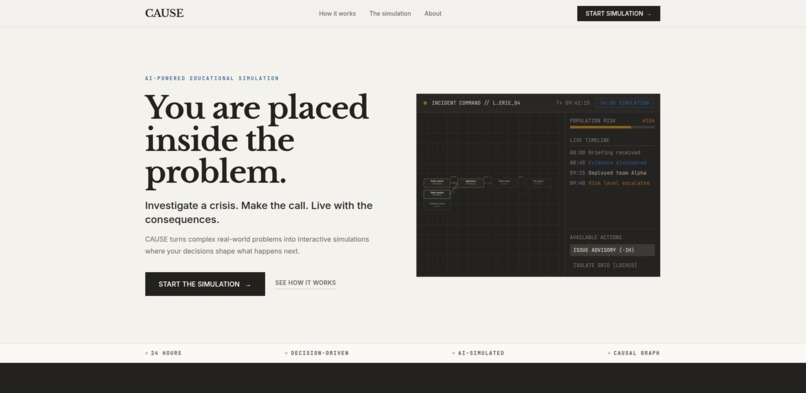
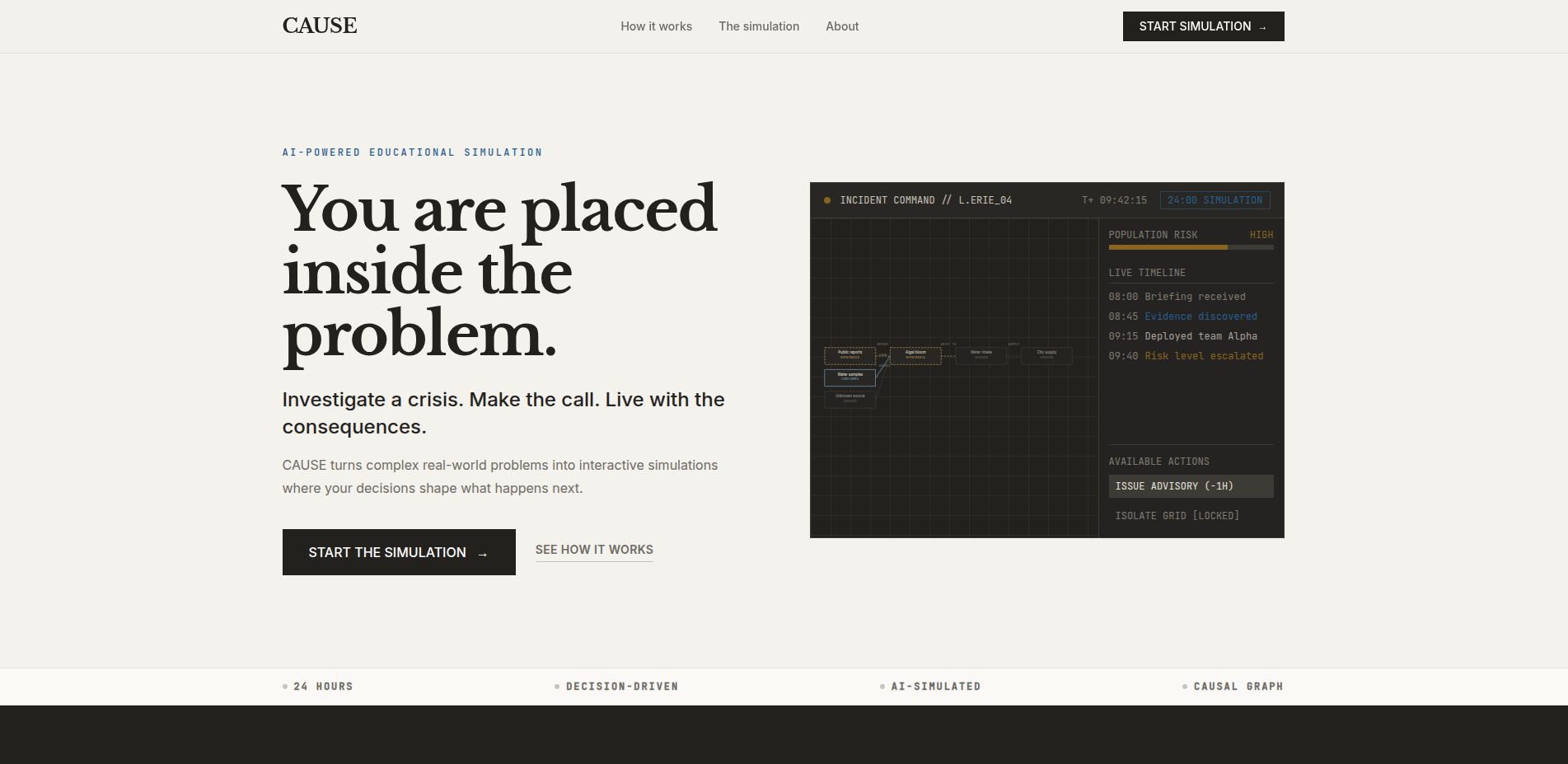
landing-page
-
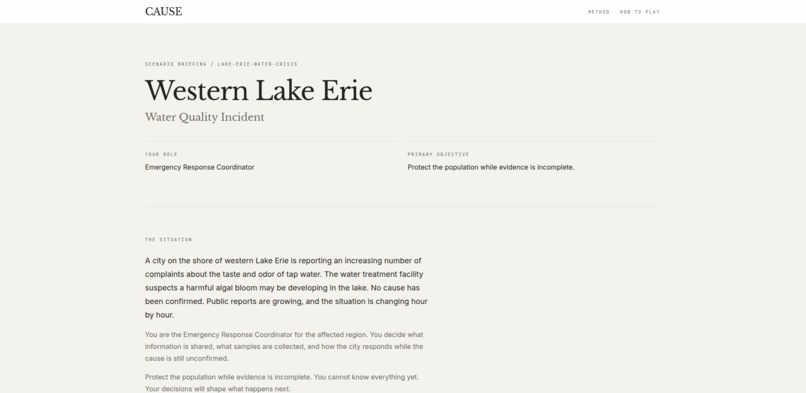
brief-section
-
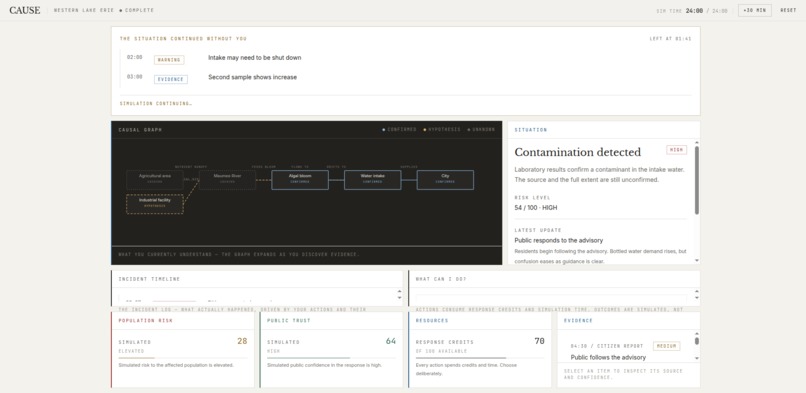
gameplay
Inspiration
Traditional education often gives students the answer before they ever have to make the decision. We wanted to explore a different question: what if students could actually experience the consequences of a decision? In real-world crises, people rarely have complete information. They have limited time, competing priorities, uncertain evidence, and decisions that can affect what happens next.
CAUSE was inspired by this gap between learning about a problem and being responsible for one.
What it does
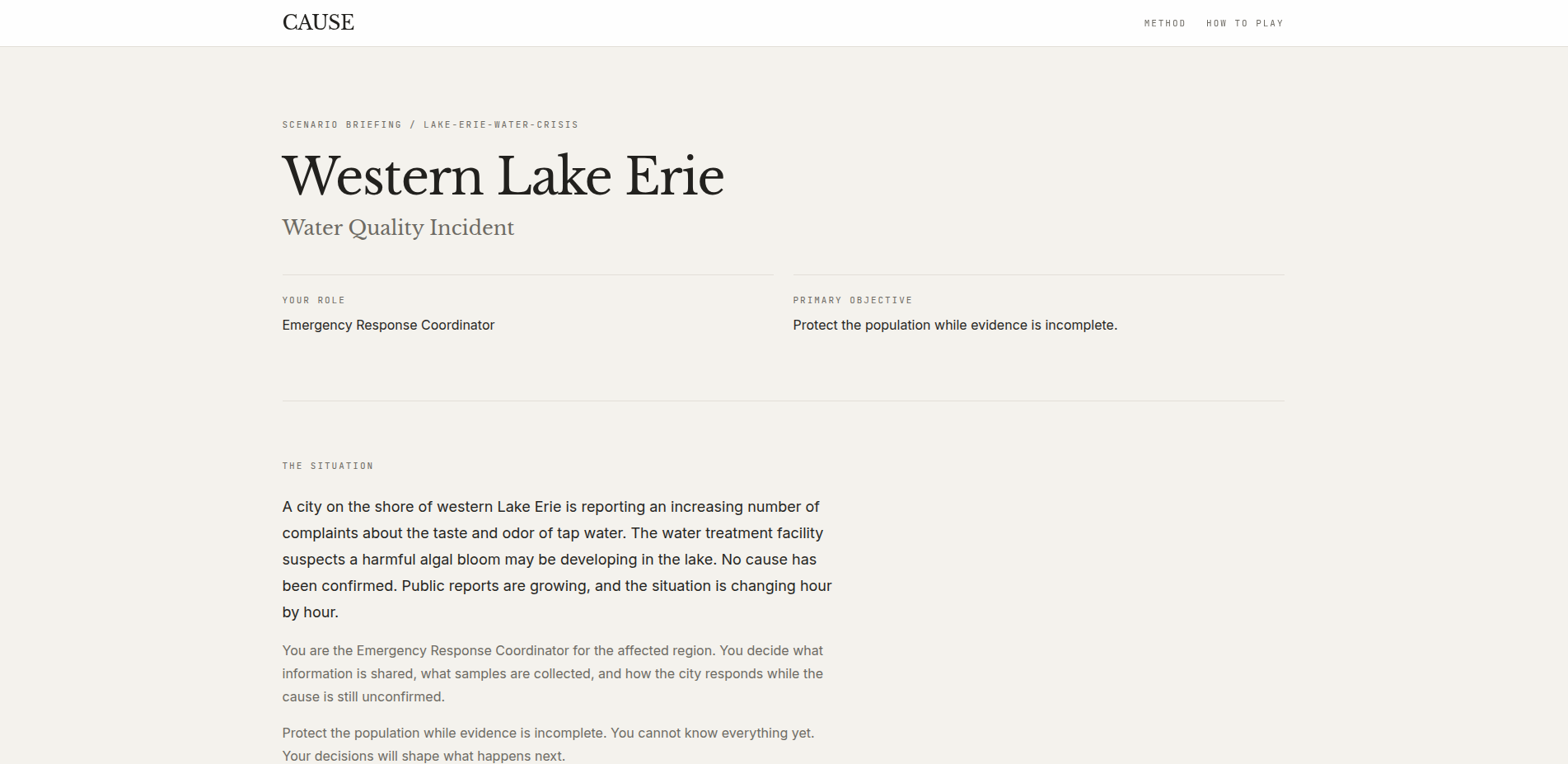
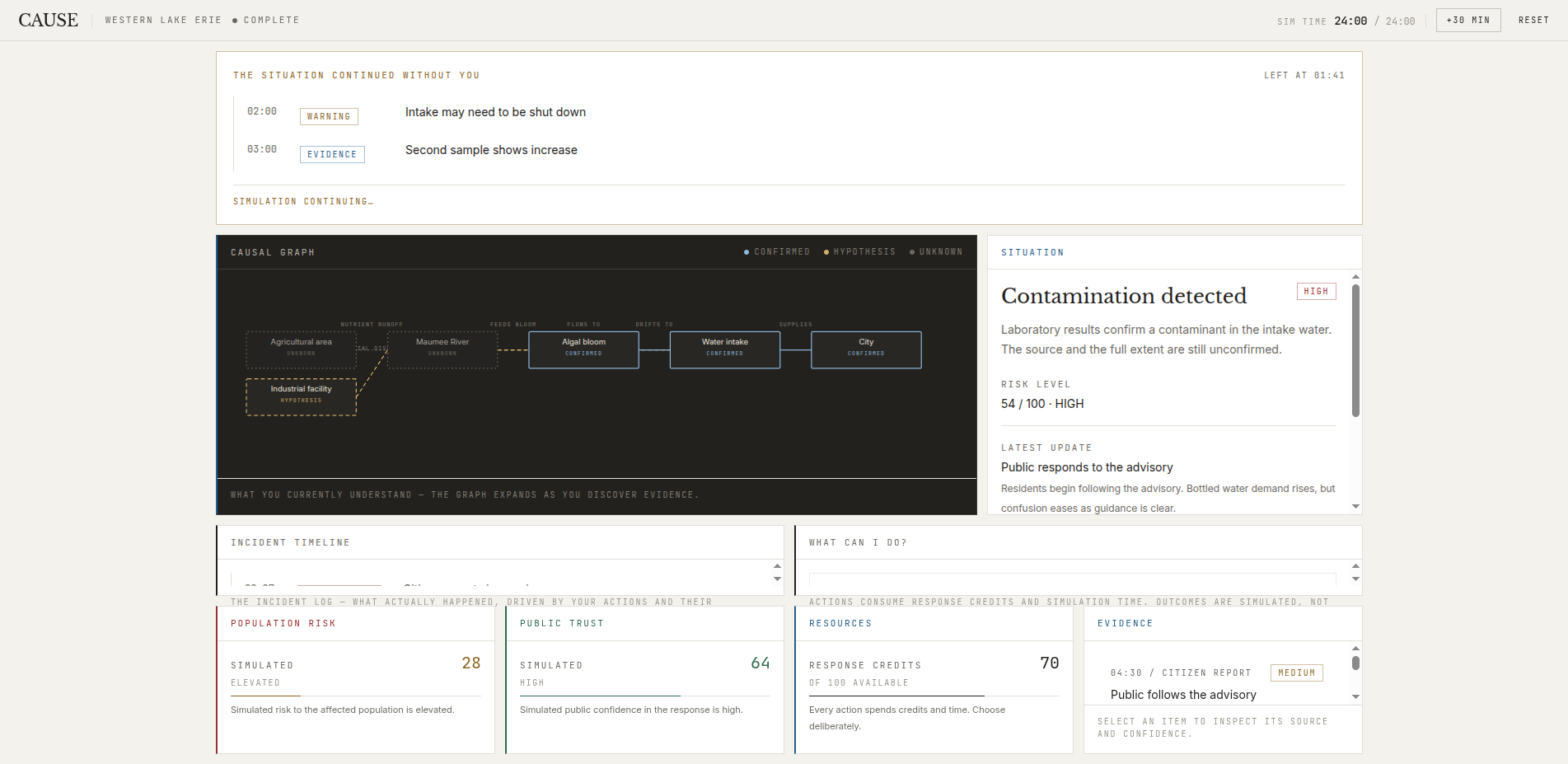
CAUSE is an AI-powered experiential educational simulation. Instead of answering questions about a crisis, students are placed inside one. They investigate evidence, build an understanding of the situation through a causal graph, choose actions, and watch the simulated world respond. Each simulation runs for 24 in-game hours. The timeline evolves dynamically as the situation develops, while the student has to balance factors such as risk, public trust, and available resources. Students can also leave the simulation early. The world continues without them until the 24-hour period ends.
At the end, CAUSE generates a Result and an AI-powered Autopsy explaining what happened, identifying the student's turning point, what they understood, what they missed, and what their decisions caused. The goal is not to find a single "correct answer." The goal is to understand how decisions create consequences.
How we built it
We built CAUSE as an interactive web application with an AI-driven simulation layer. AI is used to generate and evolve the scenario, including the incident timeline and responses to the student's actions. The application uses Groq as the primary AI provider with multiple model fallbacks configured through:
GROQ_MODELGROQ_MODEL2GROQ_MODEL3
For the final Result and Autopsy generation, we added Cerebras API to provide a larger token throughput budget for generating the final analysis.
The simulation interface combines several components:
- A 24-hour simulation clock
- An evolving incident timeline
- Evidence and investigation
- A "What Can I Do?" decision panel
- Simulation metrics
- A causal graph representing the student's understanding
- A Result page
- An AI-generated response Autopsy
We focused heavily on making the experience feel like a simulation rather than a chatbot or traditional educational dashboard.
Challenges we ran into
The biggest challenge was making an AI-generated simulation feel coherent. A crisis cannot simply produce random events. New events need to make sense in relation to previous events, the student's actions, and the underlying causal relationships. We also had to design an interface that could present a lot of changing information without overwhelming the student. Another challenge was making the causal graph meaningful. We wanted it to represent the student's evolving understanding of the situation rather than becoming another decorative visualization. Finally, we had to make the AI experience reliable enough for an interactive application, which led us to implement model fallbacks and use a separate provider for the final analysis.
Accomplishments that we're proud of
We are most proud of turning an educational concept into something students can actually interact with.
CAUSE lets a student:
Investigate → Decide → Experience → Reflect
Instead of simply showing the consequences of a historical event, the simulation allows the student to create their own path through the scenario. We are also proud of the Result and Autopsy experience. A student does not simply receive a score at the end. They receive an explanation of their response, including their turning point, missed evidence, causal relationships they failed to identify, and the resulting learning takeaway.
What we learned
We learned that experiential learning requires more than adding AI to an existing educational interface. The AI needs to support a coherent world. The interface needs to make uncertainty visible.
And most importantly, the student needs to feel that their decisions matter.
We also learned that a good simulation does not necessarily need to tell students what the "best" decision is. Sometimes the more valuable lesson is understanding the tradeoffs behind a decision and seeing what happens when you choose one path over another.
What's next for CAUSE: Learn by Living the Consequences
We want CAUSE to grow beyond a single crisis scenario. The next step is to support more scenarios, subjects, and educational contexts while making the simulation engine increasingly capable of modeling complex causal systems.
We also want to make the learning experience more measurable for students and educators, so that the simulation can reveal not only what decision someone made, but how they reasoned about the system behind it.
Ultimately, CAUSE is built around one simple idea: Don't just learn what happened. Experience what happens when you're responsible for what happens next.
Built With
- cerebras
- gpt
- groq
- next.js
- react
- tailwind
- typescript
- vercel

Log in or sign up for Devpost to join the conversation.