Inspiration
The core insight came from a frustration with how LLMs handle science: they summarize, they hallucinate, and they forget the graph structure of causality. A paper doesn't just say things — it asserts directed causal relationships with specific strengths, signs, and uncertainty bounds.
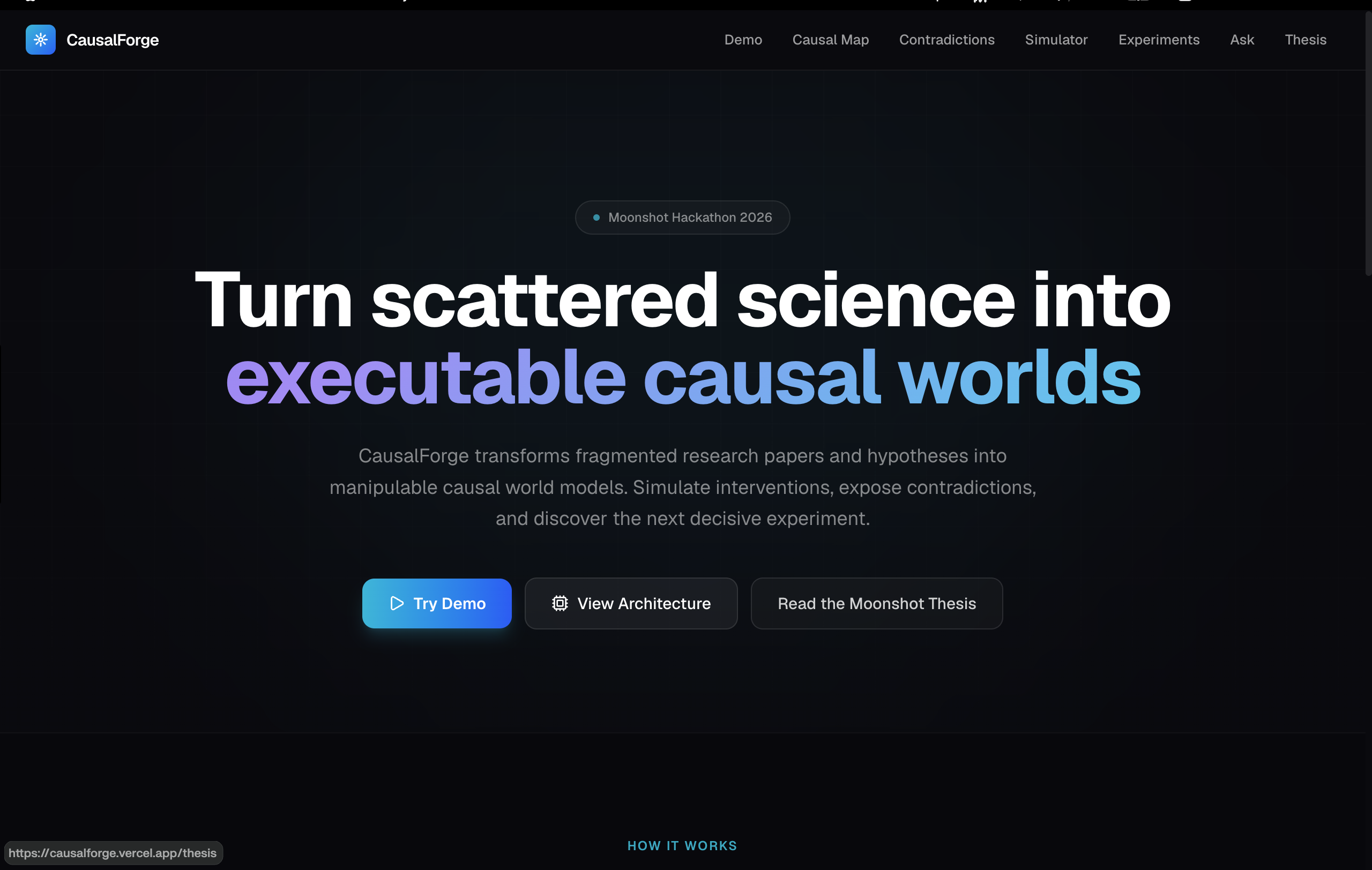
The question I wanted to answer: what if instead of summarizing papers, you compiled them into an executable causal program?
Challenges we ran into
Structured extraction at scale: Getting NIM to reliably output valid JSON claim objects required careful prompt engineering with strict schema enforcement and retry logic.
Graph consistency: Merging claims from many papers into a single coherent graph without duplication or contradictory overwrites required a canonical variable normalization step.
Simulation fidelity vs. speed: Full probabilistic Bayesian propagation is computationally expensive. The current engine uses a deterministic approximation (signed BFS with confidence decay) that is fast and inspectable.
What we learned
Causal graphs are a fundamentally better substrate for scientific knowledge than embedding vectors — they are inspectable, simulable, and falsifiable.
NVIDIA NIM's structured output capabilities are powerful enough to serve as a scientific parsing layer with the right prompting strategy.
MongoDB Atlas's document model is a natural fit for heterogeneous claim objects where schema varies by paper domain.

Log in or sign up for Devpost to join the conversation.