-
-
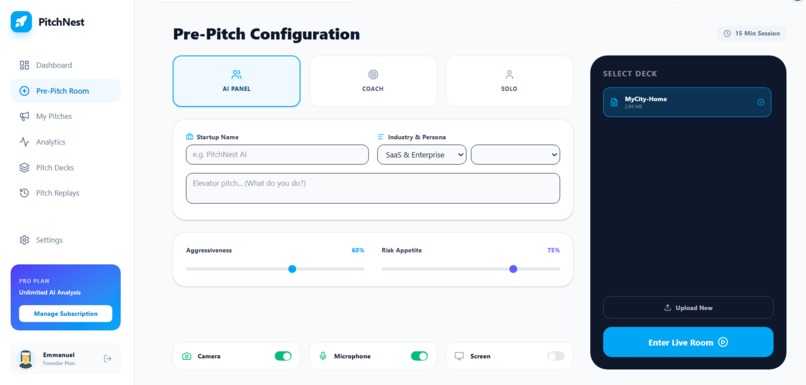
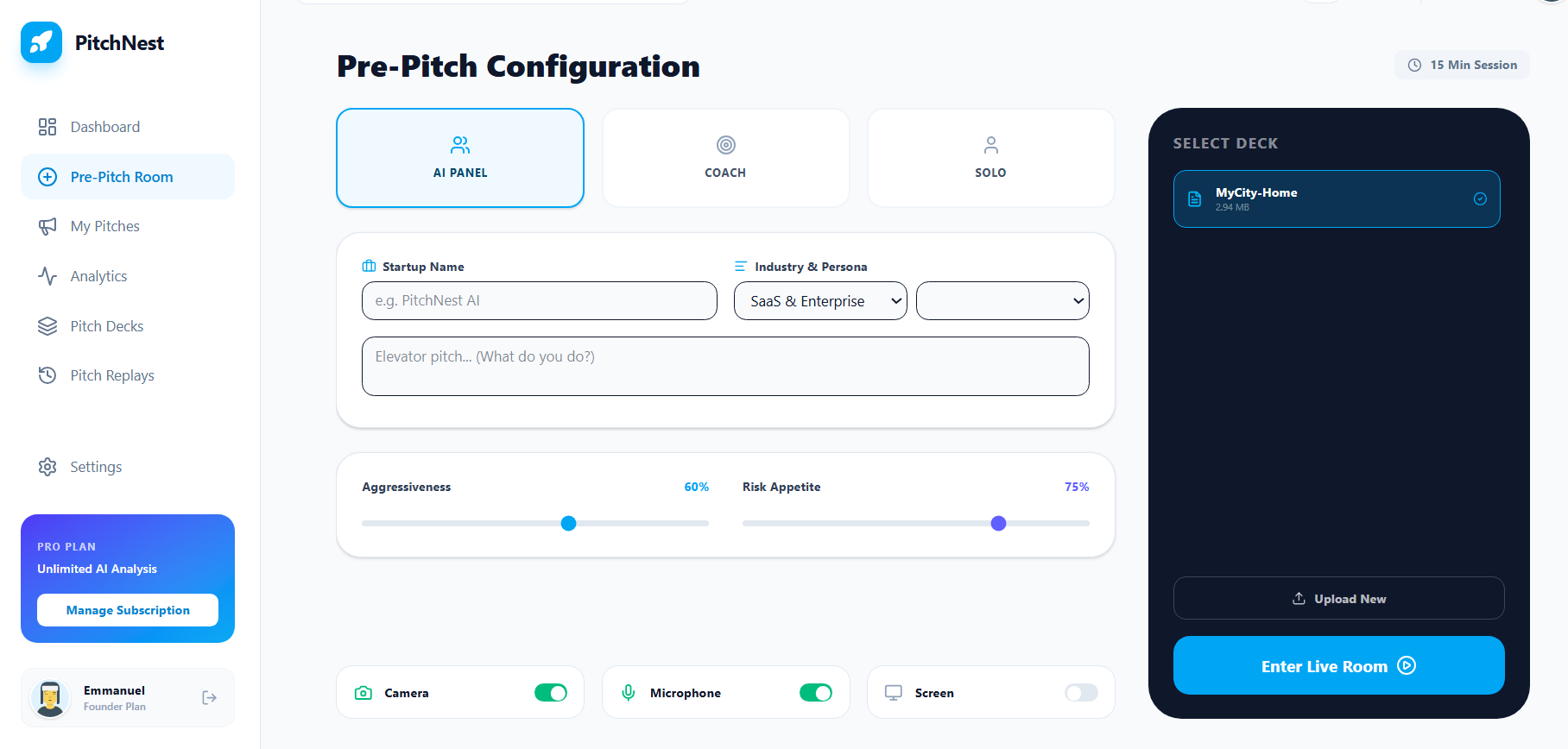
Pre-Pitch Setup
-
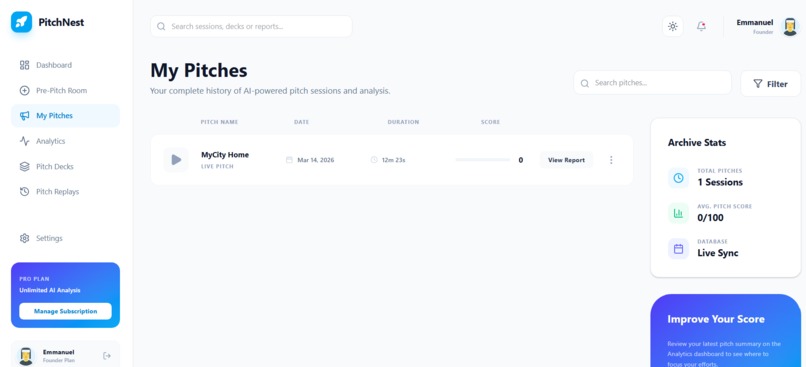
Logs of Pitches
-
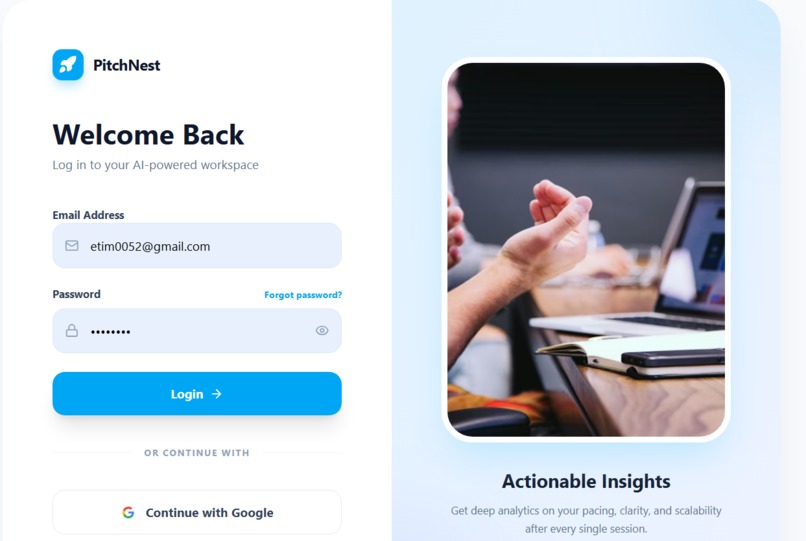
Login Page
-
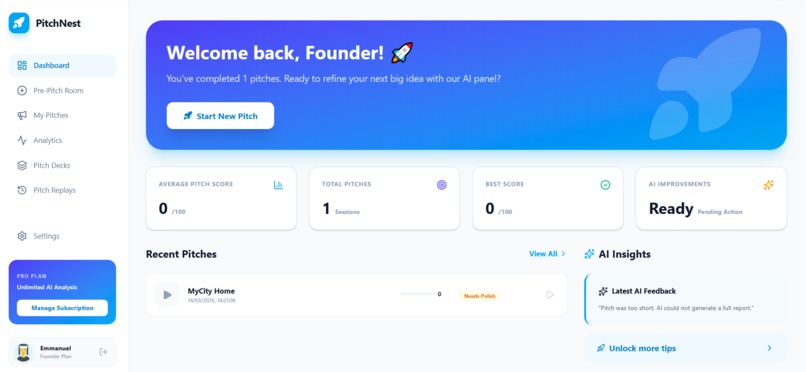
PitchNest Dashboard
-
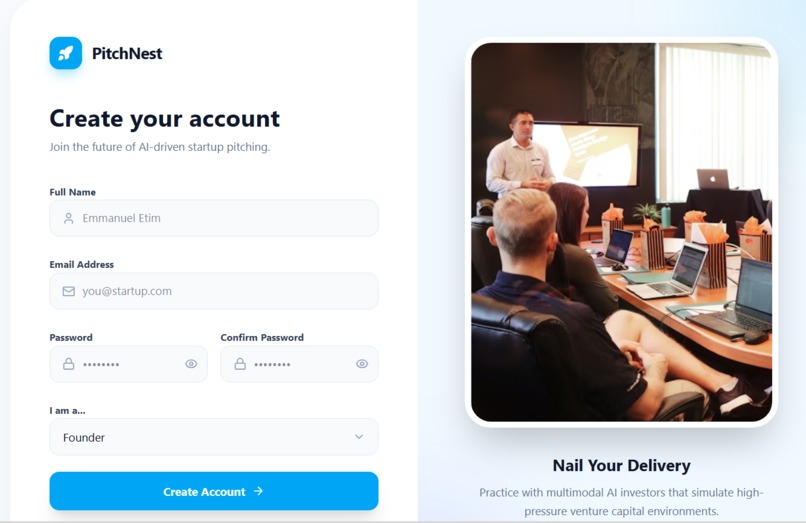
Signup Page
-
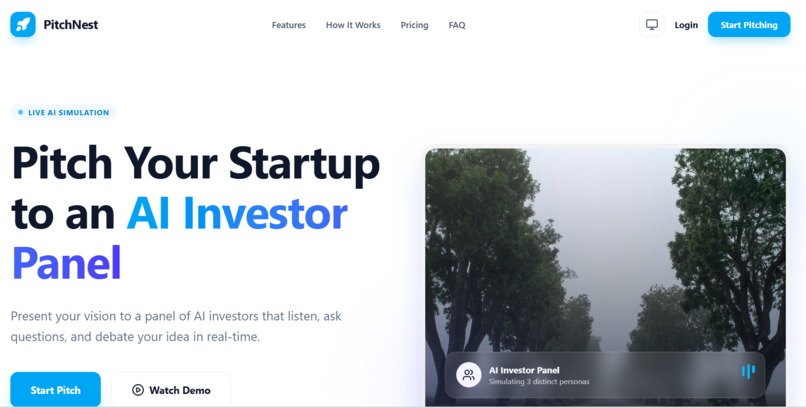
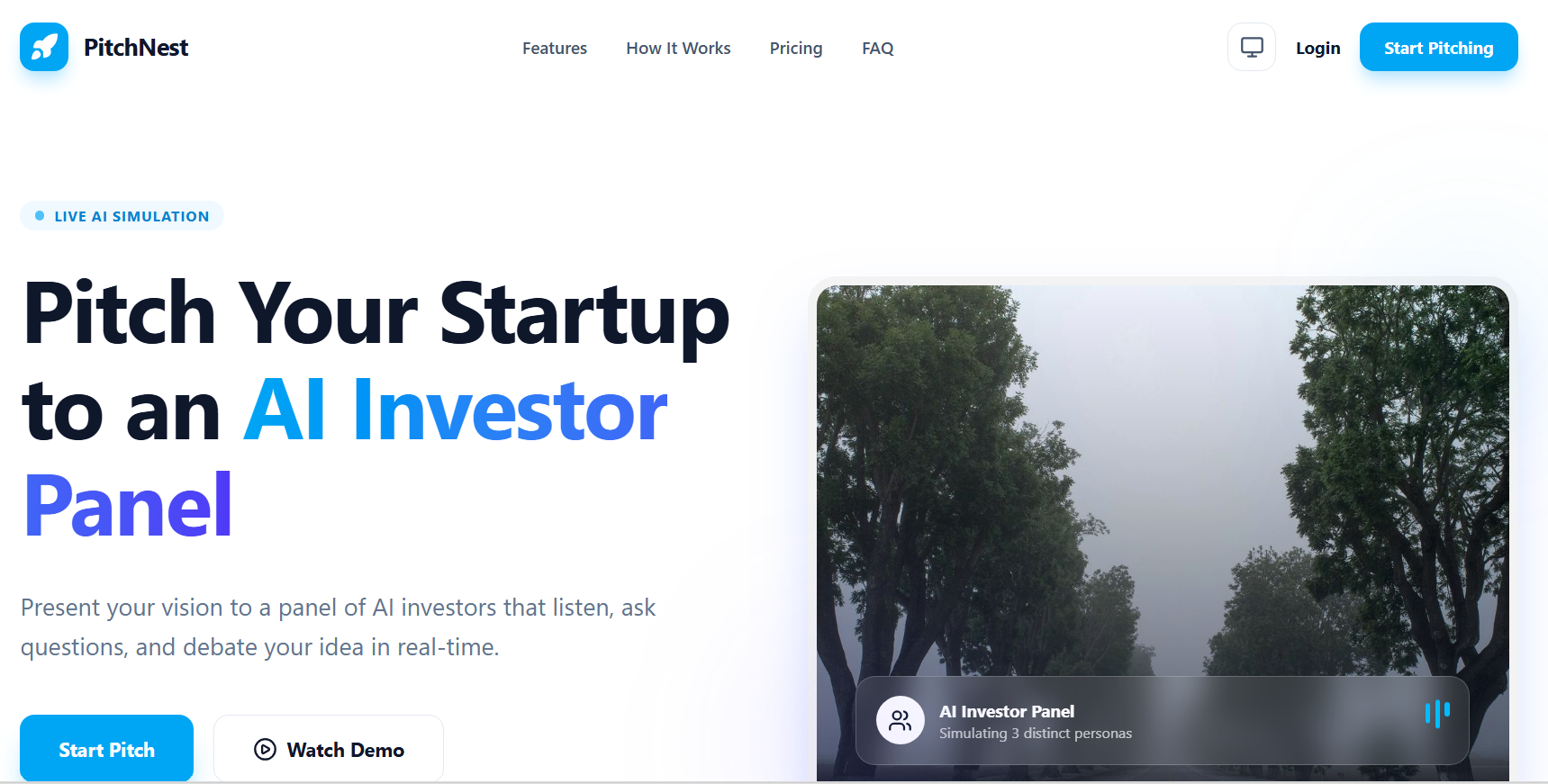
Landing Page
-
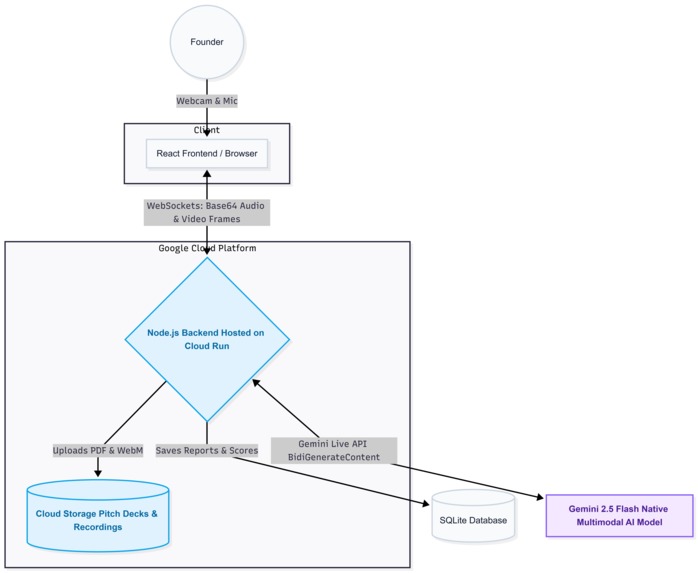
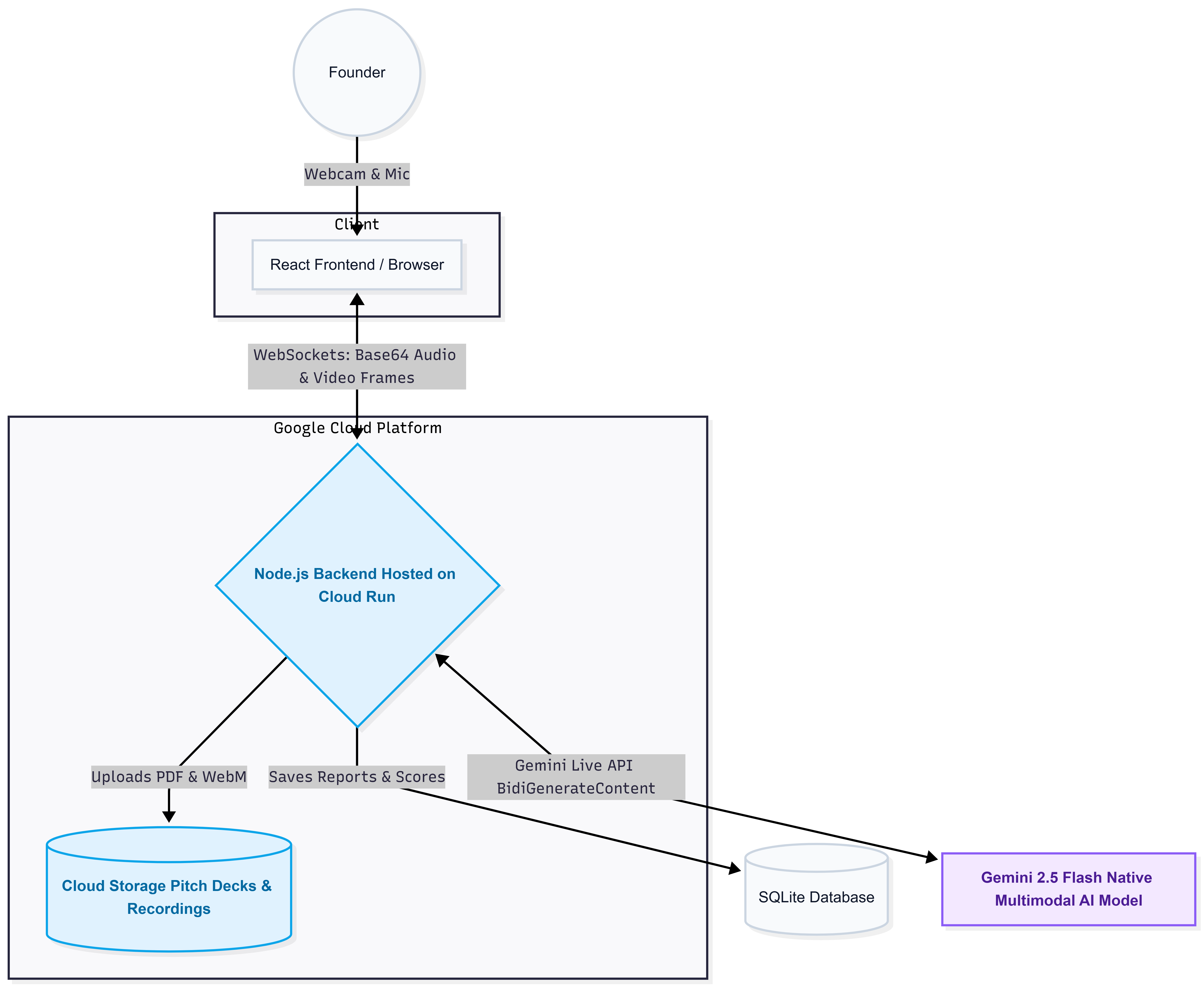
Flowchart of Ideas
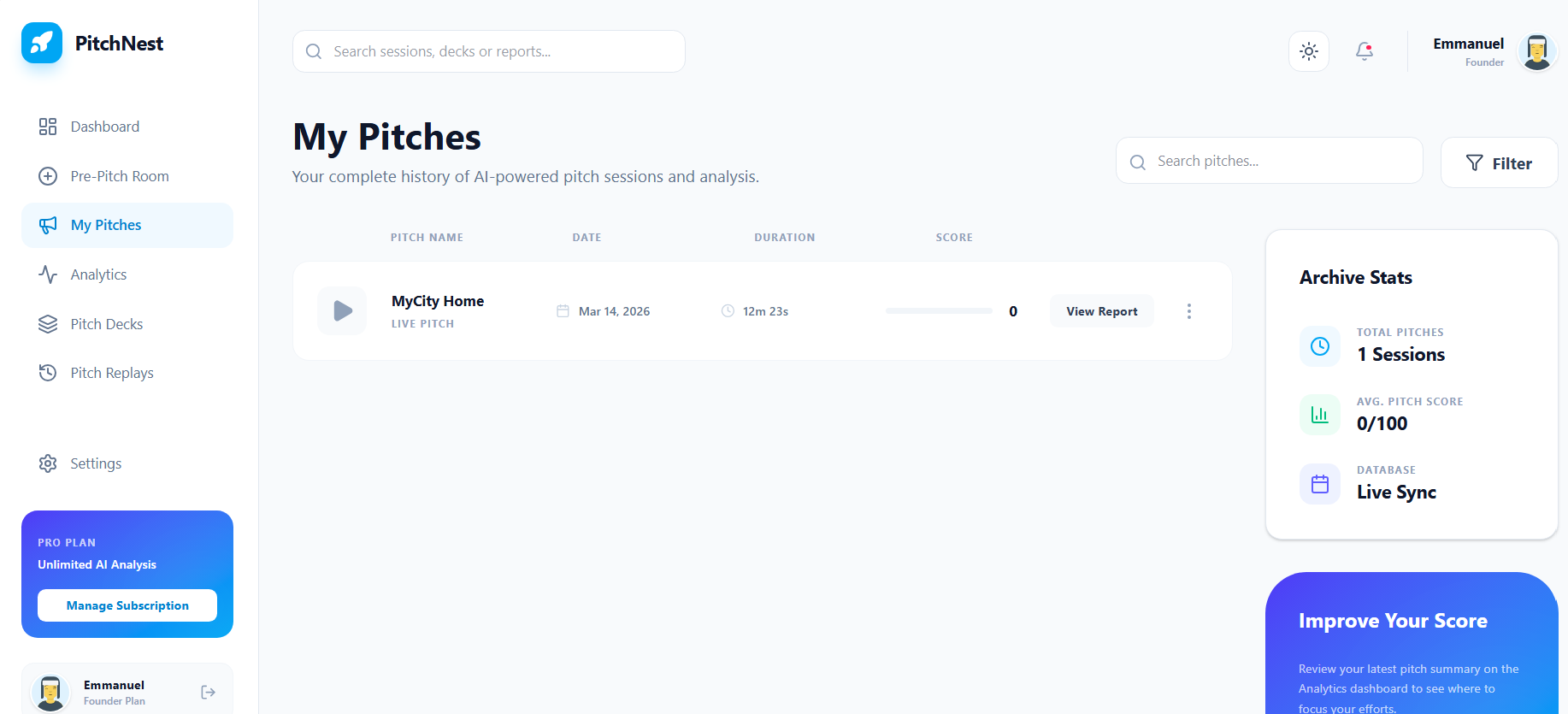
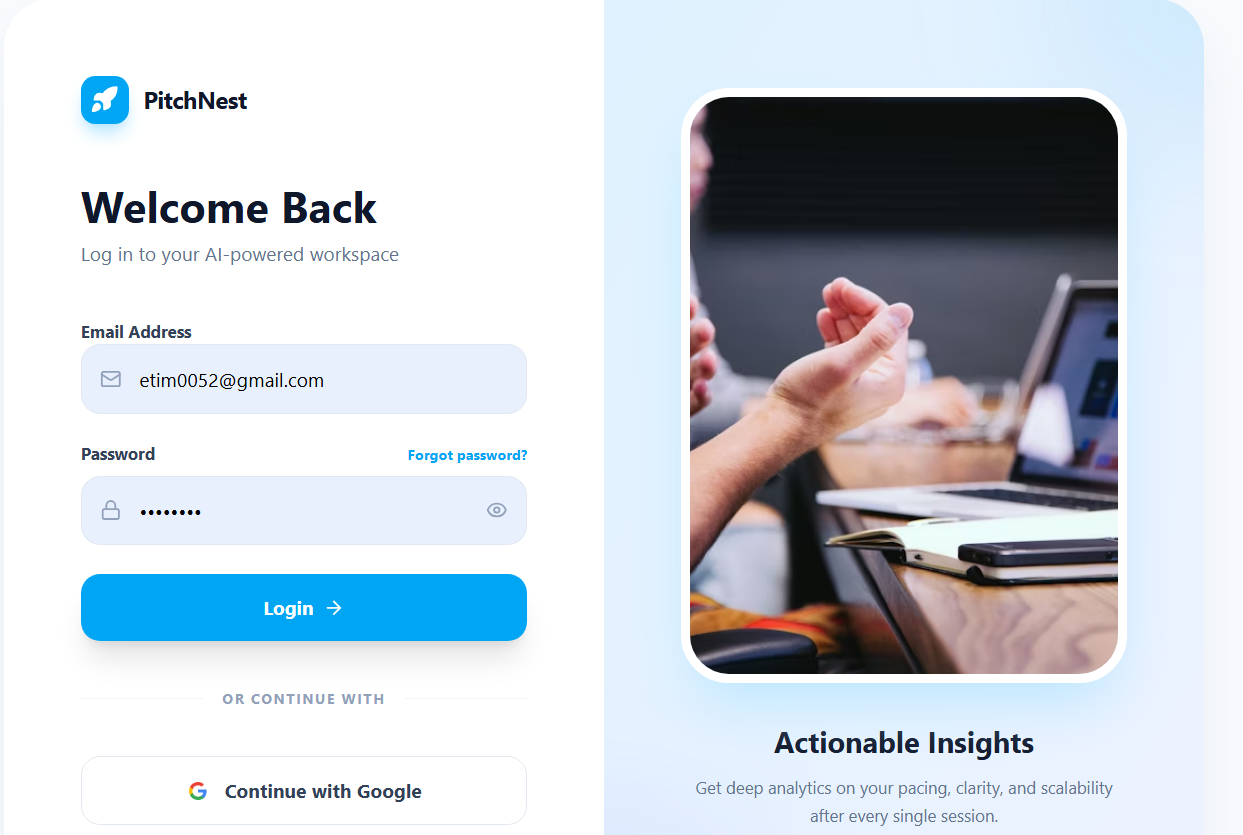
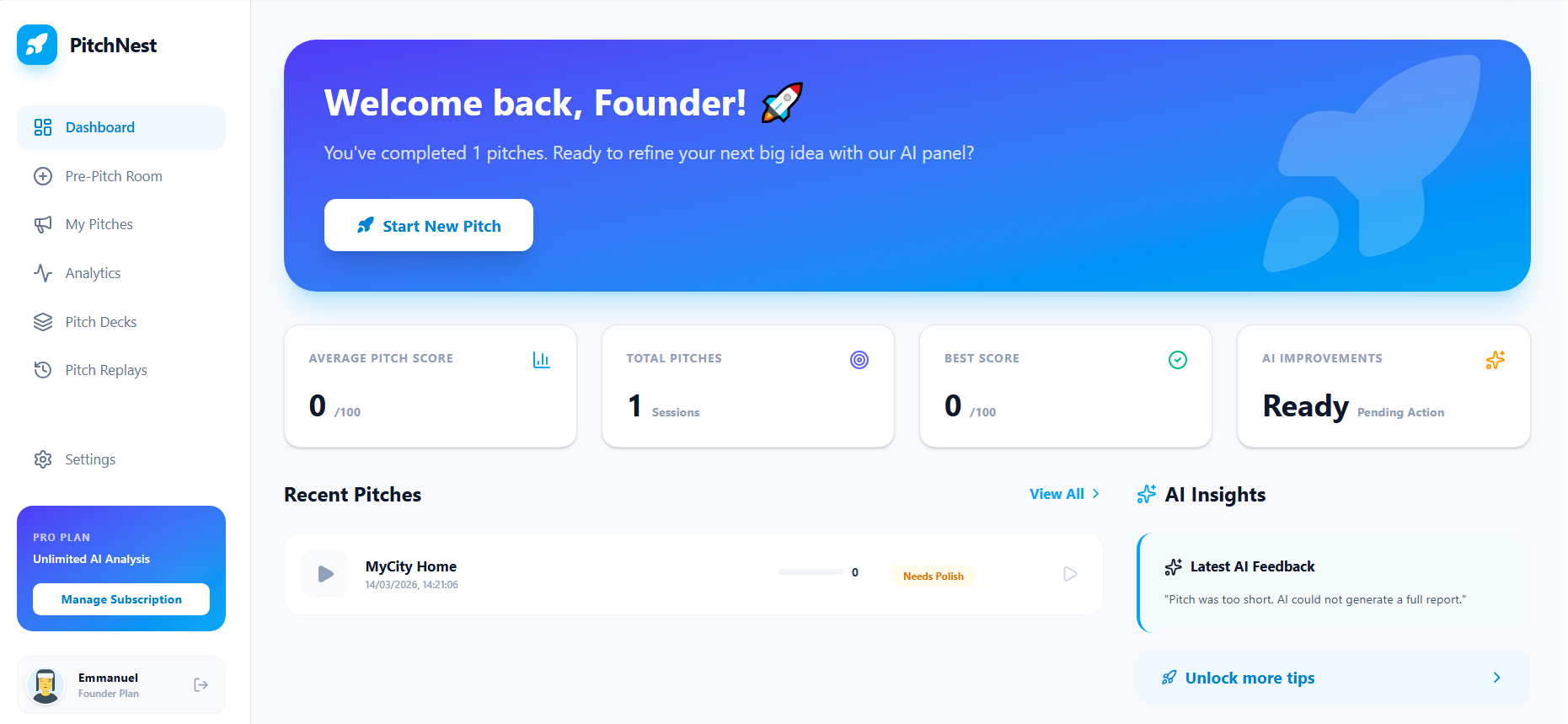
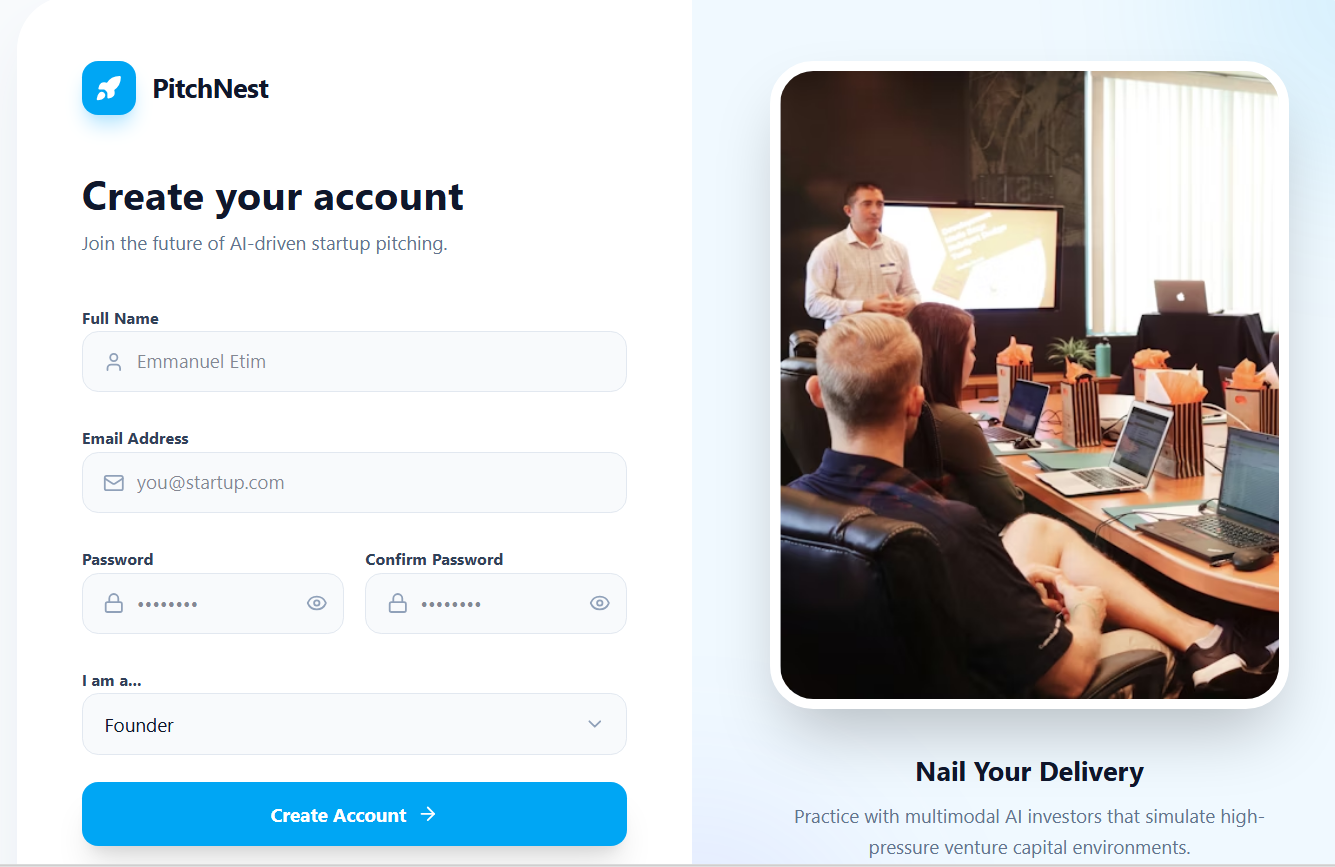
PitchNest: Face the Boardroom Before You Face the Board
Inspiration
Every great startup begins with a pitch, but the environment where founders practice is fundamentally broken. Practicing in front of a mirror doesn't prepare you for real interruptions, and pasting a pitch script into a standard AI text box feels entirely disconnected from the high-pressure reality of a VC boardroom.
We wanted to break the text-box paradigm entirely: build a simulator that triggers the same adrenaline a founder feels when pitching to real investors — one that listens while you talk, questions you the moment you go vague, and doesn't let you hide behind a script.
We built PitchNest: a real-time, voice-first AI investor panel that doesn't just take questions after your pitch — it listens live, interrupts when you ramble or dodge a hard number, and hands you a structured readiness report the moment you're done.
What It Does
PitchNest is a real-time, voice-first AI investor meeting platform.
- The Setup: Founders upload their PDF pitch deck and choose a session mode — a full three-person VC Panel, a supportive one-on-one Coach, or a no-pressure Solo practice run — plus an investor archetype (Angel, YC-style, Shark Tank, PE, Seed VC) and aggressiveness level.
- The Live Room: The founder joins over a persistent WebSocket connection and starts talking. Their mic audio streams to the server in real time; there's no camera involved — PitchNest today is audio-first by design.
- The Interaction: The panel — a lead partner, a financial analyst, and a technical partner, each with their own name and voice — listens while the founder speaks, then interrupts naturally: one question per turn, follow-ups that build on what was just said, and genuine barge-in if the founder tries to talk over a question. If a founder has pitched before, the panel remembers the previous session, greets them back by name, and probes whether last time's weaknesses got fixed.
- The Report: When the session ends, PitchNest scores the founder across four dimensions — delivery, clarity, scalability, and readiness — from their actual spoken words, and generates a branded, downloadable PDF with strengths, red flags, concrete fixes, and (on a repeat pitch) a score delta like "54 → 66, +12." Every report also gets a public, no-signup-required share link.
- Deck Check: Founders can also skip the live session entirely and get an instant structured audit of just their deck — verdict (Invest / Watch / Pass), a 0–100 fundability score, section-by-section completeness, and numbered red flags with fixes.
How We Built It
Our team of four divided the architecture to keep the live conversation feeling instant:
- Frontend & UI: A React 19 / TypeScript SPA styled with Tailwind CSS, using Radix UI primitives, Recharts for the analytics dashboard, and a custom
useMediaRecorderhook that captures clean, echo-cancelled microphone audio (video capture is deliberately disabled for now, so the camera never even turns on). - Backend Engine: A Node.js / Express server with a raw WebSocket (
ws) endpoint that orchestrates the whole live turn: it streams the founder's audio into a continuous speech recognizer, feeds recognized text to the language model, and streams the spoken response back out — all while tracking turn state so an interruption can cleanly cancel an in-flight response. - Speech Pipeline: Azure Cognitive Services Speech SDK handles both ends — continuous streaming speech-to-text with per-utterance confidence scores (so a garbled, low-confidence transcript gets a "can you repeat that?" instead of a nonsense answer), and neural text-to-speech with a distinct voice assigned per panelist (Marcus, Sarah, Chen, Riley, and others), so the panel actually sounds like different people without needing separate connections.
- AI Reasoning: Azure OpenAI (GPT-4o) powers both the live conversational turns and the post-session evaluation. System prompts enforce strict panel behavior — stay quiet while the founder is presenting, ask one question at a time, challenge internal inconsistencies (does the CAC reconcile with the LTV? is the TAM actually derived, not just asserted?) rather than asserting outside facts the model can't verify.
- Data & Storage: Supabase (Postgres + Auth + Storage) holds users, sessions, transcripts, and uploaded decks; JWT sessions with bcrypt password hashing power auth, including Google sign-in and a sign-in-method lock to prevent account confusion. pdf-parse extracts deck text as AI context, and PDFKit generates the branded report PDFs.
- Cloud Infrastructure: The app is containerized and deployed to Google Cloud Run with
--min-instances=1to keep WebSocket connections warm and stable. Resend sends verification and password-reset email.
Challenges We Ran Into
Getting barge-in right without false positives. A cough, a door slam, or someone thinking out loud shouldn't cut off the AI mid-sentence — but a real interruption needs to feel instant. We built client-side voice-activity detection tuned to a sustained ~600ms of speech above a noise floor before it counts as an intentional barge-in, paired with an abort controller on the server so a cancelled turn stops burning tokens the moment it's interrupted.
Keeping live responses fast as sessions get long. Sending the entire conversation history to the model on every turn made responses progressively slower. We cap what the live model sees to the most recent turns, while the full transcript is still kept in memory for the end-of-session evaluation — so the panel stays quick without losing context for the final report.
Being honest about a live speech recognizer. Real founders have accents and real speech recognizers make mistakes. Rather than silently penalizing a founder for a recognition error, we feed the evaluator raw, unedited transcripts and explicitly instruct it to read likely mis-transcriptions in context — so an ASR hiccup doesn't tank someone's clarity score.
Sessions surviving a refresh. An accidental page reload used to kill a live pitch outright. We rebuilt session state so a refresh mid-pitch reconnects cleanly instead of losing the founder's progress.
Accomplishments That We're Proud Of
- A panel that actually sounds like a panel. Three distinct personas, three distinct neural voices, one question at a time, real barge-in — it feels like being interrupted by a person, not prompted by a chatbot.
- Founder memory across sessions. "Pitch Again" isn't just a re-run: the panel greets a returning founder, remembers their prior score and specific weaknesses, and asks whether those were fixed — turning practice into a measurable improvement loop instead of a one-off.
- A no-session product on top of the same engine. Deck Check reuses the same evaluation backbone to give founders an instant, structured audit of just their deck — no live pitch required — which we shipped early because founders wanted feedback every time they touched a slide, not just before a full practice session.
- Reports people actually want to share. Every session produces a branded PDF and a public share link, so a founder can hand a co-founder or advisor the readiness report directly instead of screenshotting a chat window.
What We Learned
Designing for continuous, interruptible conversation is a different discipline than designing for request/response chat — you're building for barge-in, silence handling, and turn-taking, not loading spinners. We also learned to be disciplined about what the AI is allowed to claim: rather than have the model assert external facts it can't verify (e.g., "your TAM is fabricated"), we constrain it to challenge internal consistency in the founder's own numbers, which keeps the panel sharp without inventing false evidence. And on the infrastructure side, keeping a WebSocket-based live session stable on Cloud Run meant paying close attention to instance warm-up and connection lifecycle, not just request latency.
What's Next for PitchNest
Vision Feedback Engine (next up): turning on the camera. We'll stream video over WebRTC, sample it for eye contact, posture, and facial expression, and add a "Delivery – Visual" score alongside the existing four dimensions — plus timeline annotations on the replay showing exactly when a founder looked away or lost composure.
A deeper Health Audit Engine: slide-by-slide error locations (not just whole-deck feedback), granular sub-scores for TAM validity, margin health, and storytelling, and a text-based AI investor debate mode that doesn't require a live session at all.
Beyond the individual founder: a social layer with cohort benchmarking, leaderboards, and small AI-moderated peer pitch groups — and eventually a two-sided marketplace where verified, pre-screened founders can be discovered by real investors.
Built With
- express.js
- framer
- gemini-2.5-flash-native-audio-preview-12-2025
- node.js
- radix
- react
- recharts
- sqlite
- tailwind
- typescript
- websockets
- ws


Log in or sign up for Devpost to join the conversation.