-
-
Logo of the app
-
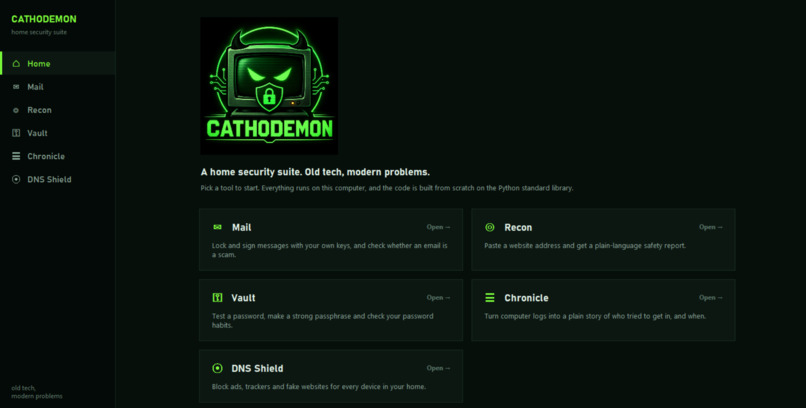
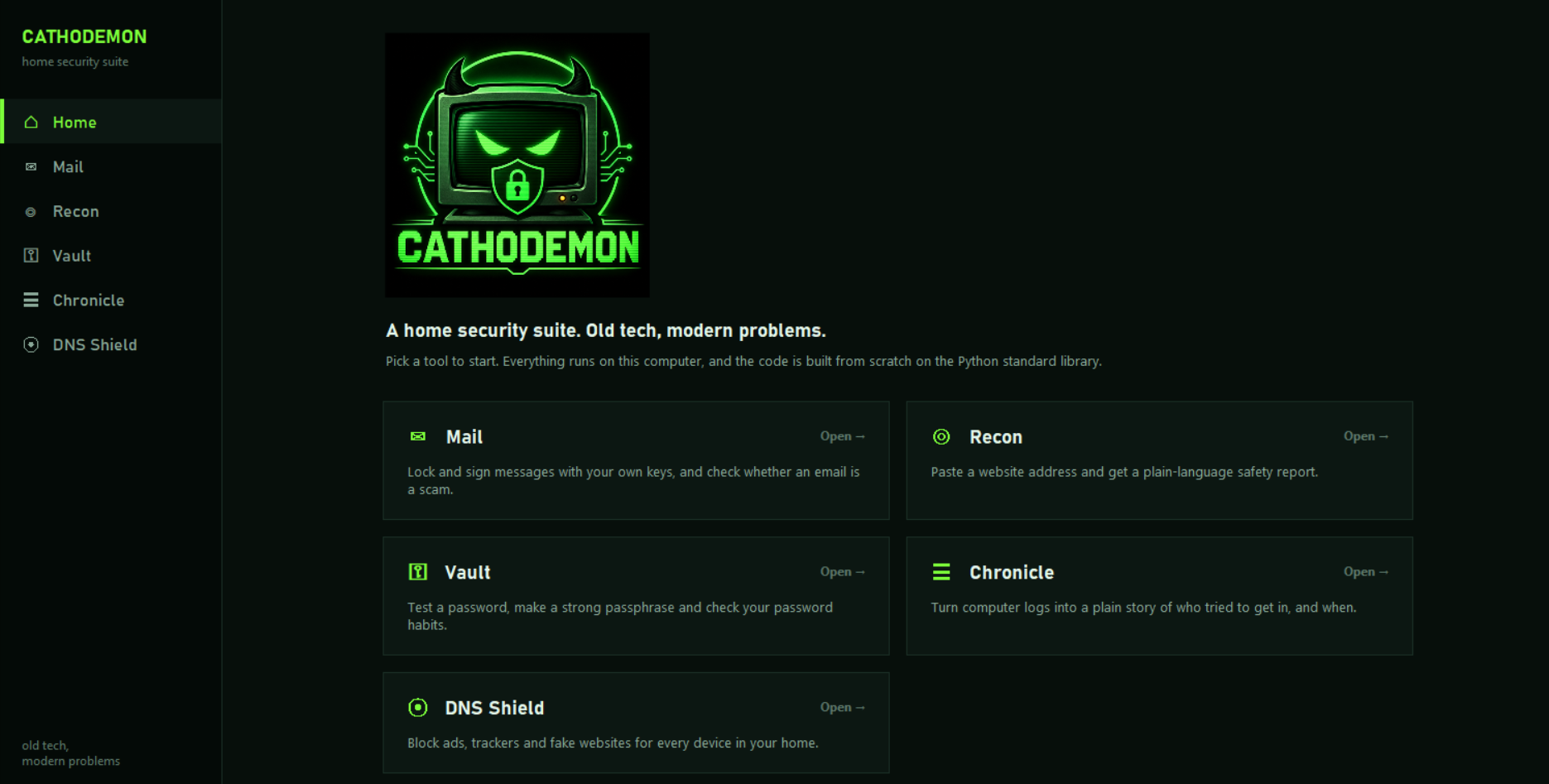
Home page with several categories stitched together.
-
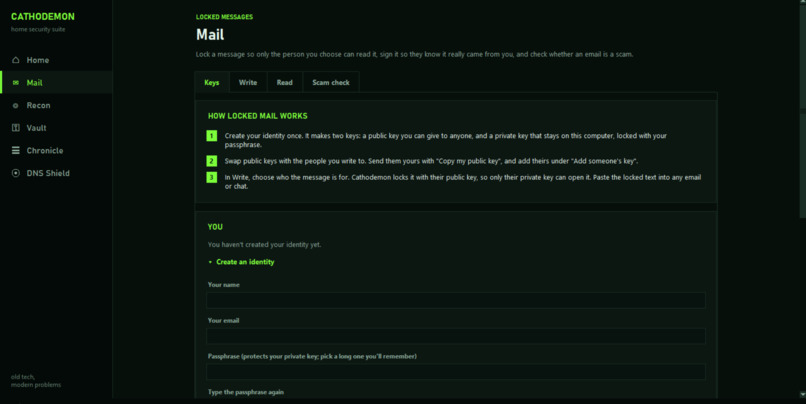
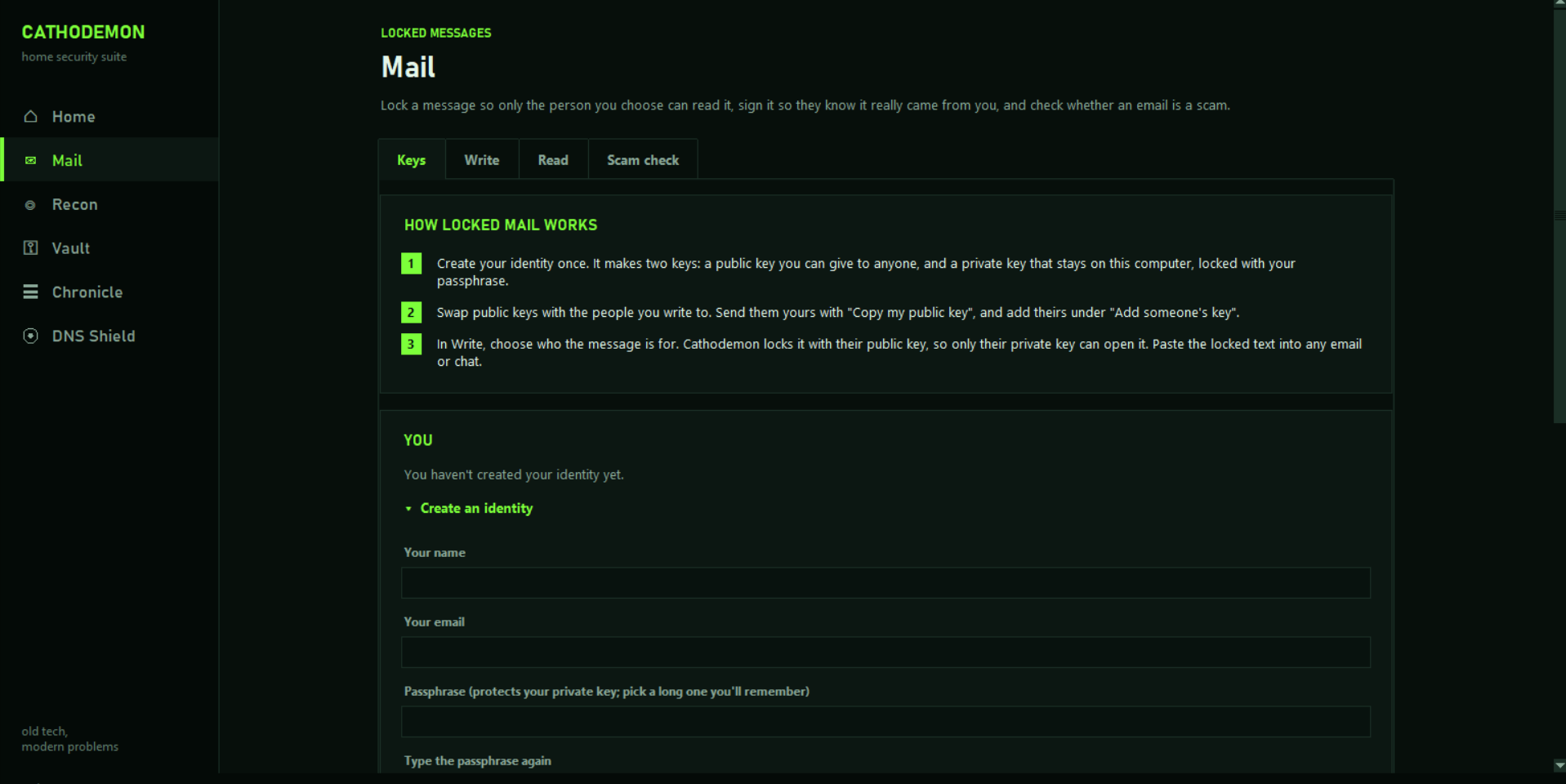
Mail section- send an encrypted mail or check whether the mail you received is a phishing email.
-
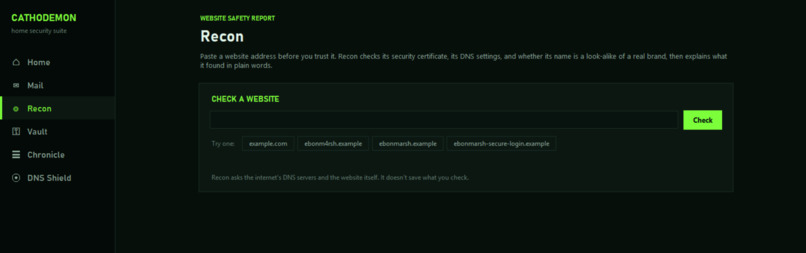
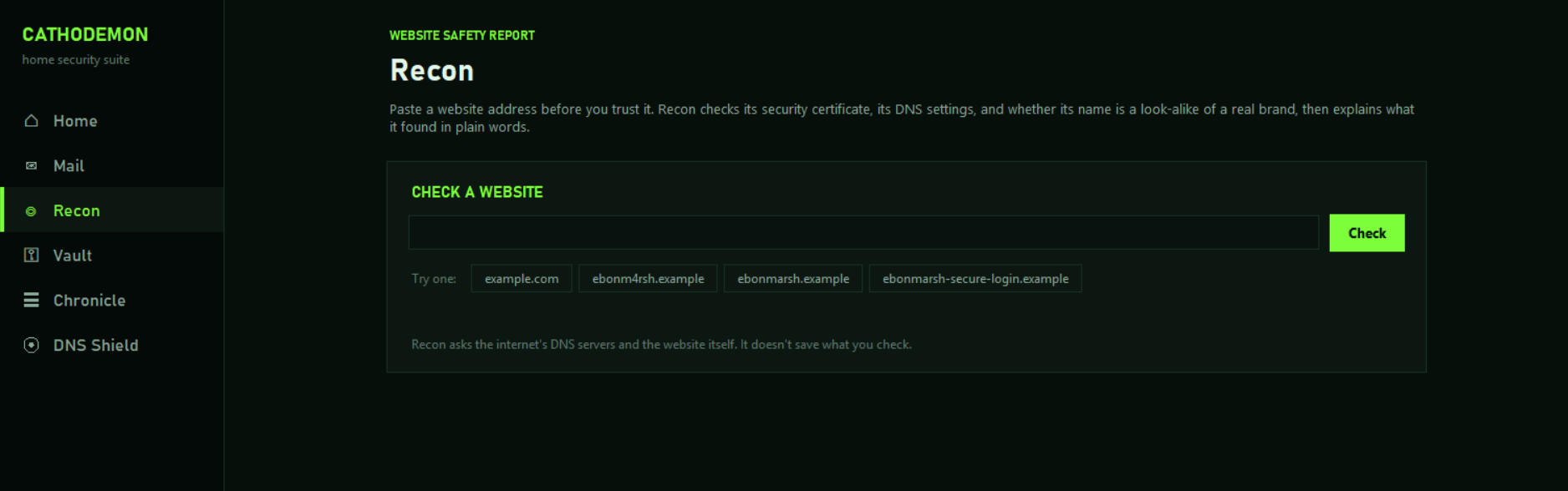
Recon - scans the website to check if its legit.
-
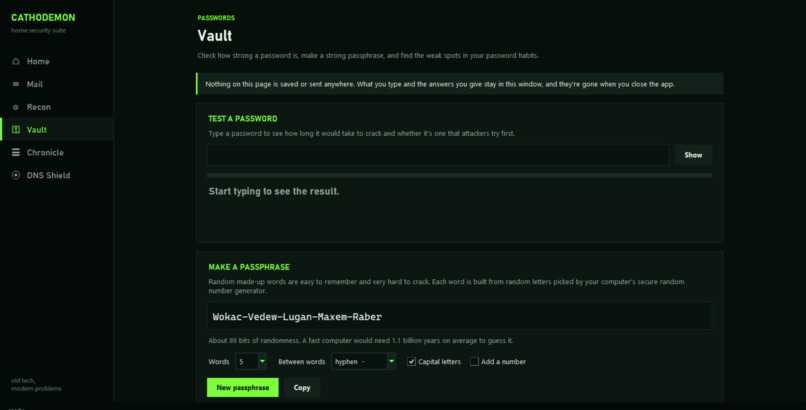
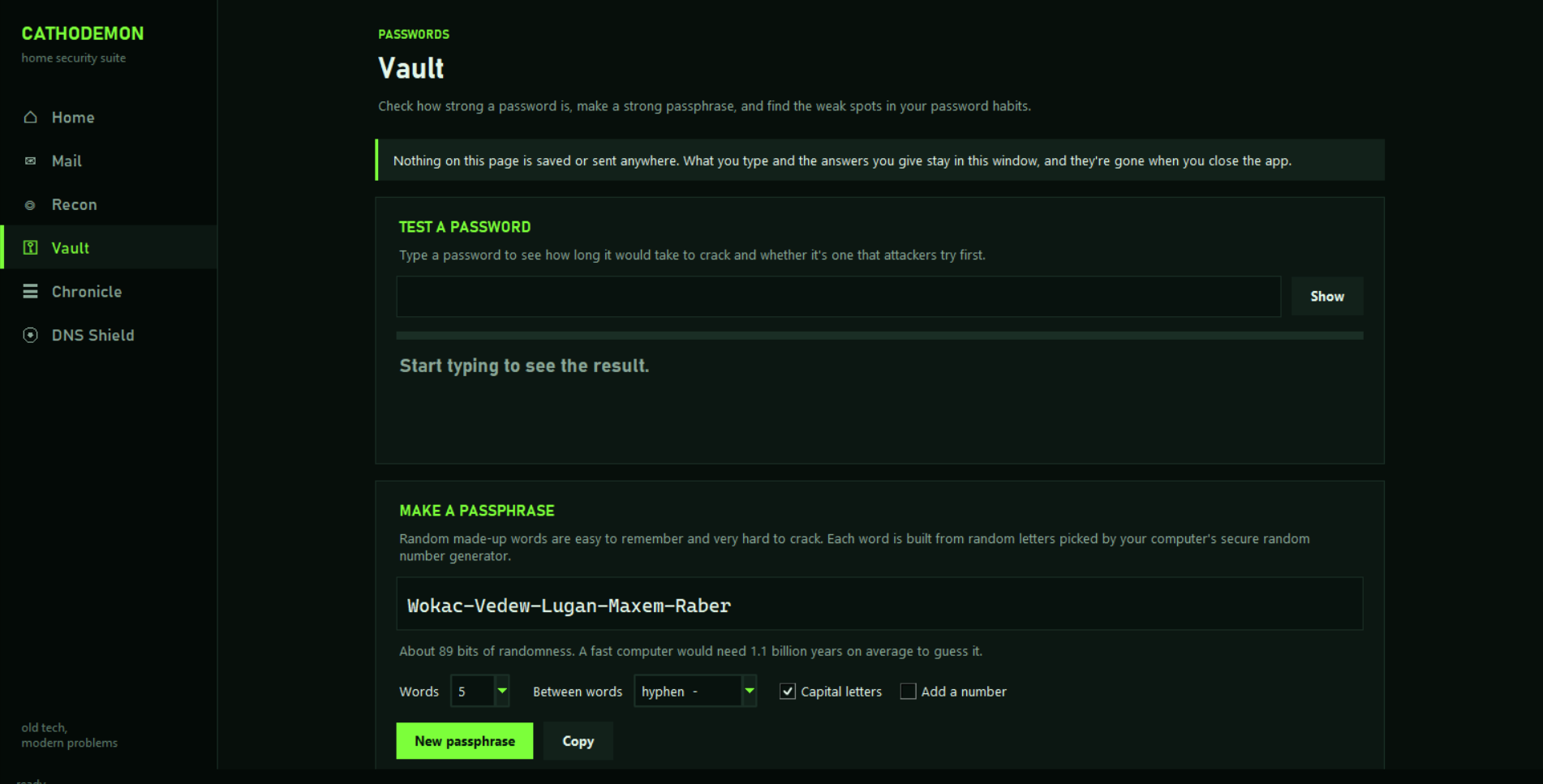
vault - Checks for password security, and generates strong passwords.
-
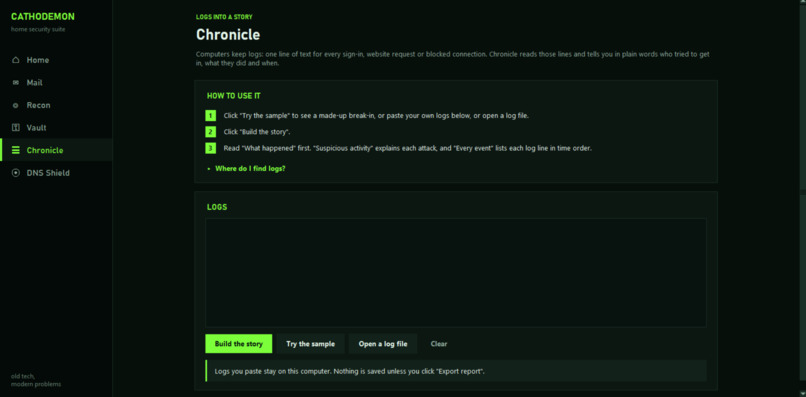
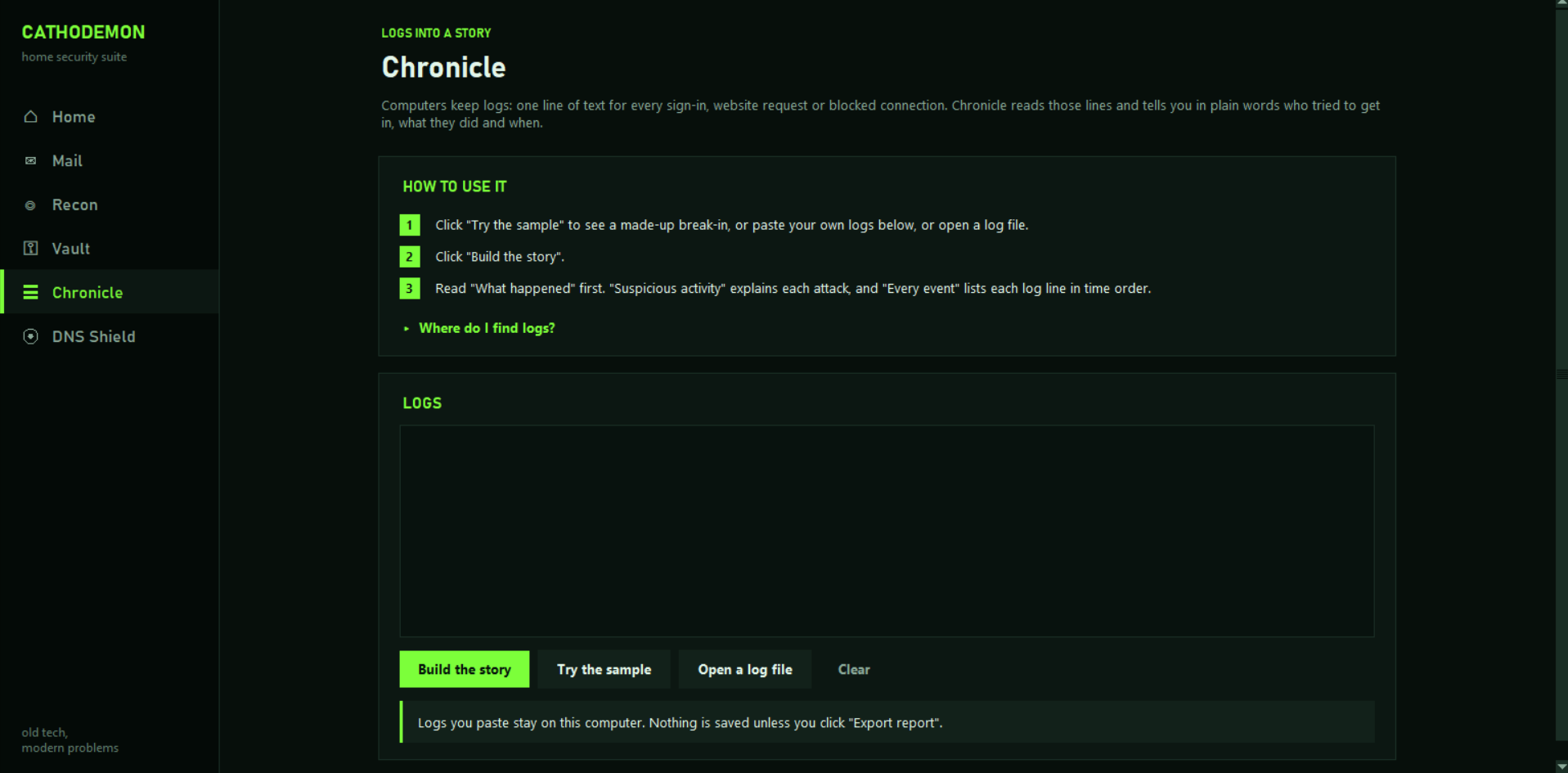
Chronicle - keeps system logs.
-
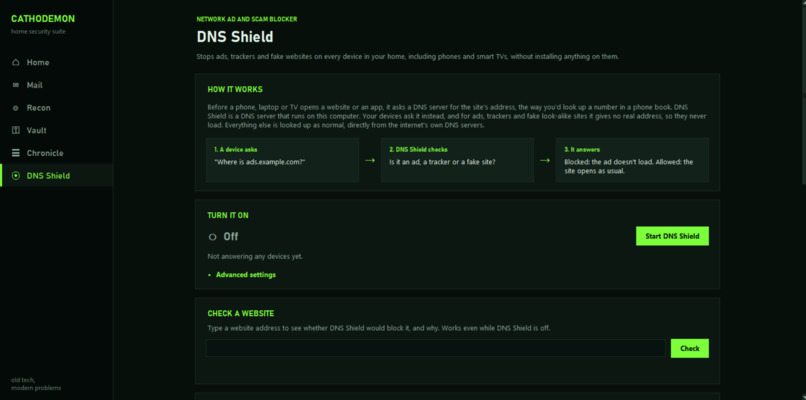
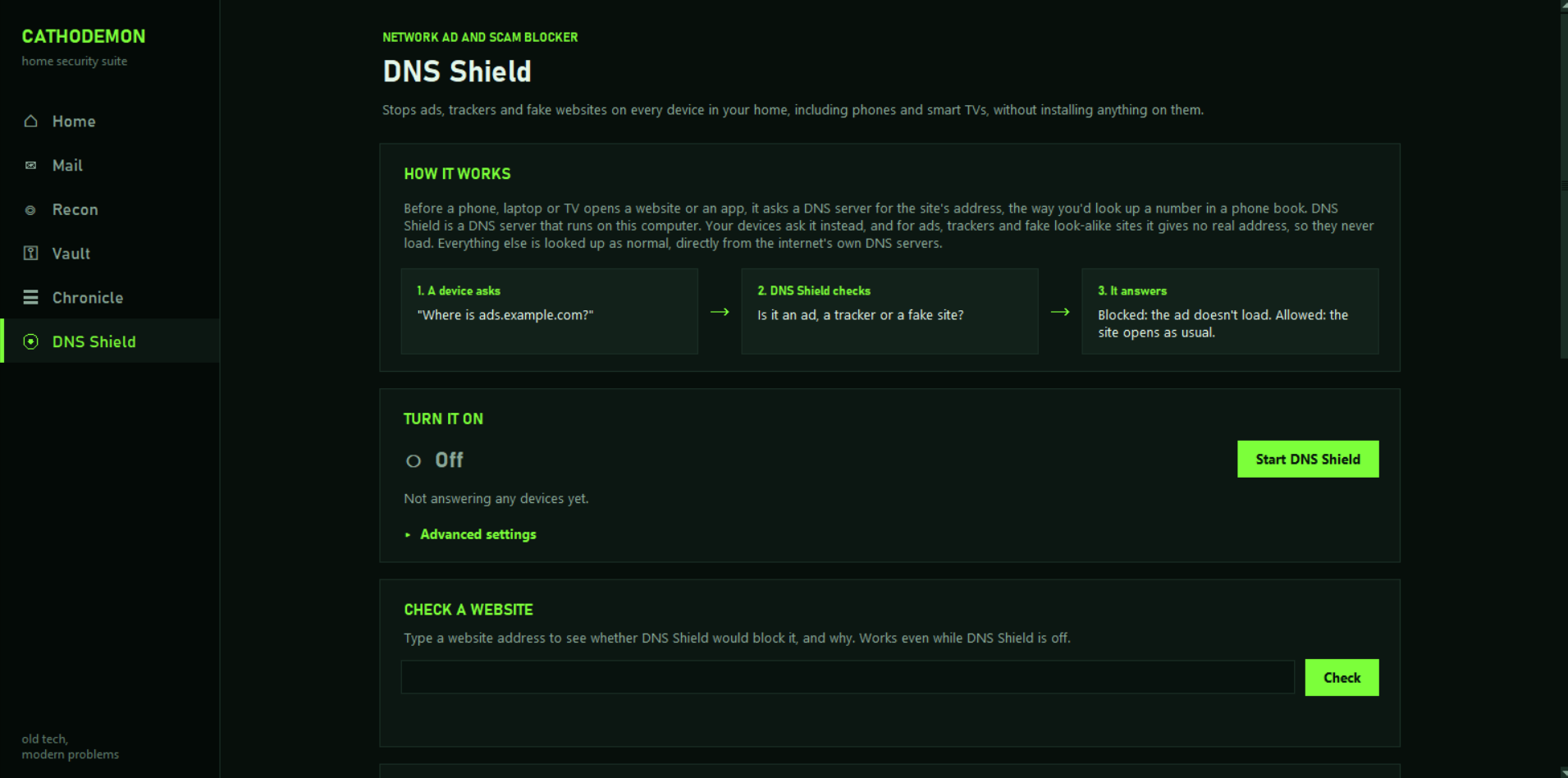
DNS - works as an adblocker and more.
Inspiration
Most security tools live in the cloud, cost money, or hide what they do. For Kiroween's Resurrection theme I wanted to revive old-school security ideas (PGP-style encryption, finger/whois lookups, diceware passphrases, the hosts-file/DNS sinkhole, and log forensics) and aim them at modern home problems: phishing, weak passwords, trackers, and not knowing whether a link is safe. Two rules shaped everything: it all runs on your own machine with nothing phoning home, and every line is built from scratch on the Python standard library, with no pip installs. The name fits the look. Cathodemon is the cathode-ray tube behind an old terminal plus a demon for Halloween, and a pun on daemon, the quiet background process that DNS Shield is.
What it does
Cathodemon is a green-on-black desktop suite with five tools:
- Mail — lock and sign a message so only the person you choose can read it, plus a plain-language check for whether an email is a scam.
- Recon — paste a website address and get a safety report: certificate age, DNS records, and look-alike or homograph name tricks, all explained in plain words.
- Vault — test a password's strength, check it against an offline leak list, and generate memorable passphrases. The entropy is transparent, so five random words give about 89 bits: $$H = w\left(3\log_2 21 + 2\log_2 5\right) \approx 17.8\,w \text{ bits}$$
- Chronicle — turn raw SSH, web and firewall logs into a plain story of who tried to get in, and when.
- DNS Shield — a DNS server for your whole home network that blocks ads, trackers and fake look-alike sites for every device, with nothing to install on the phones and TVs.
Everything stays on the device. It is an educational project: the cryptography matches the RFC test vectors but is not audited, so the app itself tells you to use GnuPG or age for secrets that really matter.
How I built it
It is a Tkinter app with a clean split between logic (core/) and screens (ui/), and it was built with Kiro from start to finish. Because the standard library has no modern cryptography, I implemented my own: RSA with OAEP and PKCS#1 v1.5 signatures (RFC 8017), ChaCha20-Poly1305 (RFC 8439), and hashlib.scrypt to protect private keys. DNS Shield has its own DNS wire-format codec, a resolver that walks from the root servers, and a sinkhole server. Recon has its own X.509 certificate parser and look-alike detector; Vault uses a transparent strength model, \(H = L\log_2 R\) for a password of length \(L\) over a character pool \(R\), discounted for the patterns attackers try first.
Kiro's surfaces did the heavy lifting:
- Steering set the hard rules: standard library only, follow the RFCs exactly, use
secretsfor every key, and keep demos free of real brands. - Agent hooks ran an import audit after every Python file I saved or created, so "no third-party code" was enforced automatically. It still reports 0 third-party imports across 43 files.
- Specs (requirements → design → tasks) drove a from-scratch property-based test runner, since Hypothesis is a third-party package.
One command, cdm test, runs six suites (an import audit, crypto against the RFC vectors, DNS, core logic, the property tests, and a GUI driver), more than 120 checks in total, all green.
Use .\cdm to run the code.
Challenges we ran into
- Matching the published RFC test vectors byte for byte for ChaCha20-Poly1305 and RSA, authentication tags and all.
- Writing a recursive DNS resolver that starts at the root servers, with no public resolver to lean on.
- Removing the third-party packages I started with (PySide6, PGPy, dnspython, zxcvbn, cryptography) and rebuilding each piece in the standard library.
- Tkinter's rough edges: precision-touchpad scrolling uses a different event than a mouse wheel, the window had to fit scaled displays, and Tk's PNG reader refused to decode the logo until I re-encoded it.
Accomplishments that we're proud of
- A working suite with zero third-party code, proven on every save by an automated audit.
- Hand-written cryptography that matches the official RFC test vectors.
- A whole-home DNS ad and scam blocker built from scratch.
- A property-based test runner with input shrinking, written without any testing library, with every suite passing.
- A UI that explains security to non-experts in plain language.
What we learned
- How much is genuinely possible with only the Python standard library.
- How to read RFCs closely, and why test vectors matter.
- That Kiro's steering, hooks and specs can hold a strict constraint across a whole codebase. The import-audit hook caught every reach for an outside package.
- Where Tkinter's limits are, and how to work around them.
- To be honest about scope: hand-built crypto is for learning, not for guarding real secrets.
What's next for Cathodemon
- A proper installer and cross-platform polish for macOS and Linux.
- Optional DNSSEC checking and more detection signals in Recon and DNS Shield.
- Turning more of the roadmap into Kiro specs; the property tests were the first.
- Accessibility and translations.
- Staying 100% standard library.
Built With
- adblocker
- check
- cryptography
- detection
- dns
- password
- phishing
- recon
- rsa
- sinkhole
- tinker

