-
-
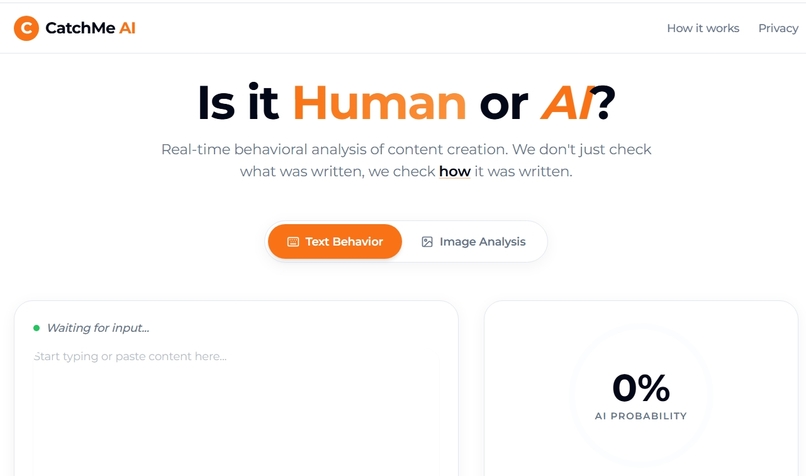
This doesn’t just work in our app it works anywhere
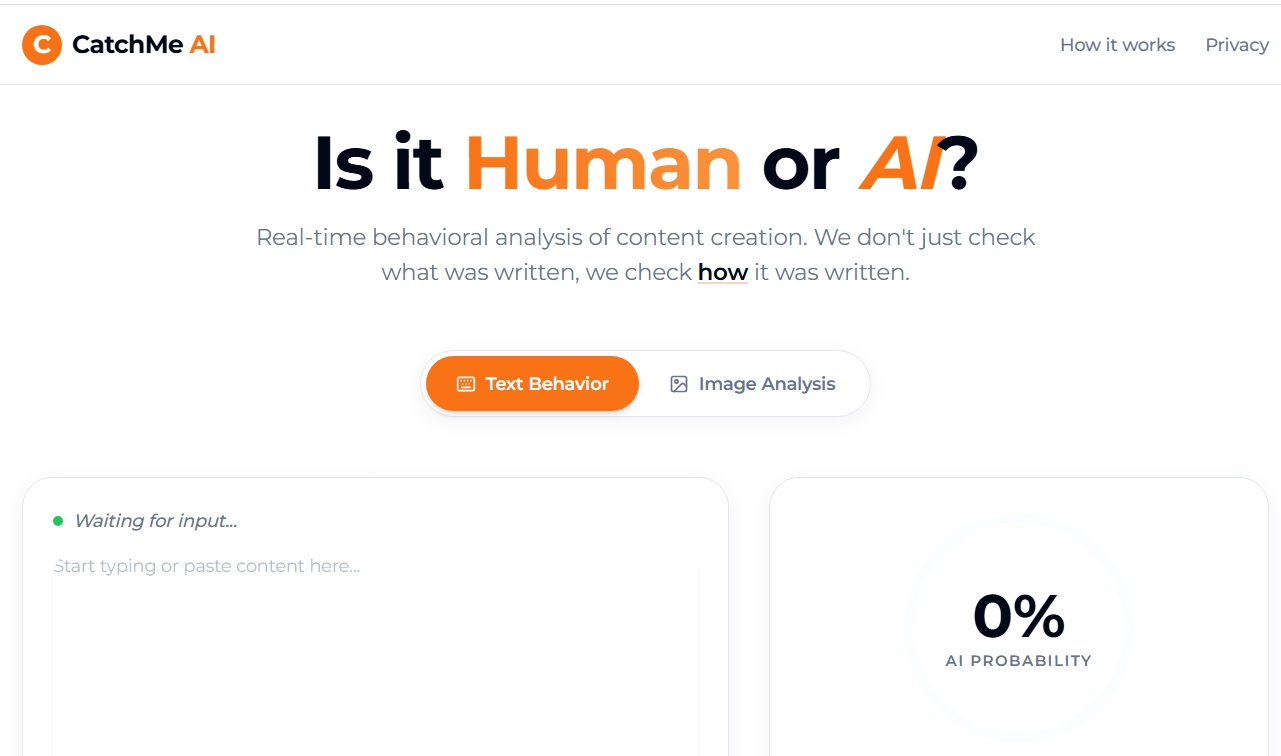
CatchMe AI Project Story
Inspiration
With the rapid rise of generative AI, especially in education and digital platforms, it has become increasingly difficult to distinguish between human-created and AI-generated content.
Most existing AI detection tools claim high accuracy but often produce inconsistent, non-explainable results. This creates a lack of trust rather than solving the problem.
CatchMe AI was inspired by a simple shift in thinking:
Instead of asking “Is this AI?”, we ask “How likely is this AI, and why?”
What I Built
CatchMe AI is a multi-modal AI content analysis platform that evaluates:
- Text content
- User behavior (typing vs pasting)
- Images
Instead of binary answers, it provides a probability score with clear, explainable signals.
How It Works
1. Text Analysis Engine
I built a hybrid scoring system using measurable linguistic features:
- Perplexity-based predictability
- Sentence structure consistency
- Lexical diversity (vocabulary variation)
- Semantic similarity between sentences
Final scoring model:
[ AI\ Probability = 0.35P + 0.25S + 0.2L + 0.2G ]
Where:
- ( P ) = Perplexity
- ( S ) = Structural consistency
- ( L ) = Lexical diversity
- ( G ) = Generic pattern detection
2. Behavioral Analysis
We added a layer that analyzes how the content is written, not just what is written:
- Typing speed (WPM)
- Paste detection (large instant input)
- Edit frequency (corrections, deletions)
- Input timing patterns
This helps distinguish:
- Human writing (gradual, imperfect, edited)
- AI-assisted input (instant, uniform)
3. Image Detection System
We extended CatchMe AI into a multi-modal platform with image analysis.
The detection uses a tiered scoring approach:
- Tier 1 (60%): visual consistency & embedding-level signals
- Tier 2 (25%): texture, lighting, spatial coherence
- Tier 3 (15%): metadata and surface artifacts
[ Score = 0.6T_1 + 0.25T_2 + 0.15T_3 ]
We also introduced uncertainty ranges to avoid overconfident outputs.
4. OpenAI Integration
We used the OpenAI API as a language intelligence layer, not a decision-maker.
It helps:
- extract semantic meaning
- analyze structure
- support signal generation
Final scoring is handled by our custom detection engine.
How I Built It
- Frontend: React (component-based architecture)
- Styling: Tailwind CSS (dark AI-themed UI)
- Backend: API integration for analysis
- AI Layer: Custom scoring engine + OpenAI API support
We focused on:
- modular components
- real-time feedback
- clean and explainable UI
Challenges I Faced
1. False Positives & False Negatives
AI detection is inherently uncertain:
- Human text can look AI-generated
- AI text can look human
I moved away from binary outputs to probability-based scoring.
2. Over-Reliance on Tone
Early versions assumed:
“If it sounds human, it is human”
This failed. I fixed it by prioritizing statistical signals over writing style.
3. Score Instability
We noticed inconsistent outputs for the same input.
I solved this by:
- removing randomness
- standardizing preprocessing
- fixing scoring weights
- ensuring deterministic outputs
4. Overconfidence Problem
Many tools output extreme results (0% or 100%).
I introduced:
- probability ranges
- confidence levels
- uncertainty handling
What I Learned
- AI detection is a probability problem, not a certainty problem
- Explainability builds more trust than accuracy alone
- Behavioral signals add strong context
- Multi-modal systems outperform single-layer detection
What’s Next
We see CatchMe AI evolving into:
- a tool for educators
- a verification layer for platforms
- a broader AI transparency system
🎯 Final Thought
CatchMe AI doesn’t try to “perfectly detect AI.”
Instead, it provides:
transparent, explainable, and probabilistic insights in an AI-driven world.


Log in or sign up for Devpost to join the conversation.