Inspiration
Walk into almost any corner store, bodega, or neighborhood restaurant and ask who runs it. Almost always, it's someone who left their home with very little money, learned an entirely new language and system, and bet everything they had on a counter, a cooler, and a phone.
These owners order their raw materials the way the only way they know: phone calls. No contract, no email, no receipt. It runs solely on trust. But trust without evidential basis is powerless.
There is alot that can go wrong with blind trust over a phone call. A delivery might arrives short or a price might be different from what was said. The owner knows what they heard, and the distributor remembers it differently and mistakes are made without anyone being at fault. For a shop surviving on thin margins, a few hundred dollars mistakes over the years isn't just an inconvenience. It's a risk to their entire livelihood. And an owner who has no lawyer, no bookkeeper, and maybe not the confidence to push back in a second language often just absorbs the loss keeping their head down.
The distributors aren't guilty either; constantly squeezed from multiple different people ordering often at the same time.
Everyone has been acting in good faith, but no one has proof.
We wanted to build something that could bridge that gap: a witness.
What it does
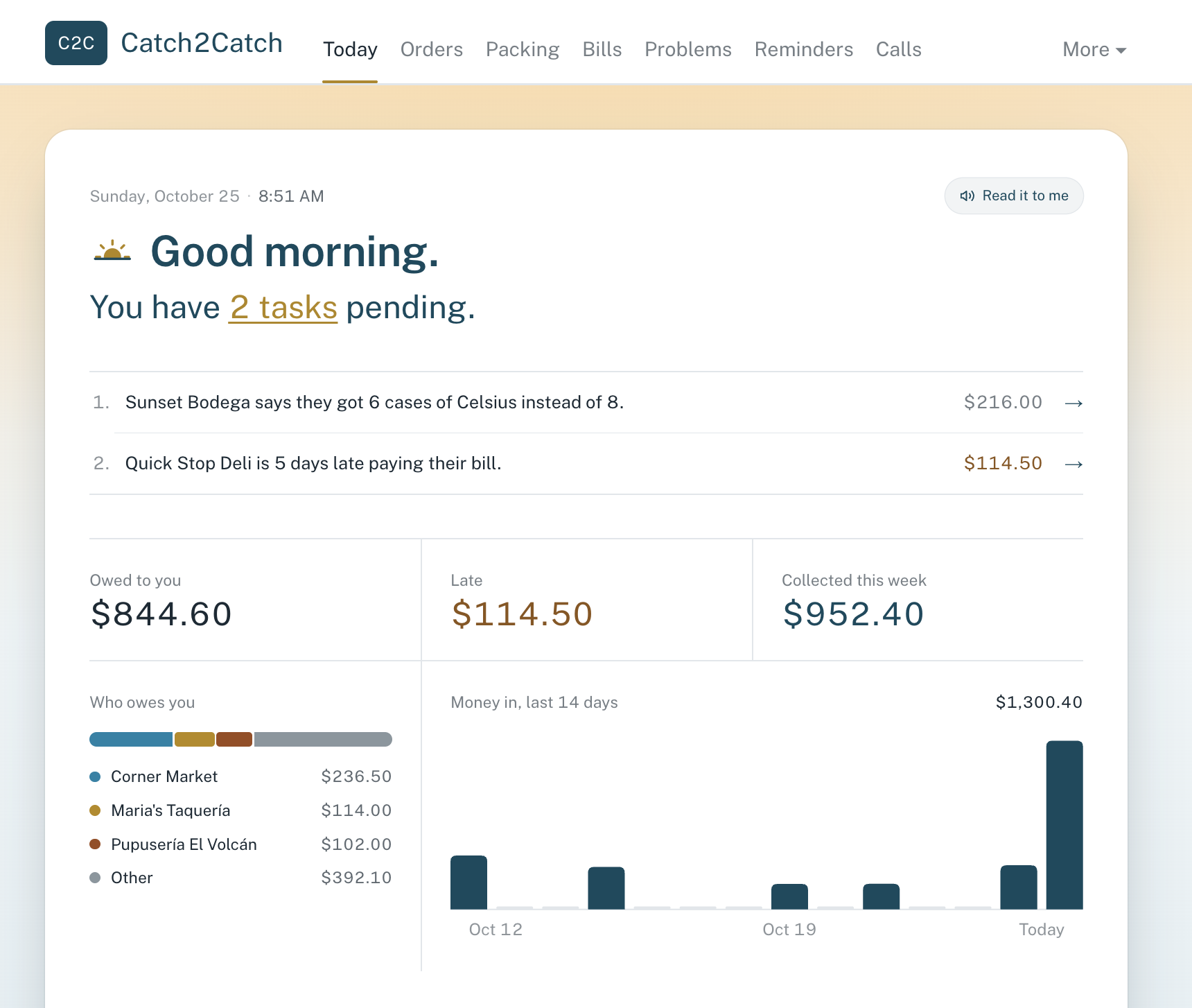
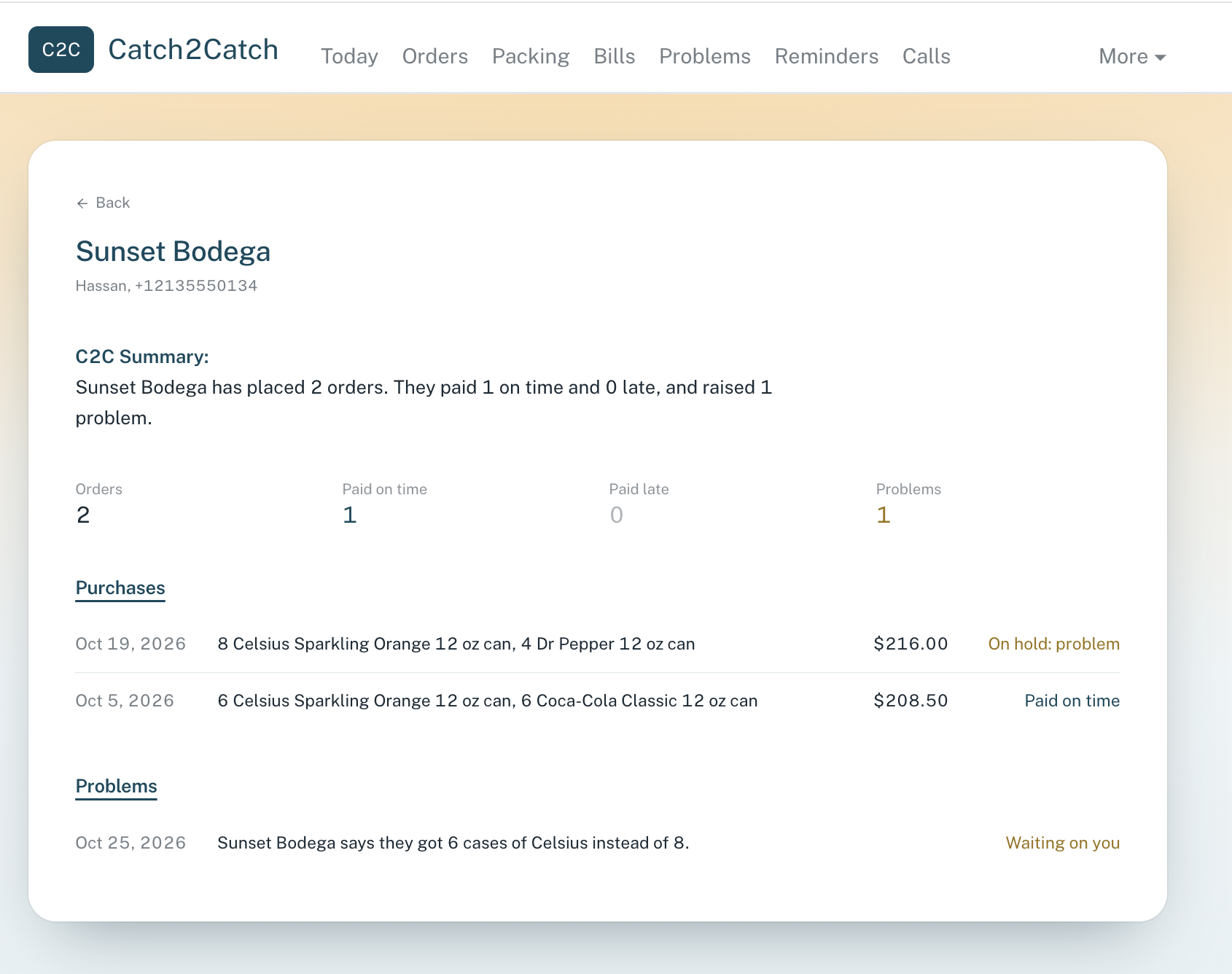
Catch2Catch is an AI order witness and back office for small drink wholesalers.
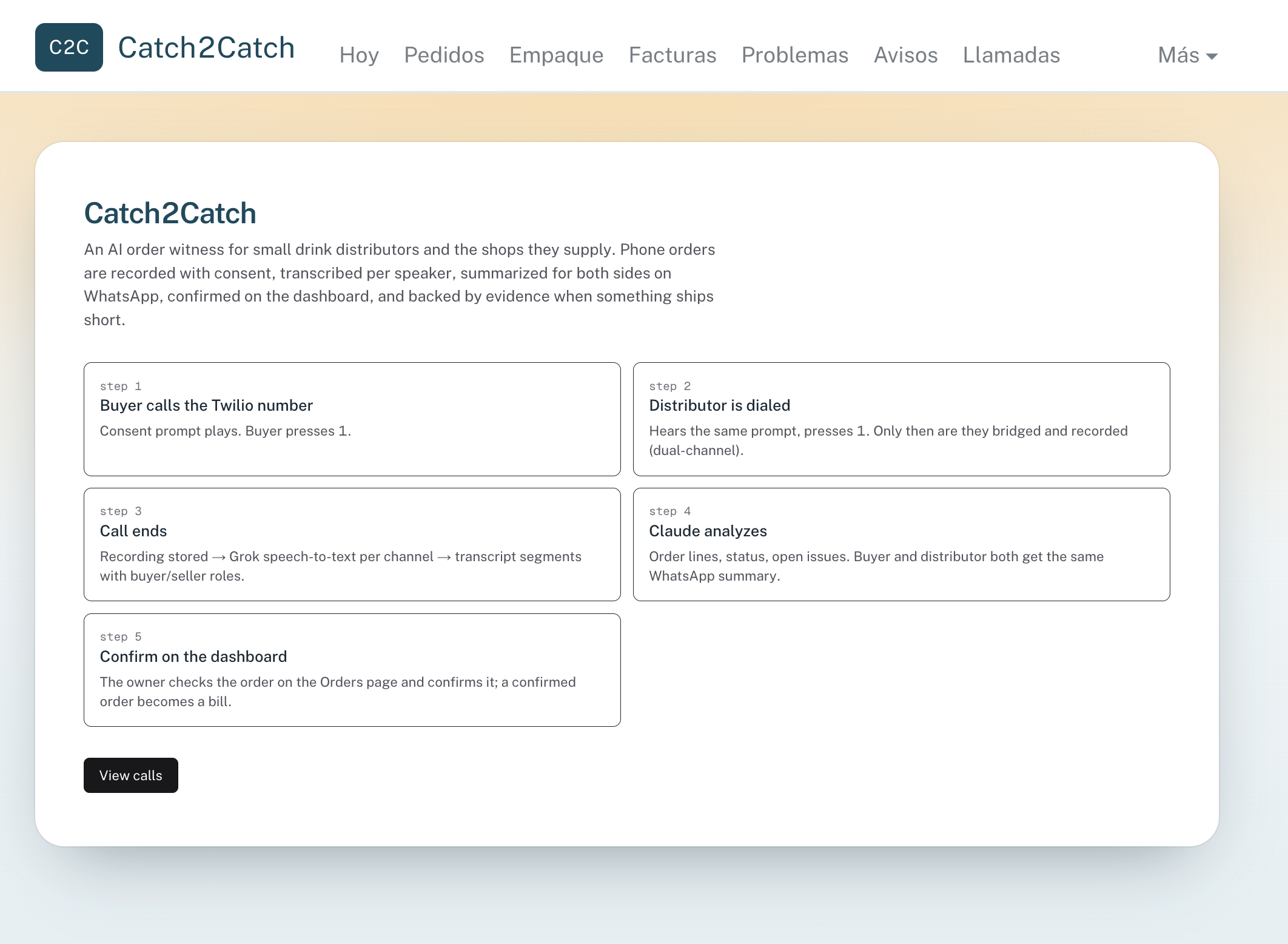
- The buyer calls the distributor as usual. Both sides consent for the call to be recorded and the audio is recorded on separate channels so there is no confusion as to who said what.
- Claude turns this unstructured conversation into a structured order , which is matched to the product catalog, flagging anything it isn't sure about.
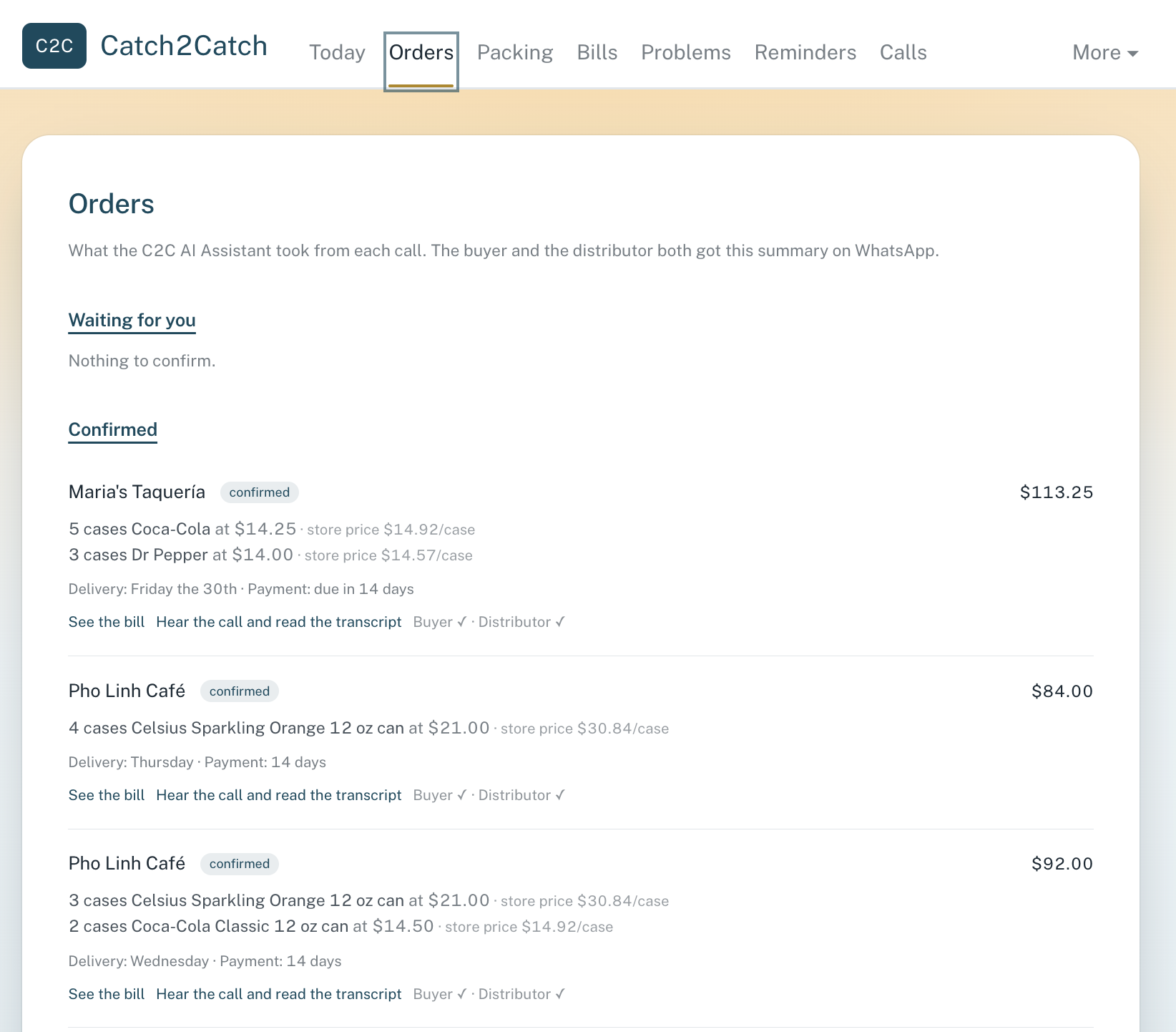
- Both parties get an accurate order summary on WhatsApp and are required to confirm it.
- Invoices and ledger entries are created automatically, and scheduled payment reminders are activated.
- At the warehouse, barcode scans and a photo of the box catch mismatches before they ship.
- If a dispute occurs, Claude weighs the evidence provided by the order conversation call and other delivery metrics and and recommends a solution, but the final decision power lies with the owner.
- Daily reference prices bring attention to deals that look unusually far from market.
How we built it
- Convex is the hub: database, file storage, HTTP actions for Twilio webhooks, scheduled jobs, and actions that call outside APIs.
- Twilio handles the consent-gated, dual-channel calls and the messaging.
- xAI Grok transcribes each speaker's channel separately.
- Anthropic Claude (
claude-sonnet-5-5) extracts orders and analyzes disputes. - Apify pulls daily reference retail prices.
- Next.js 16 powers the owner dashboard and packing flow.
Every service talks directly to Convex, which stores each result and handles the execution of the next step. Every action occurred is written to an audit log with its reason and evidence for later reference.
Challenges we ran into
- Consent comes first. Figuring out a way to record phone calls between individuals with equal consent of all parties involved.
- Who said what. Over phone calls people often talk over each other and there is alot of background noise which makes it harder to decipher who is saying exactly what.
- Turning casual speech into exact orders. People often order products by calling them as "the usual" or "two cases of the red ones." Matching that to real catalog SKUs and quantities, and flagging it when the match is uncertain, was hard to executre while maintaining accuracy.
- Keeping the AI from overreaching. It would have been very straightforward to let Claude settle all disputes on its own. But we deliberately made it recommend suggestions only, so the final decision power always stays with the owner.
- Teaching AI to admit "I'm not sure." Conflicting or low-accuracy details become
needs_reviewinstead of a guess, to make sure AI doesnt halucinate and ends up giving completely false data just for the sake of guessing something.
Accomplishments that we're proud of
- A complete loop is executed in merely one system: a phone call becomes a confirmed order, an invoice, packing evidence, and a dispute recommendation.
- Consent-gated recording, with the recording ending up deleted if either side doesn't consent.
- Zero AI on the live call, so the buyer and seller talk like they always have.
- An AI that knows its limits: it flags uncertainty, never invents numbers, and never approves its own recommendation.
- An audit trail for every action, with the reason and the evidence behind it.
- One backend tying together Twilio, Grok, Claude, and Apify.
What we learned
Trust is a product feature. The AI isn't the point; the evidence is. We learned to build Claude as an analyst, not an authority: it reads, extracts, and recommends, while confirmations, packing checks, and the owner's approval hold the line. For people who can't afford to be wrong about money, that gate matters more than any model.
What's next for Catch2Catch
- Real catalogs and real distributor feedback
- More languages, so the owners who need a witness most can use it in their own words
Built With
- apify
- claude
- convex
- grok
- next.js
- twilio
- typescript
- xai


Log in or sign up for Devpost to join the conversation.