Inspiration
Catch the Thief! is based on "Raja Mantri Chor Sipahi" (Mafia), a chit game played across South Asia. Everyone pulls a folded slip of paper with a secret role, and the police officer has to work out who the thief is. All it needs is friends, paper and a lot of bluffing.
I wanted to bring that feeling to Reddit and turn it into a vintage TV game show, with a masked host, a live audience and a new episode every day. Reddit threads already read like a room full of people accusing each other.
What it does
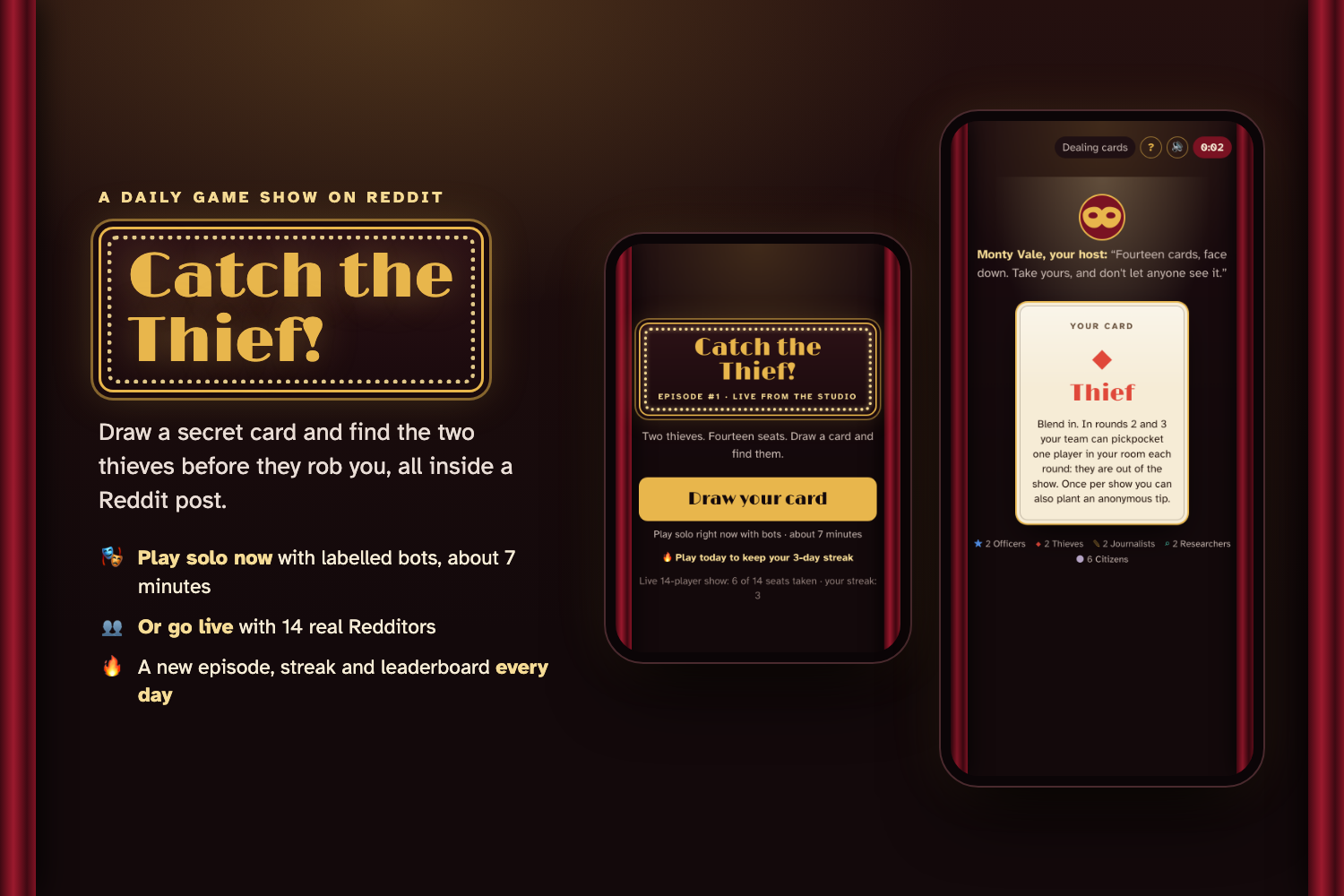
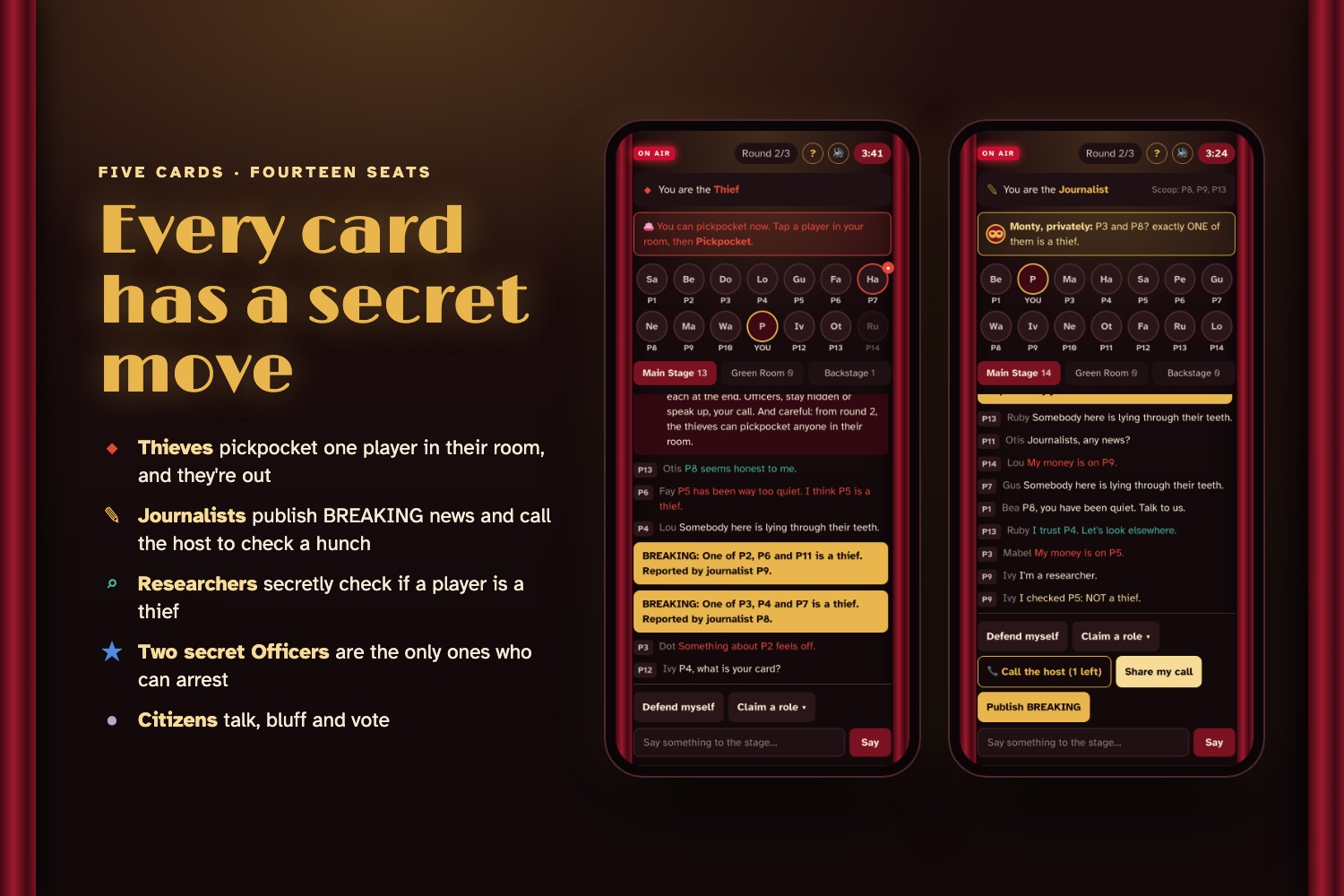
Fourteen players draw secret cards. Two are thieves, and only two secret Officers can arrest them.
- ★ Officers (2): secret, even from each other. One arrest each at the end.
- ◆ Thieves (2): know each other. In rounds 2 and 3 they can pickpocket one player in their room, which knocks that player out of the show. Robbing an Officer steals their arrest instead. They can also plant one anonymous tip.
- ✎ Journalists (2): get a scoop that one of three players is a thief. They can publish it as a BREAKING headline and call the host twice to check a pair of suspects.
- ⌕ Researchers (2): secretly check one player in round 2 and another in round 3.
- ● Citizens (6): talk, question and vote to advise the Officers.
Players move between three rooms: the Main Stage, the Green Room and Backstage. They only hear the room they're standing in, and can privately invite someone to a side room. The masked host, Monty Vale, announces which room every robbery happened in, so every move is a clue.
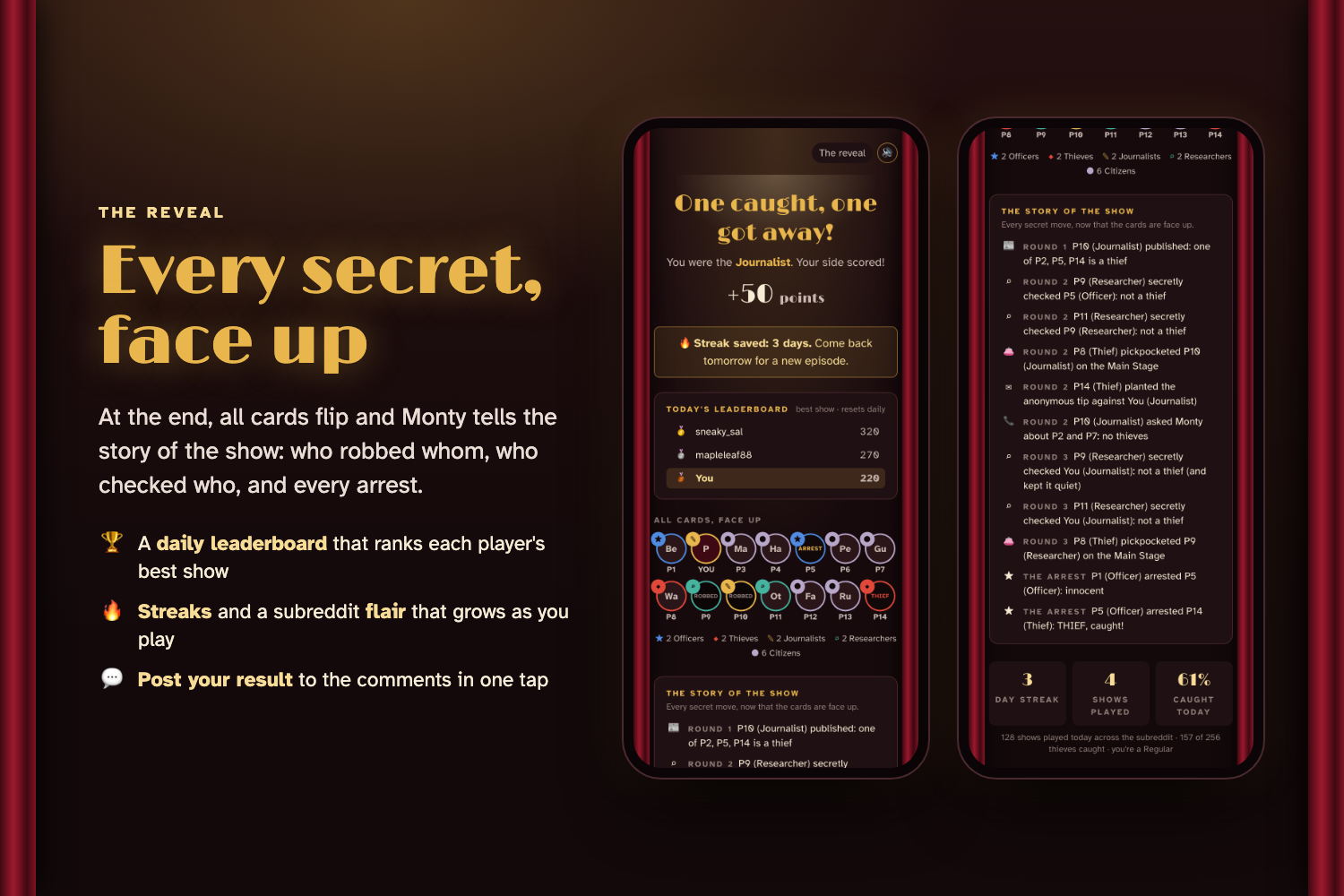
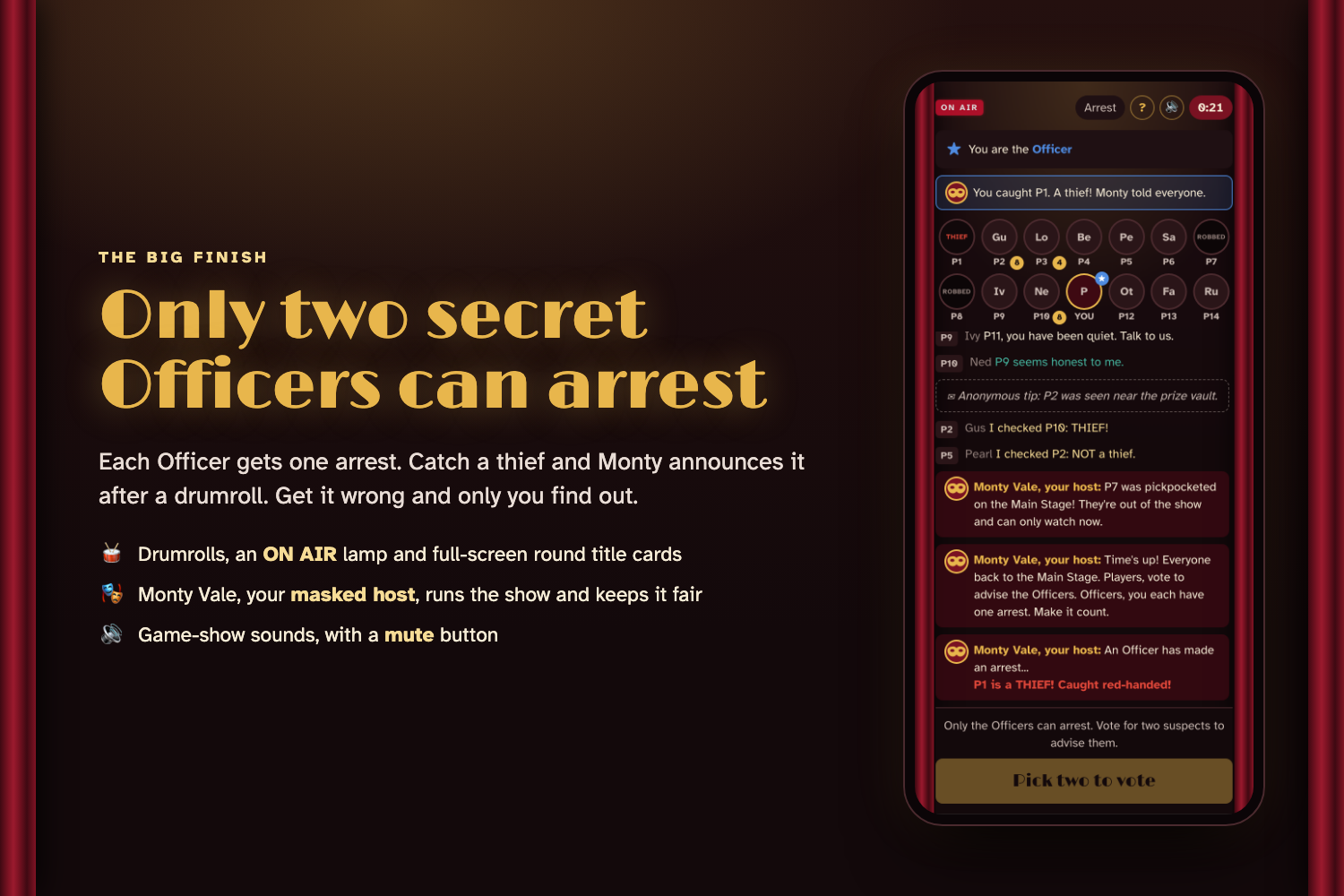
At the end, each Officer makes one arrest. If it's a thief, Monty announces it after a drumroll. If it's wrong, only that Officer finds out.
Two ways to play:
- Practice show: starts instantly. The other 13 seats are filled with clearly labelled bots that reason from the conversation. It takes about 7 minutes.
- Live show: starts only when 14 real Redditors join the queue, with no bots. It takes about 14 minutes.
Built for Reddit:
- Snoovatars appear on players' seats.
- Flair shows each player's title and daily streak.
- Players post their result to the comments in one tap.
- A daily episode post appears automatically, with a pinned recap from Monty covering last night's catch rate and top players.
- Moderator tools let mods post an episode, run a test show and remove any message.
Daily content: a new episode every day, 🔥 streaks with a reminder, and a daily leaderboard. The leaderboard ranks each player's best single show, so replaying can't farm it.
Feels like TV:
- marquee bulbs and velvet curtains that part when the show starts
- an ON AIR lamp
- full-screen "ROUND 2" title cards
- a drumroll before each arrest
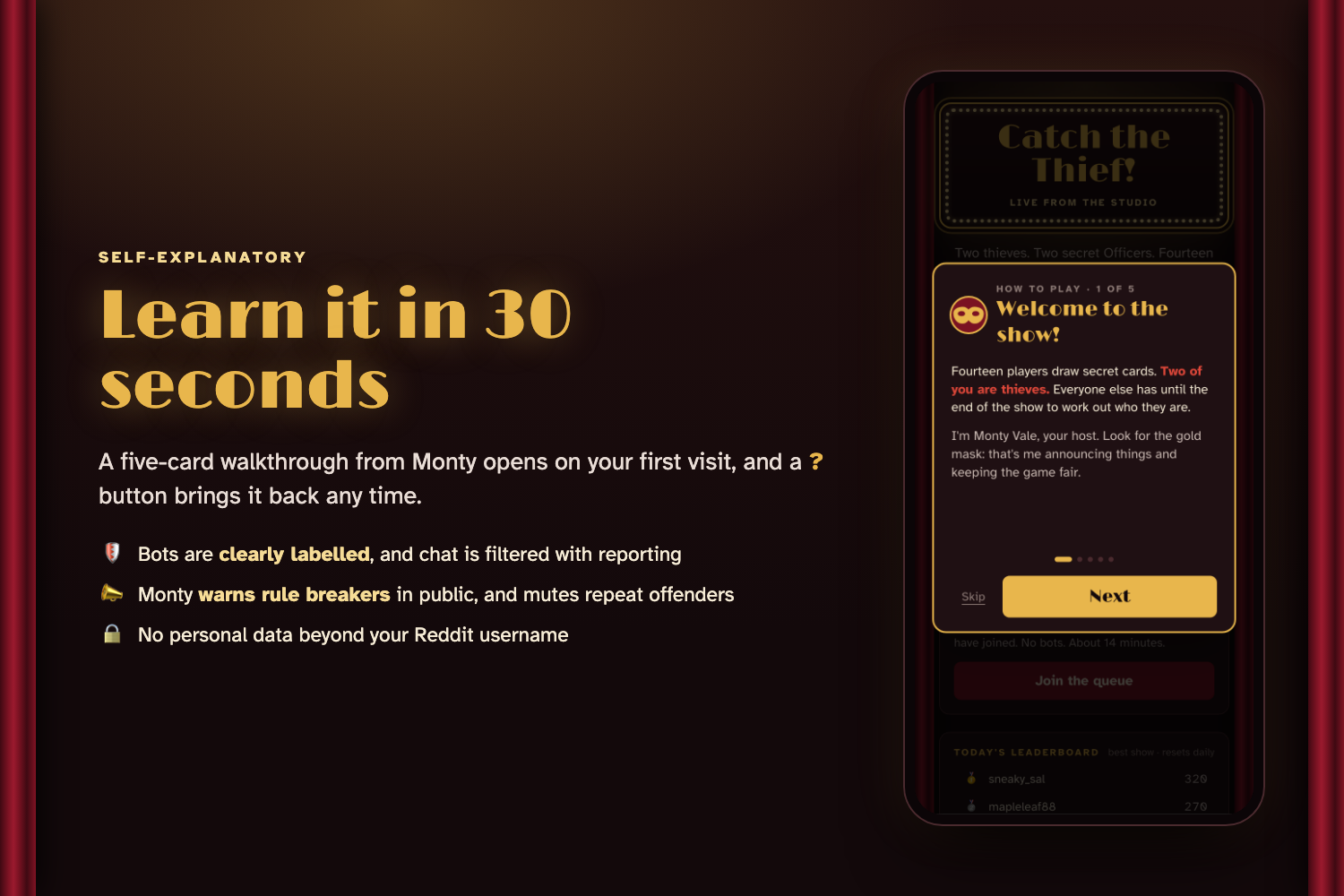
- a five-card "How to play" walkthrough, presented by Monty
How we built it
- Devvit Web:
- a React 19 and Tailwind client
- a Hono server
- Redis for shows, the queue, stats, streaks and leaderboards
- the Reddit API for posts, comments, flair and avatars
- the scheduler for daily episodes
- No realtime server needed:
- Each show runs on a "lazy clock". Every time a player's screen checks in (every 2 seconds), the server moves the show forward to the current time. It processes phase changes, bot turns and announcements in order, under a Redis lock.
- Fourteen players stay in sync without websockets.
- Private views:
- The server sends each player only what their role allows: their own card, their scoop and their check results.
- Nobody can see another player's card by inspecting the page.
- Bots that think:
- Each bot builds suspicion from what it has actually heard, such as headlines, shared checks, contested claims and anonymous tips.
- Bot thieves pick dangerous targets, and bot journalists call the host about their top suspects.
- All randomness is seeded, so any show can be replayed exactly.
- A balance simulator:
- Hundreds of simulated shows were run after every rule change, until thieves win most games but the town still catches them regularly.
Challenges we ran into
- Making bots feel human without flooding the chat. Early bots all talked at once and piled onto the same player. I capped their chatter, spaced out their turns and reduced how much a single accusation counts.
- Balancing many powers. Every new rule, such as pickpockets, secret Officers and the journalist's hotline, shifted the win rate. The simulator let me test each one in seconds.
- Keeping secrets secret. A wrong arrest stays private. Monty never confirms who an Officer is. Each player's screen only ever receives their own view.
- Live play without realtime infrastructure. The lazy clock and per-show lock made polling enough for a fourteen-player live show.
Accomplishments that we're proud of
- A complete game show loop: dealing cards, a secret hour, three rounds, the arrest and the reveal, all presented by a host.
- A practice show that's fun to play alone in about 7 minutes, so anyone can try the game straight from the post.
- Safety built in from the start:
- labelled bots
- typed chat only on the Main Stage
- a slur filter and reporting
- public warnings and mutes from the host
- no personal data beyond the Reddit username
- no outside AI service
What we learned
Social deduction games depend on small details: who knows what, when, and who else can find out. Most of the design work went into those details. Should a wrong arrest be public? Should the host confirm an Officer? What happens when a thief robs an Officer? Testing each rule with bots and simulations taught me more than any amount of planning.
What's next for Catch the Thief!
- Scheduled live shows, such as a nightly 9pm episode, so 14 players can easily gather.
- Bots that invite players and react to typed chat.
- Themed weekly episodes with special rules, such as a night with three thieves, or Officers who can see each other.
- Season leaderboards and special flair for the top players of the week.
Built With
- devvit
- hono
- node.js
- react
- redis
- tailwindcss
- typescript
- vite
