About the Project
Catch the Flood
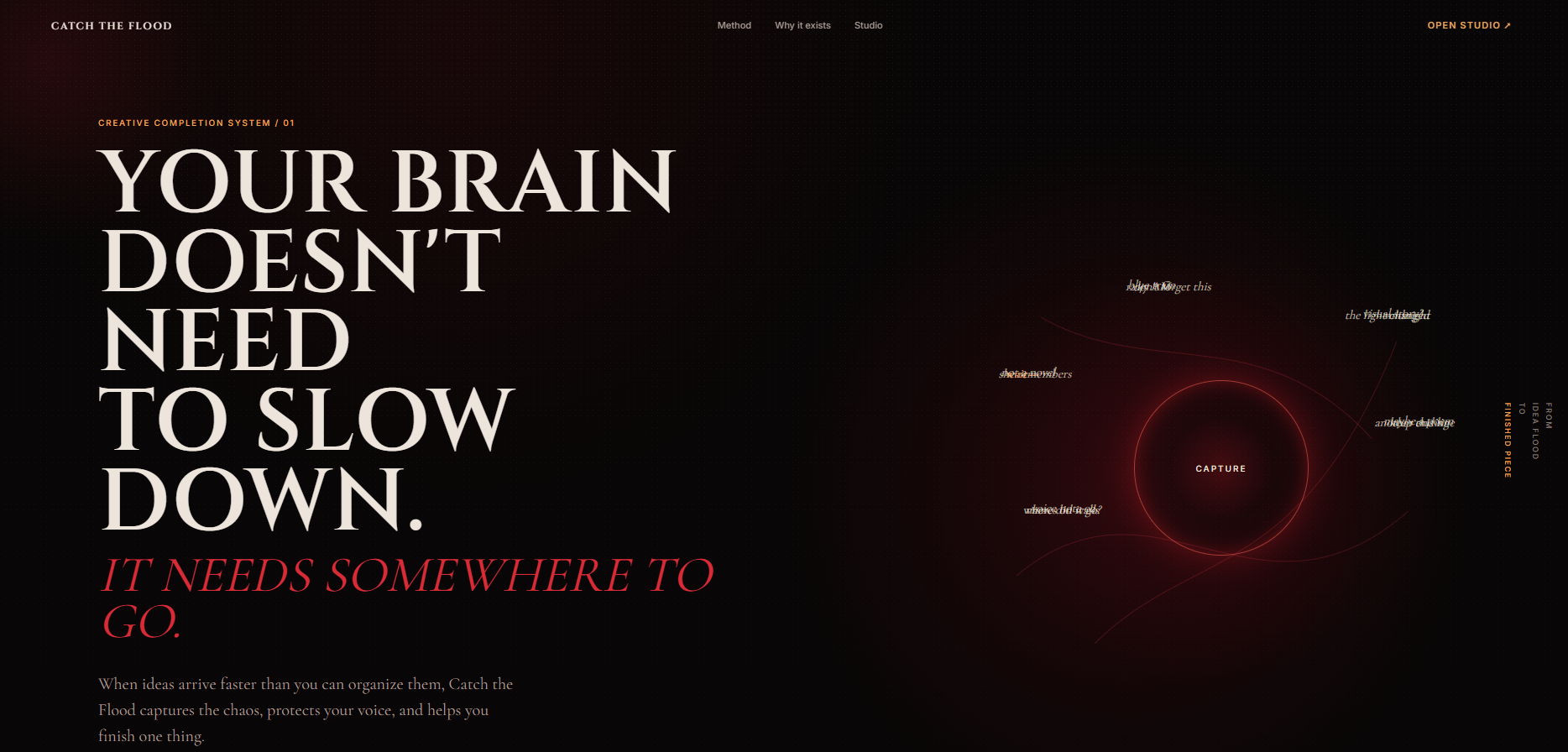
Your ideas. Your voice. Finished.
Inspiration
Creative people do not always struggle because they lack ideas.
Sometimes the problem is the opposite: too many ideas arriving at once.
A creator can have a character, an image, a sentence, a sound, a possible ending, a completely different idea, and another direction all competing for attention within minutes. During a period of intense creative focus, this can feel productive—but when that momentum disappears, the result is often a collection of unfinished notes, half-written documents, voice recordings, and abandoned concepts.
Most creative AI tools approach the problem from the opposite direction.
They begin with:
"Give me a prompt."
Then they generate something.
We wanted to ask a different question:
What if the AI's first responsibility was not to create, but to preserve the creator's existing creativity?
That question became Catch the Flood.
Catch the Flood is an AI creative amplifier designed around the gap between idea generation and creative completion.
Its purpose is not to replace the creator.
Its purpose is to reduce the friction between:
"I have too many ideas."
and
"I finished something."
The Core Insight
We designed Catch the Flood around a simple principle:
Don't organize the flood. Catch it first.
The creator is explicitly encouraged to be messy.
They can:
- type fragments
- paste unfinished thoughts
- contradict themselves
- change direction
- describe images
- mention possible endings
- abandon sentences
- combine unrelated ideas
- use stream-of-consciousness language
There is no requirement to formulate a perfect prompt.
This matters because traditional AI prompting introduces a hidden task:
The creator must already understand their idea well enough to explain it to the AI.
Catch the Flood removes that requirement.
The raw thought stream becomes the input.
What Makes Catch the Flood Different
The central architecture is a two-agent system:
1. Fidelity Agent
"What did the creator actually give us?"
2. Momentum Agent
"What can the creator actually finish?"
These agents have intentionally different responsibilities.
The Fidelity Agent is conservative.
The Momentum Agent is generative.
Keeping these responsibilities separate creates a boundary between preservation and generation.
Instead of allowing one model to immediately rewrite the user's idea, Catch the Flood first establishes a structured representation of what actually came from the creator.
Agent 1 — Fidelity Agent
The Fidelity Agent receives the raw idea flood and decomposes it into creative units.
For example:
"I keep seeing a deep red door...
maybe it leads to another life...
I don't know if it should be a poem...
there are different versions of the same person..."
can become:
OBJECT
→ recurring red door
VISUAL
→ deep red against darkness
CONCEPT
→ alternate versions of a life
THEME
→ memory / regret / choice
UNCERTAINTY
→ destination of the door is unresolved
CREATIVE INTENT
→ poem or narrative
ENDING POSSIBILITY
→ another red door
The important distinction is that the system does not treat every generated interpretation as an original creator contribution.
We conceptually model every creative unit as:
u
i
=(x
i
,s
i
,c
i
,q
i
)
where:
x
i
= extracted content
s
i
= source span from the original flood
c
i
= confidence of extraction
q
i
= semantic role
The source span is important.
It allows the system to maintain a relationship between:
what the AI says the idea is
and
where that idea actually came from.
This creates a provenance layer for creative generation.
Creative Provenance
Most generative AI interfaces make the distinction between:
user content
and
model-generated content
almost invisible.
Catch the Flood makes that boundary part of the product.
We think of the creative state as:
C=U∪G
where:
U = creator-originated material
G = generated material
The objective is not to maximize G.
The objective is to maximize the usefulness of the transition:
U→U+G
without allowing:
G→replacement of U
In simpler terms:
AI should add momentum, not erase authorship.
Fidelity as a Design Constraint
We introduce a conceptual measure called Fidelity Ratio:
F=
N
creative units
N
source-grounded
where N
source-grounded
represents creative units that can be traced back to the creator's original input.
A high F means the system is strongly grounded in the creator's original material.
This is not intended as a universal benchmark for creativity. It is a product-level design metric that reflects our core philosophy:
The more the system claims to preserve the creator's voice, the more traceable that preservation should be.
Agent 2 — Momentum Agent
Once the flood has been captured, the second problem appears:
"I have ideas. Now what do I do with them?"
This is where the Momentum Agent operates.
Instead of generating one arbitrary finished artifact, it searches for several viable creative forms.
For example:
Path A — Found Poem
Preserve fragmented imagery and emotional language.
Path B — Personal Essay
Develop the introspective or reflective elements.
Path C — Short Story
Turn narrative fragments into a structured arc.
The system is therefore not simply asking:
"What can AI generate?"
It is asking:
"What is the smallest number of meaningful choices that can get this creator moving?"
We think of this as a reduction in creative decision-space.
If the creator begins with n possible directions, the system attempts to reduce the immediate decision burden to a small candidate set k:
k≪n
while preserving meaningful diversity:
D(f
1
,f
2
,…,f
k
)>τ
where D represents meaningful difference between proposed forms and τ is a minimum diversity threshold.
The goal is not maximum options.
The goal is actionable options.
The Human Remains in the Loop
The final direction is never silently selected by the system.
The flow is:
RAW FLOOD
↓
FIDELITY AGENT
↓
CREATIVE UNITS
↓
MOMENTUM AGENT
↓
3 FINISHABLE DIRECTIONS
↓
CREATOR CHOOSES
↓
GENERATION
↓
FINISHED ARTIFACT
This creates a deliberate human-in-the-loop architecture.
The AI handles:
decomposition
organization
possibility generation
structural suggestions
production assistance
The creator retains:
intention
selection
direction
authorship
final approval
Why Two Agents Instead of One?
A single prompt could technically ask an LLM to:
"Take these ideas and make a poem."
But that misses the core problem.
The challenge is not simply content generation.
It is creative inertia.
A single model is simultaneously trying to:
understand the messy input,
decide what matters,
choose a form,
generate content,
polish it.
That creates a risk of semantic drift.
Catch the Flood separates the stages.
Fidelity optimizes for preservation.
Momentum optimizes for forward movement.
The creator optimizes for meaning.
This separation creates an intentional tension:
Preservation↔Possibility
The system needs both—but they should not be performed by the same conceptual role.
The Completion Loop
The complete product loop is:
Flood→Fidelity→Momentum→Choice→Creation
We call this the Completion Loop.
Traditional note-taking often stops at:
Idea→Storage
Generative AI often jumps directly to:
Prompt→Generation
Catch the Flood focuses on the missing middle:
Idea→Structure→Direction→Completion
That is the problem we are trying to solve.
From Thought to Artifact
The final result is deliberately not another chat response.
The creator receives an actual creative artifact.
Depending on the selected form, Catch the Flood can produce a finished piece that can be:
refined
styled
exported
shared
revisited
The product therefore has a measurable endpoint:
Finishedness=
initial creative fragments
creative intention converted into artifact
This is a conceptual product metric rather than a claim that creativity itself can be reduced to a single number.
The important idea is that the system has a destination:
not another conversation, but something finished.
The Interface Is Part of the Mechanism
The visual language intentionally avoids the typical bright blue "AI assistant" aesthetic.
Catch the Flood uses a dark, deep-red creative environment to communicate:
intensity
focus
concentration
creative energy
transformation
The interface is organized around the creator's journey:
CAPTURE
↓
FIDELITY
↓
MOMENTUM
↓
CHOICE
↓
FINISHED PIECE
The dashboard makes this journey visible instead of hiding the AI behind a single "Generate" button.
Why This Is an AI Creative Amplifier
We are not trying to build another AI writer.
An AI writer generally starts with:
"Tell me what you want."
Catch the Flood starts with:
"Show me whatever is already happening in your head."
That difference changes the interaction model.
The AI is not the source of creativity.
It becomes an amplification layer around the creator's existing creative signal.
Conceptually:
Creative Output=Creator Signal×AI Momentum
rather than:
Creative Output=AI Generation
The creator supplies the signal.
The system supplies structure and momentum.
Technical Architecture
The system is organized into several logical layers:
┌─────────────────────────────┐
│ CREATOR INPUT │
│ text / raw idea flood │
└──────────────┬──────────────┘
↓
┌─────────────────────────────┐
│ FIDELITY AGENT │
│ extraction + provenance │
└──────────────┬──────────────┘
↓
┌─────────────────────────────┐
│ CREATIVE UNIT GRAPH │
│ themes / objects / ideas │
│ emotions / possibilities │
└──────────────┬──────────────┘
↓
┌─────────────────────────────┐
│ MOMENTUM AGENT │
│ form discovery + options │
└──────────────┬──────────────┘
↓
┌─────────────────────────────┐
│ CREATOR DECISION │
│ choose the direction │
└──────────────┬──────────────┘
↓
┌─────────────────────────────┐
│ CREATIVE GENERATION │
│ structured artifact │
└──────────────┬──────────────┘
↓
┌─────────────────────────────┐
│ EXPORT / SHARE │
│ finished creative piece │
└─────────────────────────────┘
The architecture is intentionally modular.
This means additional modalities can eventually enter the same pipeline:
I={T,V,A,S}
where:
T = text
V = voice
A = visual/audio creative signals
S = structured creative state
All modalities can ultimately be transformed into a common representation of creative units before reaching the Momentum layer.
What We Learned
One of our biggest discoveries was that adding more AI does not necessarily make a creative product better.
The most important architectural decision was actually deciding where AI should not intervene.
We deliberately keep the creator's initial flood as raw as possible.
We do not want to immediately "clean up" the input because the mess itself can contain:
unusual associations
incomplete imagery
unexpected metaphors
contradictory possibilities
emotional signals
creative directions
Premature organization can destroy exactly what makes an idea interesting.
So the system follows:
Capture first. Interpret second. Generate last.
Challenges
1. Preserving the creator's voice
A conventional generation prompt can easily transform a user's rough idea into something that sounds like generic AI prose.
We addressed this by separating extraction from generation and explicitly representing source-grounded creative units.
2. Avoiding the blank-page problem
Giving users 20 possible directions recreates the original problem.
We therefore designed Momentum around a small number of actionable alternatives rather than unlimited generation.
3. Preventing AI from becoming the author
The system could easily become another "type an idea and AI writes everything" product.
We intentionally introduced creator checkpoints.
The creator must choose the direction before the final artifact is produced.
4. Turning a conversation into an artifact
A chatbot response is not necessarily a finished creation.
The final stage therefore focuses on a tangible, styled output that can be exported and shared.
Why the Name "Catch the Flood"?
Because we don't want to stop the flood.
We don't want to tell the creator to:
"Slow down."
We don't want to tell them:
"Organize your thoughts first."
We don't want to tell them:
"Write a better prompt."
We want to say:
Keep going. We'll catch it.
The system exists at the moment where creative abundance would normally become creative abandonment.
The Bigger Vision
Catch the Flood is currently focused on creative idea floods, but the underlying architecture can become a broader creative continuity layer.
Future versions could accept:
voice streams
sketches
images
music fragments
photographed notes
handwritten ideas
browser clippings
multiple unfinished projects
The same principle remains:
Capture→Preserve→Find Momentum→Create
The long-term goal is not to make AI more creative than humans.
It is to make human creativity harder to lose.
Final Principle
Catch the Flood is built around one belief:
The problem isn't always a lack of creativity. Sometimes creativity arrives faster than a person can turn it into something finished.
So we built an AI system that doesn't try to replace that flood.
It catches it.
It protects the creator's signal.
It creates momentum.
And it helps turn one of those ideas into something finished.
Your ideas.
Your voice.
Finished.
Built With
- agentic
- css
- embeddings
- engineering
- generation
- graphs
- grounded
- guardrails
- human-in-the-loop
- knowledge
- langgraph
- llm
- multi-agent
- next.js
- nim
- nvidia
- pydantic
- python
- qdrant
- react
- structured
- tailwind
- typescript
- vector


Log in or sign up for Devpost to join the conversation.