About the project
Inspiration
I built this project after seeing how often crypto traders get trapped by single-indicator decisions.
A setup can look clean on RSI or MACD, but still fail because of weak participation, fragile trend structure, adverse catalyst flow, or poor fundamental quality.
The goal was to build a signal engine that asks not only “where price might go”, but also:
- How strong is the setup?
- What can invalidate it quickly?
- How much confidence should we place in it right now?
What I built
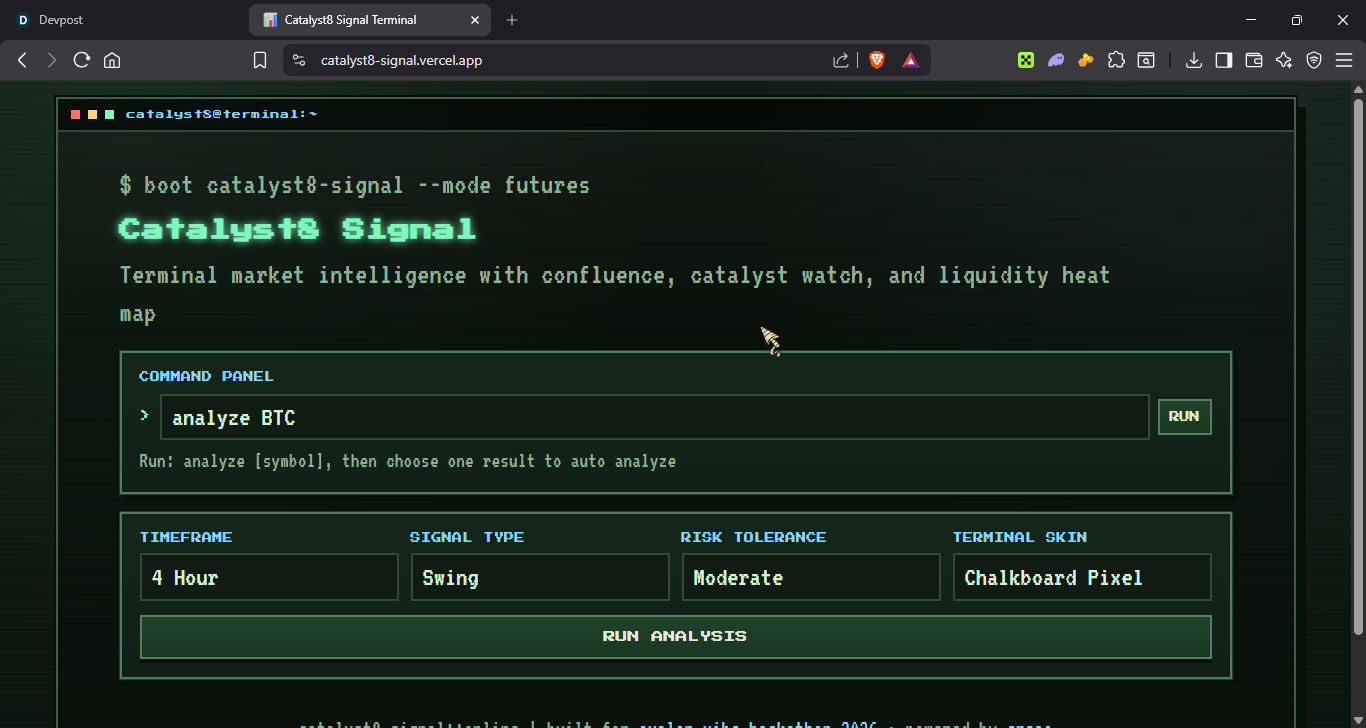
This is Catalyst8 Signal, a terminal-style crypto signal intelligence app that combines:
Technical confluence
- RSI, MACD, Bollinger Bands
- EMA20 / EMA50 and EMA slopes
- ATR, ADX, Stochastic, momentum
Market structure & liquidity
- liquidity heat map
- breakout vs fakeout detection
- regime-aware scoring
Risk stress layer
- liquidation risk meter
- contradiction and conflict penalties
Catalyst layer
- CoinGecko trend/catalyst signals
- news pulse
- market regime context
Fundamental layer
- market-cap rank
- FDV/MCAP ratio
- volume/MCAP ratio
- supply profile
- developer and community activity proxies
Explainability
- factor breakdown
- quality score
- confidence
- reasoning trail
Optional LLM enhancement
- OpenAI reasoning upgrade (structured and fallback-safe)
The system outputs BUY / SELL / HOLD, confidence, entry zone, TP/SL, risk-reward, and explainable rationale.
How I built it
- Frontend: Next.js + React (terminal-style UI, theme switcher)
- Backend: Next.js API routes (serverless)
- Data source: CoinGecko SDK API (Demo and Pro supported)
- Reliability: in-memory cache + stale fallback + optional Upstash Redis distributed cache
- Reasoning engine: weighted multi-layer confluence with contradiction/conflict penalties
- Optional AI layer: OpenAI API for structured narrative enhancement
- Hackathon alignment: CREAO.ai branding integrated in the product
Core pipeline:
fetch data → compute indicators → derive market/catalyst/fundamental context → score buy/sell evidence → apply penalties & quality calibration → return explainable output
The math (core idea)
Bullish and bearish evidence are aggregated from multiple layers. The scoring model is inspired by ensemble decision systems used in quantitative trading and risk models.
The bullish score is defined as $S_{buy} = \sum_{i=1}^{n} w^{buy}{tech,i} + \sum{i=1}^{n} w^{buy}{liq,i} + \sum{i=1}^{n} w^{buy}{deriv,i} + \sum{i=1}^{n} w^{buy}{news,i} + \sum{i=1}^{n} w^{buy}{fund,i}$, while the bearish score is $S{sell} = \sum_{i=1}^{n} w^{sell}{tech,i} + \sum{i=1}^{n} w^{sell}{liq,i} + \sum{i=1}^{n} w^{sell}{deriv,i} + \sum{i=1}^{n} w^{sell}{news,i} + \sum{i=1}^{n} w^{sell}_{fund,i}$.
When both sides show strong evidence, a contradiction penalty is applied using $P_c = \lambda \cdot \min\left(S_{buy}, S_{sell}\right)$.
The adjusted scores become $S^{\prime}{buy} = S{buy} - P_c$ and $S^{\prime}{sell} = S{sell} - P_c$.
Directional edge is computed as $E = \left| S^{\prime}{buy} - S^{\prime}{sell} \right|$.
Finally, the quality score is calculated using $Q = \mathrm{clip}\left(28 + 8S_d + 10E + 1.9N + B - 10P_c - 18P_s - C,\ 10,\ 99\right)$.
Where $S_d$ is the dominant side score, $N$ is the evidence count, $B$ is alignment bonus, $P_s$ is soft penalty, and $C$ is conflict penalty.
Challenges I faced
- API reliability: handling rate limits, partial payloads, and environment mismatches safely.
- False confidence risk: preventing fast responses from being interpreted as high-quality live signals.
- Cross-layer disagreement: technical vs catalyst vs fundamental signals frequently conflict.
- Scoring calibration: adapting thresholds to trend strength and volatility.
- Explainability under complexity: keeping outputs transparent despite many interacting factors.
- UI density: surfacing deep quant context without overwhelming users.
What I learned
- Confluence is stronger than isolated indicators.
- Trend strength and liquidity context matter as much as direction.
- News and fundamentals significantly improve robustness when combined with technicals.
- Fallback design must be explicit and observable, not silent.
- Explainable scoring builds trust faster than opaque confidence numbers.
- Product polish (terminal UX, interaction flow, visual hierarchy) directly improves usability of quant outputs.
Built With
- binance-futures-api
- coingecko-api
- cryptocompare
- css3
- html5
- javascript
- next.js
- node.js
- react
- vercel


Log in or sign up for Devpost to join the conversation.