Introduction
Your future best friend, partner, or co-founder could be standing a few feet away. You might share the same ambition, obsess over the same ideas but still end up leaving the room as strangers. We walk into crowded rooms all the time full of possibilities, but meeting someone new means taking a chance, finding an opening, and hoping the conversation goes somewhere. That’s the problem with making connections these days, The people you want to talk to are right in front of you, you just don't know where they are.
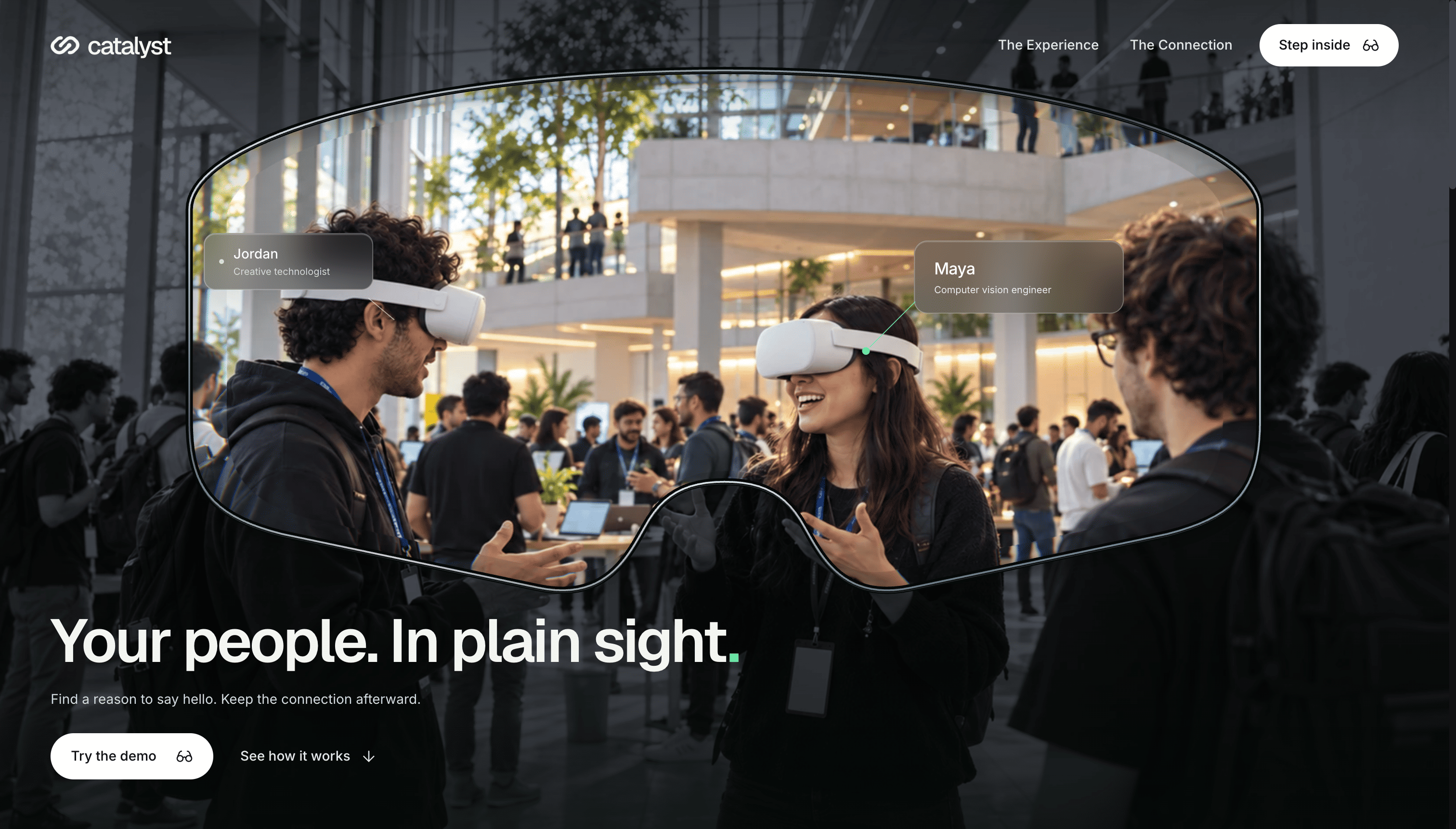
We created Catalyst to explore how mixed reality could reveal just enough shared context to make introductions feel natural. Instead of publicly ranking people or displaying their entire profile, Catalyst gives compatible attendees a private visual cue and a useful conversation starter.
What it does
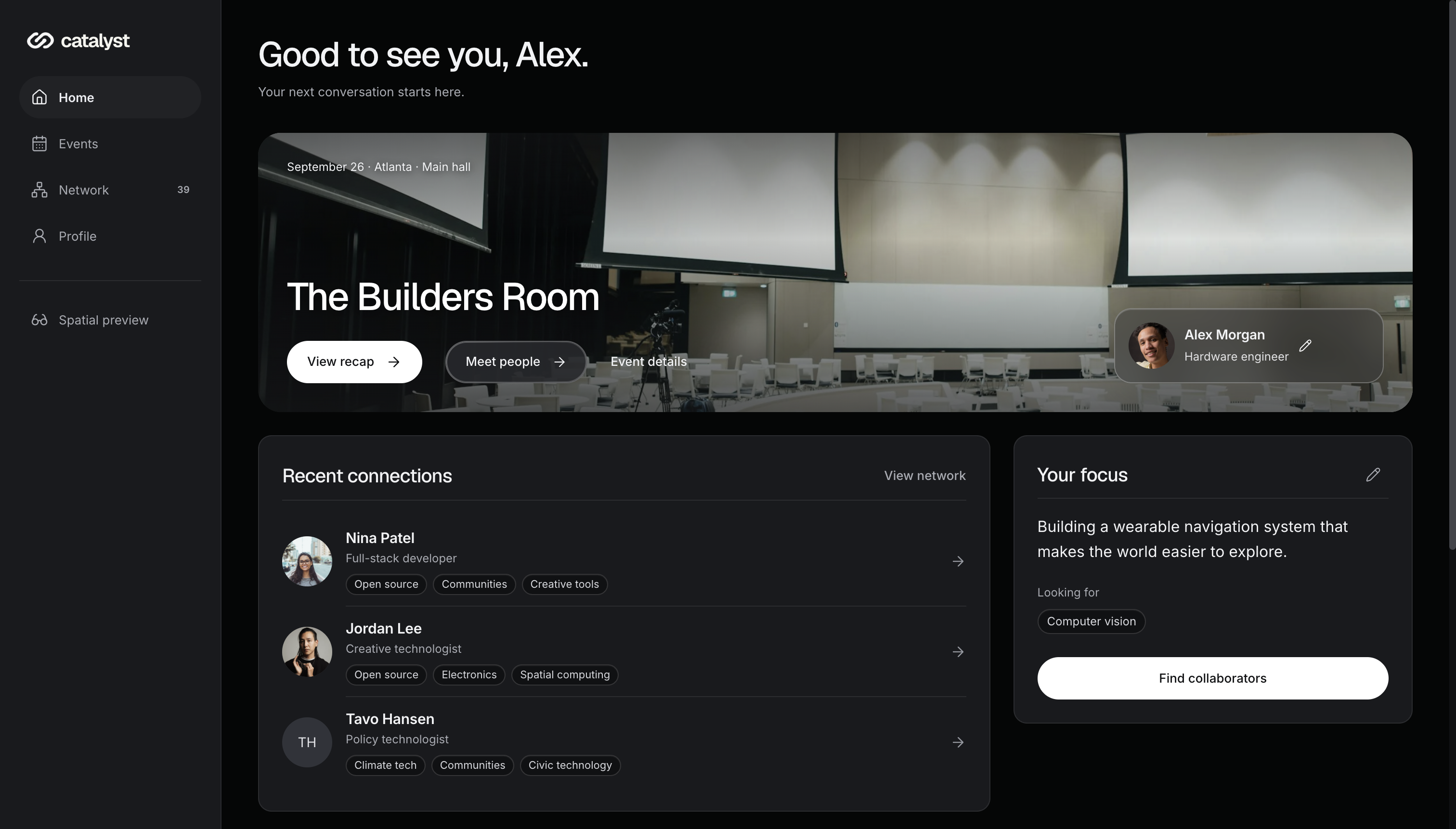
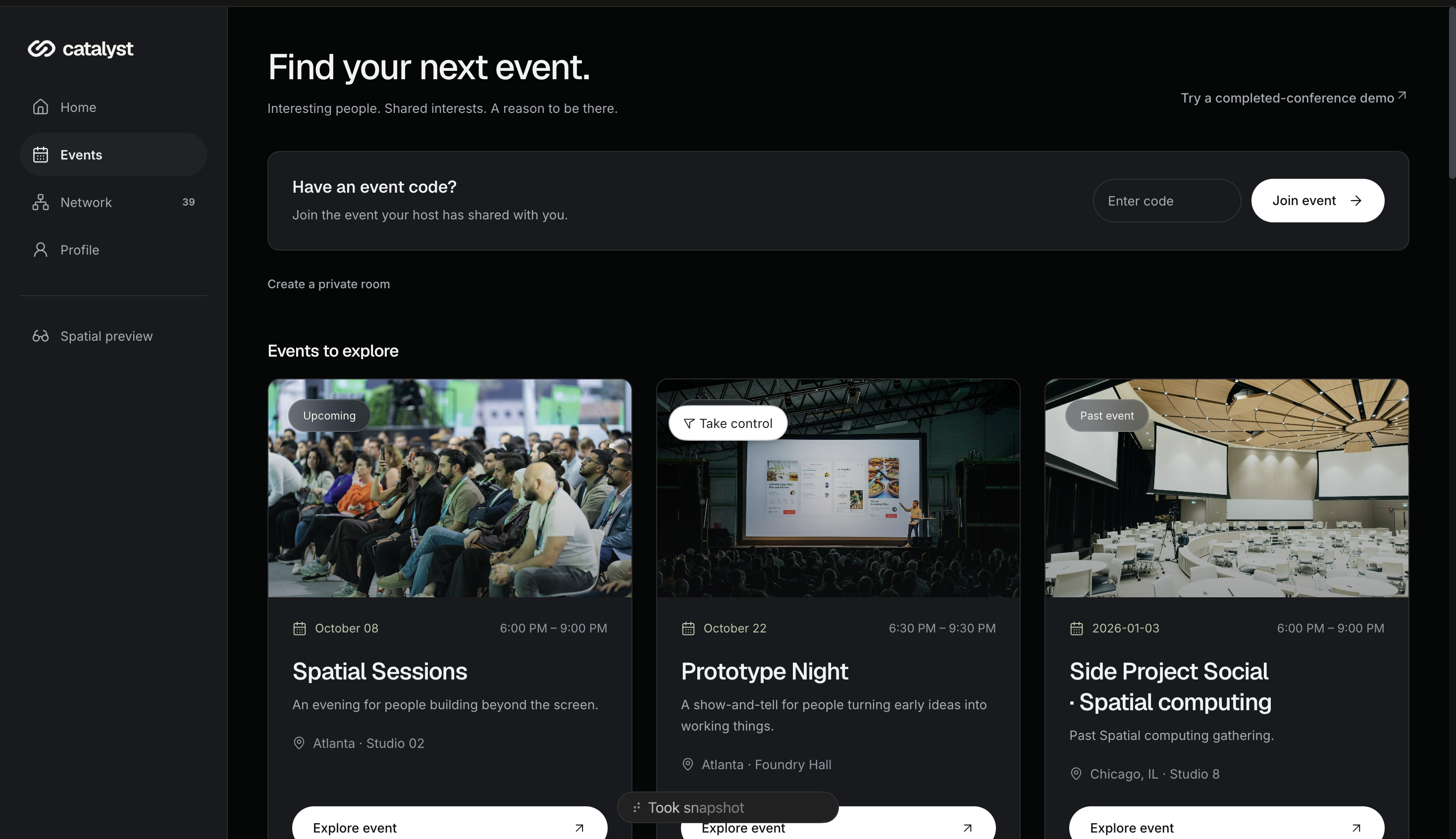
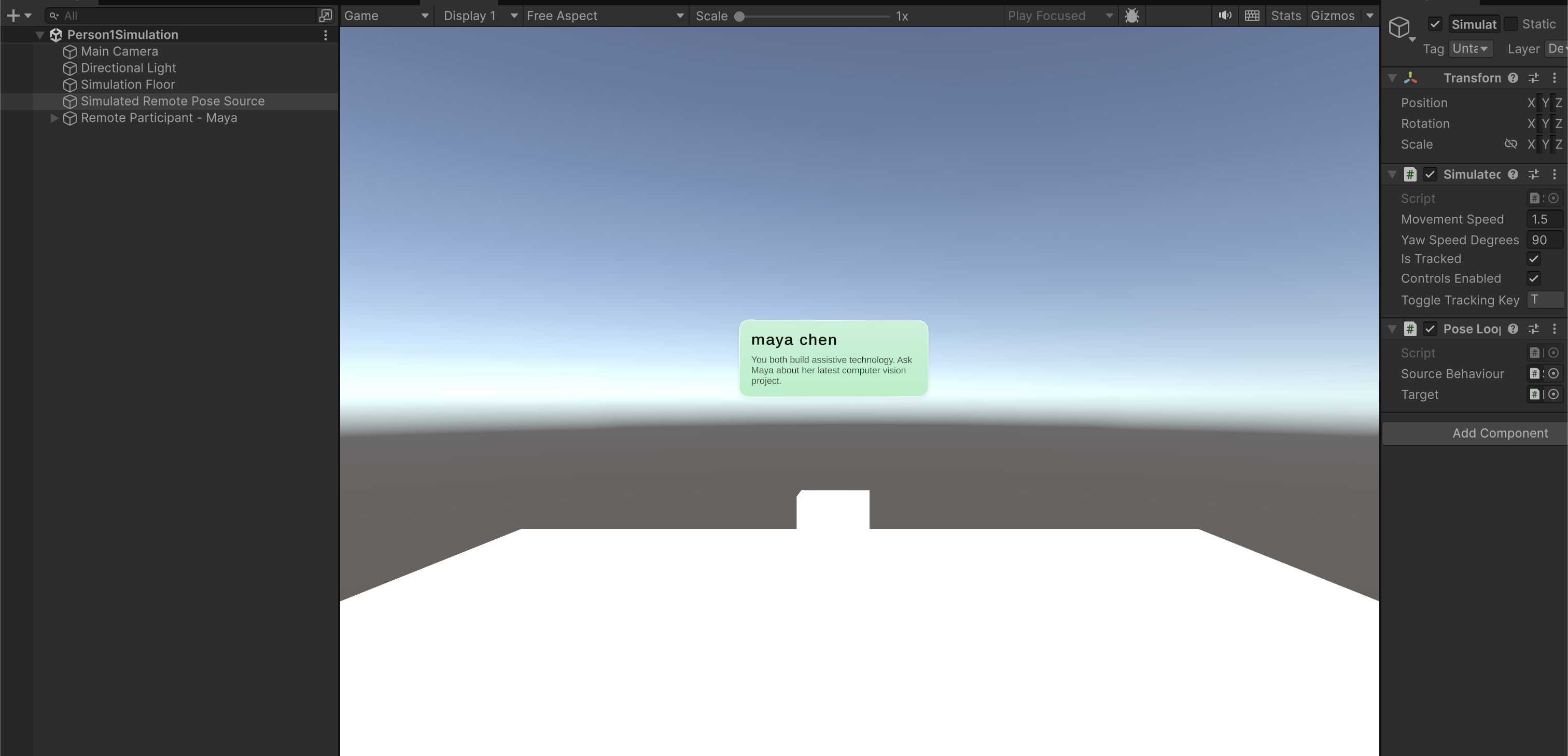
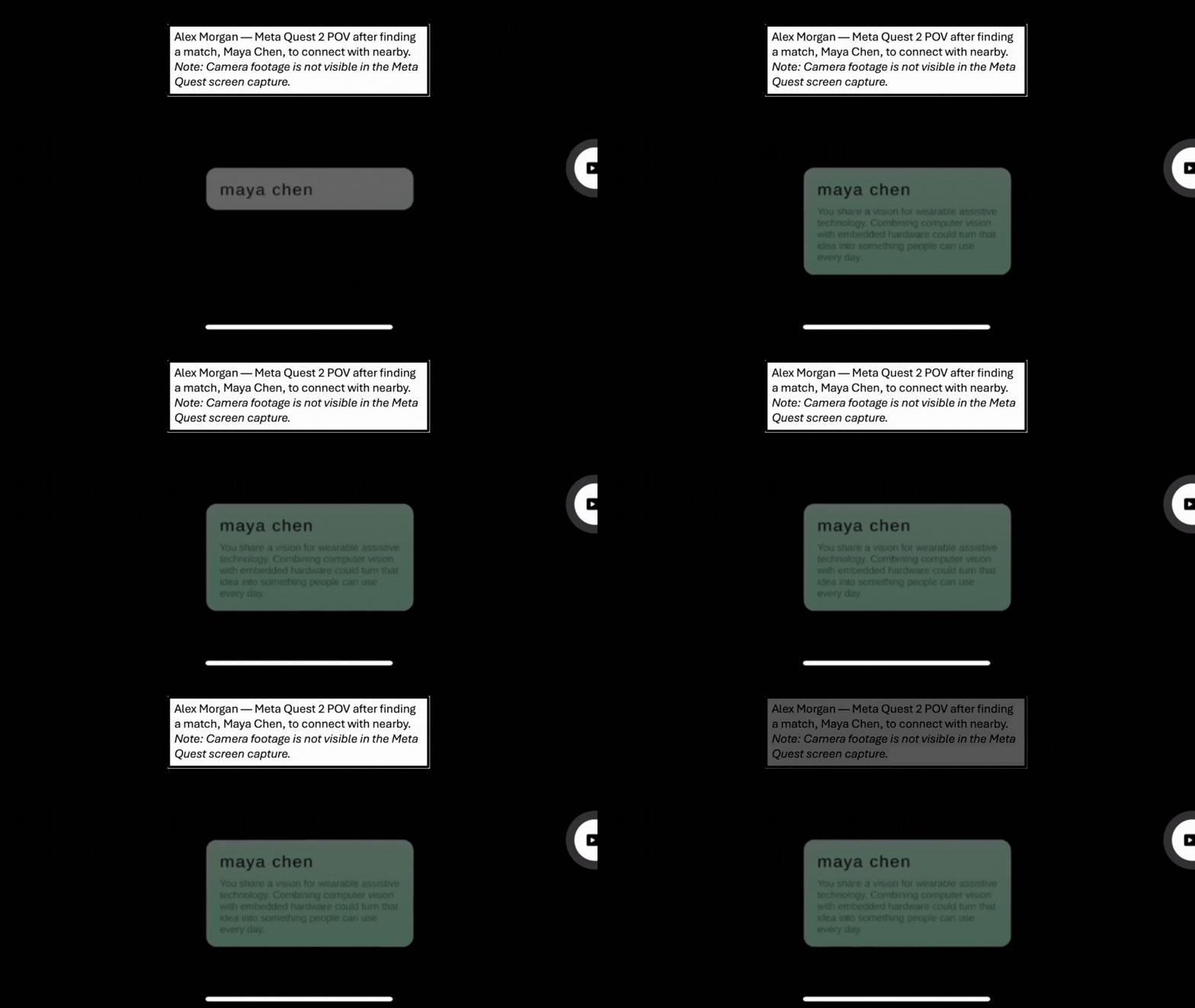
Catalyst is an AI-powered mixed-reality experience designed for Meta Quest. Attendees enter a shared physical space where AI identifies meaningful common ground based on their interests, skills, and experiences. Its companion website gives attendees a space to discover and explore events where they can meet people with shared interests and complementary skills. When two people are compatible, both receive a private green visual cue, the other person’s name, and a personalized conversation starter. The introduction is displayed visually and spoken aloud, helping users stay present while supporting people with low vision. If there is no match, nothing is revealed. Catalyst also includes a companion website where attendees can create profiles, explore events, manage privacy settings, discover people, save connections, and follow up afterward.
How we built it
We built Catalyst as three connected systems:
- The mixed-reality client uses Unity, C#, and OpenXR to bring AI-powered introductions into shared physical spaces. Private, mutual visual cues help people recognize meaningful connections while staying present face-to-face.
- The matching service uses Gemini to understand each person’s interests, skills, and experiences, identify genuine common ground, and generate a personalized conversation starter. Private information is filtered before processing, and nothing is revealed without a match.
- The companion website uses React, TypeScript, Three.js, and GSAP. It lets people create profiles, control visibility, join shared experiences, save connections, and continue conversations afterward, and uses and MongoDB Atlas powering profiles, events, and saved connections. To keep the experience responsive and reliable, Catalyst includes strict timeouts, caching, request deduplication, and a deterministic offline fallback if the AI service becomes unavailable.
Challenges we ran into
- Connecting the headsets: Meta Quest Developer Hub repeatedly failed to recognize our devices. After troubleshooting drivers, developer mode, and USB connections, we factory-reset the headsets and reconfigured them, which restored a stable connection.
- Synchronizing the physical space: Each headset created its own coordinate system. We solved this with a shared calibration process that aligns both devices to the same physical origin and forward direction.
- Making AI reliable: Gemini could respond slowly or inconsistently during live interactions. We added structured JSON outputs, strict validation, evidence requirements, caching, short deadlines, and a deterministic fallback.
- Protecting user privacy: AI needs personal context to identify common ground, but users should remain in control of what others see. We separated matching data from visible profile data and excluded contact details and social links from AI requests.
- Managing the project scope: Our original vision included many social features. We focused the prototype on one polished interaction: helping two people discover meaningful common ground and confidently start a conversation.
Catalyst and Meta: Bringing People Closer Together with AI
Catalyst aligns with Meta’s challenge by focusing on what makes a connection meaningful: mutual understanding, a reason to engage, and the opportunity to build a lasting relationship. Its value extends beyond meeting someone to helping that relationship become part of a stronger community.
AI is central to interpreting why two people might connect, through complementary goals, shared experiences, or interests that their profiles express differently. Catalyst’s originality is bringing that understanding into a face-to-face encounter, where it can spark a real conversation.
Post-event follow-ups carry that impact forward. Helping people continue conversations creates opportunities for mentorship, friendship, and collaboration. Our aim is for the connections made at temporary gatherings to become lasting sources of support and belonging.
Catalyst and Make it Legendary with SpaceXAI
Catalyst addresses a broader challenge: access to the people, expertise, and communities that help ideas become reality. Valuable collaborations often depend on chance encounters or existing networks. Our ambition is to make those opportunities more discoverable and accessible.
We used Grok and Cursor as coding tools to turn this futuristic vision into a mixed-reality prototype. It explores how wearable AI could expand human awareness beyond what is immediately visible, helping people recognize opportunities to combine their knowledge and tackle shared problems.
Inclusion is part of that ambition. Spoken introductions through ElevenLabs reduce reliance on visual information, supporting participation by people with low vision. By widening access to connection and collaboration, Catalyst aims to help more people contribute to progress in areas such as accessibility, education, and public health.
Accomplishments that we're proud of
Catalyst is a working, end-to-end social experience that connects AI, mixed reality, voice, and a polished companion platform.
- A Gemini-powered matching engine that identifies meaningful common ground and generates evidence-based conversation starters
- A Unity and Meta Quest experience with passthrough, shared-space calibration, participant positioning, and private MR connection cues
- ElevenLabs voice narration that lets people hear their shared introduction while remaining present face-to-face
- A polished, responsive UI with cinematic Three.js and GSAP visuals, spatial previews, event pages, profiles, and connection tools
- Privacy-first matching that filters sensitive information and reveals nothing when two people are not compatible
- A complete connection journey - from discovering someone to saving the connection, adding notes, and following up after the event
- Reliable live interactions supported by validation, caching, request deduplication, strict timeouts, and offline fallback behavior
- Extensive automated coverage across the AI matcher, APIs, browser experience, and Unity client Most importantly, Catalyst uses AI to create moments of genuine human connection—not to publicly score people, but to give them a meaningful reason to start talking.
What we learned
We learned that technology strengthens human connection when it creates confidence without distracting from the people involved. In mixed reality, a private shared cue and one meaningful conversation starter can be more powerful than displaying an entire profile. We also learned that AI is most valuable when it understands context and turns hidden common ground into something actionable. To earn trust, its introductions must be personal, evidence-based, privacy-aware, and grounded entirely in information people choose to share. Finally, we learned that a strong social prototype needs both emotional clarity and technical reliability. Shared schemas, strict validation, timeouts, and clear system boundaries helped us deliver one focused experience: transforming two strangers in the same room into people with a genuine reason to connect.
What's next for Catalyst
- Expand Catalyst to future Meta glasses and next-generation MR hardware, using on-device computer vision and strictly opt-in facial recognition to enable faster, hands-free identification and smoother real-world interactions while preserving consent and privacy.
- Replace the HTTP room relay with Photon Fusion for lower-latency pose synchronization, automatic reconnection, and larger multi-user rooms.
- Use Meta Shared Spatial Anchors to align devices without requiring attendees to stand on a physical calibration marker.
- Adapt Catalyst for future Meta glasses with hands-free controls, on-device computer vision, and strictly opt-in identity recognition.
- Expand MongoDB persistence with secure authentication, durable profiles, event history, saved connections, and organizer controls.
- Improve AI matching with user feedback, clearer evidence-based explanations, and more personalized conversation starters.
- Run real-world testing to measure latency, match quality, privacy comfort, accessibility, and whether introductions lead to lasting connections.


Log in or sign up for Devpost to join the conversation.