Inspiration
It's 2am. A founder gets a notification. "Chase Bank: A charge of $1,247 from Amazon Web Services has been processed." $1,300 yesterday. $53 today. There are 25,225 active startups in the US - each built by someone who decided to create something the world didn't have yet. People building healthcare tools that reach rural communities. Climate solutions that actually work. Edtech platforms giving kids a shot they'd never otherwise get. They're not chasing money. They're building the future one commit at a time. And while they do that - heads-down shipping, hiring, pitching, surviving on four hours of sleep - something quiet and devastating is happening in the background. Cloud credits counting down. SaaS subscriptions multiplying. Tools from dead pivots billing every single month. Nobody watching. $6.2 billion in cloud credits expire unnoticed every year. 78% of startups cite cloud cost management as their biggest operational headache. The average company wastes 35% of its SaaS spend on tools nobody uses. Every dollar lost to a surprise charge is a feature that doesn't get built. A hire that doesn't happen. A problem that stays unsolved. We built Catalyst because this happened to someone on our team. We're not solving a hypothetical. We're solving Tuesday.
What It Does
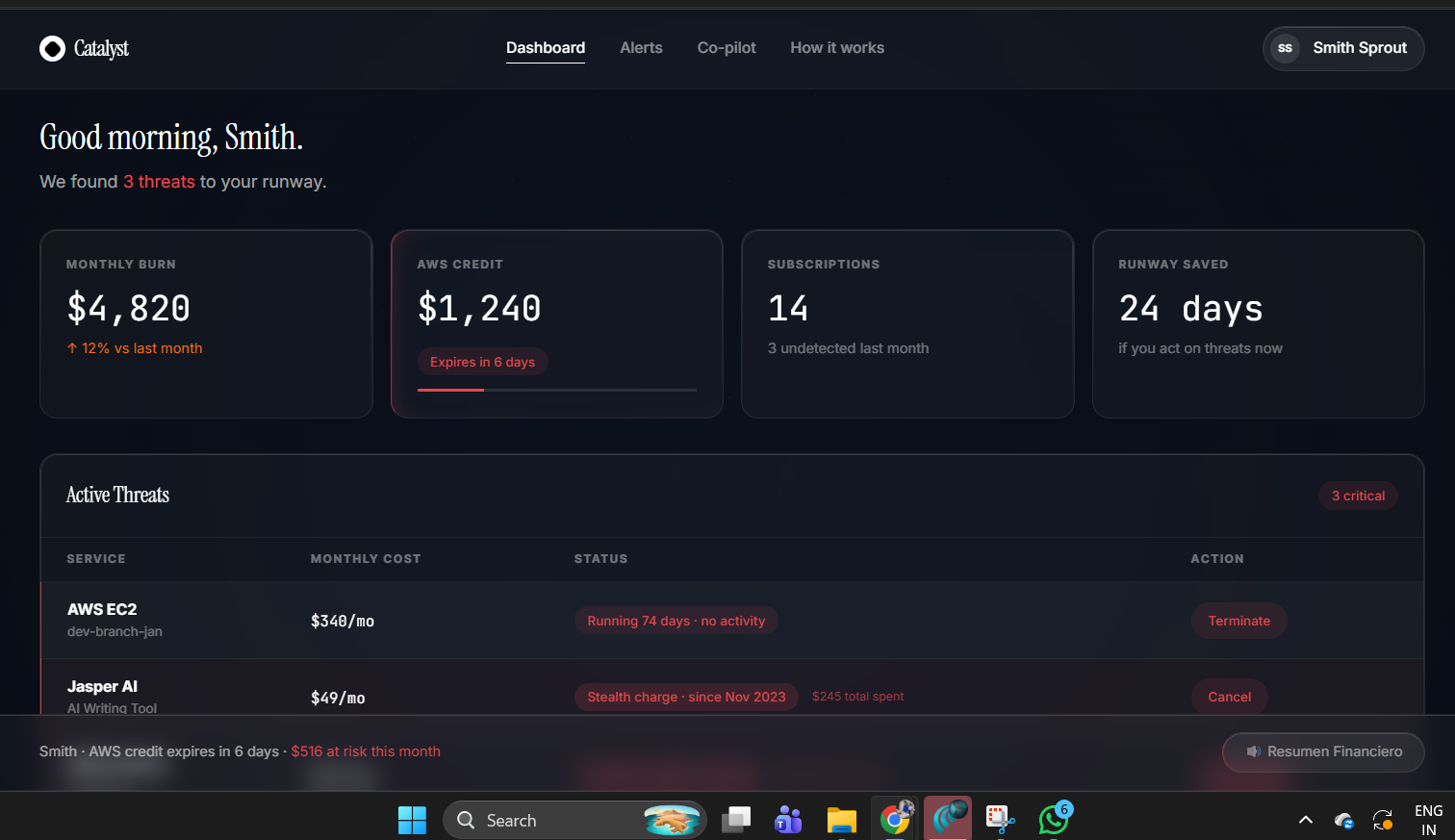
Catalyst is a proactive cloud-credit and subscription burn tracker for early-stage founders. It sits across your bank, inbox, and cloud accounts and does what none of them do alone - warns you before it costs you. Connect in 60 seconds. Link your bank via Plaid and authorize Gmail. Catalyst reads billing invoices from AWS, GCP, Azure, and every SaaS tool automatically. No manual entry. No configuration. One burn dashboard. Monthly burn, active credit balances, subscription count, projected runway saved - all live. Every subscription ranked by risk with one decisive insight per row. Three villains caught automatically. The EC2 bleeding money with zero deployment activity. The AI SaaS nobody uses but everyone pays for. The free tier that quietly crossed into paid. Catalyst surfaces all three with exact dollar amounts, first-charge dates, and a single action to take. In your language. ElevenLabs generates a personalized voice briefing - urgent, human-sounding, in English, Spanish, Hindi, or Mandarin - before a single dollar leaves your account. Ask your financial co-pilot. Gemini answers natural language questions against your real transaction data. "When does my AWS credit run out?" "What if I shut down my dev environment?" Real answers, not estimates. Surface stealth charges. Gmail invoice parsing uncovers every recurring charge you forgot about - first-charge dates, total spent, month-over-month trends.
How We Built It
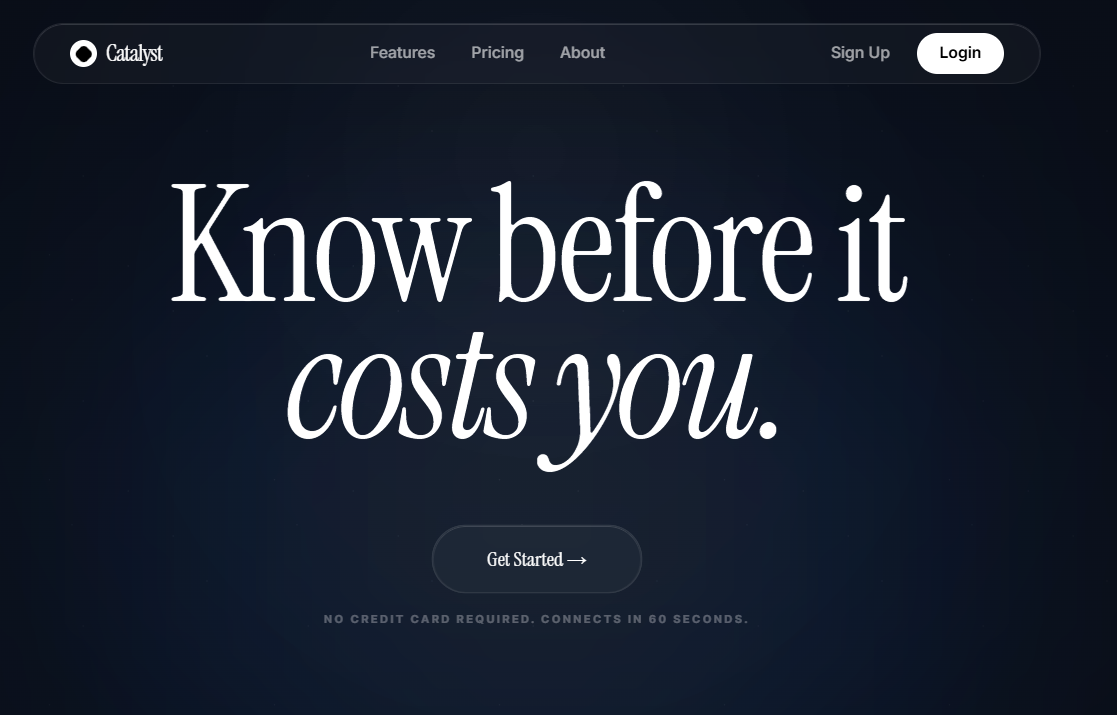
Catalyst is a web application built around one principle: catch financial risk before the founder thinks to look. A cinematic landing page sets the emotional context. One click transitions into guided onboarding: login, connect data sources, watch Catalyst scan in real time, then land on a personalized dashboard that greets you by name and tells you exactly what it found. Dual-source data pipeline. Plaid reads every bank transaction - merchant name, amount, date. Gmail API - scoped only to known billing senders, never personal emails - parses invoices and extracts credit balances per service. The two sources validate each other. Matching charge from Gmail and Plaid on the same day means confidence. A mismatch means a flag. Credit engine. Current balance divided by daily burn rate equals days remaining. One formula drives every number on the dashboard - the countdown, the red badges, the alert thresholds, the co-pilot responses. Alert system. Three thresholds - 7 days, 48 hours, 24 hours - fire personalized alerts with exact dollar amounts and specific service names. A unique database constraint ensures no alert ever fires twice. AI layer. Gemini generates personalized briefing scripts from the founder's real threat data. ElevenLabs converts them to voice using eleven_multilingual_v2 for natural, urgent delivery across four languages. Design system. Liquid glass aesthetic throughout - backdrop blur, near-zero opacity backgrounds, subtle white border gradients. Instrument Serif for headlines, monospace for numbers, red only on threat data, green only on healthy data. Every transition fades to black. It feels like a product that ships, not a hackathon project.
Data Privacy and Compliance
Catalyst is built on a strict principle: we read only what we need, we store only what matters, and we never touch what isn't ours. Bank data via Plaid. Founders authenticate directly through Plaid's secure OAuth modal - we never see, handle, or store banking credentials at any point. Plaid issues us a read-only access token. We use it to pull transaction records - merchant name, amount, date - and nothing else. We cannot initiate transfers, view account numbers, or access any data outside transaction history. The token can be revoked by the founder in Plaid's dashboard at any time, immediately cutting our access. Gmail access. We request the most minimal Gmail permission scope available - read-only, filtered programmatically to known billing sender addresses: [email protected], [email protected], [email protected], and similar. We never access personal emails, attachments, contacts, or any non-billing content. From each billing email we extract exactly three fields - charge amount, service name, and date - and store only those parsed values. Raw email content is never written to disk or stored in our database. AWS via IAM role. Founders create a read-only IAM role in their own AWS account using our eight-permission billing policy. We use AWS STS to assume that role temporarily. Credentials are valid for one hour and are never stored - they exist only in memory for the duration of the API call. We access Cost Explorer and billing data only. We cannot touch compute resources, storage, application data, or any operational infrastructure. What we store. Our database contains only derived financial insights - credit balances, burn rates, depletion projections, subscription amounts, and alert logs. No raw credentials, no email content, no personal communications, no banking details. Every stored value is a number or a date that the founder can see on their own dashboard. Alert deduplication. A unique constraint on the alerts table - indexed on credit ID and threshold - ensures no duplicate alerts are ever sent regardless of scheduler behavior. Founders are never bombarded. Data deletion. Founders can disconnect any data source at any time from the dashboard. Disconnecting removes the access token and queues all associated stored data for deletion within 24 hours. No data is retained after disconnection.
Challenges We Ran Into
ElevenLabs multilingual quality. Getting the Spanish financial briefing to sound genuinely urgent rather than robotic required switching from eleven_monolingual_v1 to eleven_multilingual_v2 and tuning stability, similarity boost, and style parameters until the delivery matched what the script demanded. The difference between robotic and human-sounding is everything when the product's job is to make a founder stop what they're doing. Building without a full team. We lost a developer mid-hackathon. Rather than scaling back the vision we made a decision - build the most complete, polished experience possible with the people we had. Every design decision had to count. No wasted screens. No features that didn't serve the core story. The constraint made the product sharper.
Accomplishments That We're Proud Of
We're proud that Catalyst doesn't feel like a burden. No manual entry, no dashboard to remember to check. It runs in the background, connects to tools you already use, and comes to you - in your language, before anything goes wrong. Invisible until it matters. Unmissable when it does. We're proud of stitching four APIs - Plaid, Gmail, ElevenLabs, and Gemini - into one coherent chain where each layer reinforces the next. The bank validates the invoice. The invoice feeds the engine. The engine triggers the voice. The voice gets the founder to act. That chain, end to end, is the product. We built a Gemini-powered voice briefing that writes a personalized financial script and speaks it in Spanish. No tool in this space has done that. We built it in 48 hours with a team that was down a developer.
What We Learned
Financial data is messier than any API documentation admits. Building for edge cases first - not last - is what separates a demo from a product. The biggest design lesson was urgency. Our first alerts informed. They didn't work. We rebuilt every alert to direct - exact dollar amount, specific service, projected date, runway impact, all in the notification itself. The shift from informing to directing is what makes Catalyst genuinely useful rather than just informative. We learned we weren't building a dashboard. We were building an early warning system. Those are different products with different design principles. A dashboard is something you visit. An early warning system comes to you. Naming that gap early made every architecture decision after it obvious. Constraints build better products. Losing a developer forced us to cut everything that wasn't essential and perfect everything that was. Catalyst is sharper for it.
What's Next for Catalyst
90 days. 50 real founders through YC Startup School, Indie Hackers, and founder communities. One honest Hacker News Show HN post about what happened to our co-founder at 2am gets us there. 6 months. Native Ramp and Brex integrations. AWS Cost Explorer and GCP Billing APIs for direct resource-level reads. Language support from four to eight languages targeting Southeast Asian and Latin American founder communities. A proprietary memory layer begins accumulating each founder's financial behavioral patterns. 12 months. Catalyst becomes the financial operating layer for early-stage startups. Automated credit renewal reminders. Vendor spend benchmarking against anonymized peer data. Predictive burn modeling 90 days out. A recommendation engine built on a proprietary dataset of founder financial decisions no competitor can replicate. 24 months. The memory layer is the moat. Every transaction, every alert interaction, every financial decision feeds a model that learns how founders at specific stages spend under pressure. After 10,000 founders, Catalyst knows patterns an individual founder has never seen because they've only ever run one startup. That compound knowledge is what Ramp can't buy and AWS can't build in a quarter. Business model. Free tier for three services. Pro at $19/month for unlimited services, full multilingual voice alerts, and AI co-pilot. Enterprise at $299/month for accelerators wanting portfolio-wide financial visibility across every company in their cohort. The market is every founder who has ever been surprised by a charge they should have seen coming. That's not a niche. That's every founder we know. Catalyst doesn't just save money. It saves the mental bandwidth founders need to keep building. And the founders who keep building are the ones who change things.
Built With
- elevenlabs
- gemini
- next.js
- plaid
- react19
- typescript
- vite


Log in or sign up for Devpost to join the conversation.