-
-
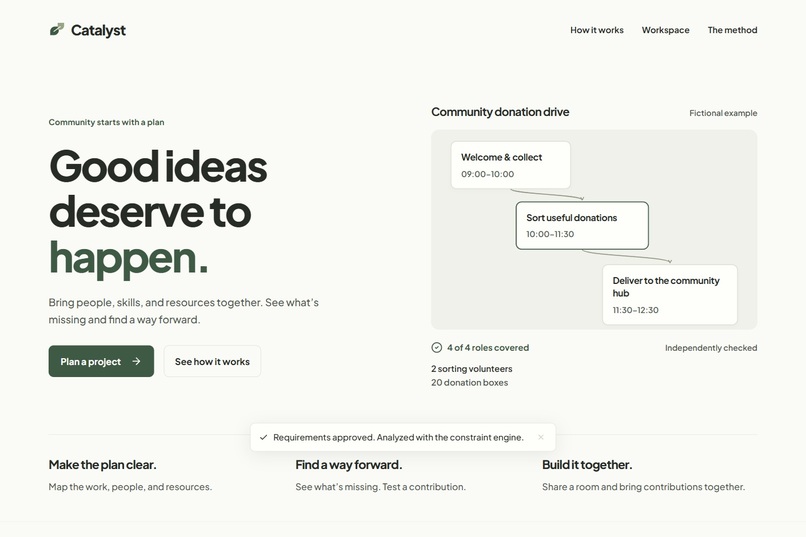
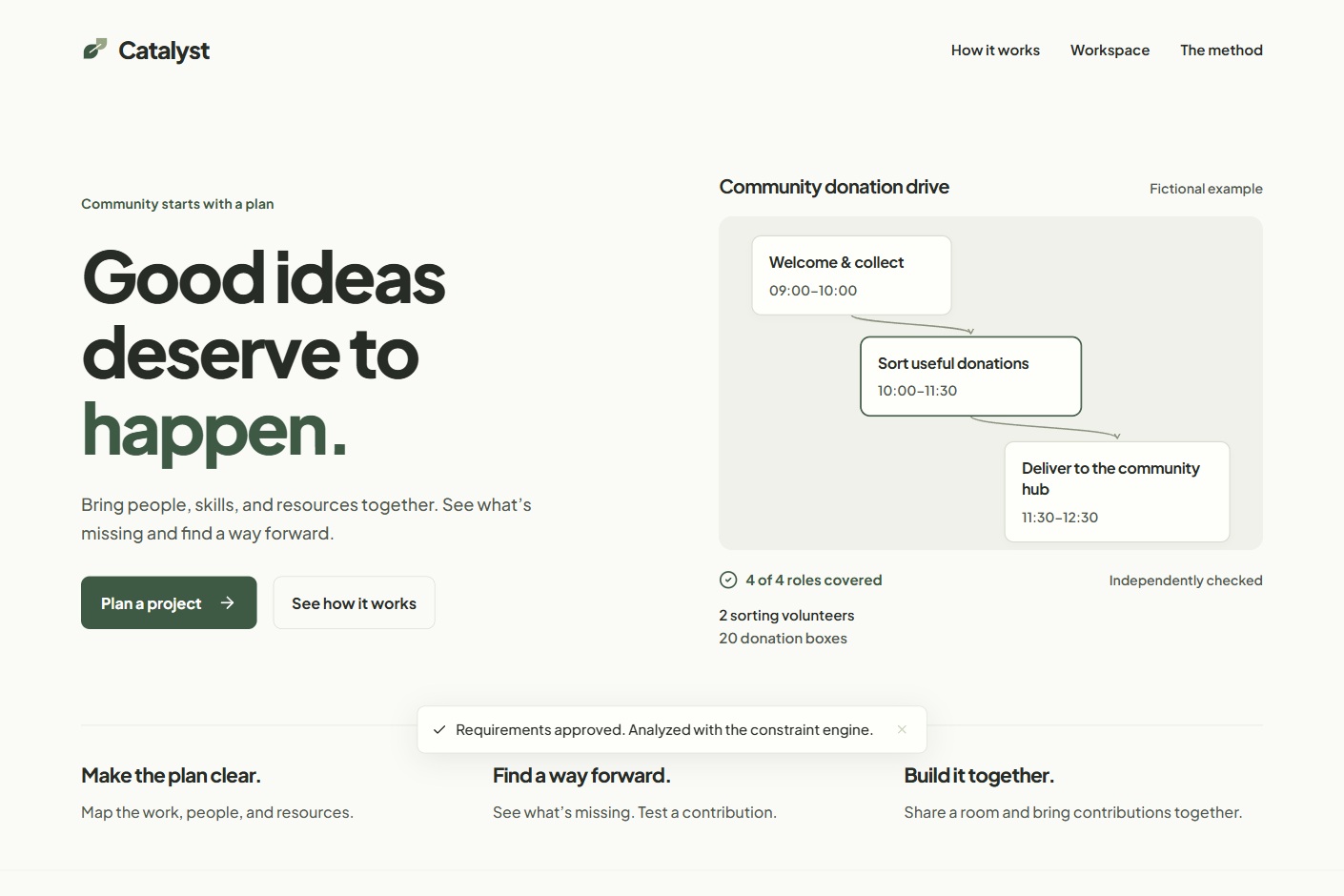
A shared starting point: connect the work, people, and resources behind a community project.
-
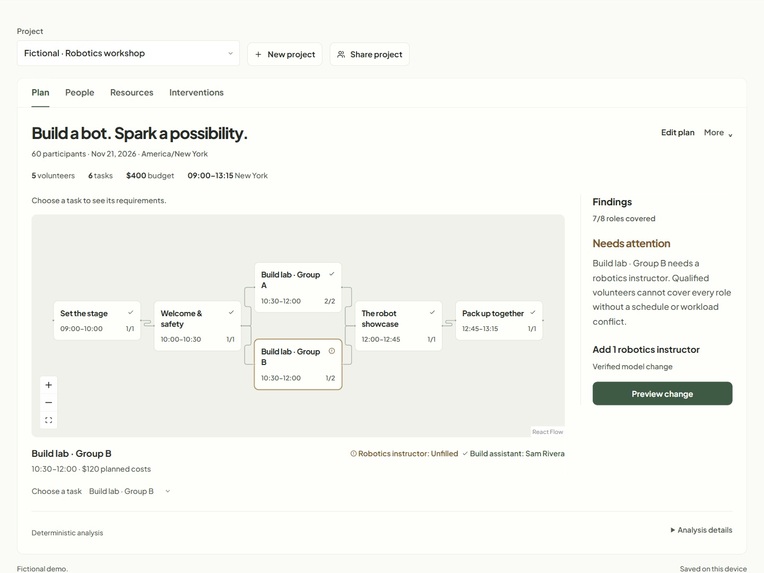
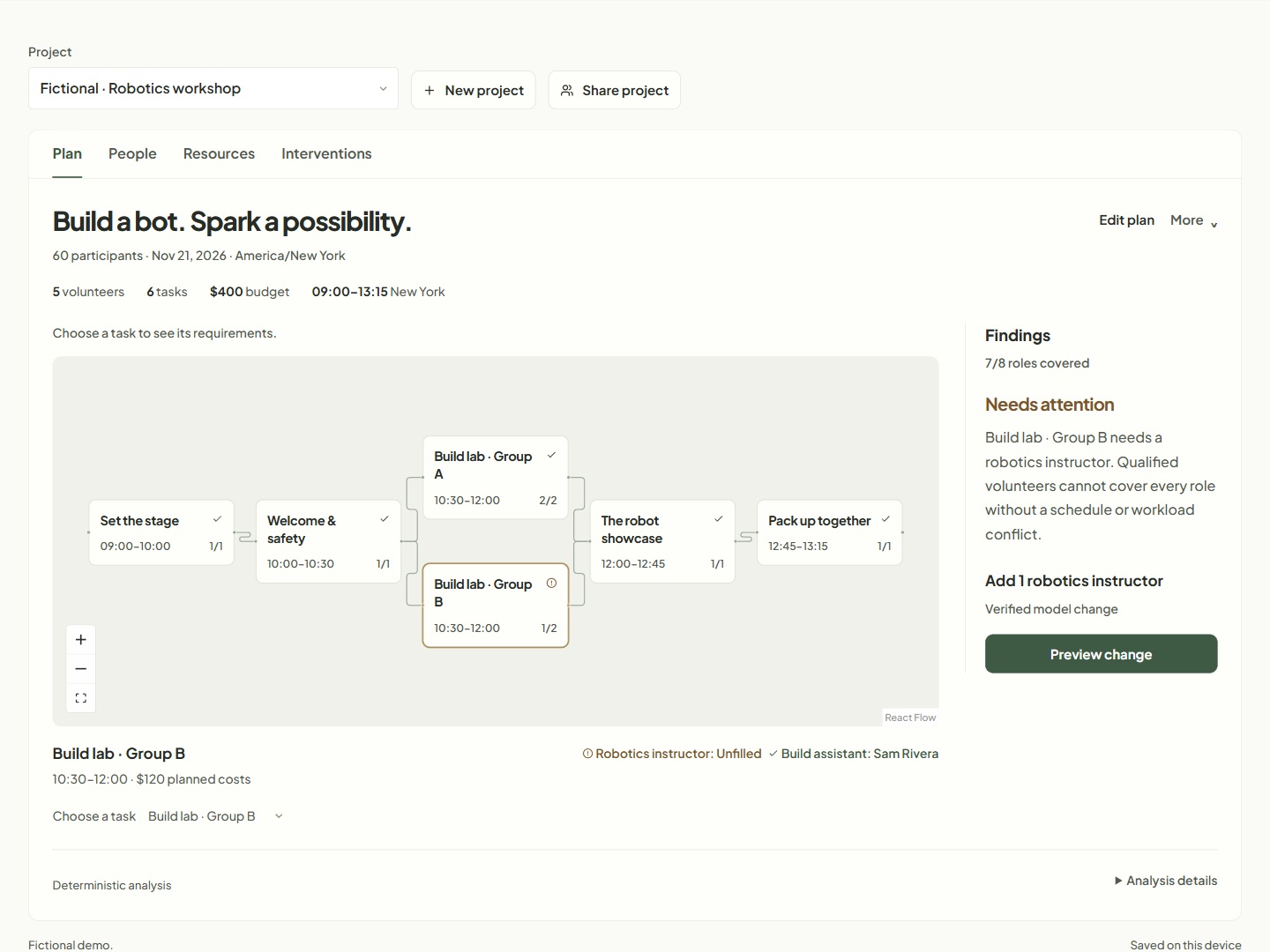
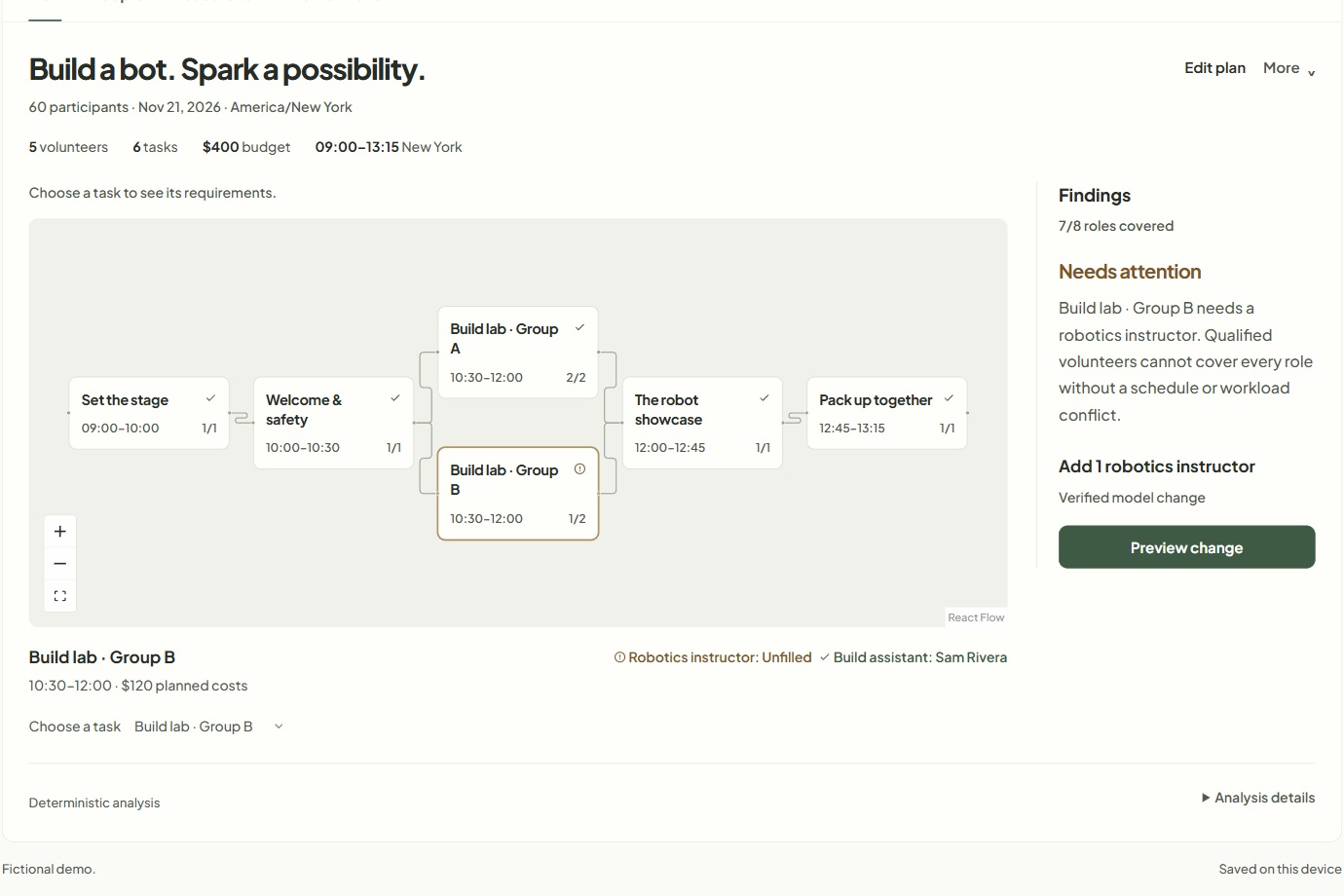
Explore a robotics workshop with seven of eight roles covered.
-
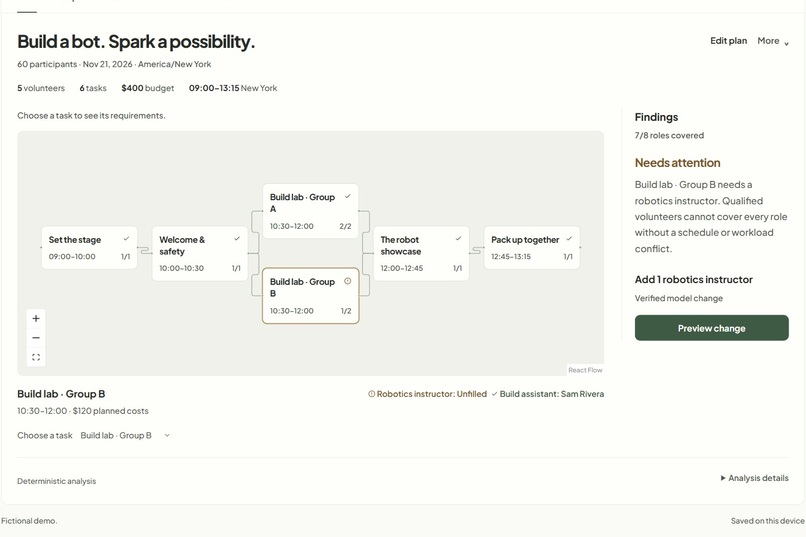
A specific request for help: another qualified instructor during two simultaneous labs.
-
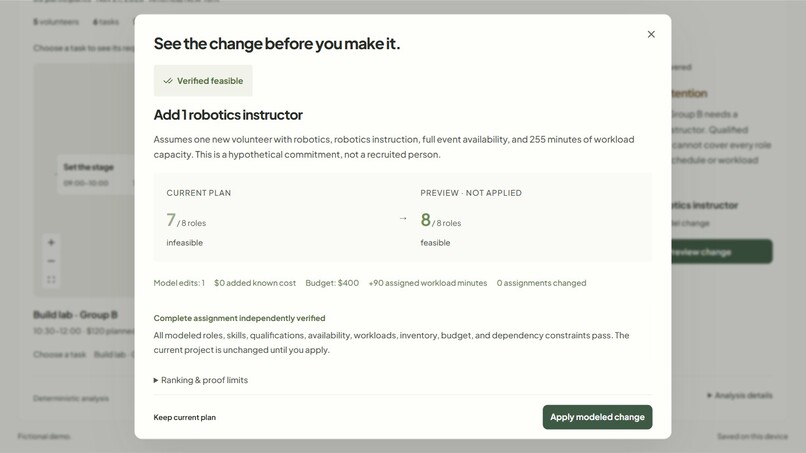
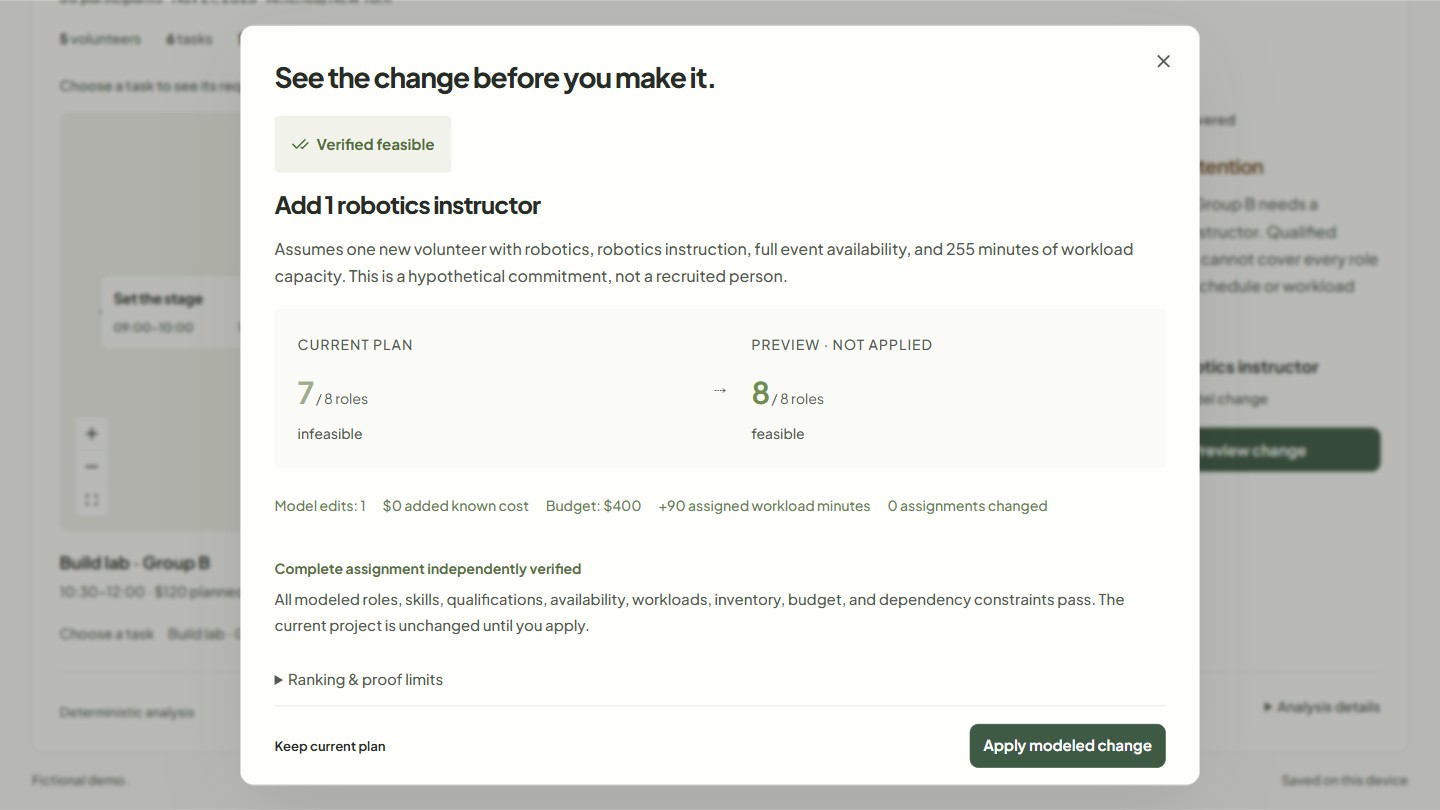
Test an instructor contribution: eight of eight roles, independently verified.
-
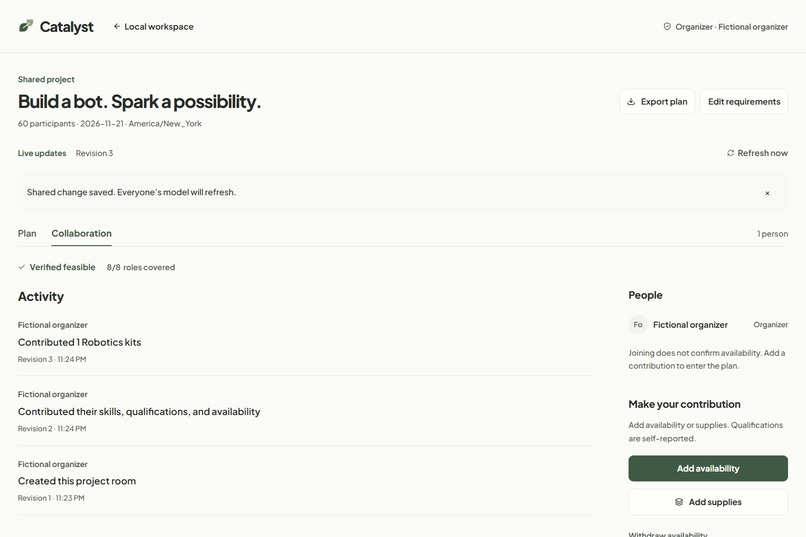
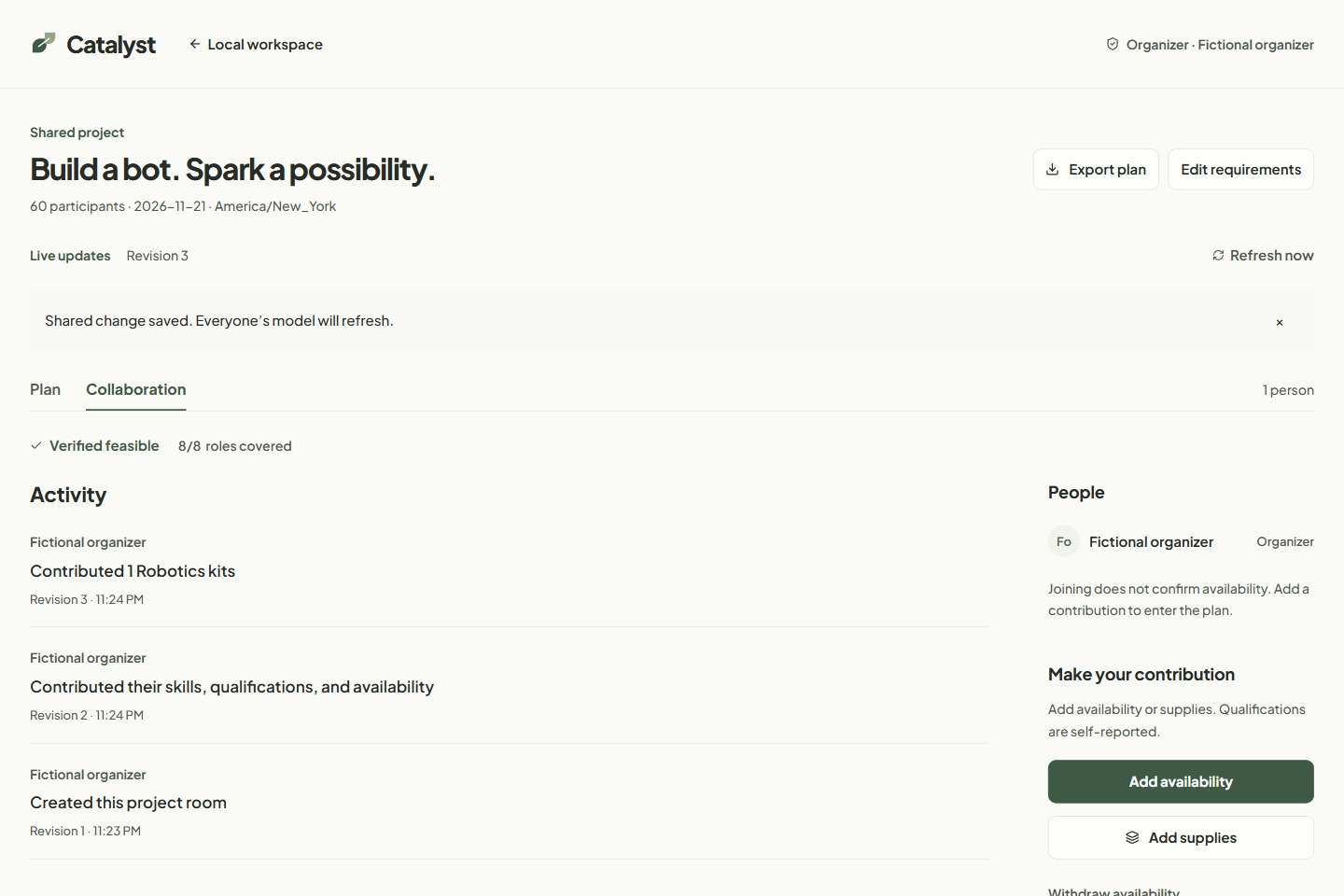
Participants contribute availability and supplies to a saved shared plan and activity history.
-
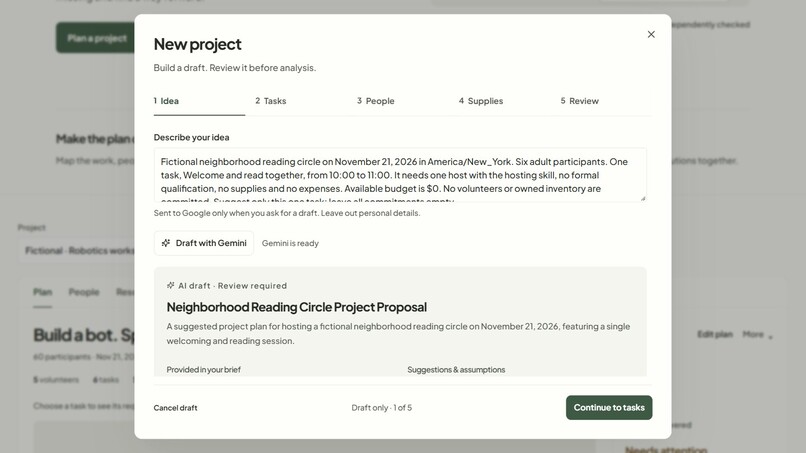
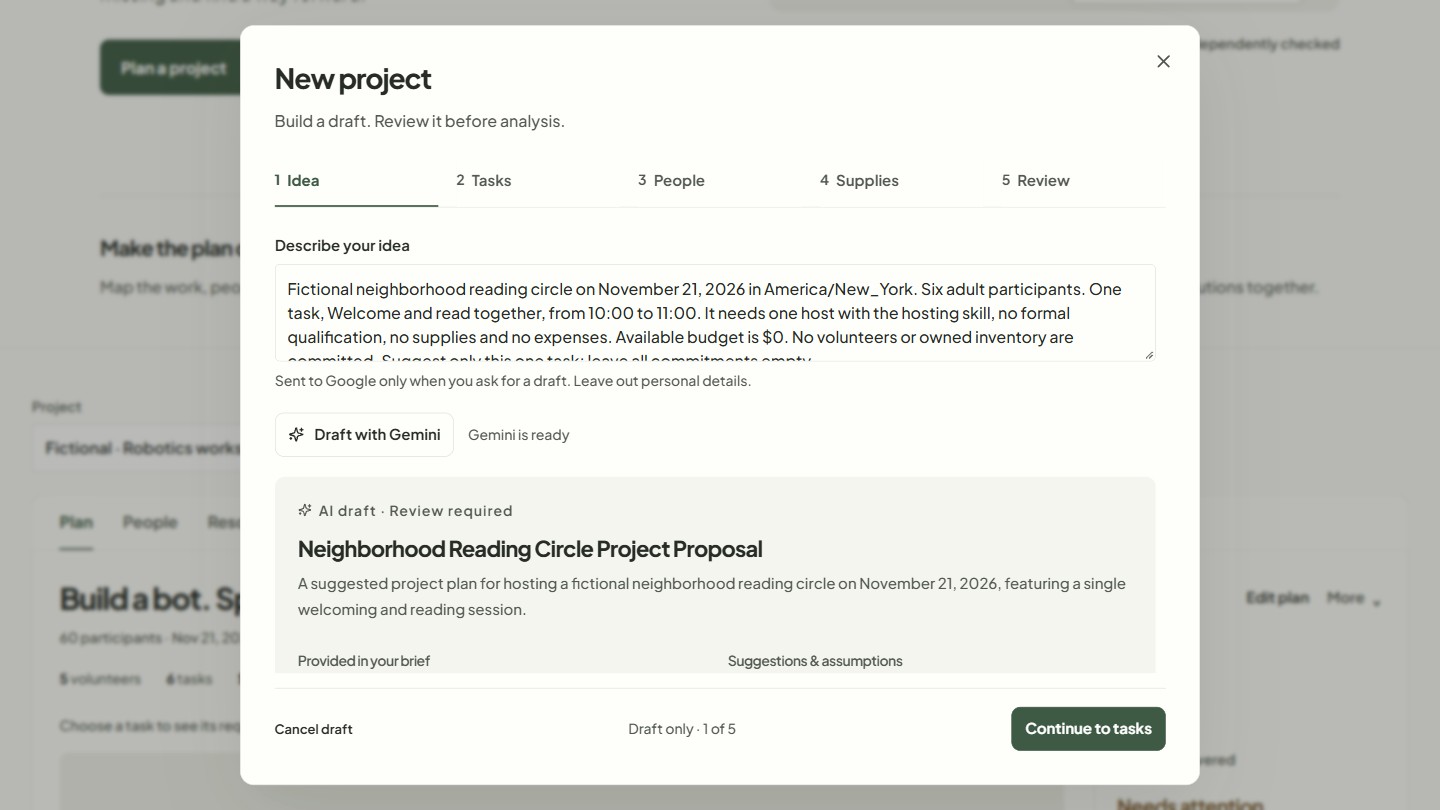
Review Gemini suggestions, assumptions, and questions before using them.
-
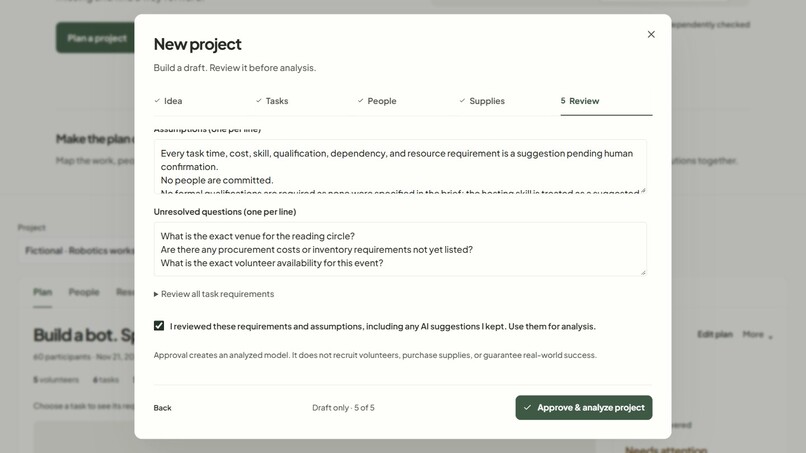
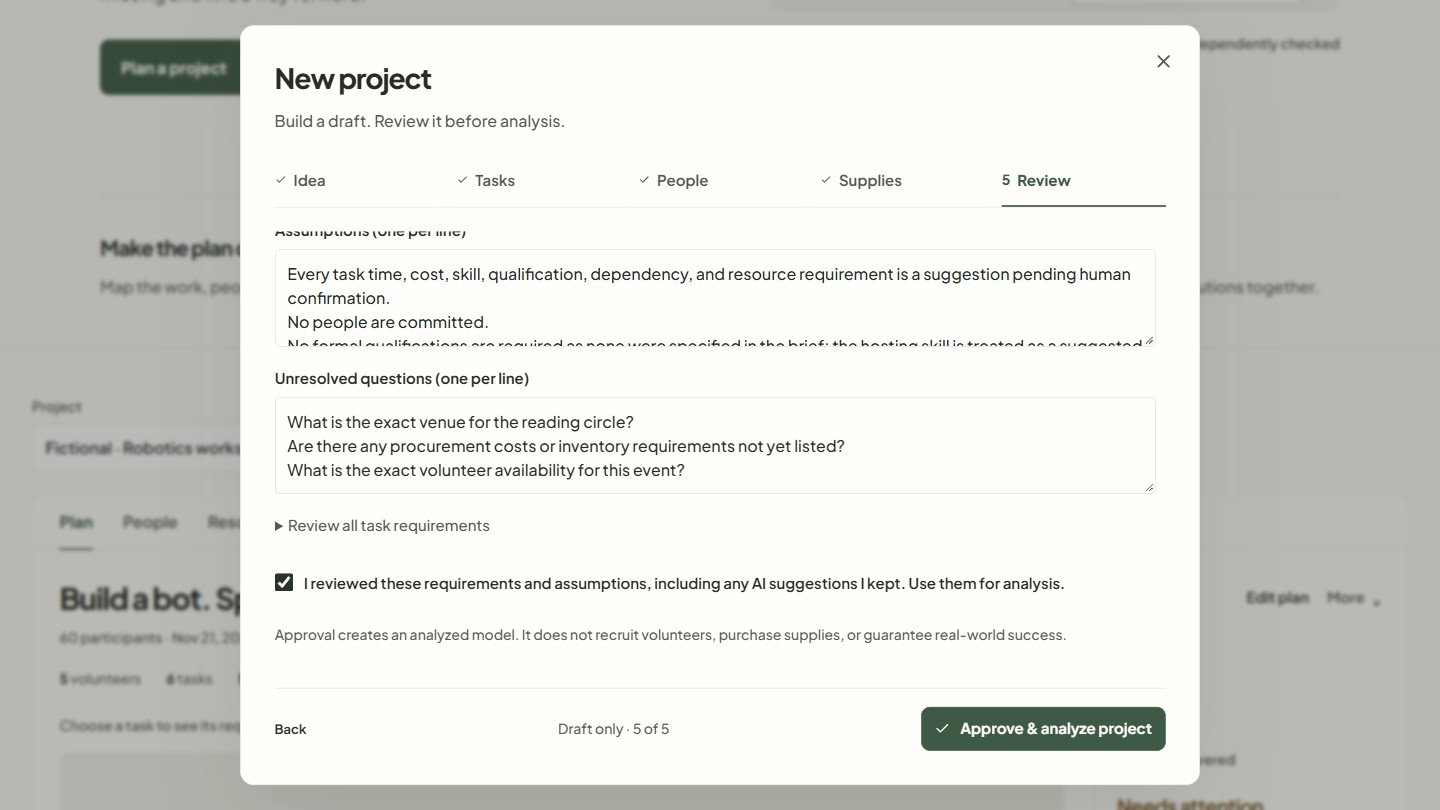
Human approval comes before deterministic feasibility analysis.
Inspiration
A student club can have a great idea and people willing to help, yet still struggle to make an event happen. An instructor might be needed in two places at once. Someone might have the right skills but only be free after the task ends. The missing piece is often coordination.
I conceived Catalyst to help people turn collective willingness into coordinated action. It gives students, community organizations, and volunteers a shared way to understand a plan and see where a contribution could make a difference.
What Catalyst does
Organizers map tasks, required roles, skills, availability, supplies, budget, and dependencies. Catalyst analyzes the plan, explains bottlenecks, and tests changes before they are applied.
In the fictional robotics workshop, seven of eight roles can be covered. Two labs run simultaneously, so the same qualified instructor cannot cover both. Previewing one additional instructor produces a complete eight-role assignment, checked by a separate verifier. The result shows what contribution would help; it does not claim that a real person has volunteered.
That turns an abstract request for help into something specific: another qualified instructor, available during the overlapping labs.
Collaboration and potential impact
Shared project rooms let invited participants enter their own skills, availability, and existing supplies. Saved contributions update the model and activity history. Organizers manage project requirements, while participants contribute the parts they control. Revision checks reject stale edits, and persistent storage keeps shared work across reloads.
The intended value is practical mutual support: a student can see where their time fits, a volunteer can identify a useful skill to offer, and an organizer can explain the gap instead of asking everyone to do more. These are intended uses, not claims of adoption or measured community impact.
How it works
A deterministic constraint solver searches assignments against fixed task times, skills, declared qualifications, availability, workload limits, overlapping work, supplies, budget, and dependencies. A separate verifier checks successful assignments. Counterfactual analysis tries candidate changes on copies of the plan, solves them again, and ranks verified repairs.
Google Gemini optionally turns a natural-language brief into suggested requirements with evidence, assumptions, and questions. The server validates the response. A person reviews, edits, and explicitly approves the model before analysis. Gemini proposes; the deterministic engine checks feasibility. It does not invent committed volunteers or owned inventory.
The stack is Next.js, React, TypeScript, React Flow, and Zod, with server-side Gemini integration, Vercel Hobby hosting, and Turso Free/libSQL persistence. Core planning also works without AI drafting.
Challenges and accomplishments
Overlapping roles make simple headcounts misleading. The engine had to check who can actually cover each role at the right time, then independently verify the assignment. Gemini's initial structured-output schema exceeded provider limits; simplifying the provider schema while retaining strict application validation preserved the review boundary. Hosted collaboration also required managed persistence instead of assuming local SQLite files would survive serverless deployments.
Verification includes 143 automated tests, 19 solver fixtures, 200 additional small cases matched against an independent reference calculation, and verified repairs for 12/12 defined repairable fixtures. Hosted checks covered room APIs (19), managed storage (10), and HTTPS/security/input handling (27). The demo uses actual production interactions and my original recorded narration.
Learning through iteration
The design went through repeated reviews of typography, spacing, copy, and visual hierarchy. Those iterations made a technical priority clearer: people need to distinguish a suggestion, a checked hypothetical change, and an actual contribution. Shorter explanations and a readable graph help communicate those differences. Another lesson from the engineering work is that a plausible result needs a separate check, not just a confident explanation.
Current limits and next steps
All example projects and participants are fictional. Feasibility applies to the entered model, not guaranteed attendance, safety, or authentic qualifications. Repair search is bounded and does not prove the globally smallest or cheapest change.
Independent API sessions and separate role interfaces were tested; hosted same-room collaboration using two independently authenticated browser UIs remains unverified. Member revocation and account-based organizer recovery are not implemented. Rotating an invitation blocks future joins through the old link, not existing sessions.
Next priorities are completing that browser acceptance test, improving recovery and membership controls, and learning from real community organizers.
My role and AI assistance
I created Catalyst as a solo project, developing the concept and directing its features, product requirements, technical priorities, integration decisions, and design through repeated review and iteration. I reviewed implementation results, guided revisions, and recorded the demo narration. I used OpenAI Codex extensively as an AI coding assistant for architecture, substantial implementation, debugging, testing, and development workflows. Google Gemini powers the optional in-app drafting feature; a separate deterministic solver handles feasibility analysis. Libraries and font licenses are credited in the repository.
Development timeline and reused work
This CSC entry reuses the existing Catalyst application, repository, production screenshots, and narration also prepared for STEM2Connect. It is not work created exclusively for CSC. The available Git history begins with the milestone-one baseline on November 18, 2026 (67ce39c), followed by collaboration work on November 19, the approved interface release on November 21 (3d6a836), and submission documentation on November 22. These recorded commits fall within CSC's published October 29–November 29 development period; commit dates alone do not establish when every line or idea originated. Frameworks, libraries, and fonts are pre-existing third-party resources. Cross-event eligibility remains for organizer confirmation before final submission.
Built With
- google-gemini
- next.js
- react
- react-flow
- turso
- typescript
- vercel
- zod