-
-
Logo for our app
-
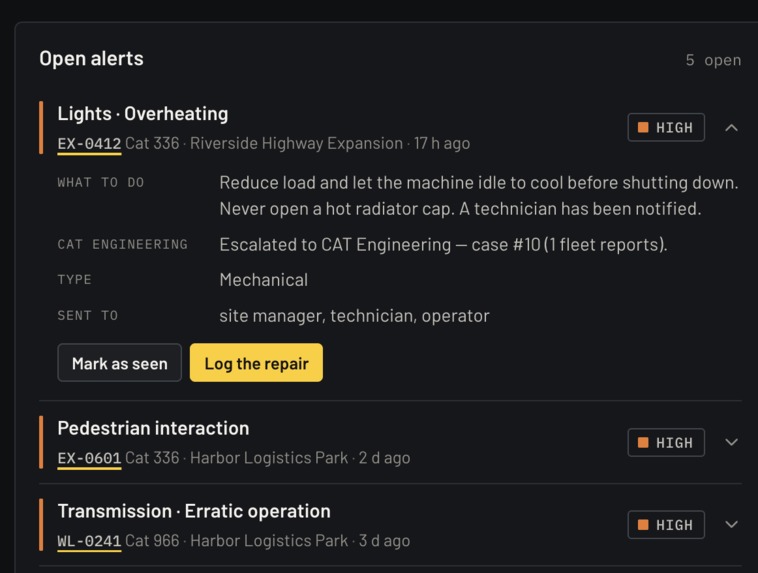
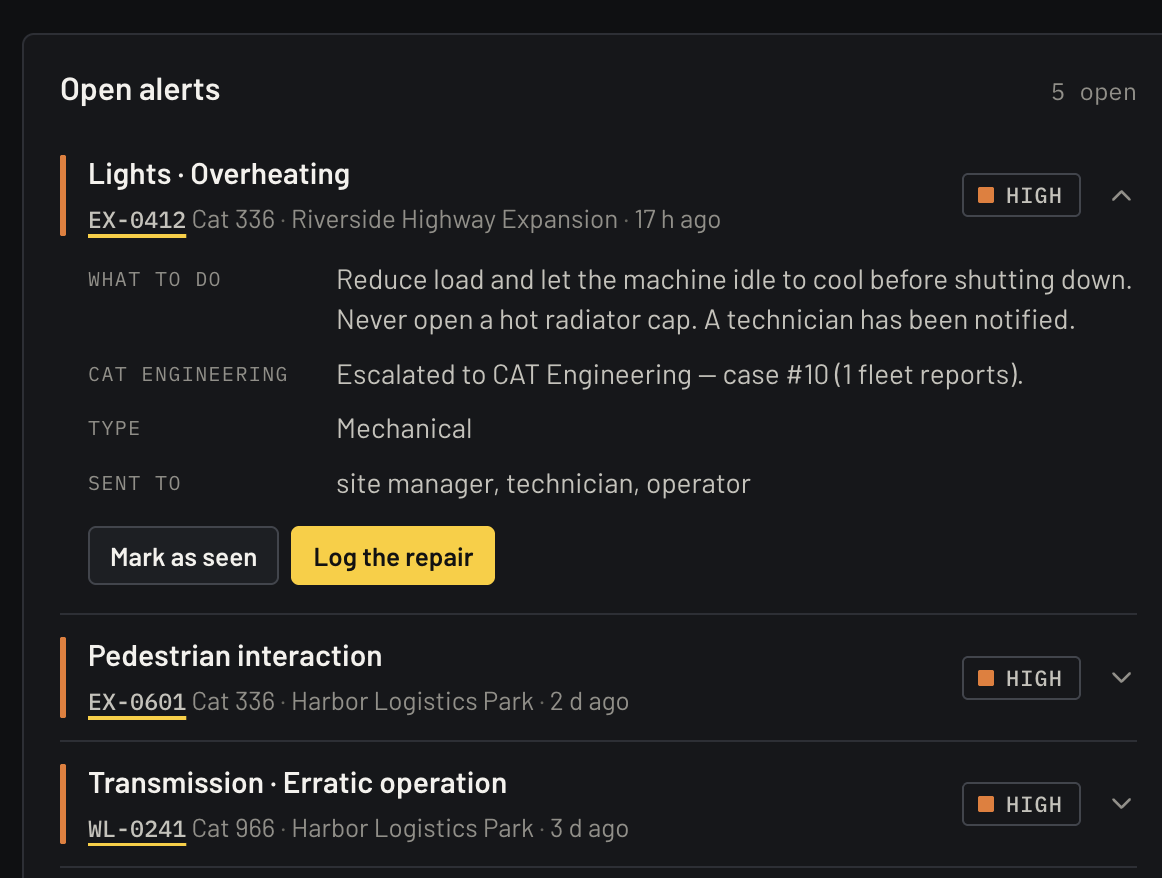
Open alerts with urgency, location, and logs.
-
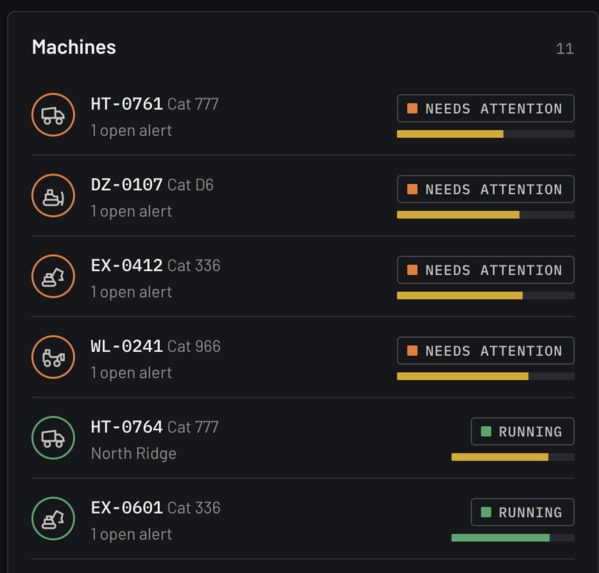
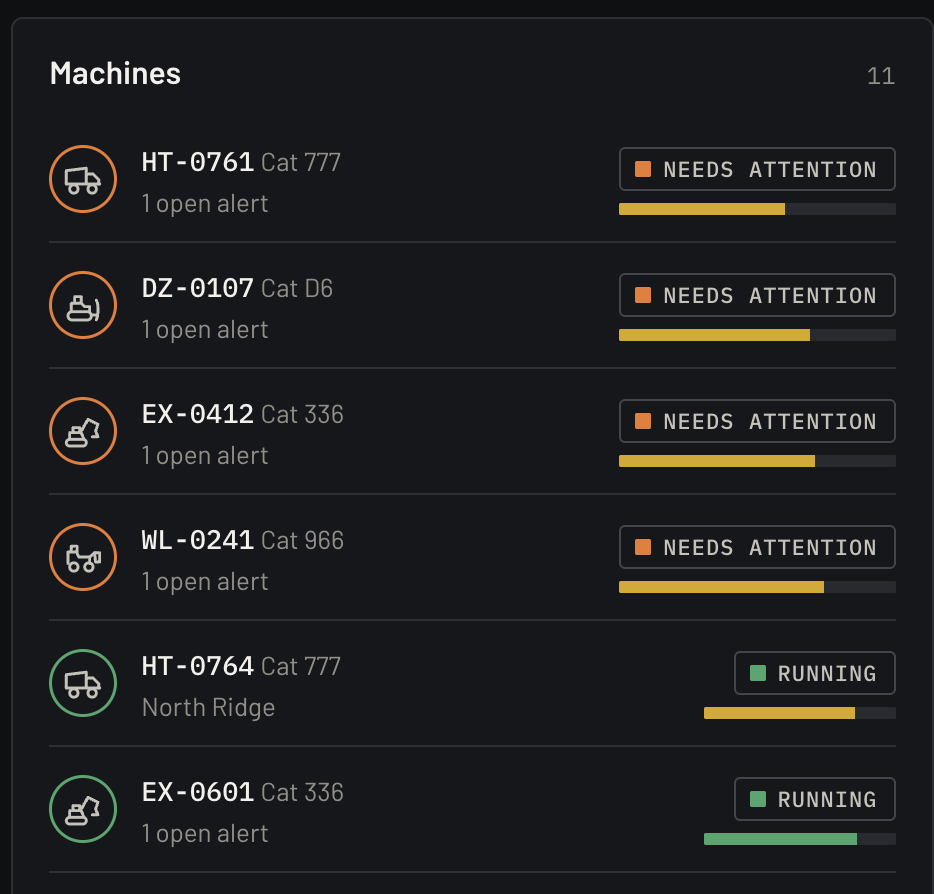
Status and location of assets
-
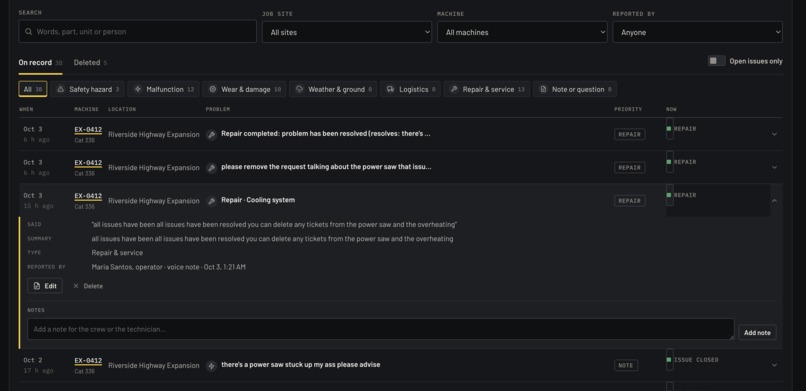
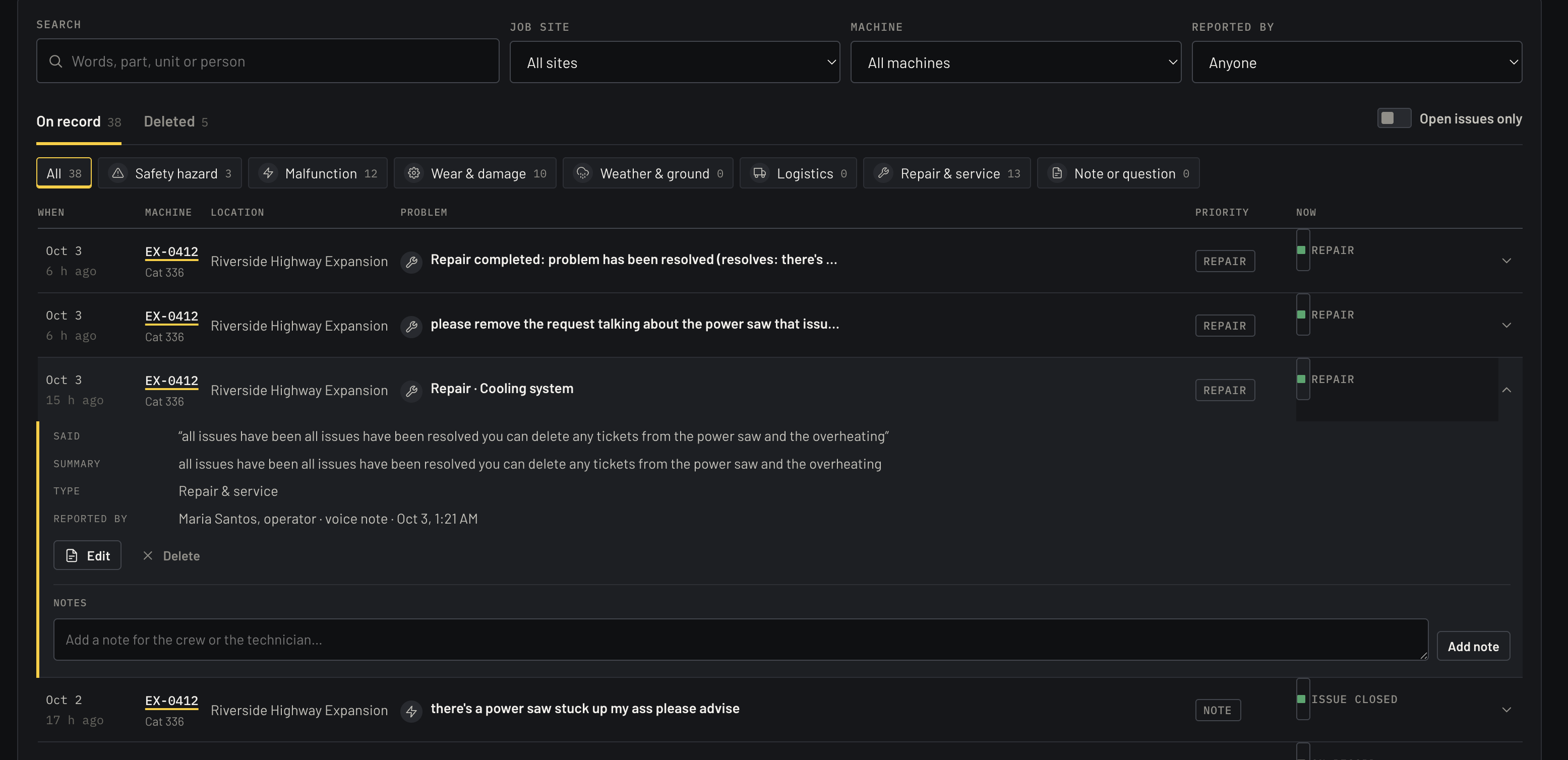
Log of all raw reports with transcript and worker information
-
Workers can file reports on their phone using their voice in many languages

What did you build and how does it address the prompt? Talk about target user group, their pain points, and how your solution addresses this group.
Cat Track gives every machine and job site a memory. When a crew member describes a problem out loud(multiple languages supported) and scans the qr code on a machine, Cat Track understands the report, links it to that machine, and compares it to similar past events, error codes and repairs. It then alerts the people who need to know and tells the crew member how to proceed.
Our users are equipment operators, site supervisors, service technicians, and engineers who watch for issues across many sites. They face a few shared problems. Knowledge about a machine often lives in people's heads and gets lost at shift change. Problems that come and go are hard to diagnose when the history is scattered. The same issue can appear at several sites without anyone noticing. Formal reporting is also hard in a noisy cab, with gloves on, so many observations never get recorded.
Cat Track makes reporting as easy as talking. Every report becomes part of the machine's history, so nothing sits as an isolated note. When something goes wrong, the system recalls similar events and what fixed them before. When the field reports whether a fix worked, that result shapes the advice next time. Engineers can see repeating problems across sites and send guidance back to crews.
How did you build it? What tools did you use, what issues did you run into, and how did you overcome them?
We built Cat Track as a web app using Node.js, a built-in SQL database, and plain HTML, CSS and JavaScript. That keeps it simple to run on a laptop and on an operator's phone. We used AI language models to interpret voice recordings of reports and answer questions, speech-to-text for voice, and a visual map to show how sites, machines and reports connect. The app also keeps working without an AI provider, using a simpler built-in fallback.
We ran into a few problems along the way. Voice input behaved differently on different phones, and microphones need a secure connection. We switched to our own speech processing, tuned for equipment terms, and used a secure link for phone testing.
People also describe the same problem in many different ways. We used a shared vocabulary so the system treats similar descriptions as the same issue. Since people sometimes misspeak or change their minds, reports can be corrected, edited, or undone. We did not have real fleet data, so we created a demo fleet with several months of made-up history to test the full flow.
How can you implement this further?
The next step is connecting Cat Track to real machine data, such as fault codes, inspections, and service records. That would let a crew member's report be read alongside what the machine itself recorded. We also see Cat Track working behind tools Cat already uses, like the Cat app and Cat's AI assistant.
We would also make it work in places with poor connection, and add more languages and accents. Finally, we would add clear access rules and privacy controls for voice data, keep the focus on machines rather than judging workers, and make sure every recommendation shows the records behind it.
How does your project relate back to the Caterpillar prompt?
The prompt asks for a memory layer that lets machines and job sites keep learning from their history, maintenance, conditions, and the people who use them. Cat Track does this in four ways. Each machine builds a lasting record of problems, repairs, and what resolved them. Reports capture the conditions around a problem, so patterns like heat-related issues can show up. The people closest to the machine are the main source of information, and their reports and repair results shape future advice. Repeated problems on different machines and sites are grouped together, so what one machine learns can help the whole fleet. It also supports the wider goal of letting more people use a system successfully. A voice-first faster design lowers the barrier for workers who cannot easily use screens or forms on a job site.
\( \sum_{n=1}^\infty \frac{1}{n^2} = \frac{\pi ^2}{6}\)


Log in or sign up for Devpost to join the conversation.