Inspiration
When information is incomplete, people often repeat the same interpretation until it begins to feel like a fact. A delayed reply can become “They are pulling away.” Silence after several job applications can become “I am not capable.”
The problem is not simply having a negative thought. It is becoming stuck between guessing and acting, without receiving new information from reality.
We created Cat Is Here to help someone stay with one specific event, separate what happened from what they think it means, and find one small action they can control. The goal is not to remove uncertainty or provide reassurance. It is to help the user observe, act, and update their judgment through experience.
What it does
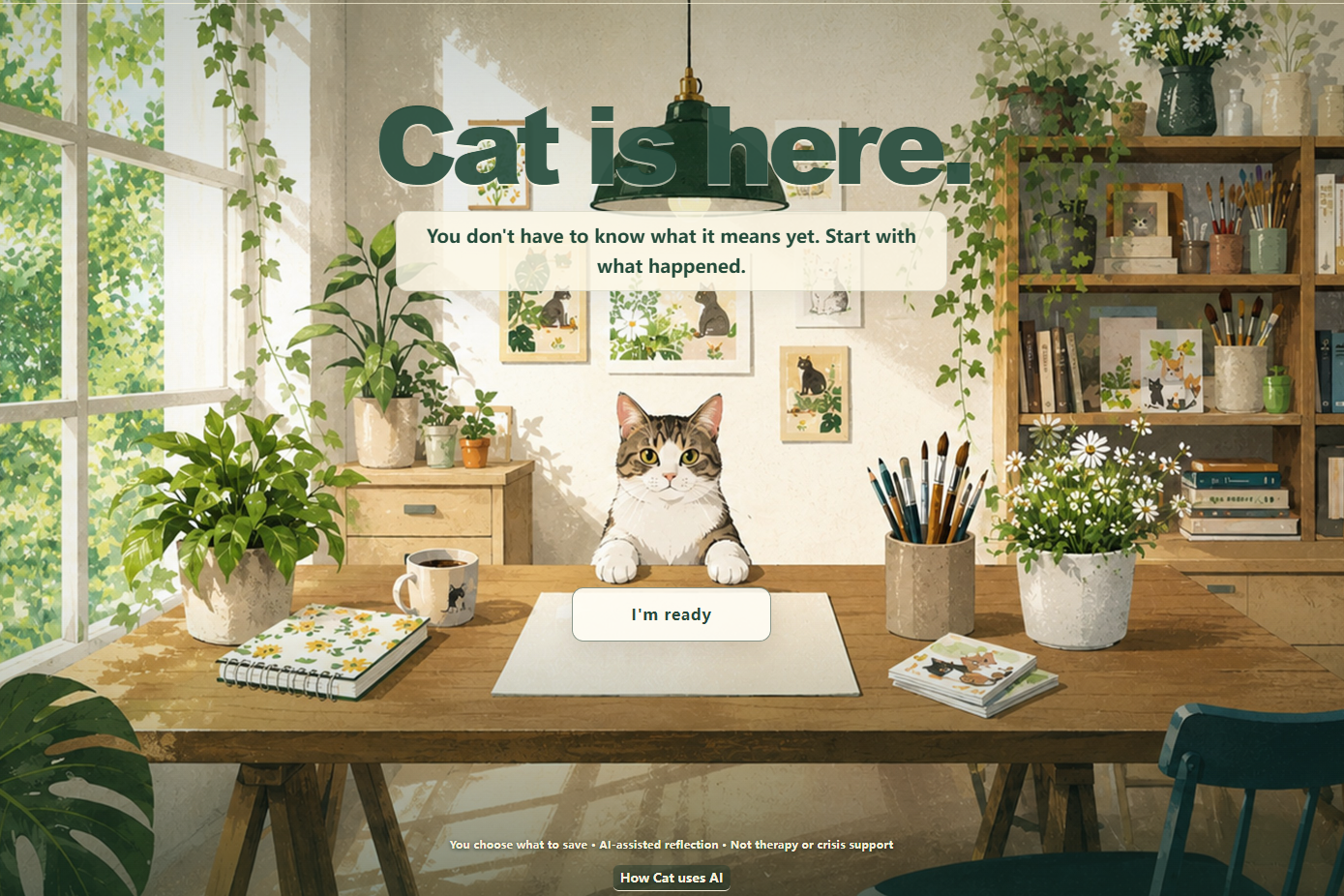
Cat Is Here is an AI-assisted reflection experience guided by a quiet cat character.
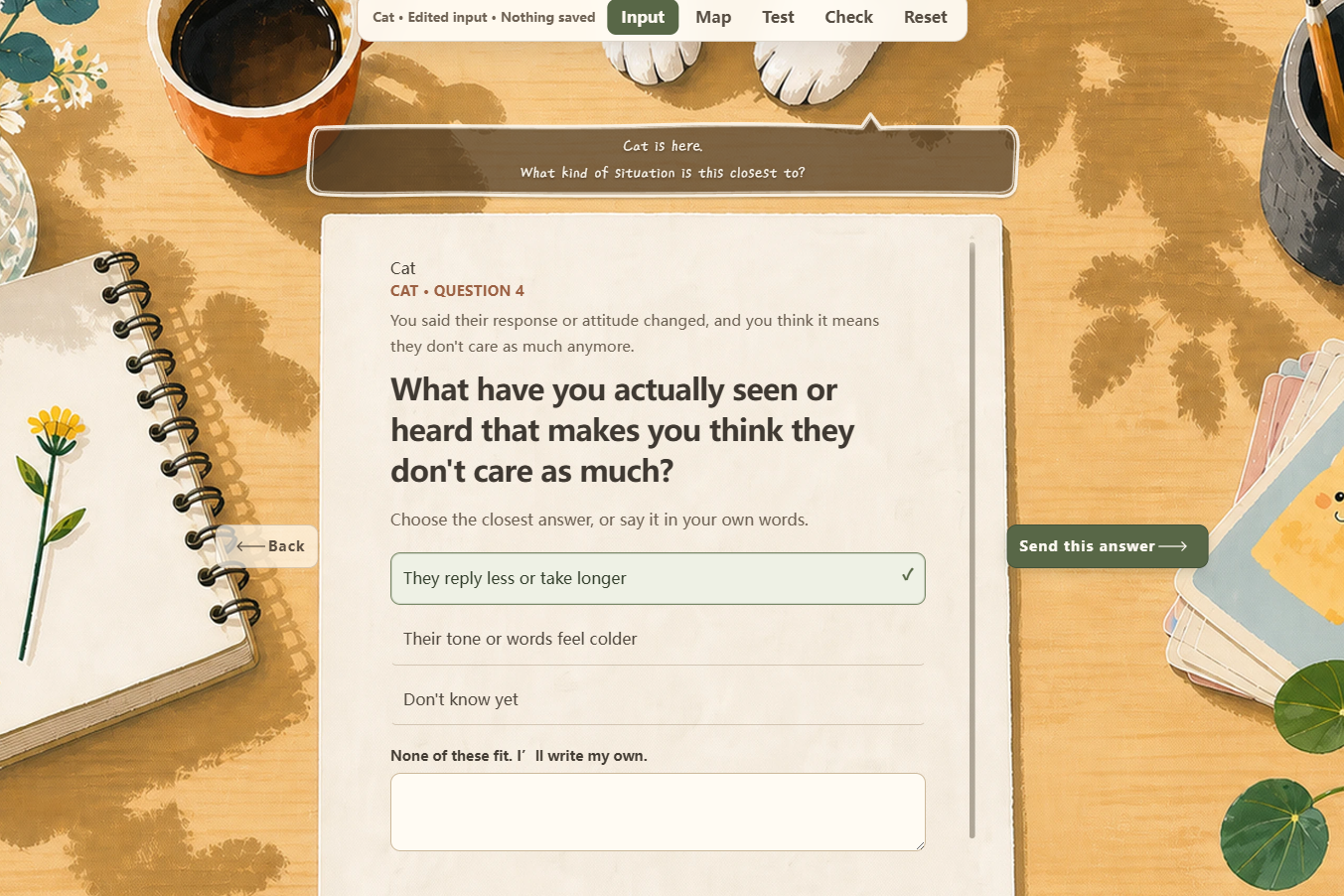
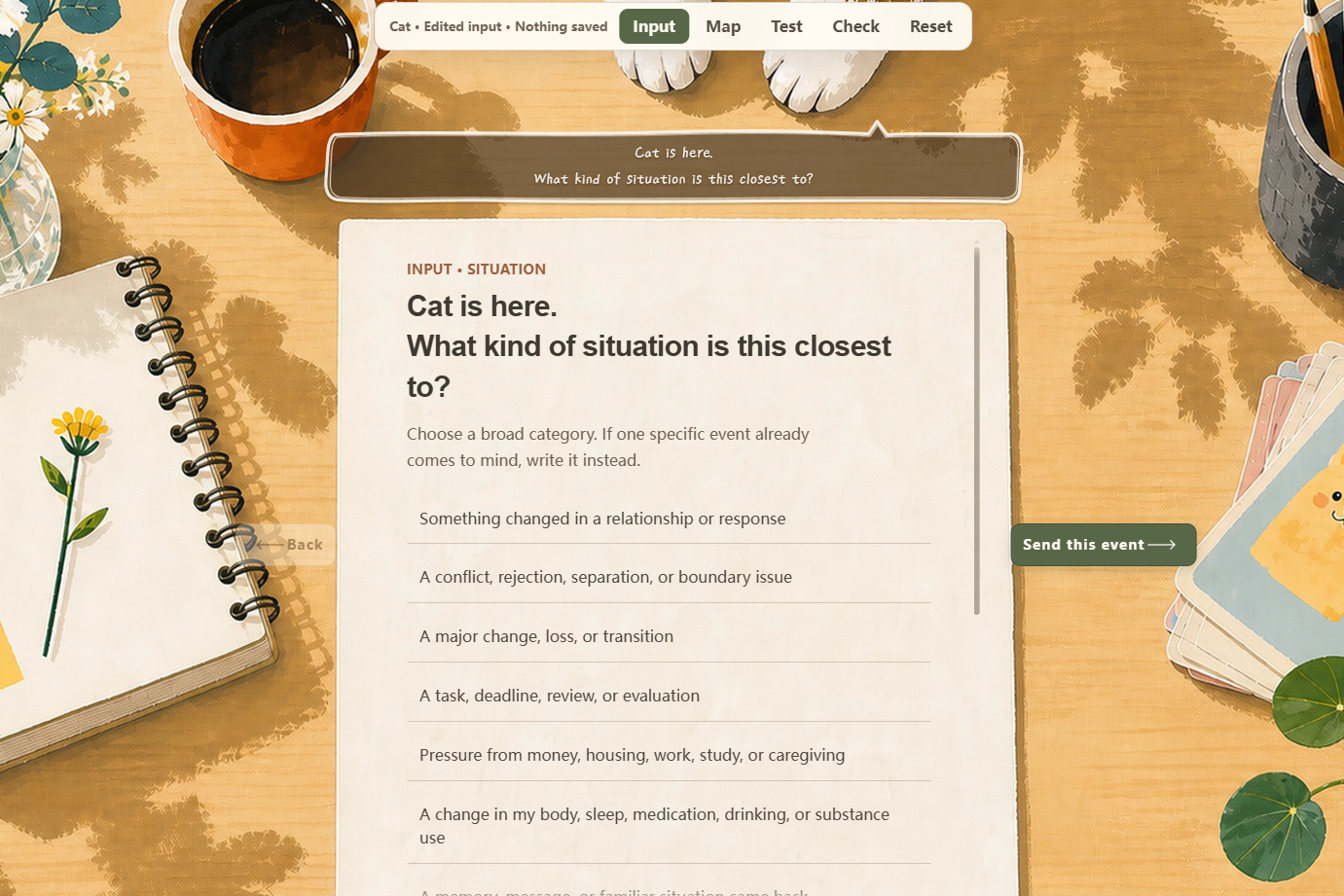
The user starts with one concrete event. Cat asks one question at a time, using each confirmed answer to decide what is still missing. Together, they build an editable Problem Map:
- What happened
- What I thought it meant
- What I felt
- What I did or did not do
- What happened as a result
Cat may offer a tentative interpretation, but the user can confirm it, edit it, or say that Cat misunderstood.
After confirming the map, the user proposes a small real-world action. Cat helps make it controllable, low-risk, stoppable, and capable of producing one new piece of information.
Success does not depend on another person responding perfectly. If the user completes the part they control and observes what actually happens, the experiment has produced useful evidence.
At the end, the user compares the original judgment with the actual result. Anything still unknown remains visible instead of being replaced with an artificial positive conclusion.
How we built it
Cat Is Here uses native HTML, CSS, JavaScript, and a small Node.js server. We avoided frontend frameworks and additional runtime dependencies so the experience would remain focused and lightweight.
The competition version connects to a hosted model through an OpenAI-compatible API. Every AI round receives only the context required to generate the next question.
The system includes:
- Local safety routing before ordinary AI reflection
- Direct-identifier redaction
- One-question-at-a-time adaptive follow-ups
- Structured model responses
- Source IDs connecting map statements to confirmed answers
- Editable and correctable AI interpretations
- Validation against diagnosis, mind-reading, unsupported claims, and invalid placeholder values
- A clearly labeled synthetic fallback that requires user consent
- User-controlled structured saving in the normal product
- No Local Storage or IndexedDB persistence in competition mode
The visual experience uses a warm, hand-drawn desk and paper environment. Cat is presented as a calm adult companion, not a therapist, judge, or all-knowing assistant.
Challenges we ran into
The biggest challenge was preventing the model from sounding more certain than the available evidence allowed.
Earlier versions sometimes felt like a fixed questionnaire or filled gaps with plausible but unsupported interpretations. We changed the flow so each question depends on confirmed prior answers, unselected options never become user facts, and every non-missing map statement must have a valid source.
Another challenge was defining success without depending on an ideal external response. In the relationship example, receiving “Saturday works” does not prove that the relationship is repaired. It provides one smaller fact: the user initiated the conversation and received a time. The larger outcome remains unknown.
We also needed to handle model failure honestly. If Live AI is unavailable, the product does not silently display a fixed response. It stops, explains what happened, and lets the user retry or explicitly continue with a continuously labeled synthetic example.
Finally, we worked to make the experience emotionally warm without making therapeutic promises or allowing Cat to become an authority over the user.
Accomplishments that we're proud of
- Built an adaptive reflection flow instead of a fixed questionnaire
- Created an editable, source-grounded Problem Map
- Kept user judgment above AI interpretation
- Designed experiments around controllable actions rather than ideal outcomes
- Added clear Live AI and synthetic-example states
- Prevented browser persistence in competition mode
- Created complete English and Chinese product paths
- Added safety routing, identifier redaction, and structured-output validation
- Reached 116 passing automated checks
- Deployed a working public competition experience
What we learned
We learned that useful AI reflection depends less on producing an impressive interpretation and more on maintaining clear boundaries between observation, prediction, and uncertainty.
A short, well-grounded question can be more valuable than a complete analysis. Giving users the ability to correct the model is not an optional feature; it is part of the reasoning process.
We also learned that an experiment does not need to resolve the entire situation. One controllable action that produces one new fact can be enough to revise a judgment and make the next action feel more possible.
Most importantly, AI should not give the user certainty about another person's thoughts or motives. It can help the user build confidence in their own ability to observe facts, take action, and revise their understanding.
What's next for Cat Is Here
Next, we want to evaluate Cat Is Here across more diverse real-world scenarios and a larger sample of model runs.
We also plan to:
- Conduct broader usability and accessibility testing
- Improve crisis-resource localization
- Test the quality of adaptive questions across different models
- Strengthen privacy controls for saved structured records
- Study whether users can transfer the observe-act-update process to later situations
- Explore optional ways to return and record an outcome without introducing streaks or pressure
Cat Is Here is not therapy, diagnosis, or crisis support. It is a tool for structured reflection and small, reality-based learning.
Built With
- accessibility
- css3
- deepseek
- generative-ai
- html5
- javascript
- large-language-models
- mental-health
- node.js
- prompt-engineering
- render
- responsible-ai
- responsive-design
- rest-api
- structured-output


Log in or sign up for Devpost to join the conversation.