-
-
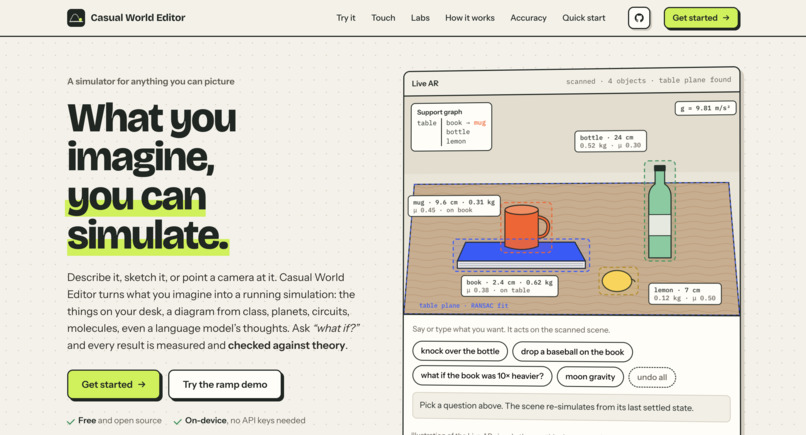
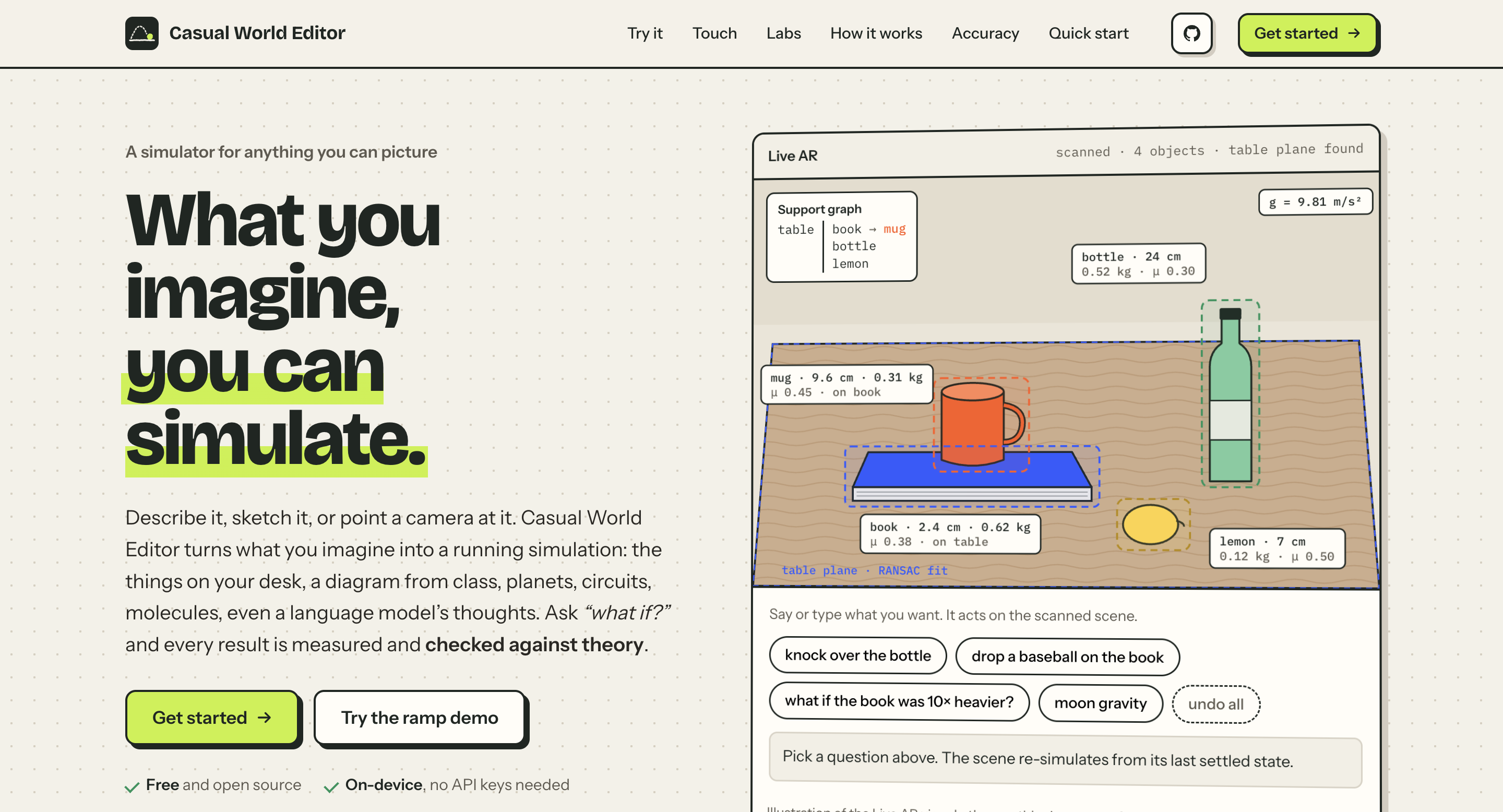
Landing Page
-
Logo Dark
-

Logo Light
-
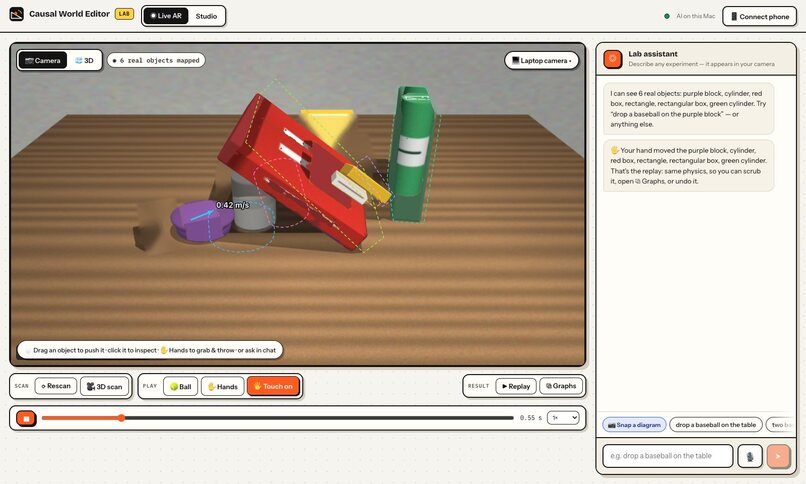
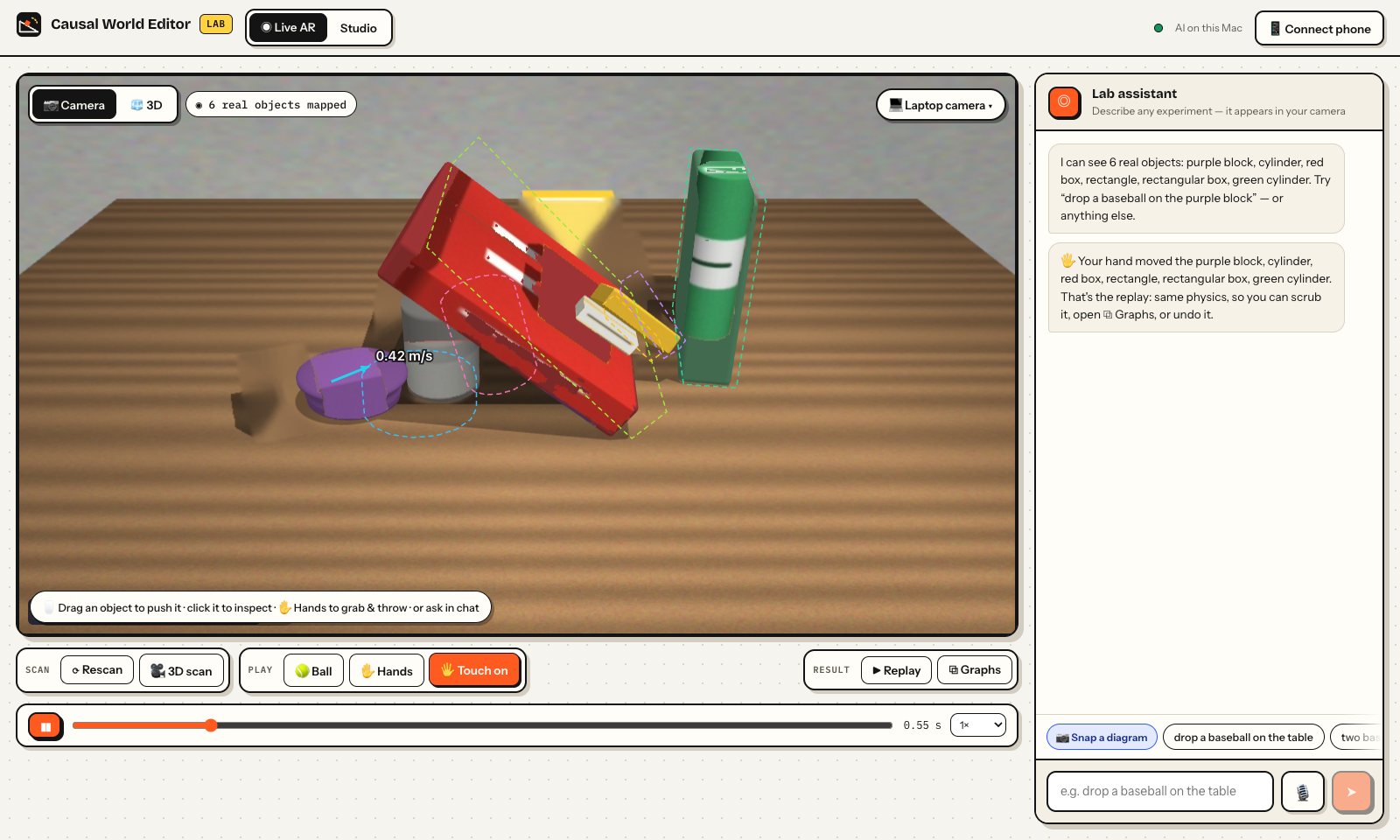
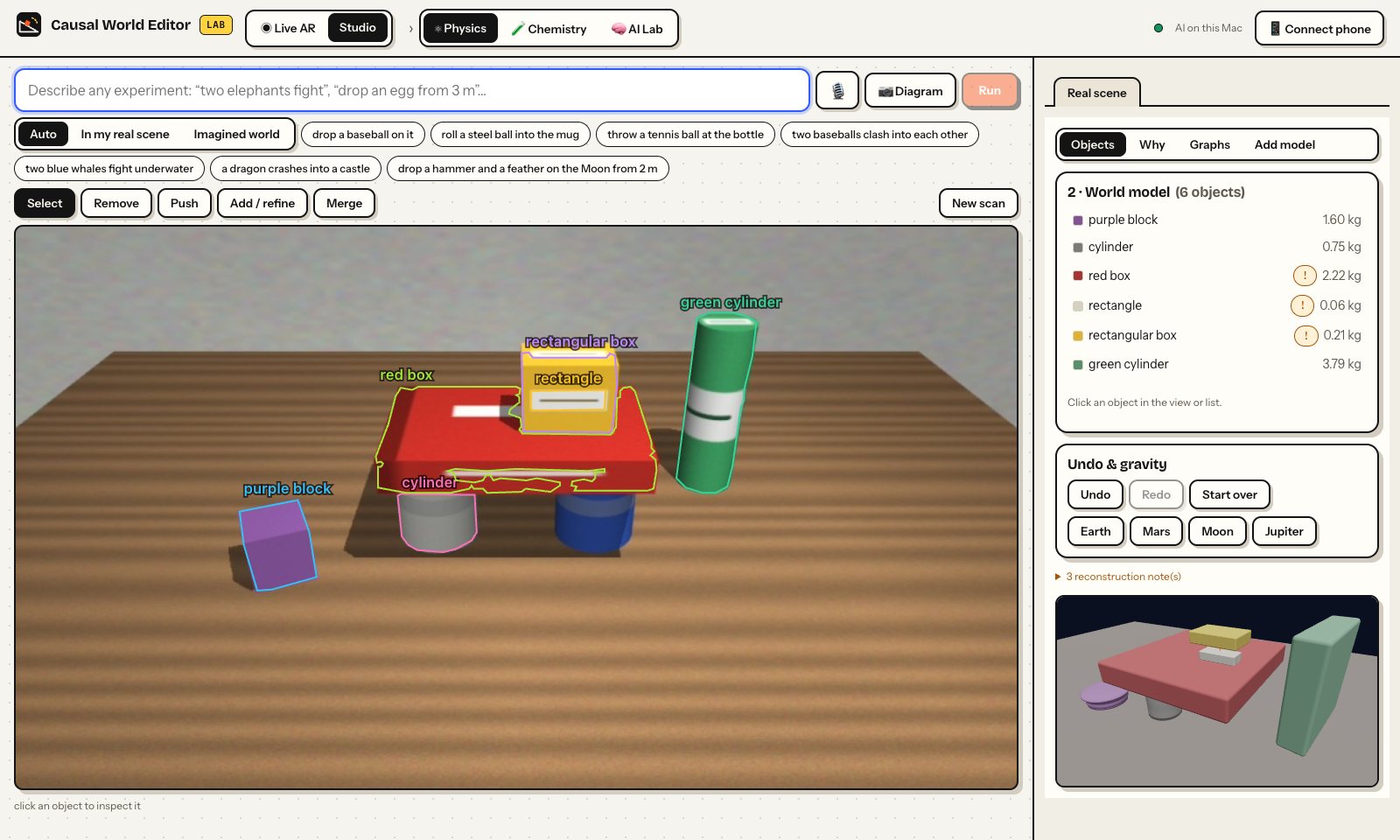
Live 3D Scanned
-
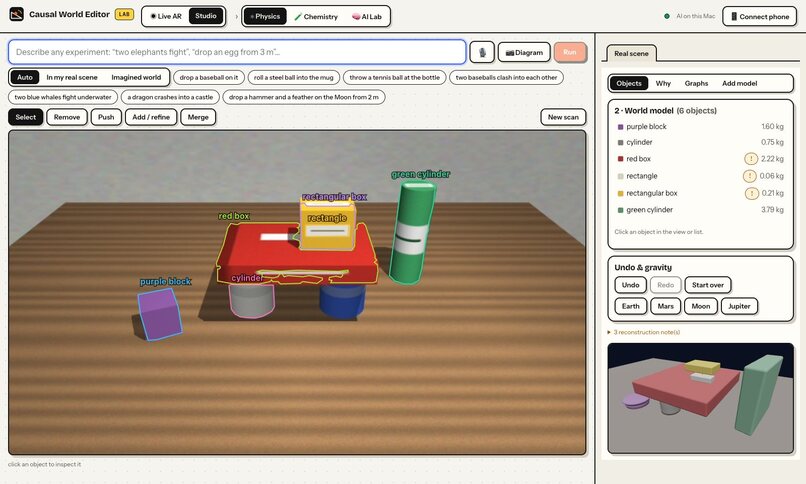
3D manipulation using hand gesture
-
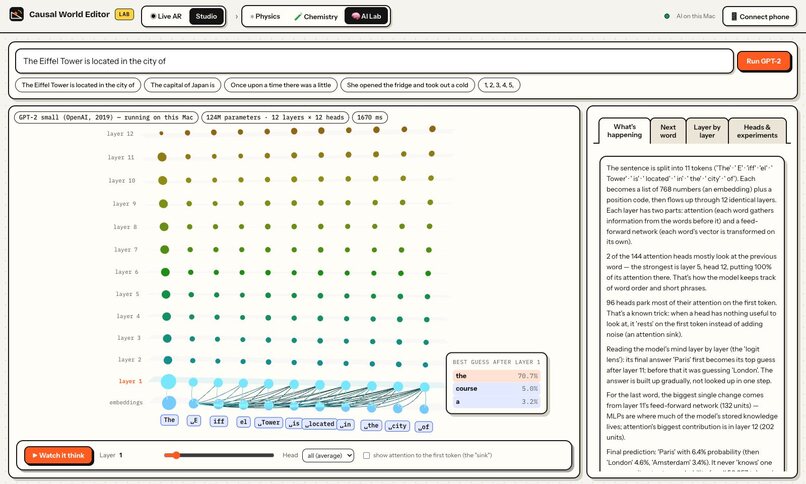
AI Model Simulation
-
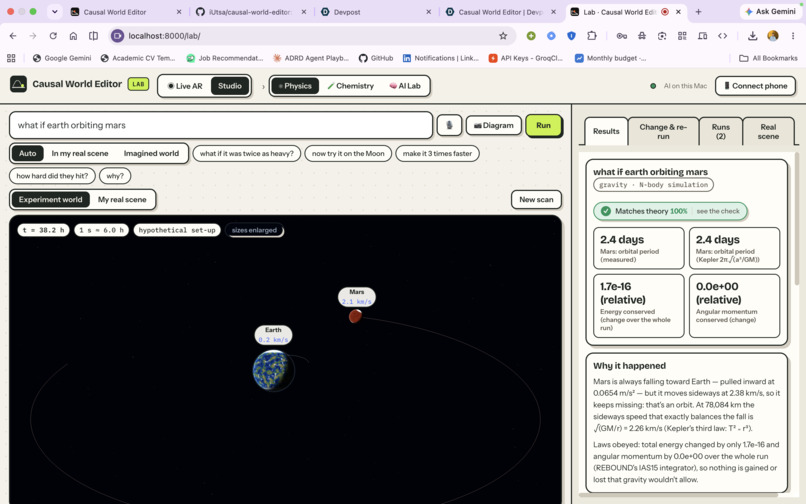
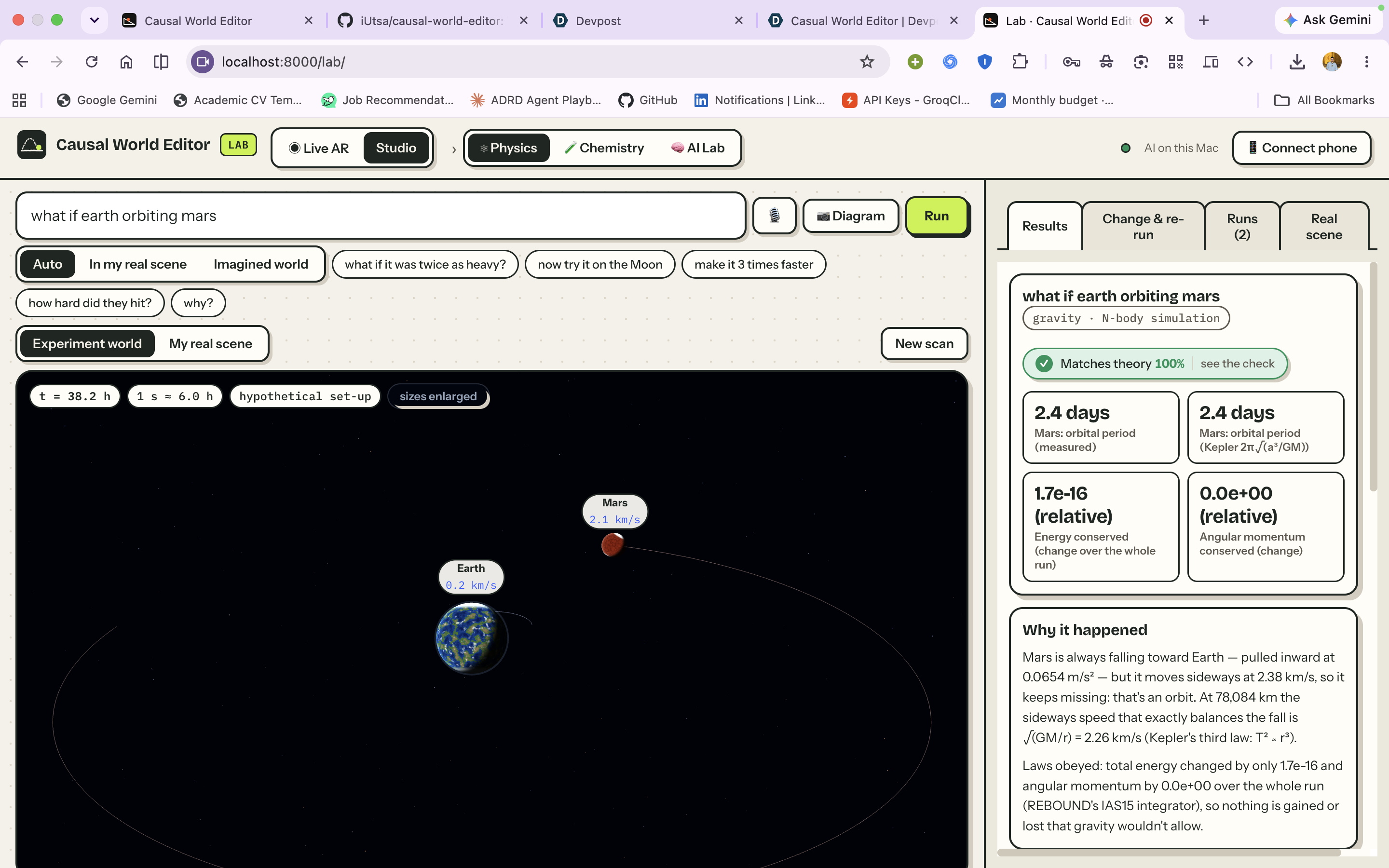
What if Earth orbits Mars!
-
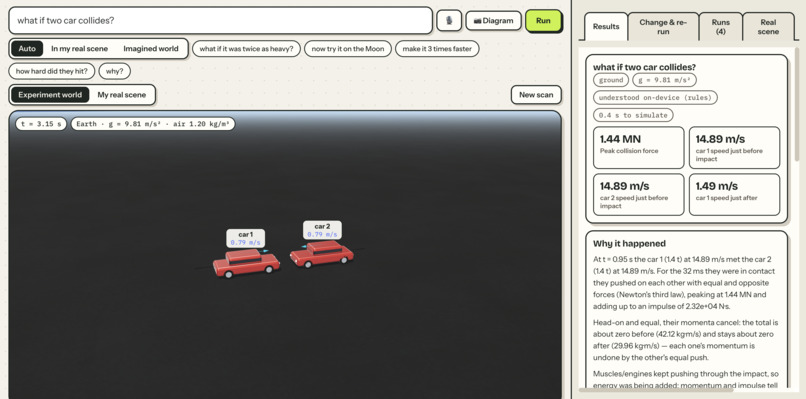
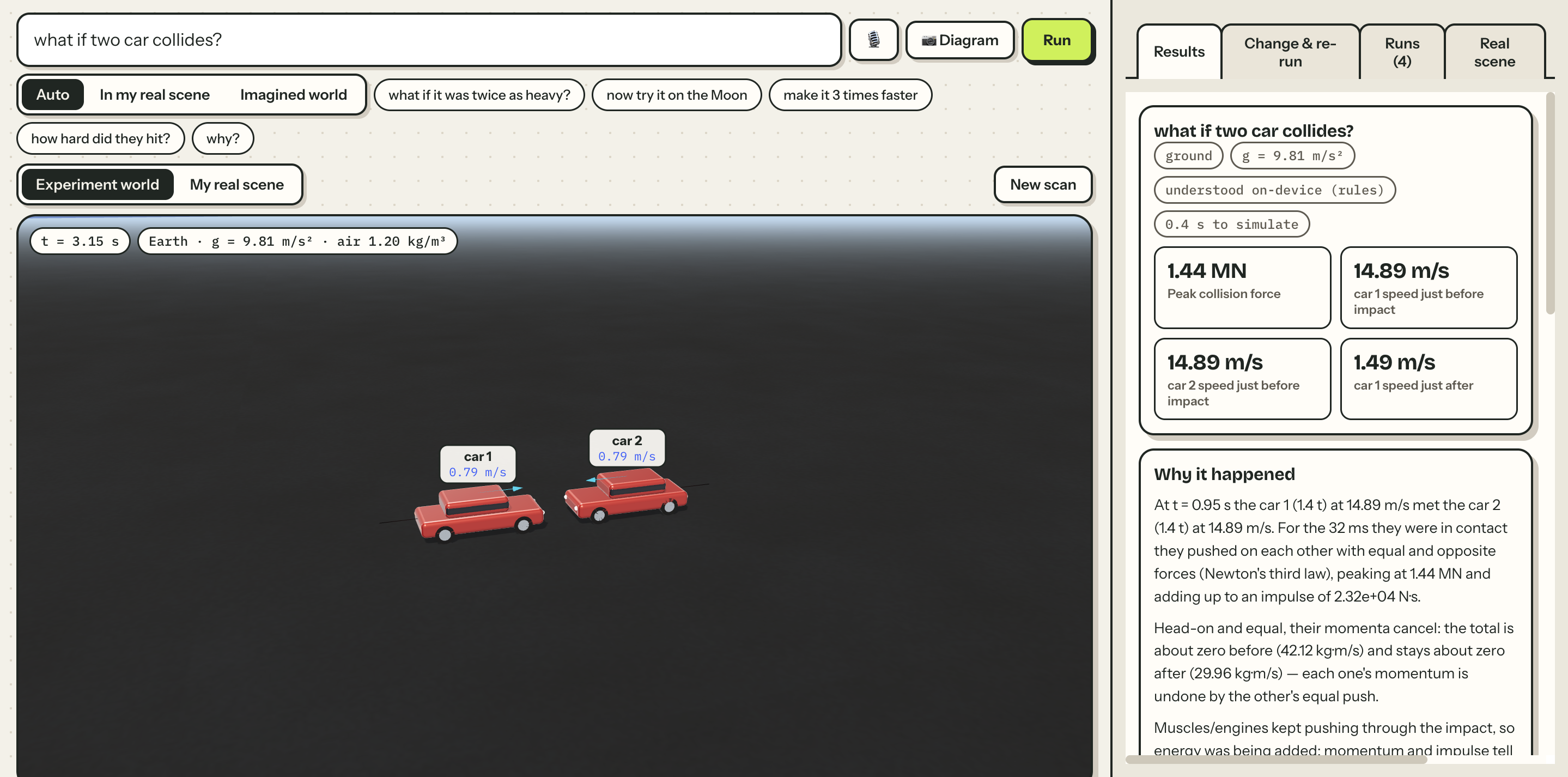
What if two cars collide?
-
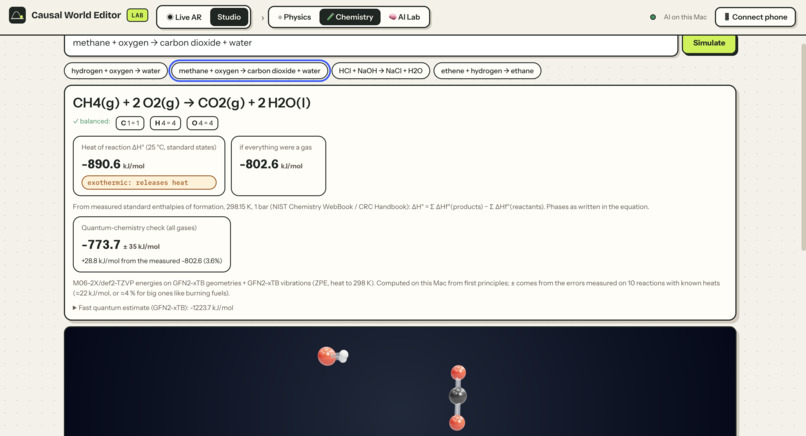
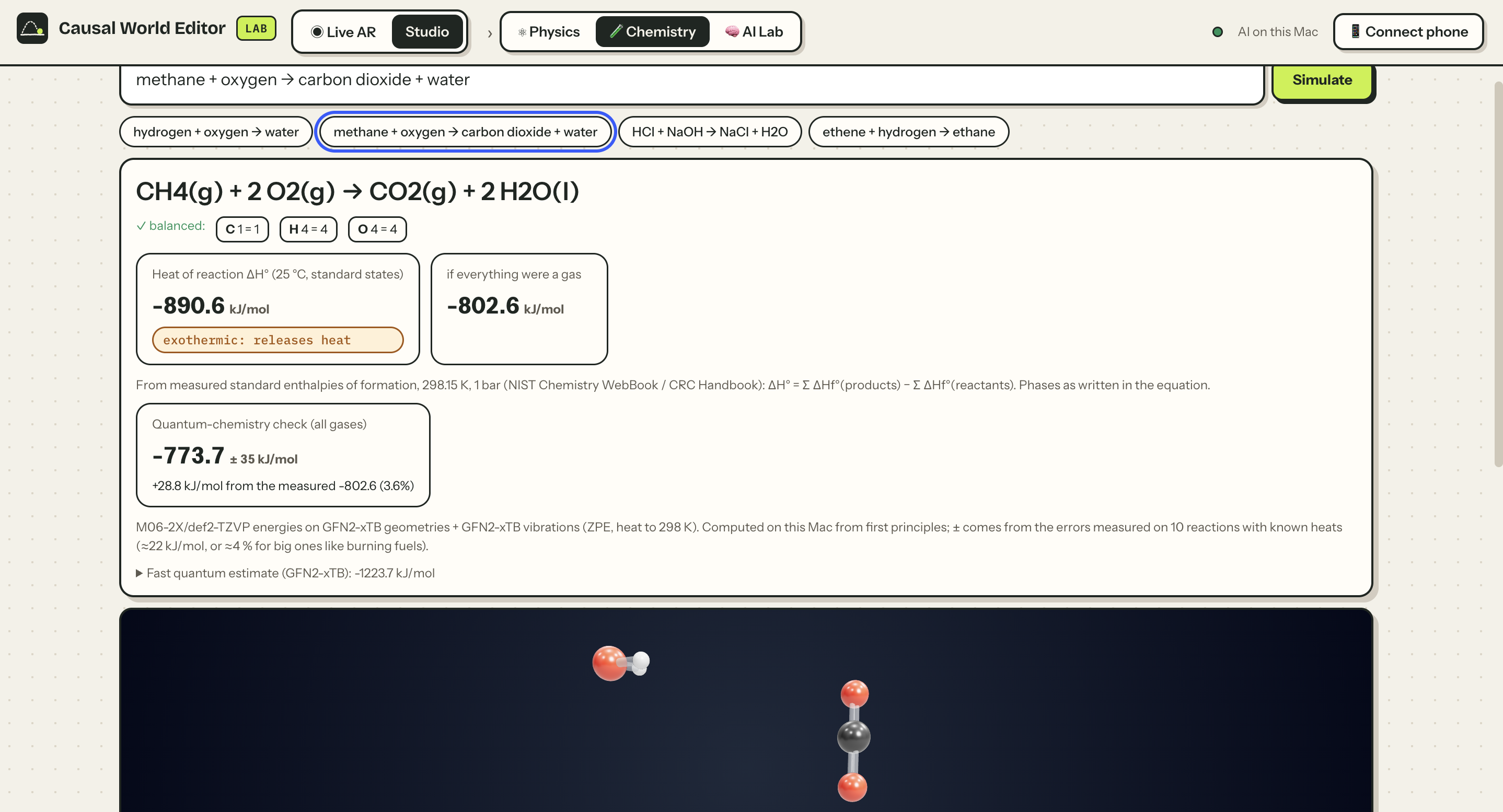
Chemistry Reaction Simulation
Inspiration
Every idea starts as a picture in your head. A block sliding down a ramp, two planets passing too close, a reaction you're curious about. But a picture only shows the first frame. Students see this every day: they stare at a still textbook diagram and try to play the movie in their head. Cognitive scientists call this mental animation, and it's hard even for people who know the formulas. Real labs, where you can just try it, need equipment most schools don't have.
We wanted one thing: what you imagine, you can simulate. Point a camera at your desk, snap a diagram, or just describe a world that doesn't exist. Ask "what if?" and get a real simulation with numbers you can check.
What it does
Casual World Editor turns the real world, or an imagined one, into a running simulation:
- 📷 Live AR: point a laptop or phone camera at a desk. In seconds, every object becomes part of a 3D physics world, with its size, mass, friction and what it's resting on. Then ask in plain words: "drop a baseball on the red box", "make the table icy", "moon gravity".
- 🖐 Touch: hold up your hand and push the digital twin with your real fingers. All 21 tracked joints become physics bodies, with live contact forces in newtons. When your hand leaves, the session is replayed exactly and can be measured or undone.
- 📐 Snap a diagram: photograph a textbook figure. A local vision model reads it into an editable card, then simulates it.
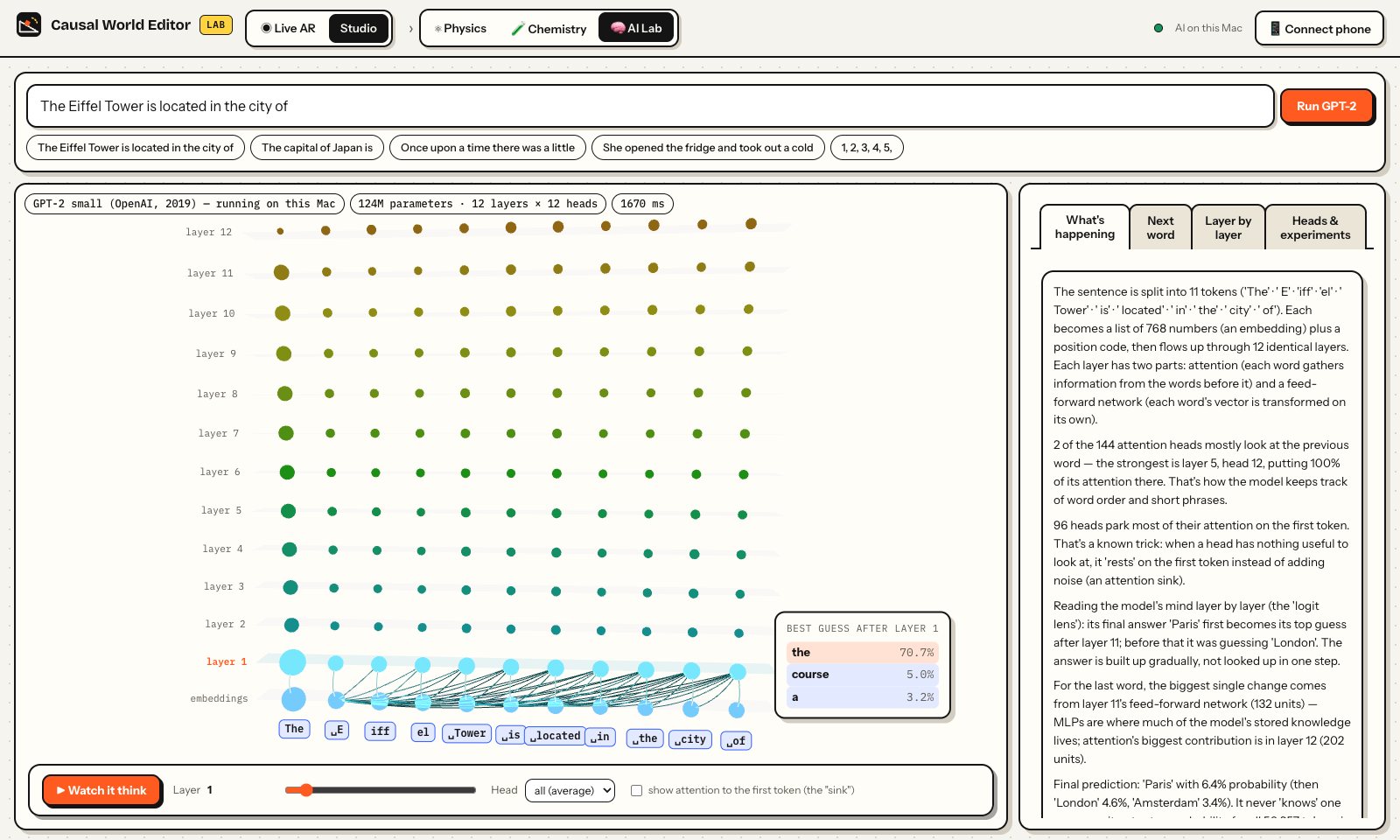
- ✨ Studio, worlds you only describe: "two blue whales collide at 10 m/s", "what if Jupiter orbited Earth?", circuits, chemical reactions, and even a real GPT-2 showing how it forms its next word, layer by layer.
Every result comes with a theory check: the measured value next to the textbook prediction, and how closely they agree:
$$ \text{agreement} = 100\% \times \left(1 - \frac{|x_\text{measured} - x_\text{theory}|}{|x_\text{theory}|}\right) $$
When a formula doesn't apply, the app says so instead of printing a misleading score. Everything runs free and on-device: camera frames, voice and diagrams never leave the laptop.
How we built it
See → Understand → Simulate → Check → Show, all on an M1 MacBook with 8 GB of memory.
- Perception: Depth Anything V2 for metric depth. SAM 2.1-tiny is prompted from geometry instead of "segment everything", so it fits in 8 GB. A RANSAC table plane and shape fitting (boxes, cylinders, revolved profiles) lift each object into 3D.
- Walk-around 3D scan: our own structure-from-motion: SIFT tracks, PnP, and a hand-written Levenberg–Marquardt bundle adjustment using the Schur complement. Objects are found by plane + parallax, then carved into textured meshes with label-consistent space carving.
- Physics: MuJoCo with calibrated contacts, saving the scene after every action so each one continues from the last settled state (0.4–1.3 s per action). Toys scale physically: for a scale factor $k$,
$$ m \propto k^3, \qquad v \propto \sqrt{k} $$
- Throws are solved ballistically, so "throw a ball at the mug" actually lands on the mug:
$$ \tan\theta = \frac{v^2 \pm \sqrt{v^4 - g\,(g\,d^2 + 2\,h\,v^2)}}{g\,d} $$
- 🖐 Touch: MediaPipe tracks the hand in the browser (~13 ms per frame). A linear solve converts its landmarks to real-world 3D. The poses stream over a WebSocket, timestamped by the camera, and drive kinematic finger bones that are updated every 2 ms physics step.
- Space, circuits, chemistry: REBOUND IAS15 with real NASA JPL Horizons positions. For circuits, modified nodal analysis, the method SPICE uses. For chemistry, measured enthalpies, GFN2-xTB molecular dynamics, and DFT (M06-2X/def2-TZVP) for molecules with no measured data.
- Language and voice: Qwen2.5-VL-3B (4-bit, MLX) and Whisper, both running locally.
- App: FastAPI + React Three Fiber. The public demo uses Cloudflare Pages plus a tunnel back to the laptop.
Challenges we ran into
- 8 GB of memory. SAM 2's video tracker swapped for over 10 minutes, so we replaced it with geometry-guided prompts that use constant memory. PySCF and PyTorch deadlocked in the same process (two OpenMP runtimes), so quantum chemistry now runs in its own process.
- Monocular depth isn't geometry. The depth model was 2–3× off on test scenes, so the "table" wasn't even flat. Our multi-view geometry now finds the table plane exactly (0.00° tilt error), and the depth model only sets the overall scale.
- Camera solving from plain phone video. Bundle adjustment took 130 s and lost frames. Our Schur-complement solver brought it to ~36 s, and re-placing badly started cameras took the worst-case error from 48 cm to 2.5 cm.
- Live hand vs. replay drift. A live hand session and its replay ended 27 mm apart, even though each was deterministic on its own. The recording was rounded to micrometres, and contact physics amplified the difference. Feeding the rounded values to the live simulation too made them match to 0.00 mm.
- Visual-hull "ghosts." Carving left blobs between objects, and a book came out 16 cm thick instead of 3.5 cm. Label-consistent carving with free-space votes from depth fixed it.
Accomplishments that we're proud of
- 99.89% mean agreement with textbook theory across a 19-experiment battery (worst 99.55%).
- 151 automated tests that check physics, not just code paths: a resting contact force must equal the object's weight, energy given to an object must equal the energy the other one lost, and a replay must match its live run.
- A full multi-angle 3D reconstruction pipeline written from scratch for an 8 GB laptop.
- Live hand physics at 2.2 ms per update (the budget is 33 ms).
- Quantum reaction energies within 21.6 kJ/mol of measured values.
- All of it free, offline and private, so any school could use it.
What we learned
- Never let a model's guess shape the physics. Measure, then show the measurement next to the theory.
- On small hardware, geometry beats bigger models. Plane + parallax found 5 of 6 objects where the depth model alone found 1.
- Test against ground truth. Almost every bug above was caught by a benchmark with a known answer, not by watching the demo.
What's next for Casual World
- Relocalize the camera against the 3D scan, so you can move it after scanning.
- Grip, not just push, in 🖐 Touch, plus per-user hand calibration.
- Separate sessions for each visitor to the hosted demo.
- Teacher-made "what if" lesson packs and classroom pilots.
Built With
- depth-anything-v2
- fastapi
- gpt-2
- jpl-horizons
- mediapipe
- mlx
- mujoco
- numpy
- opencv
- pyscf
- python
- pytorch
- qwen2.5-vl
- rdkit
- react
- react-three-fiber
- rebound
- scipy
- segment-anything-2
- sentence-transformers
- three.js
- typescript
- websockets
- whisper
- xtb

