-
-
DASHBOARD
-
DASHBOARD
-
DASHBOARD
-
INTRO
Inspiration
What it does
How we built it
Challenges we ran into
Accomplishments that we're proud of
Inspiration
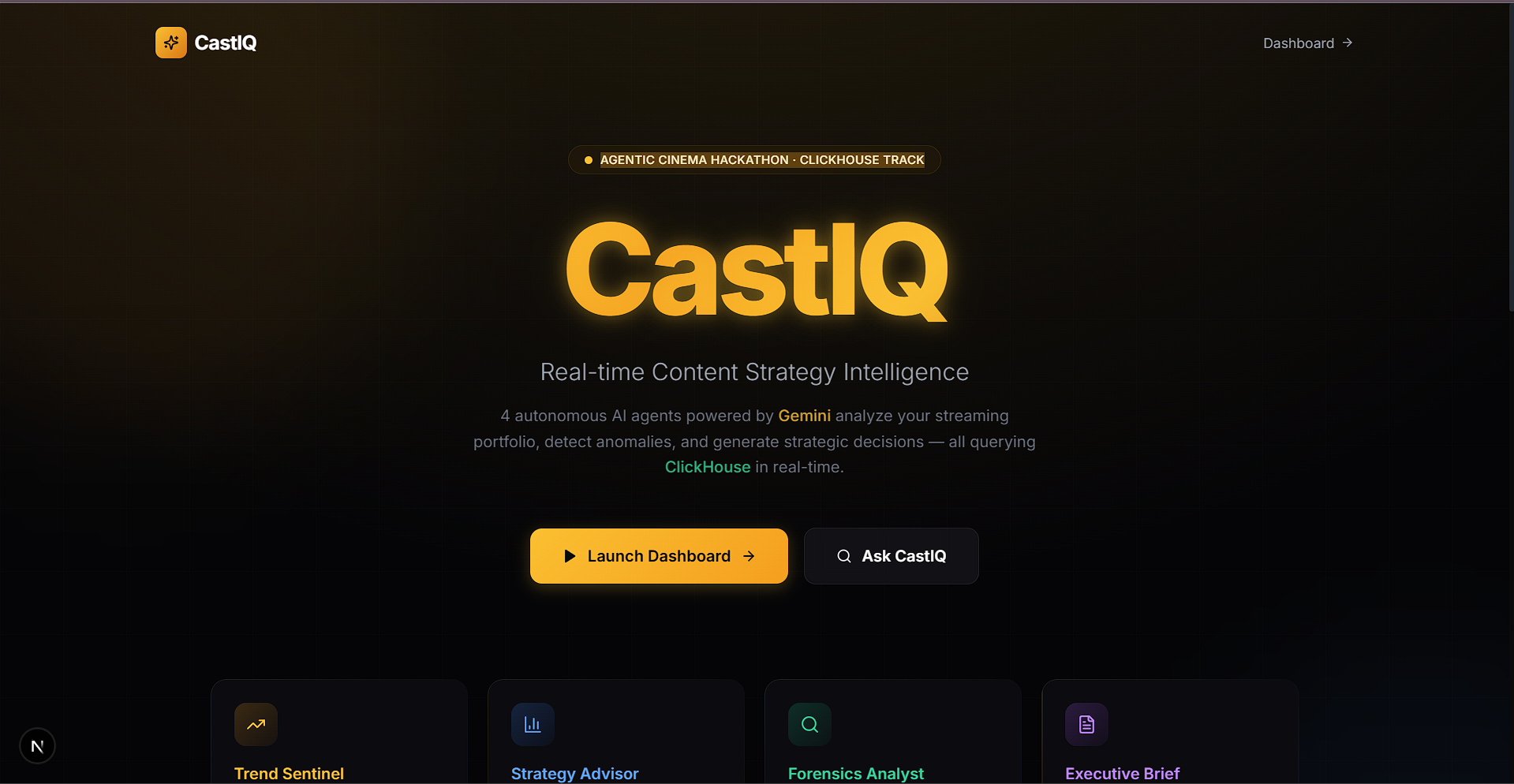
The media & entertainment industry spends $200B+ annually on content production and acquisition — yet the decisions behind these investments rely on dashboards with 3-6 month delayed data. When a show starts losing viewers mid-season, studios find out from quarterly reports. When a movie goes viral on TikTok, the marketing team misses the 48-hour window to capitalize.
We asked: What if streaming platforms had an autonomous intelligence layer — not another dashboard to stare at, but AI agents that actively monitor, reason, and recommend in real-time?
That's CastIQ.
What it does
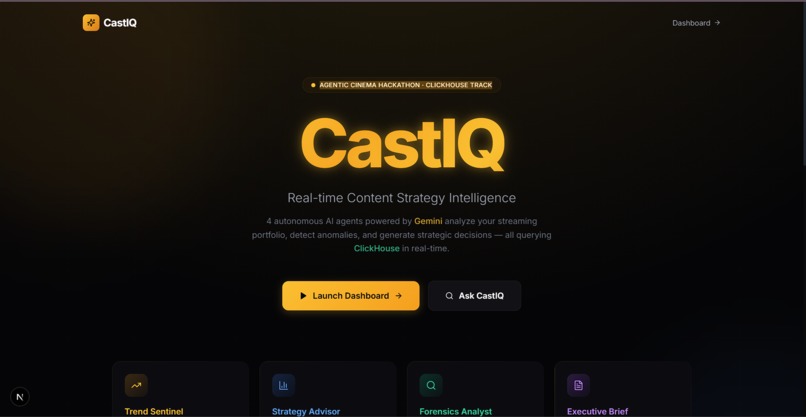
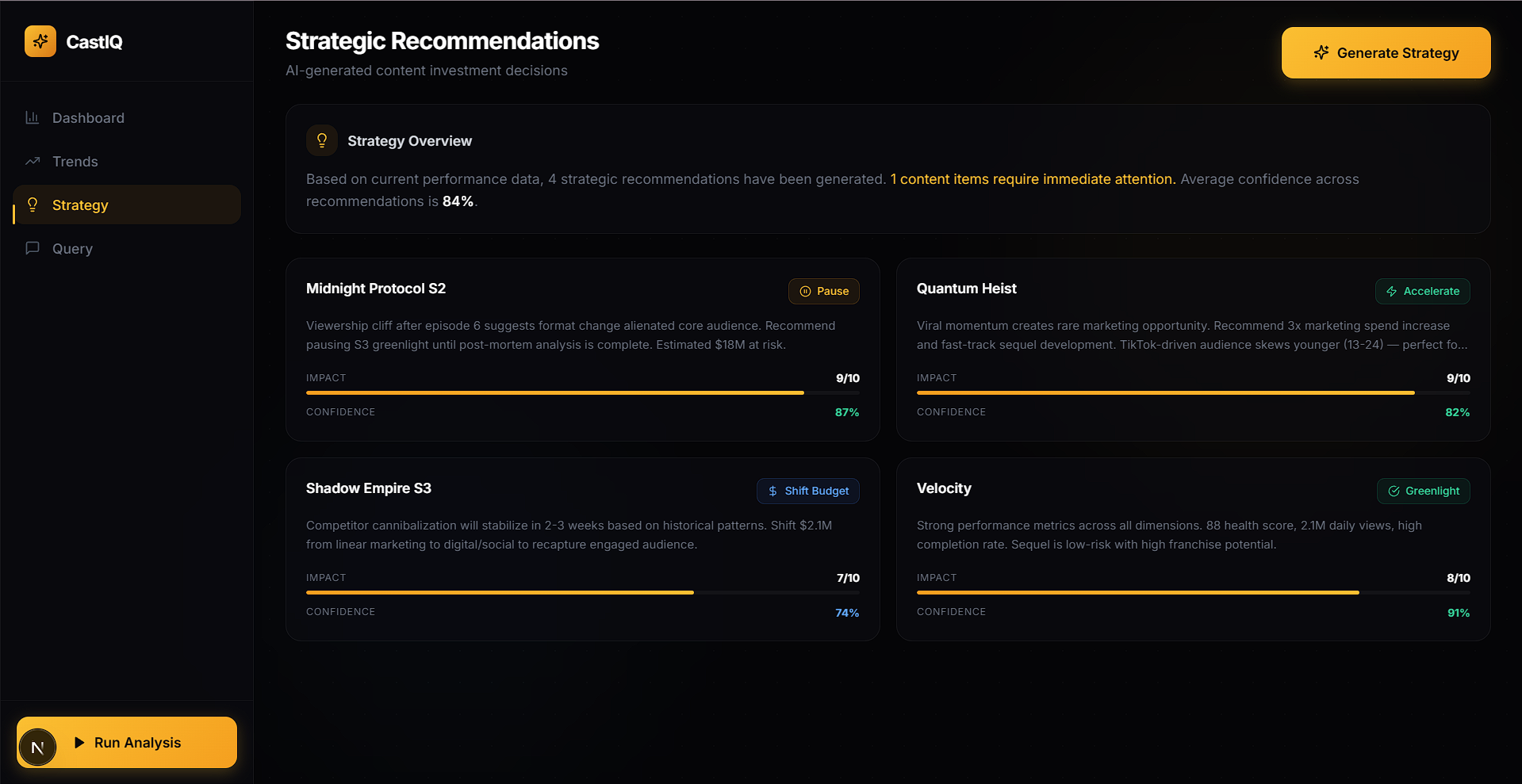
CastIQ is a multi-agent content strategy intelligence engine that runs on Google Cloud with Gemini and ClickHouse. It deploys 4 specialized AI agents that autonomously analyze a streaming platform's entire content portfolio:
| Agent | Role | ClickHouse Tools |
|---|---|---|
| Trend Sentinel | Monitors viewership anomalies & sentiment shifts | query_viewership, query_anomalies, query_sentiment |
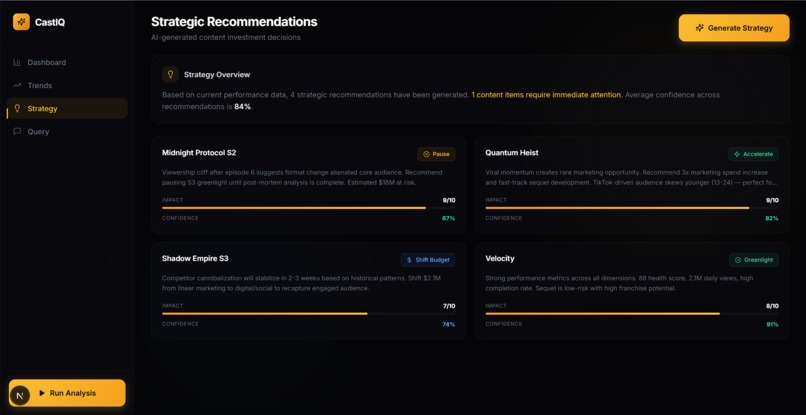
| Strategy Advisor | Generates content investment recommendations | query_content_list, query_revenue, run_sql |
| Forensics Analyst | Deep-dives into root causes of anomalies | query_viewership, query_sentiment, run_sql |
| Executive Brief | Synthesizes all findings into C-suite briefings | Receives outputs from all agents |
The Pipeline
$$\text{Streaming Data} \xrightarrow{\text{ingest}} \text{ClickHouse} \xrightarrow{\text{MCP/SQL}} \text{Gemini Agents} \xrightarrow{\text{orchestrate}} \text{Dashboard}$$
Each agent uses Gemini function calling to query ClickHouse through 7 specialized tools — from viewership metrics and sentiment analysis to custom SQL execution. The orchestrator runs them in sequence: detect → strategize → investigate → brief.
Demo Scenarios
We seeded 3 real-world anomaly scenarios to showcase the pipeline:
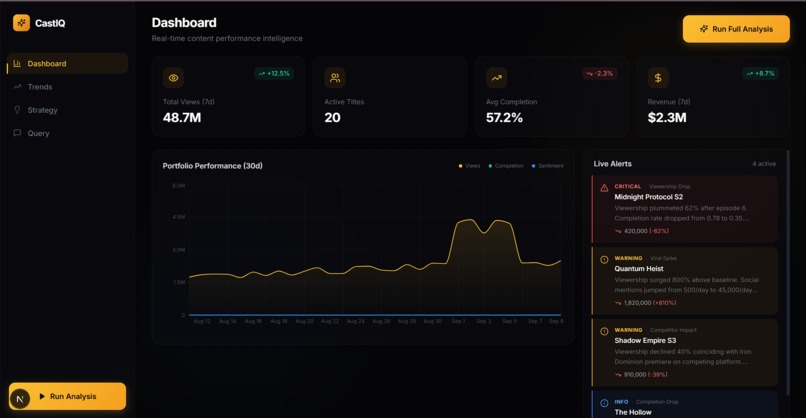
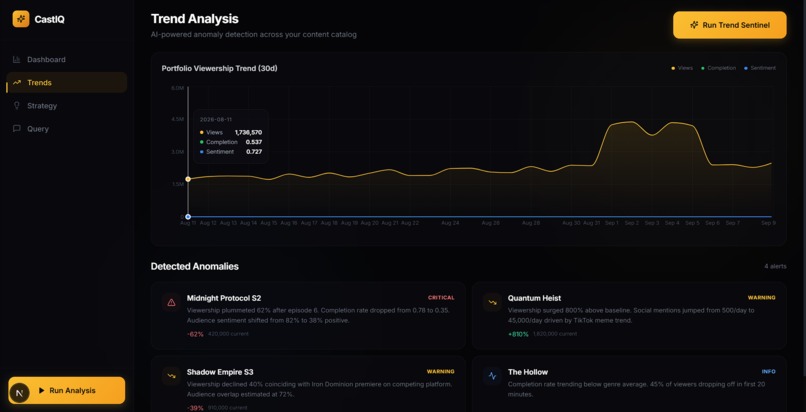
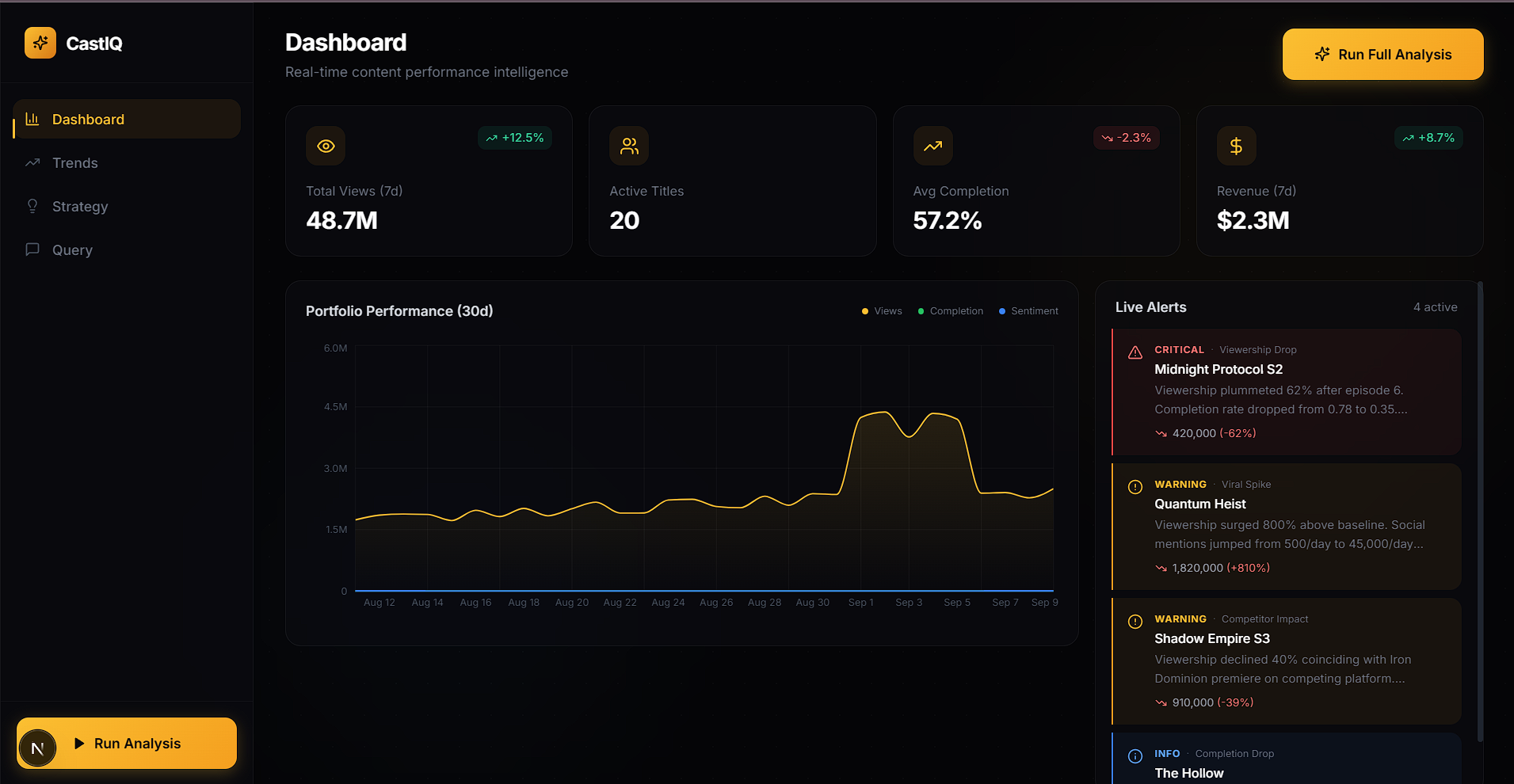
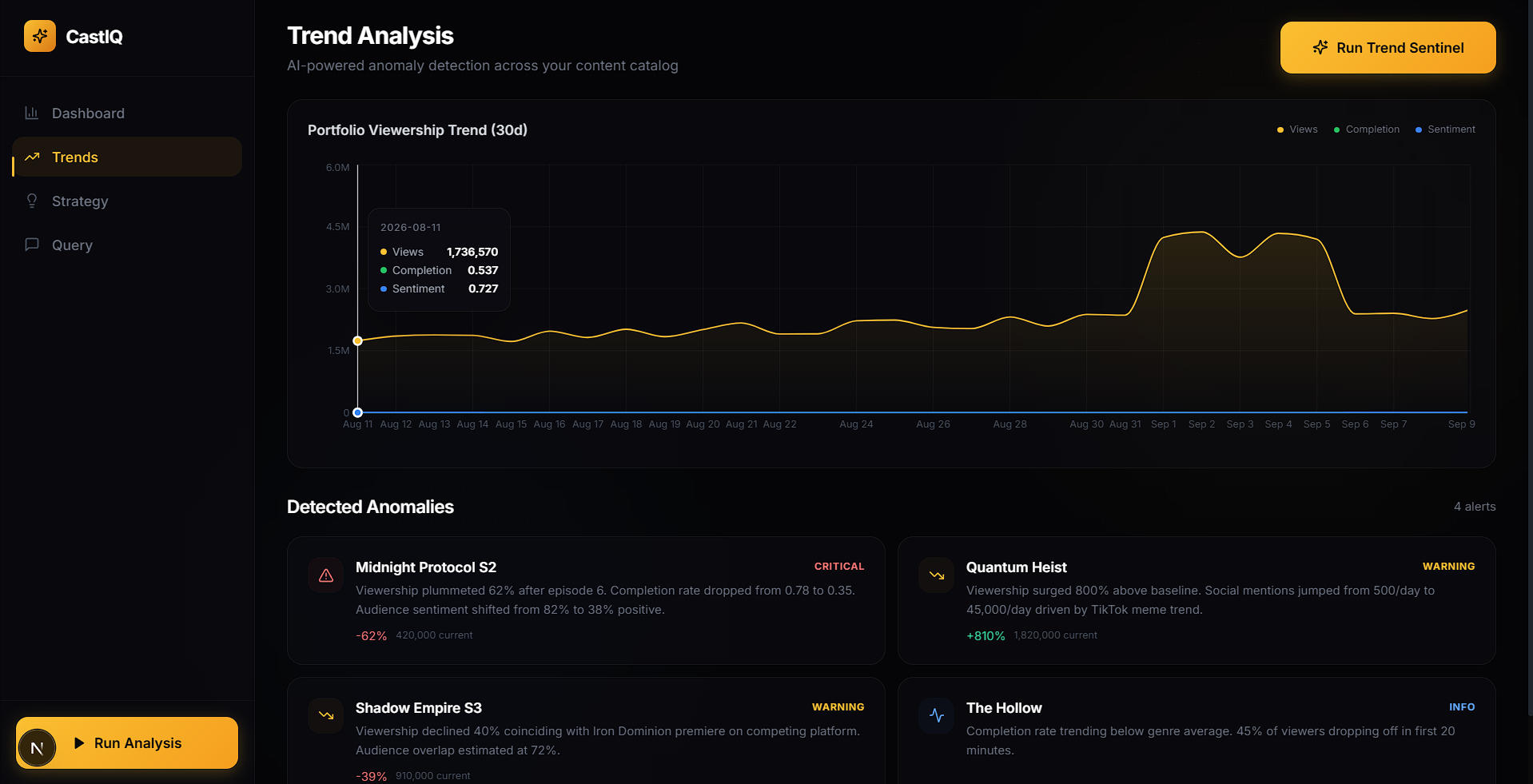
"Midnight Protocol S2" — Viewership Cliff
- Views dropped from $2.1M \to 400K$ after episode 6
- Completion rate crashed: $0.78 \to 0.35$
- Sentiment flipped: $82\% \to 38\%$ positive
- Root cause: Bottle episode format change + runtime increase from 42min → 58min
"Quantum Heist" — Viral Spike
- Baseline $200K$ views/day → suddenly $1.8M$
- Social mentions: $500 \to 45{,}000$/day
- Trigger: TikTok meme trend featuring the villain's catchphrase
"Shadow Empire S3" — Competitor Cannibalization
- Steady $1.5M$ views → dropped to $900K$
- Coincided with "Iron Dominion" premiere on rival platform
- Audience overlap: $72\%$
How we built it
Architecture
┌─────────────────────────────────────────────────┐ │ Next.js 15 Frontend │ │ (Glassmorphism + Framer Motion) │ ├─────────────────────────────────────────────────┤ │ API Routes (8 endpoints) │ │ /orchestrator /query /agents/* /dashboard │ ├─────────────────────────────────────────────────┤ │ Gemini Agent System │ │ ┌───────────┐ ┌──────────┐ ┌─────────────────┐ │ │ │ Trend │ │ Strategy │ │ Forensics │ │ │ │ Sentinel │ │ Advisor │ │ Analyst │ │ │ └─────┬─────┘ └────┬─────┘ └───────┬─────────┘ │ │ │ │ │ │ │ └────────────┼───────────────┘ │ │ ▼ │ │ 7 Function-Calling Tools │ │ (query_viewership, query_anomalies, │ │ query_sentiment, query_revenue, │ │ query_content_list, run_sql, ...) │ ├─────────────────────────────────────────────────┤ │ ClickHouse Cloud │ │ 5 tables + materialized view │ │ 90 days × 20 titles × hourly granularity │ │ Sub-second OLAP on millions of rows │ └─────────────────────────────────────────────────┘
Tech Stack
| Layer | Technology | Why |
|---|---|---|
| AI Engine | Google Gemini API (@google/generative-ai) |
Function calling enables agents to autonomously query databases |
| Analytics DB | ClickHouse Cloud | Sub-second analytical queries on billions of rows — perfect for real-time streaming metrics |
| Frontend | Next.js 15, Tailwind CSS, Framer Motion | App Router + glassmorphism UI with staggered animations |
| Visualization | Recharts | Area charts for viewership trends with custom dark theme |
| Deployment | Vercel | Zero-config deployment for Next.js |
The Agent-Database Loop
The core innovation is the function calling loop between Gemini and ClickHouse:
- Agent receives a task (e.g., "find anomalies")
- Gemini decides which ClickHouse tools to call
- Tool executes SQL query → returns results to Gemini
- Gemini reasons over data → may call more tools
- Loop repeats (up to 10 iterations) until Gemini has enough context
- Agent returns structured analysis
This makes the agents data-grounded — every recommendation cites real metrics, not hallucinations.
Challenges we ran into
Gemini SDK migration: The
@google/generative-aiSDK was recently deprecated in favor of@google/genai. We discovered this mid-build and had to evaluate both APIs before choosing the stable path.Function calling type system: Gemini requires
SchemaTypeenums (not string literals) for function parameter types. Getting TypeScript to cooperate with the SDK's type system required careful casting.ClickHouse window functions in anomaly detection: Detecting day-over-day viewership changes of >30% required
lagInFrame()window functions with proper partitioning — ClickHouse's SQL dialect differs from PostgreSQL in subtle ways.Structured output parsing: Gemini agents sometimes return JSON wrapped in markdown code blocks. We built fallback parsers that extract JSON from freeform text responses using regex matching.
Demo data realism: Creating synthetic streaming data that looks realistic required modeling viewership lifecycle curves (exponential decay), hour-of-day multipliers, and specific anomaly injections at exact episode boundaries.
Accomplishments that we're proud of
- 4 fully autonomous agents that query a real database through function calling — not prompt-only wrappers
- 7 ClickHouse tools including custom SQL execution with read-only safety guards
- Full orchestration pipeline: Detect → Strategize → Investigate → Brief runs end-to-end
- Natural language queries: Users can ask questions in plain English and get SQL + results + AI interpretation
- Award-quality UI: Glassmorphism, Framer Motion animations, gradient borders, ambient orb effects — built for the big screen
What we learned
Agentic AI is about tools, not prompts: The real power comes from giving agents the ability to query structured data autonomously. A well-designed tool set matters more than a clever system prompt.
ClickHouse is absurdly fast: Queries that would take seconds on PostgreSQL return in milliseconds. For real-time AI agent workflows, this speed difference is the difference between a usable product and a demo that times out.
Function calling is the bridge: Gemini's function calling capability is what makes "agentic" more than a buzzword — it lets the model decide what data it needs and how to get it, rather than us pre-fetching everything.
What's next for CastIQ
- Real streaming platform integrations (Netflix API, YouTube Analytics, Twitch)
- Multi-agent collaboration where agents can query each other's findings
- Predictive models using ClickHouse's ML functions for viewership forecasting
- Slack/Teams integration for automated executive briefings
- A/B testing agent that recommends thumbnail, title, and description optimizations
What we learned
What's next for CastIQ
Built With
- cloud
- gemini
- next.js
- react
- tailwind
- typescript

Log in or sign up for Devpost to join the conversation.