-
-
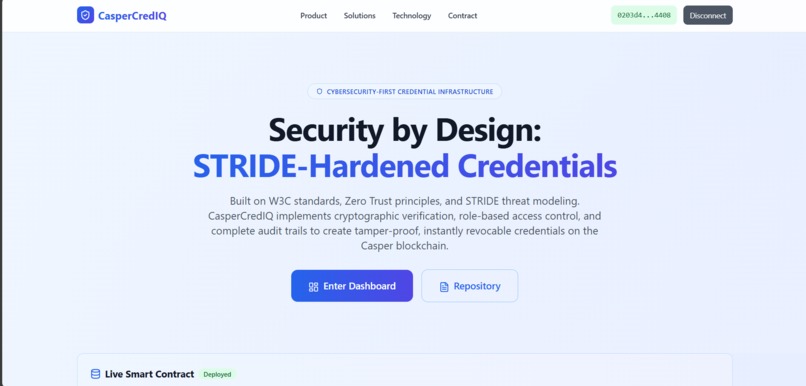
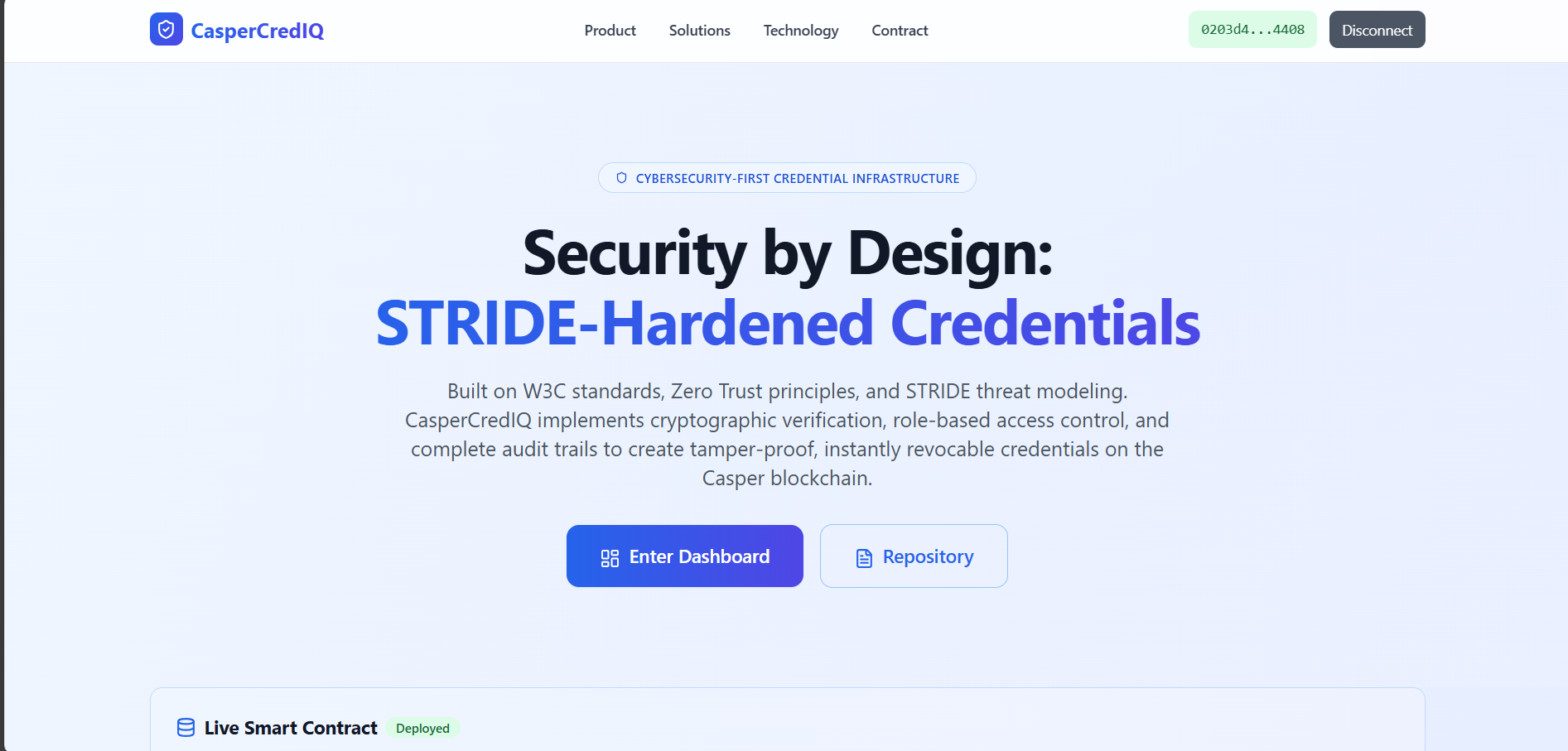
Landing Page
-
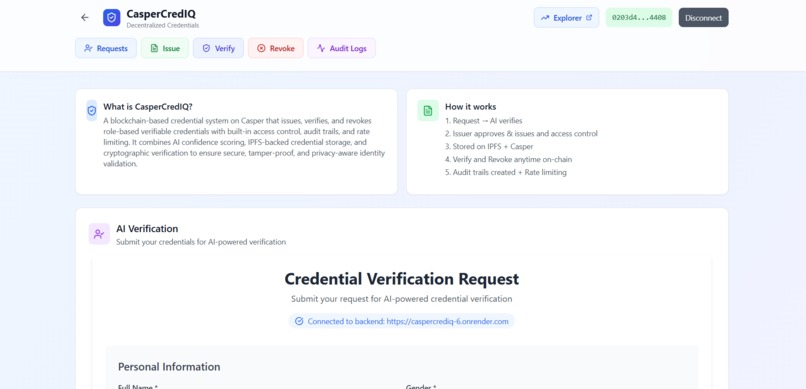
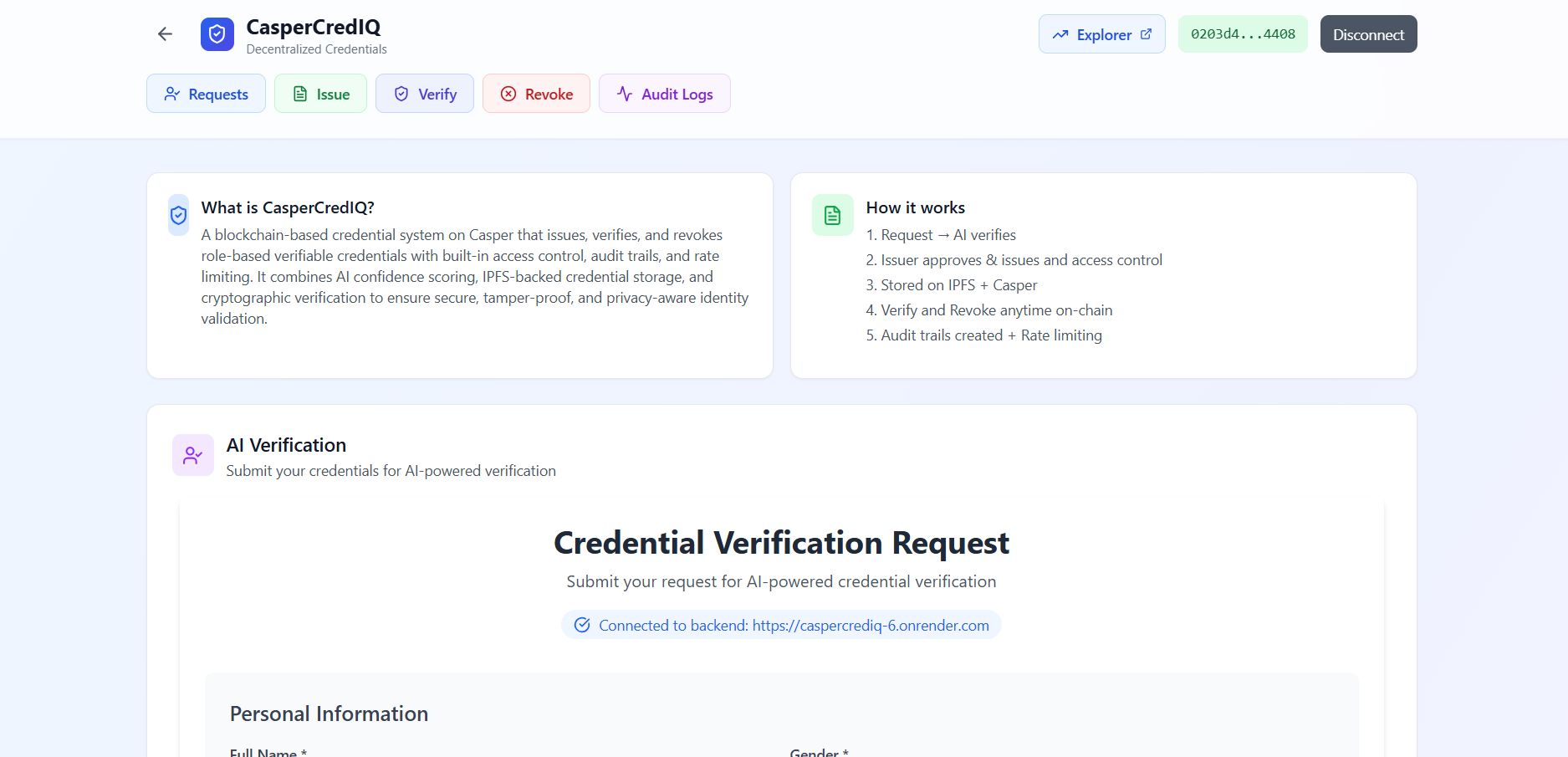
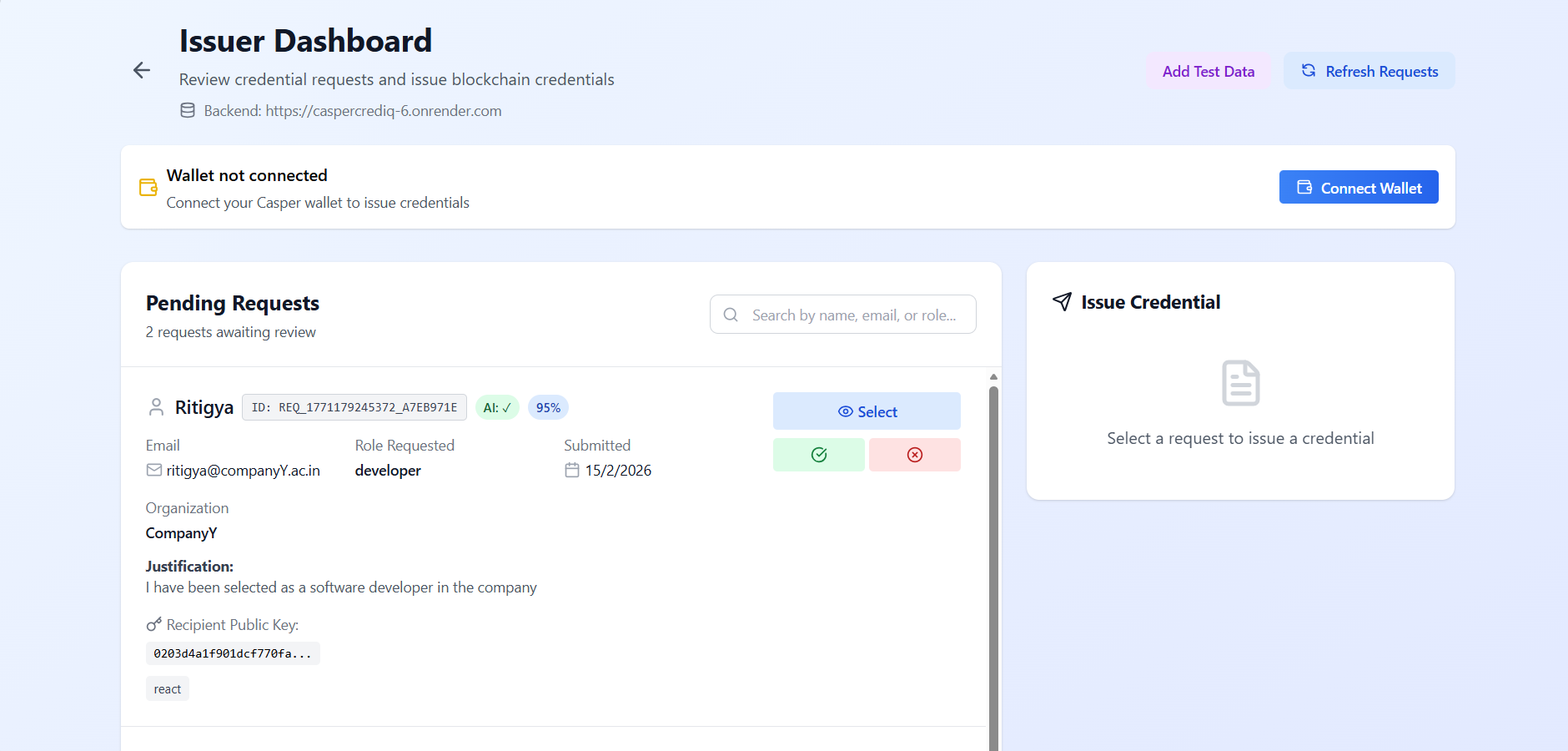
Dashboard
-
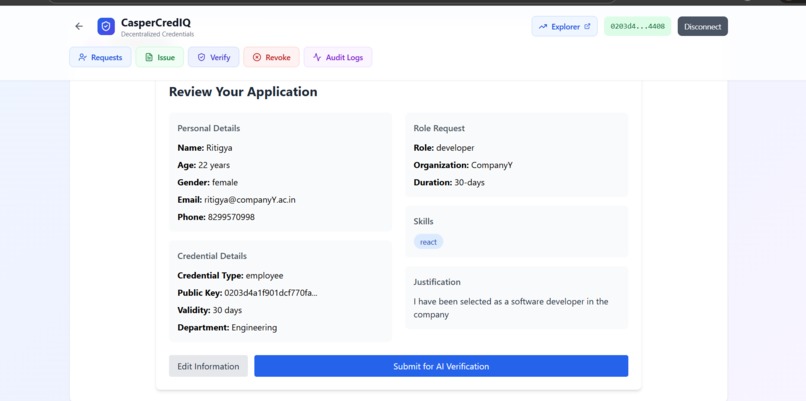
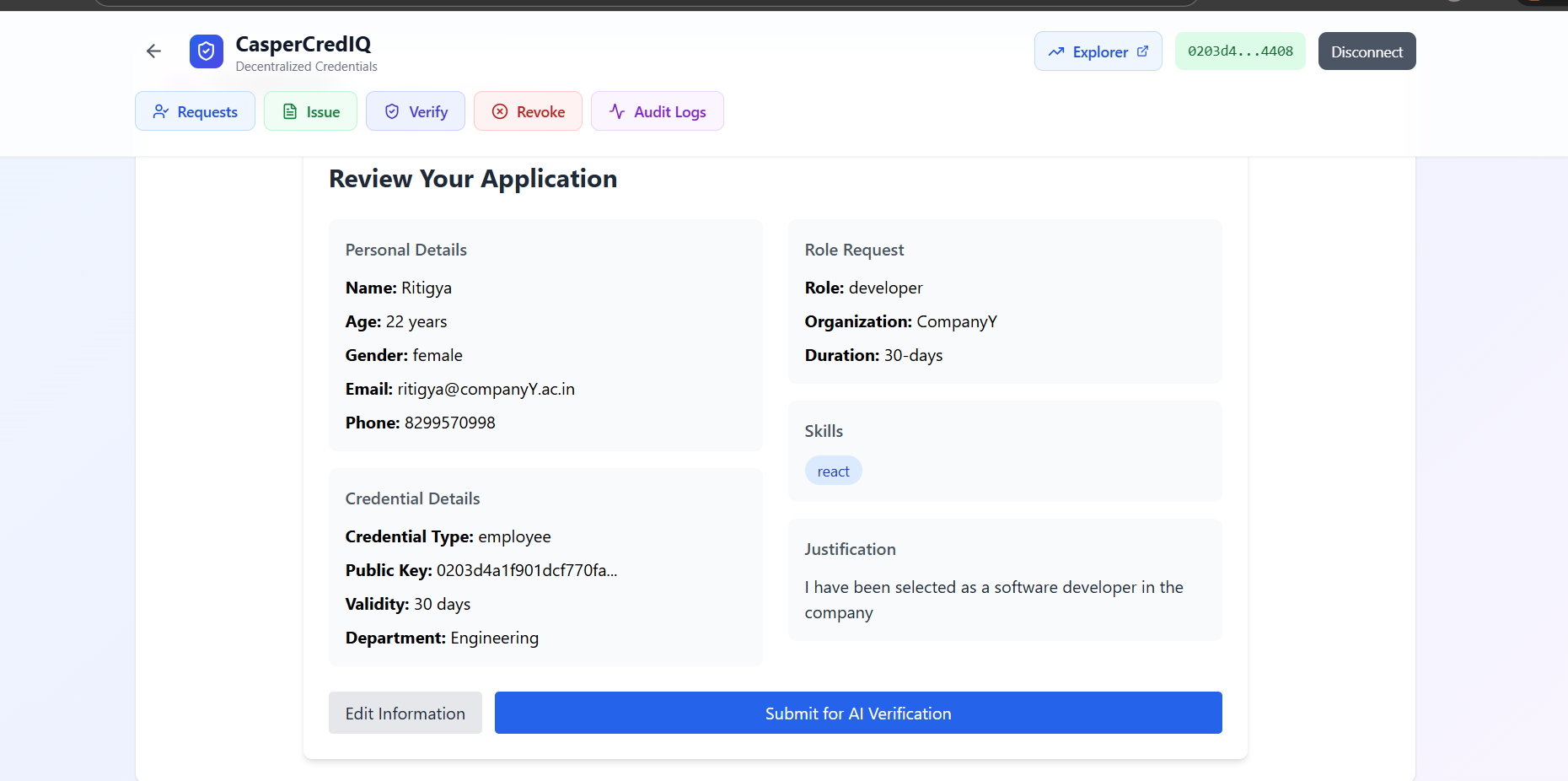
AI Form Filled
-
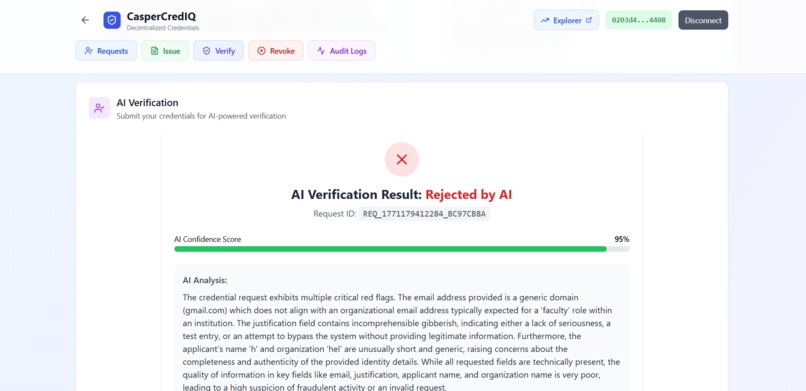
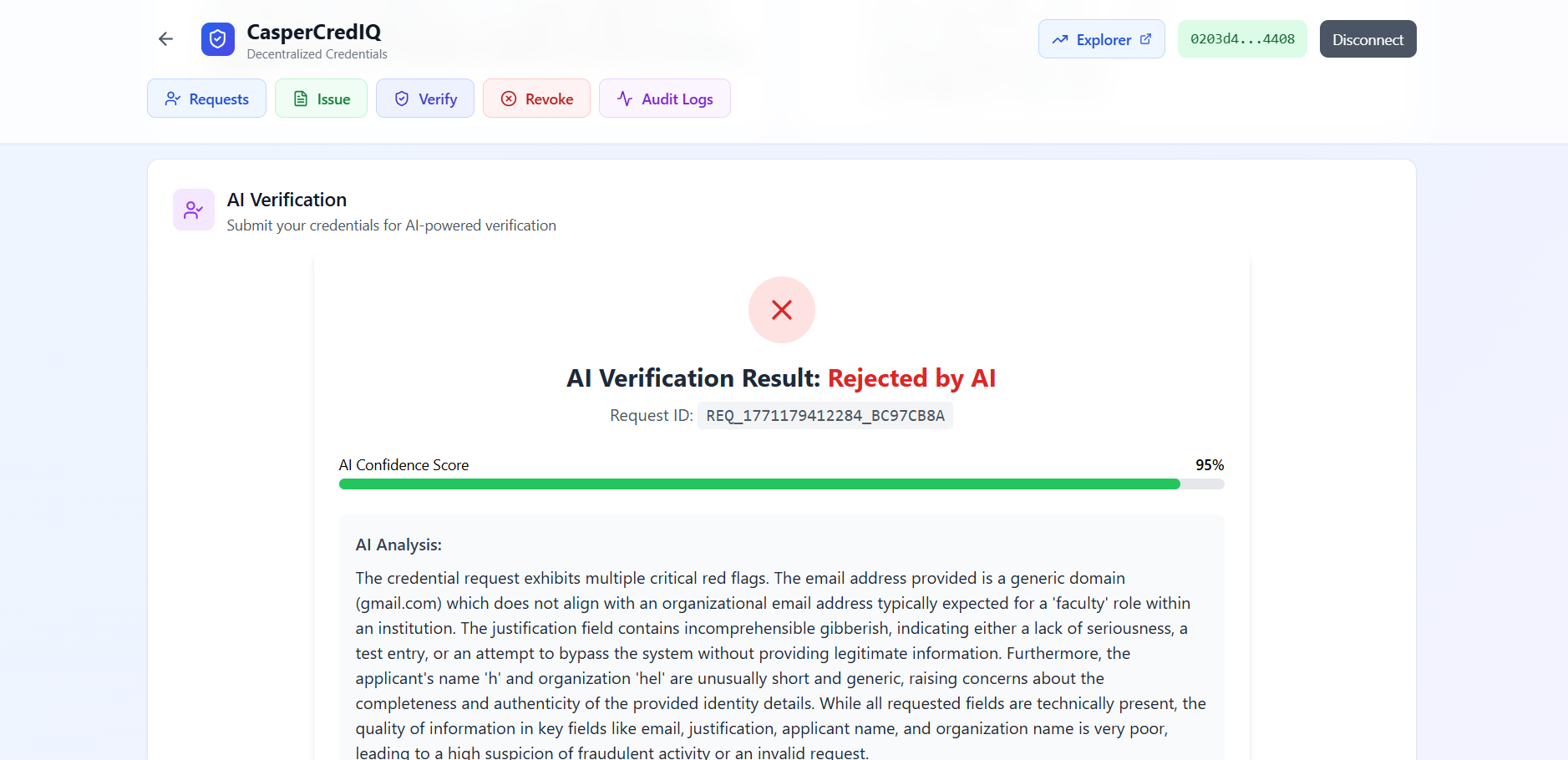
AI Verification
-
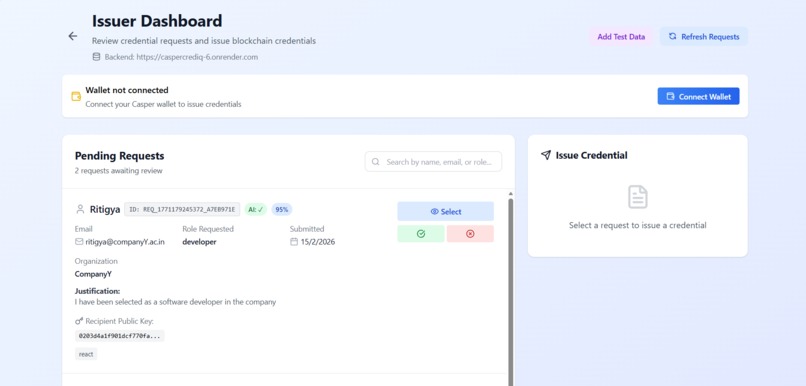
Issue
-
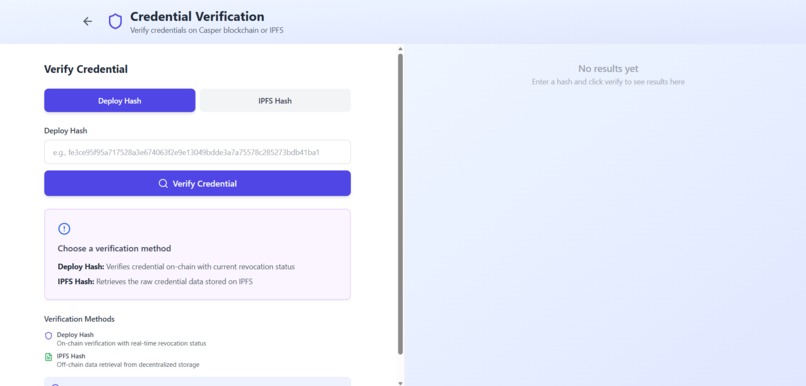
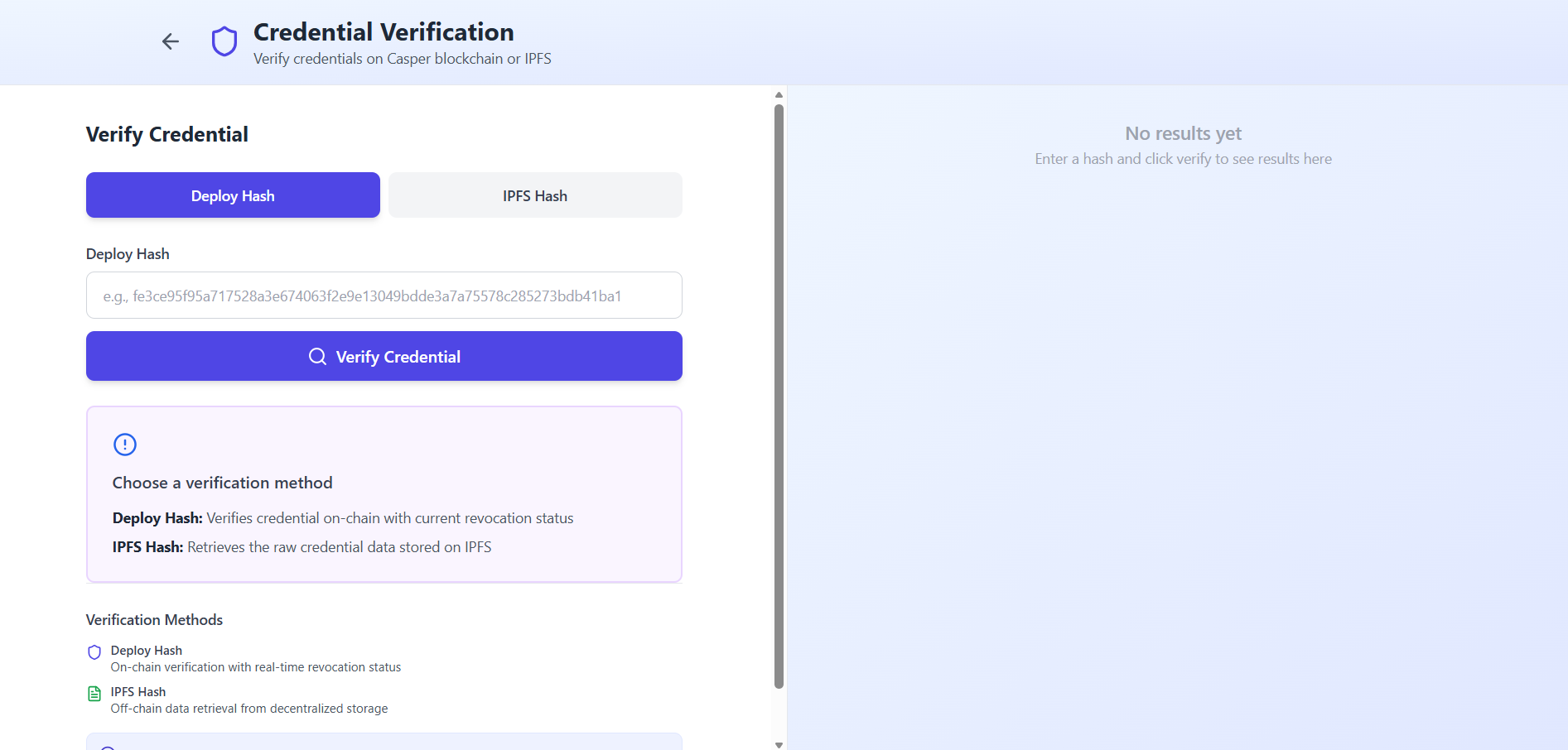
Verify
-
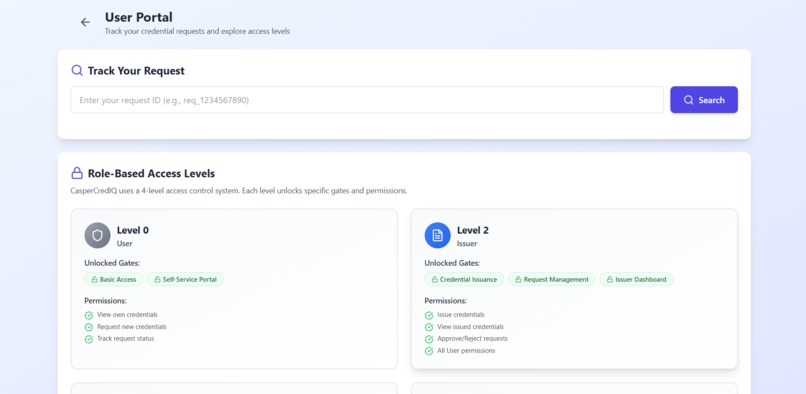
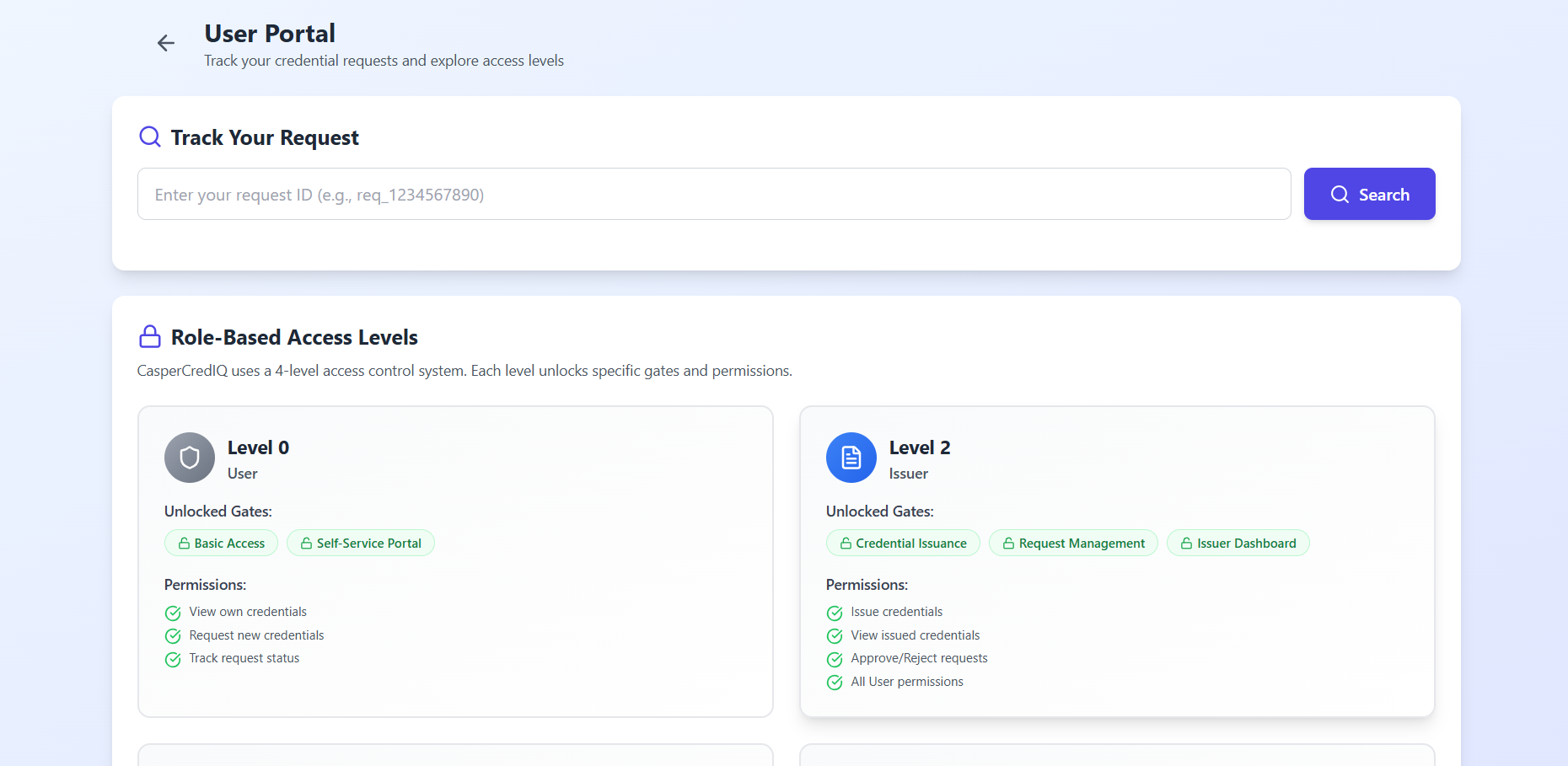
Request
-
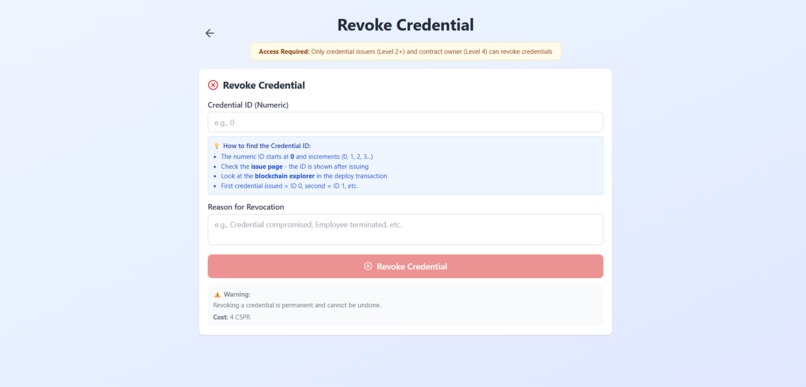
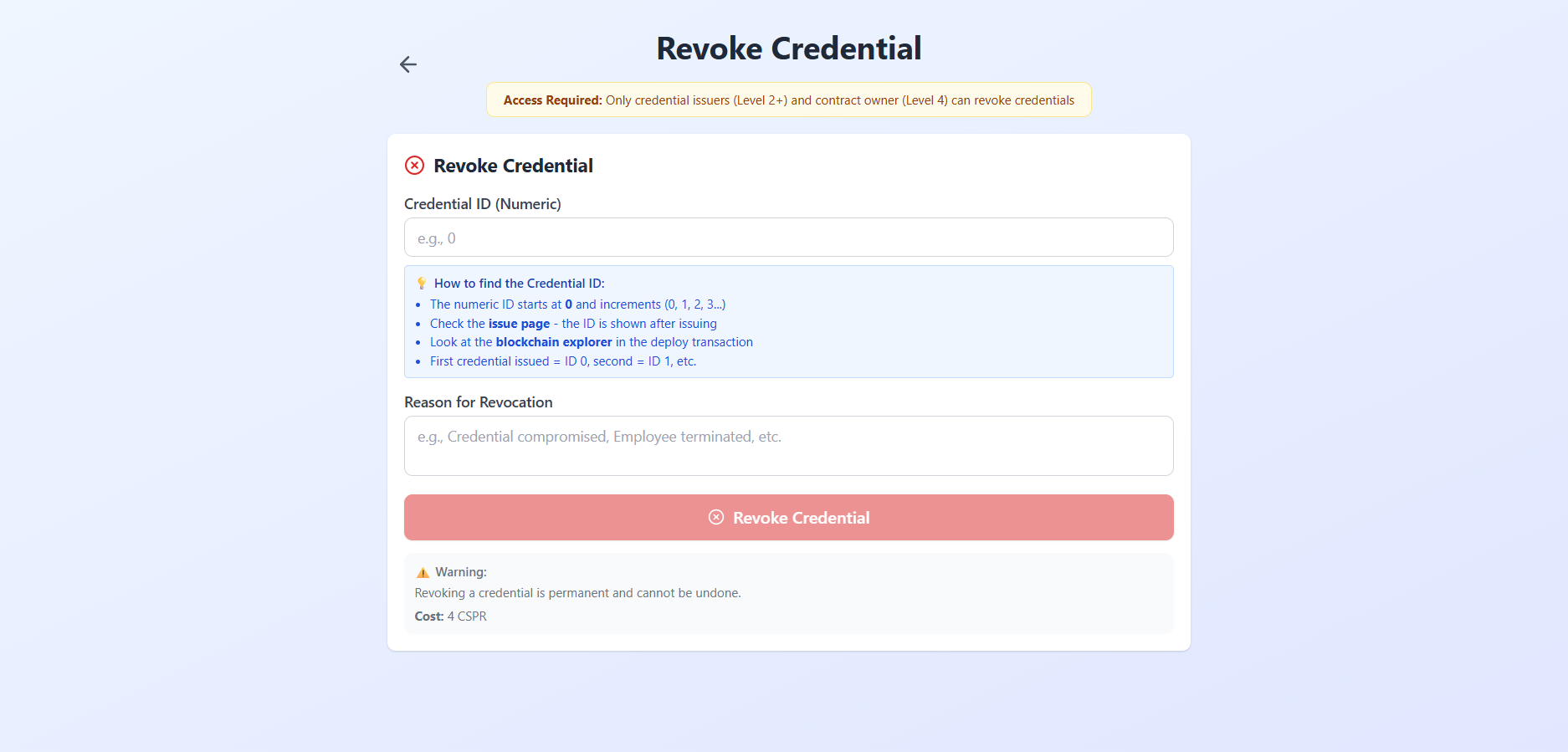
Revoke
-
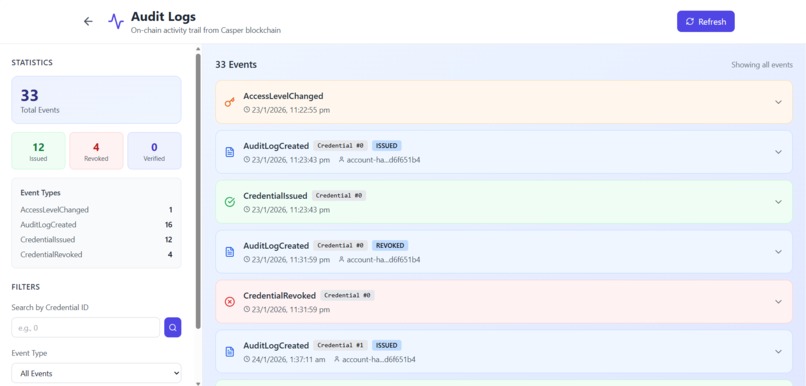
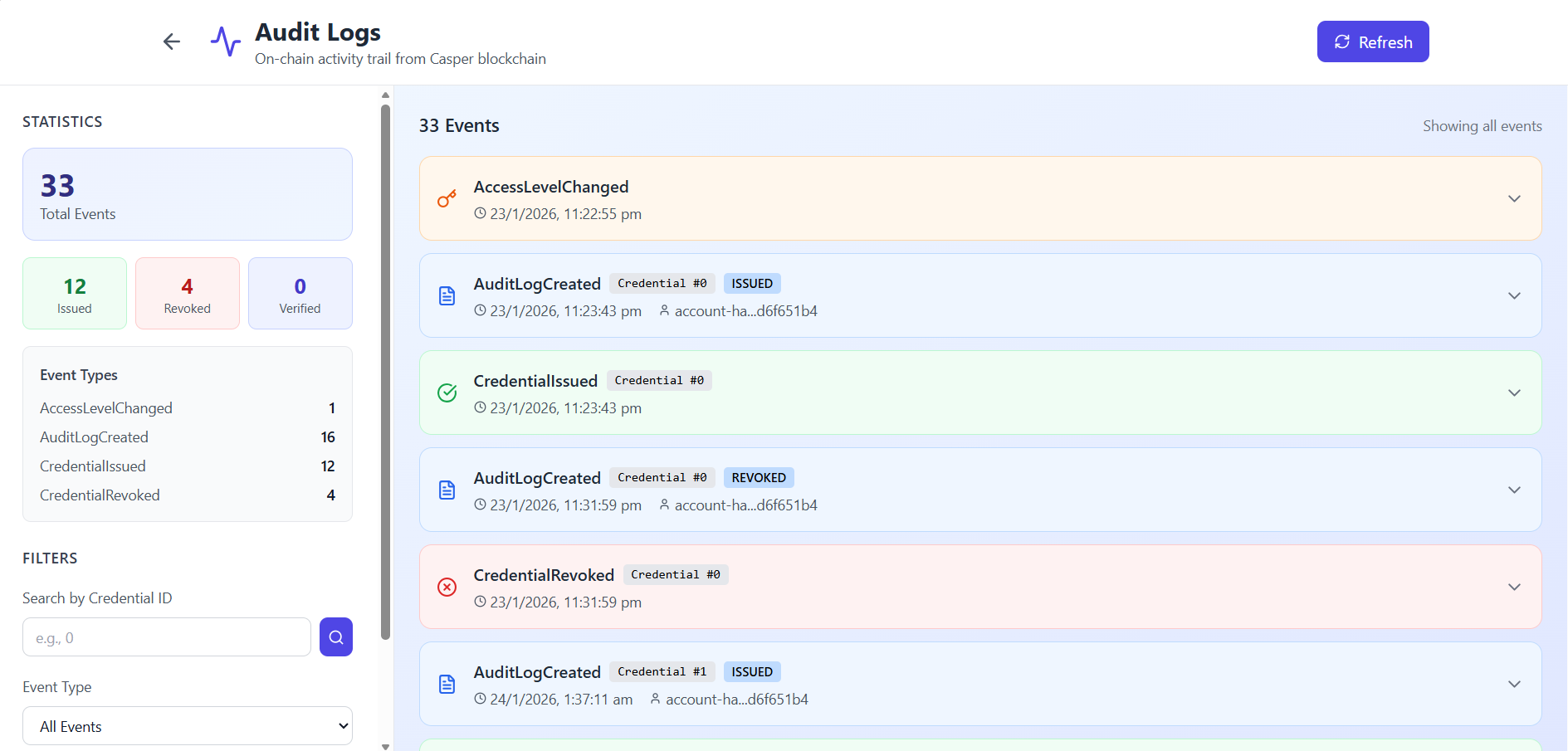
Audit logs
Inspiration
Credential fraud, fake certificates, and delayed access revocation are everywhere from education and hiring to healthcare and governance. Existing systems either rely on centralized databases that can be altered or breached, or on blockchain credentials that permanently store unverified data.
We were inspired by a simple question: What if credentials were not just verifiable, but justified before they ever existed?
CasperCredIQ was built to combine the decision-making strength of AI with the enforcement guarantees of blockchain so trust is evaluated before it is made permanent.
What it does
CasperCredIQ is an AI-gated, blockchain-secured credential infrastructure.
Before any credential is issued:
- AI evaluates whether the request is legitimate
- Issuers receive a confidence score and justification
- Only validated credentials are minted on-chain
Once issued:
- Credentials are cryptographically verifiable
- Instantly revocable across all systems
- Time-bound with automatic expiry
- Fully auditable via immutable on-chain logs
The result is a trust system that prevents fraud at the source, not after damage is done.
How we built it
CasperCredIQ follows a dual-trust architecture:
1) AI Verification Layer
- Integrated Google Gemini 2.5 Flash
- Analyzes credential requests, documents, and domain signals
- Produces a 0–100 confidence score with reasoning
2) Blockchain Enforcement Layer
- Smart contracts deployed on Casper Network using Odra
- Role-based access control (Viewer / Issuer / Auditor)
- Credential hashes stored on-chain, data on encrypted IPFS
- Instant revocation and millisecond-precision expiry
3) Application Layer
- Web dashboard for submitting, approving, issuing, and verifying credential
- Real-time verification in under 100ms
- Immutable audit trail of every action
Challenges we ran into
Balancing AI autonomy vs human control
Ensuring AI assists decisions without becoming a black box required explainable scoring and issuer override logic.
Designing instant revocation
Most credential systems fail here. Implementing near-real-time invalidation while maintaining decentralization was non-trivial.
Security vs demo accessibility
Access-controlled smart contracts are safer but harder to demo. We had to clearly document this for reviewers.
Avoiding PII exposure
Ensuring no sensitive data ever touched the blockchain required careful hashing and storage design.
Accomplishments that we're proud of
- Built a working, deployed prototype with real smart contracts
- Achieved instant revocation across all verifications
- Implemented AI-first decision gating, not AI as a gimmick
- Designed a fully auditable, privacy-preserving credential flow
- Created infrastructure usable across education, hiring, healthcare, and governance
What we learned
- Blockchain alone cannot solve trust input validation matters
- AI must be explainable to be usable in security-critical systems
- Revocation speed is as important as verification accuracy
- Infrastructure projects need strong documentation to communicate value clearly
What's next for CasperCredIQ
Short term (3–6 months):
- Mobile credential scanner with QR verification
- Biometric confirmation before credential usage
- Multi-chain compatibility (Ethereum / Polygon)
Long term (1–2 years):
- Zero-knowledge selective disclosure
- ML-driven fraud pattern learning
- Decentralized credential marketplace
- Cross-border compliance partnerships
CasperCredIQ aims to become the trust layer for the next generation of digital credentials—where every credential is provably earned, transparently issued, and instantly revocable.
Testing Instructions (Judges & Reviewers)
Access setup required (intentional security feature)
CasperCredIQ uses role-based access control to prevent unauthorized credential issuance.
To test full functionality, Issuer access is required.
Step 1: Share Your Casper Public Key
- Install the Casper Wallet browser extension
- Create or import a wallet
- Copy your public key (starts with
01or02) - Share it with me via:
- GitHub Issues (CasperCredIQ)
- Email: [email protected]
- Platform messaging (Devpost / DoraHacks)
Step 2: Access Levels
- Level 0: No access (default)
- Level 1: Viewer (public data only)
- Level 2: Issuer (required for testing)
- Level 3: Auditor
- Level 4: Owner (admin only)
Step 3: Test the Full Flow
- Submit a credential request
- Review AI confidence score & justification
- Approve and issue credential on-chain
- Verify credential instantly
- Revoke credential and observe real-time invalidation
- View immutable audit logs
Expected Results
- AI confidence score: 60–95%
- IPFS upload: <2 seconds
- Blockchain confirmation: ~30 seconds
- Verification latency: <100ms
Note: Access control is a security design choice, not a limitation.
It ensures only authorized issuers can mint or revoke credentials.
Track
FinTech & Blockchain – Innovative applications in finance, crypto, secure transactions, or decentralized systems.
CasperCredIQ is a next-generation digital trust infrastructure that combines AI-driven verification with blockchain-enforced credentials. It enables fraud-resistant issuance, instant revocation, and cryptographic verification of digital credentials making it ideal for financial compliance, identity verification, and decentralized governance use cases.
Solo Project
This project was designed and built entirely by me as a solo developer for Frostbyte Hackathon.
Built With
- caper
- ipfs
- next.js
- node.js
- pinata
- rust
- typescript
- wasm

Log in or sign up for Devpost to join the conversation.