Inspiration
One side of my home receives plenty of sunlight, while rooms on the shaded side remain dark for much of the day. Artificial lighting helps, but it does not provide the warmth or quality of natural sunlight.
Heliostats can solve this by using a motorized mirror to continuously redirect sunlight toward a fixed target. However, existing systems are expensive, difficult to install, and require precise mechanical calibration.
I wanted to build an affordable heliostat that a normal homeowner could install and operate without needing to understand solar geometry, coordinate systems, or robotics.
What it does
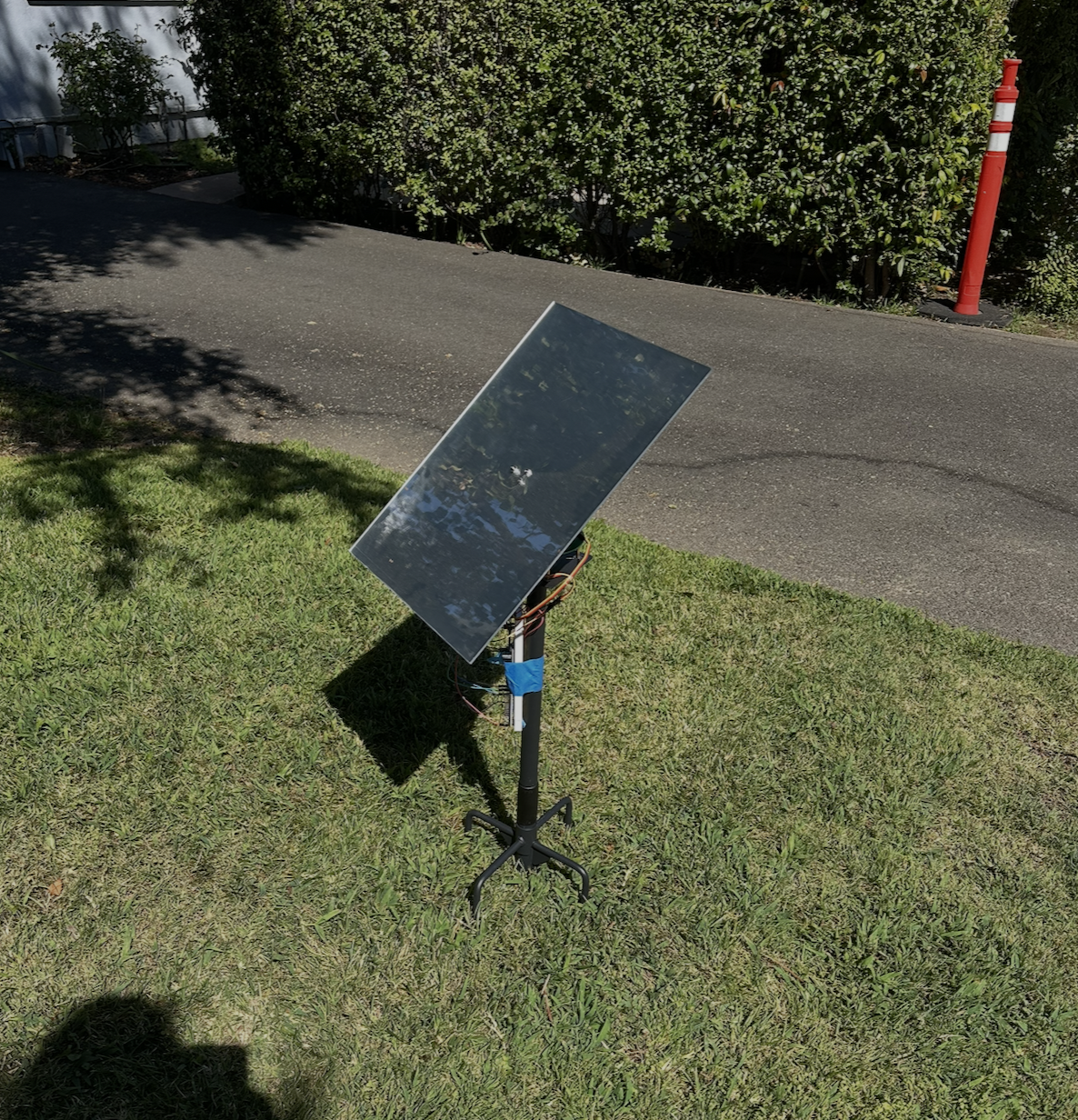
Casper the Heliostat is a two-axis motorized mirror that tracks the sun and reflects daylight toward a chosen window, wall, or indoor target.
The system:
Controls the mirror’s pan and tilt through a web interface
Remembers its position after restarting
Calculates how the sun moves throughout the day
Continuously adjusts the mirror to keep light aimed at a fixed target
Uses photos and natural-language instructions to guide calibration
Helps diagnose problems such as reversed motors, incorrect orientation, limited movement, or a missed target
Lets the user describe a goal such as “keep sunlight centered on this window until 4 PM”
The OpenAI-powered assistant converts that goal into structured device actions and explains the setup process in plain language.
How we built it
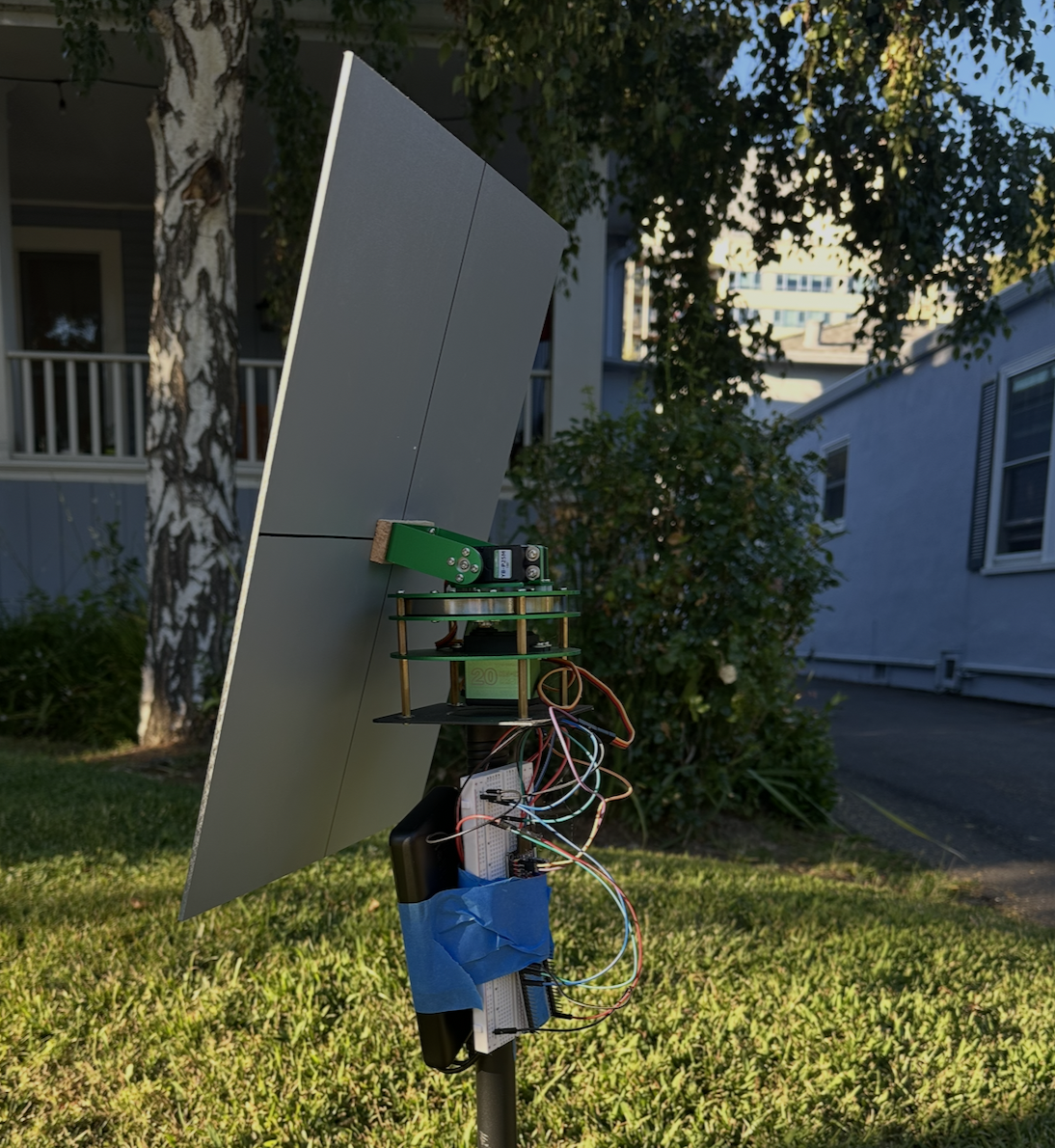
The physical prototype uses an ESP32 connected to two servo motors through a PCA9685 controller. The servos control the mirror’s horizontal and vertical movement.
The ESP32 hosts a local web interface for manual control and configuration. Device settings and the most recent mirror position are stored locally so the system can recover correctly after losing power. The firmware also supports Wi-Fi connectivity, over-the-air updates, and local network discovery.
The tracking system calculates the sun’s position using the device’s fixed location and time. It then determines the mirror orientation required to reflect the incoming sunlight toward a fixed target.
The OpenAI layer acts as the installation and calibration assistant. A user can provide a photo of the heliostat, reflected light, and intended target. The model interprets the scene, asks for specific adjustments, and invokes structured device controls for actions such as:
Moving the mirror
Saving calibration points
Reversing a motor direction
Setting movement limits
Starting or stopping tracking
Checking whether the reflected spot is approaching the target
This allows the model to help bridge the gap between the mathematical tracking system and the imperfect physical installation.
Challenges we ran into
The hardest problem was calibration.
A mathematically correct solar-tracking algorithm is not enough because every physical installation is slightly different. The base may not be level, the mirror may not be perfectly aligned with the servo axes, and the motors may have different ranges or directions.
Small angular errors also create large targeting errors over distance. A mirror can appear almost correctly positioned while the reflected light misses the target by several feet.
Another challenge was designing a system that behaves reliably outside a controlled prototype environment. It needs to recover after power loss, reconnect to Wi-Fi, preserve its position, respect physical movement limits, and avoid making sudden movements during startup.
The AI assistant helps address these problems by observing the result of each adjustment rather than assuming the physical system perfectly matches its mathematical model.
Accomplishments that we’re proud of
We built a functioning physical heliostat prototype with:
Two-axis motorized mirror control
ESP32-based firmware
A browser-based control interface
Saved positions and configuration
Wi-Fi connectivity
Over-the-air firmware updates
Solar-position tracking logic
A calibration framework that does not require a perfectly level installation
We are especially proud of connecting a multimodal AI assistant to a physical control system. Instead of simply explaining how the device works, the assistant can participate in the setup process, observe results, and recommend or execute the next adjustment.
What we learned
We learned that building a physical AI product requires much more than connecting a model to hardware.
The geometry may be exact, but real motors have backlash, mirrors flex, mounts are imperfect, and users describe locations imprecisely. The system needs feedback from the real world.
We also learned that multimodal models can make technically complex hardware much more approachable. Solar-vector math and reflection geometry can remain inside the system while the user interacts through photos and simple instructions.
The strongest role for AI was not replacing the tracking algorithm. It was helping the user configure, understand, and troubleshoot the system around it.
What’s next for Casper the Heliostat
The next steps are to:
Complete closed-loop visual calibration
Add magnetic encoder feedback
Design a custom circuit board
Improve the weather-resistant mechanical enclosure
Add automatic target detection
Track changes in the reflected light throughout the day
Support multiple saved targets
Create safety limits for windows, people, vehicles, and neighboring properties
Test installations across different home orientations and climates
Longer term, the same technology could manage sunlight for greenhouses, solar panels, architectural daylighting, thermal systems, and other environments where light needs to be precisely redirected.


Log in or sign up for Devpost to join the conversation.