-
-
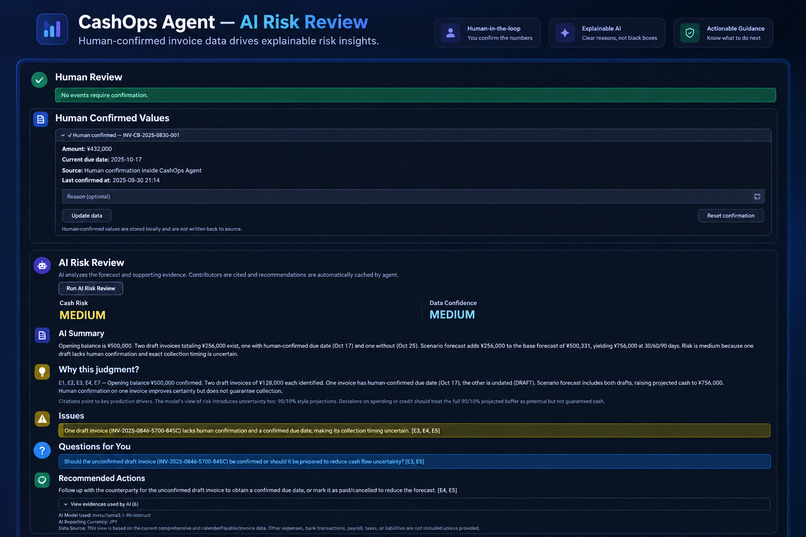
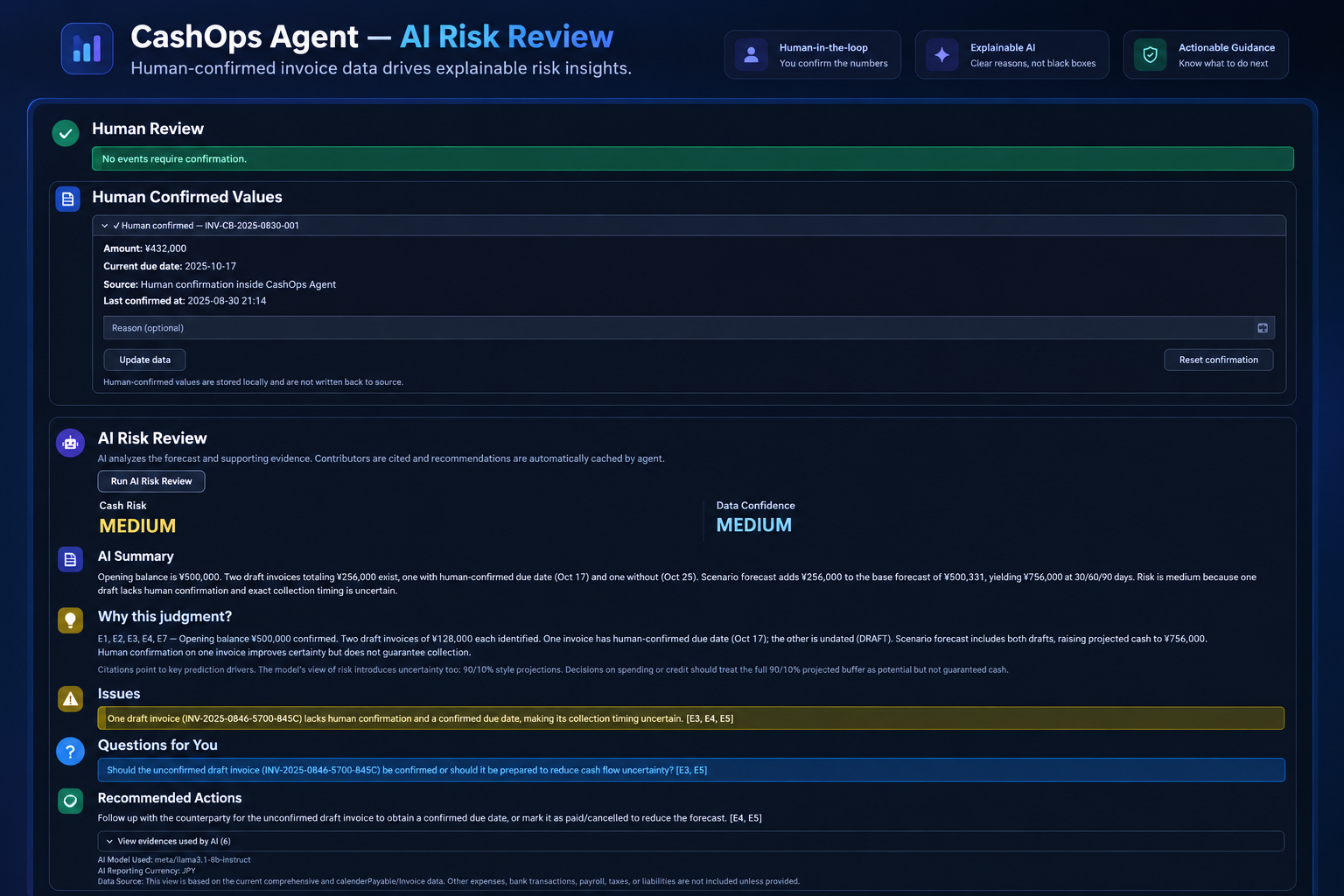
AI risk review highlights issues, questions, and recommended actions based on invoice uncertainty and forecast risk.
-
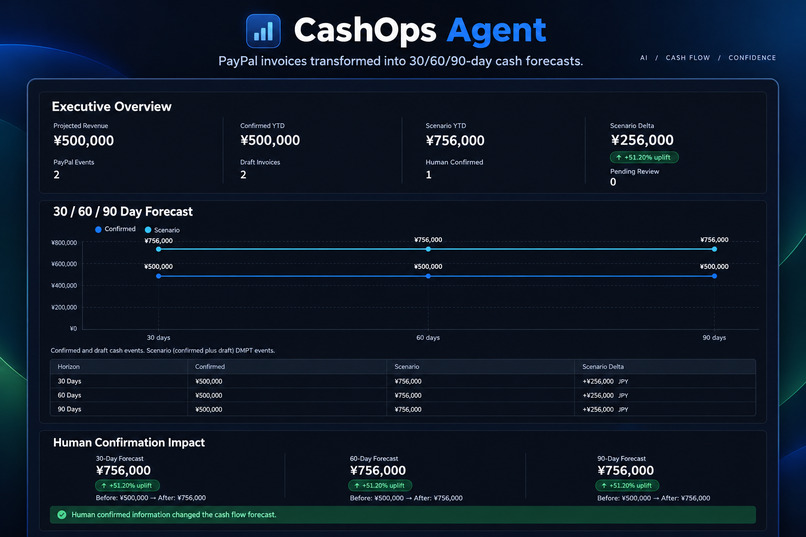
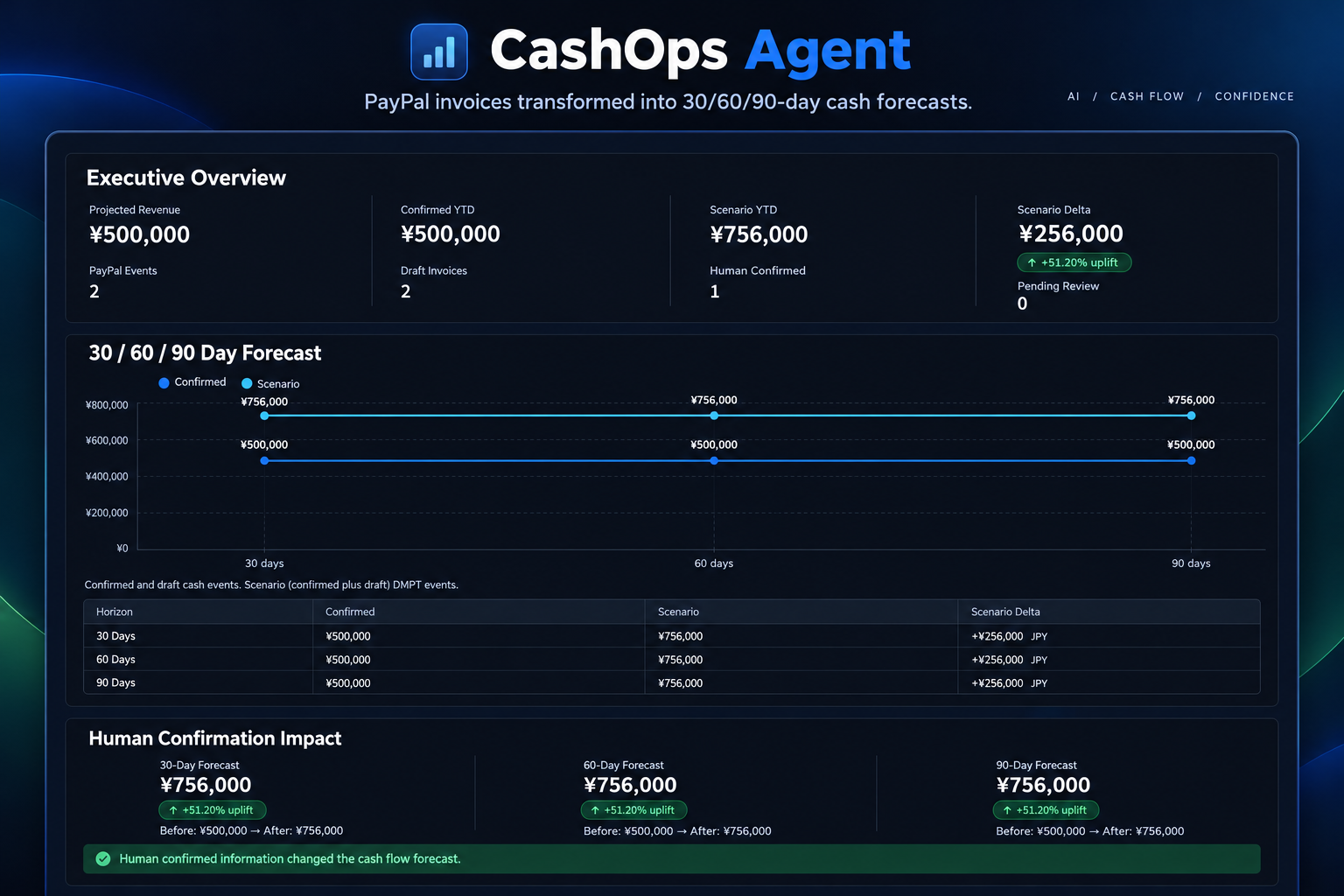
30/60/90-day cash forecast dashboard showing confirmed vs. scenario cash positions from PayPal invoice data.
Inspiration
Small businesses often know what they have invoiced, but that does not always tell them what their cash position will look like in the weeks ahead.
A draft invoice may be missing a due date. A payment may be expected but not yet certain. Owners need more than accounting data — they need enough time to make a decision before a cash problem becomes urgent.
CashOps Agent was built to turn PayPal invoice data into an actionable cash-flow view.
What it does
CashOps Agent connects to PayPal Sandbox invoice data and converts it into structured cash-flow events.
It then:
- detects missing or uncertain information
- asks for human confirmation when required
- produces deterministic 30 / 60 / 90-day cash forecasts
- separates confirmed cash flow from draft invoice scenarios
- shows how human-confirmed information changes the forecast
- uses AI to interpret cash-flow risk and explain the evidence behind its judgment
For example, if a PayPal draft invoice is missing a due date, CashOps Agent does not silently guess one. It flags the invoice for Human Review.
Once the user confirms the expected due date, the scenario forecast is immediately updated.
Why PayPal matters
PayPal provides the transaction and invoice source data that starts the CashOps workflow.
Instead of treating PayPal invoices as isolated records, CashOps Agent turns them into forward-looking financial signals.
The workflow is:
PayPal → Human Review → Cash Forecast → AI Risk Review
This helps transform invoice data into information a small-business owner can actually use when deciding what to do next.
Human-in-the-loop design
Cash-flow decisions should not depend on AI guesses.
CashOps Agent separates deterministic calculations from AI interpretation.
Cash balances and 30 / 60 / 90-day forecasts are calculated by the application itself.
When source data is incomplete, the application requests human confirmation rather than inventing missing values.
AI is used only after the underlying evidence and forecasts have been established.
AI Risk Review
The AI Risk Review evaluates the forecast and supporting evidence and returns:
- cash risk level
- data confidence
- decision basis
- identified issues
- questions for the user
- recommended actions
Each important judgment is tied back to evidence generated by CashOps Agent.
This keeps the AI layer explainable and prevents it from inventing financial balances that were not present in the source data.
How we built it
CashOps Agent is built with Python and Streamlit.
PayPal Sandbox invoice data is retrieved through PayPal APIs and transformed into structured cash-flow events.
The forecasting layer calculates confirmed and scenario balances independently of the AI model.
The AI interpretation layer currently uses NVIDIA Nemotron through Nebius Token Factory.
The application is deployed as a public Streamlit web app.
Challenges
One of the biggest challenges was handling uncertainty correctly.
A draft invoice may represent possible future cash, but it should not automatically be treated as guaranteed income.
We therefore created separate Confirmed and Scenario forecasts and added a Human Review layer for missing information.
Another challenge was making AI useful without allowing it to become the source of financial truth. The solution was to keep all cash calculations deterministic and use AI only for interpretation.
What we learned
The most useful financial AI is not necessarily the system that makes the most decisions automatically.
For small businesses, a better approach can be to surface uncertainty early, ask for human confirmation where necessary, and give the owner more time to act.
What's next
Future versions could support additional PayPal transaction types, automated reconciliation, cash-outflow sources, accounting integrations, and multi-currency conversion.
The long-term goal is to turn fragmented financial events into a continuously updated cash-operations assistant for small businesses.

Log in or sign up for Devpost to join the conversation.