-
-
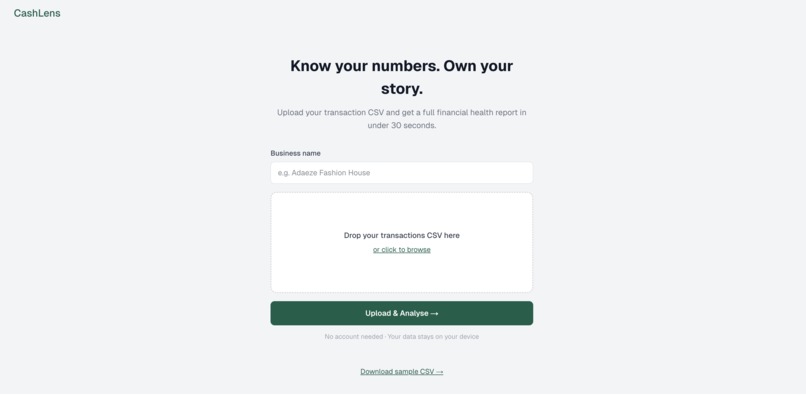
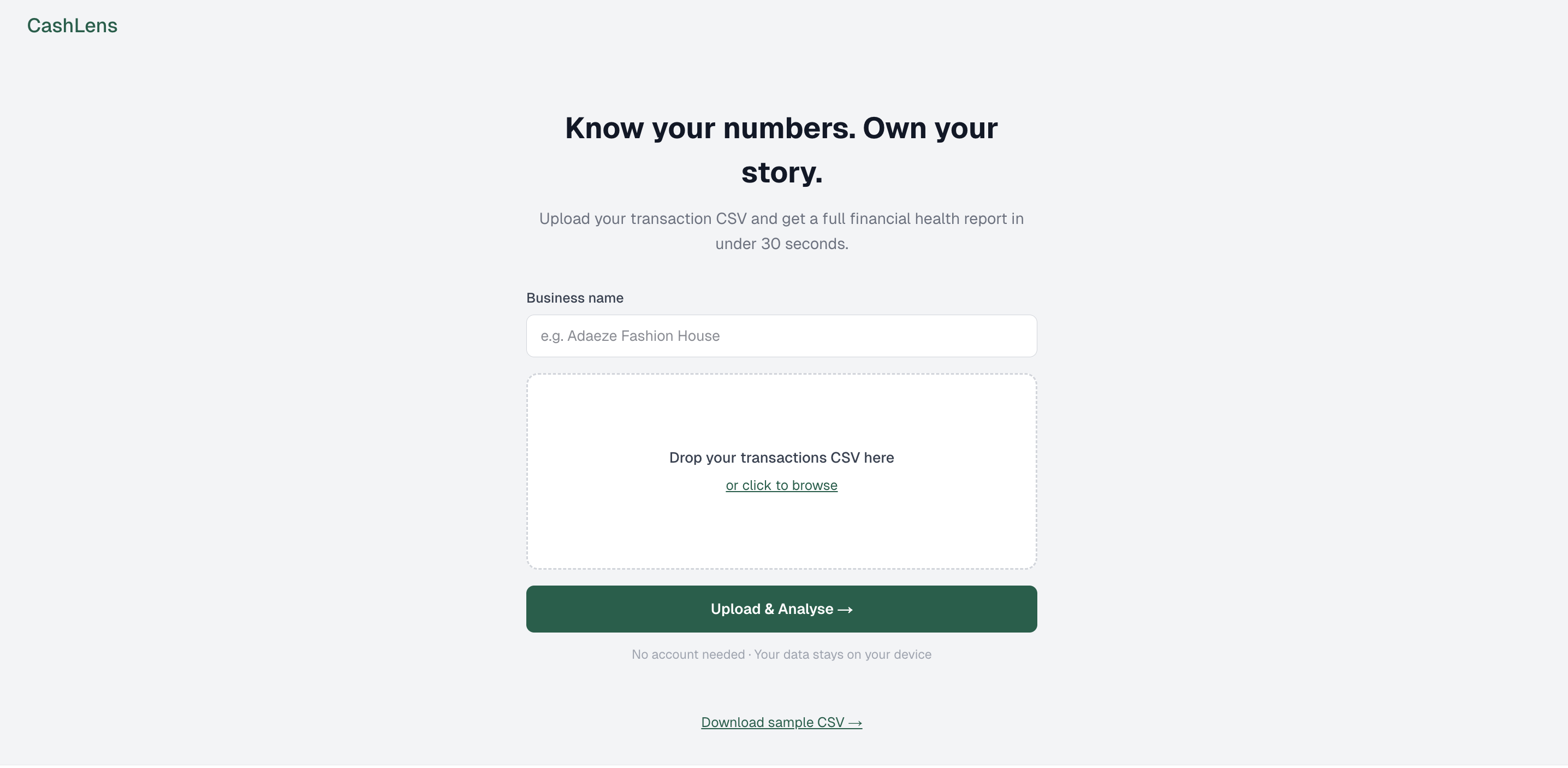
Upload Page
-
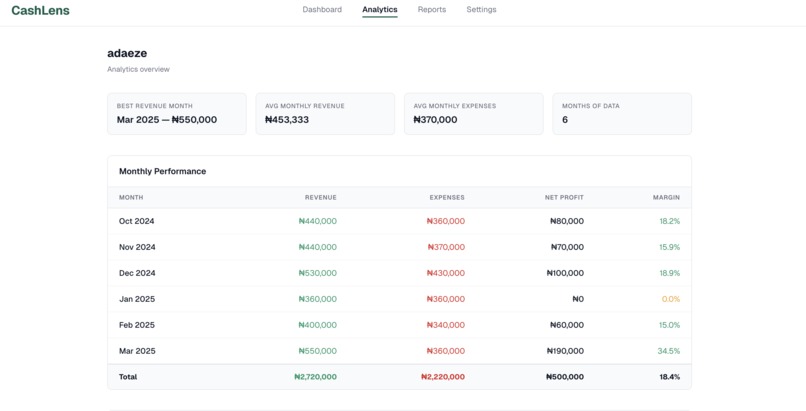
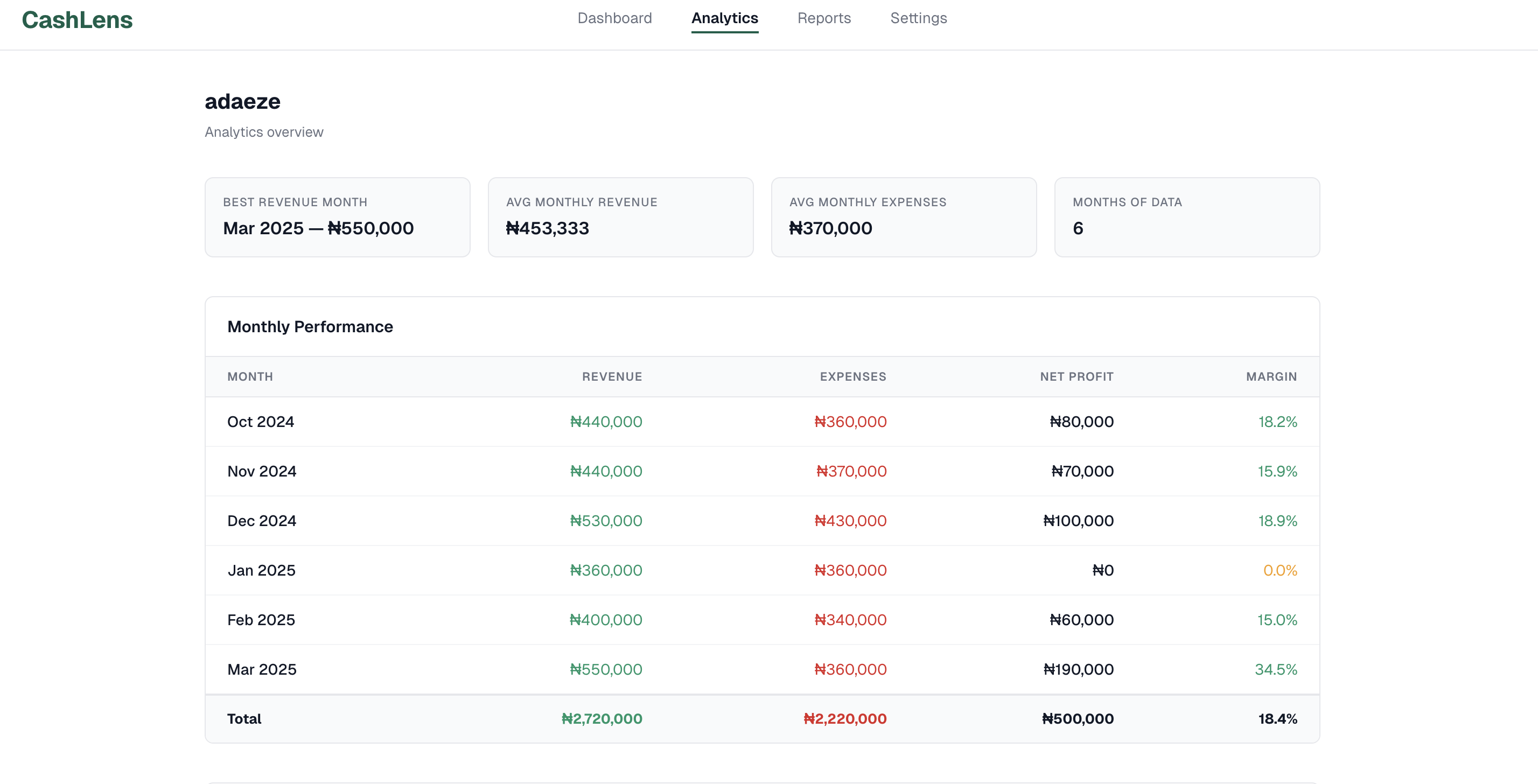
Analytics page
-
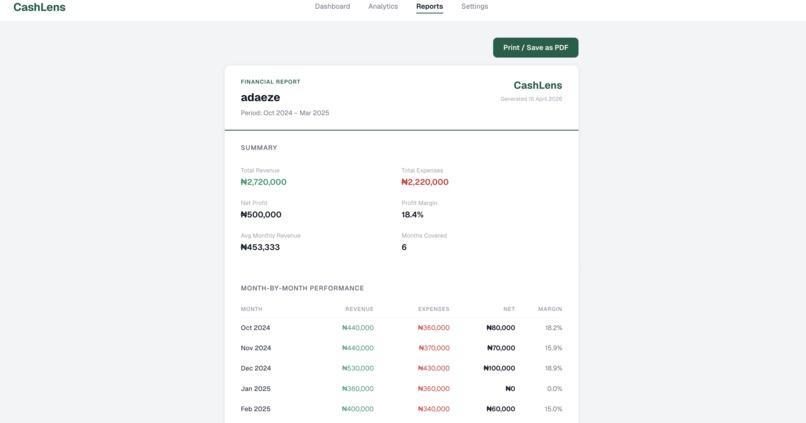
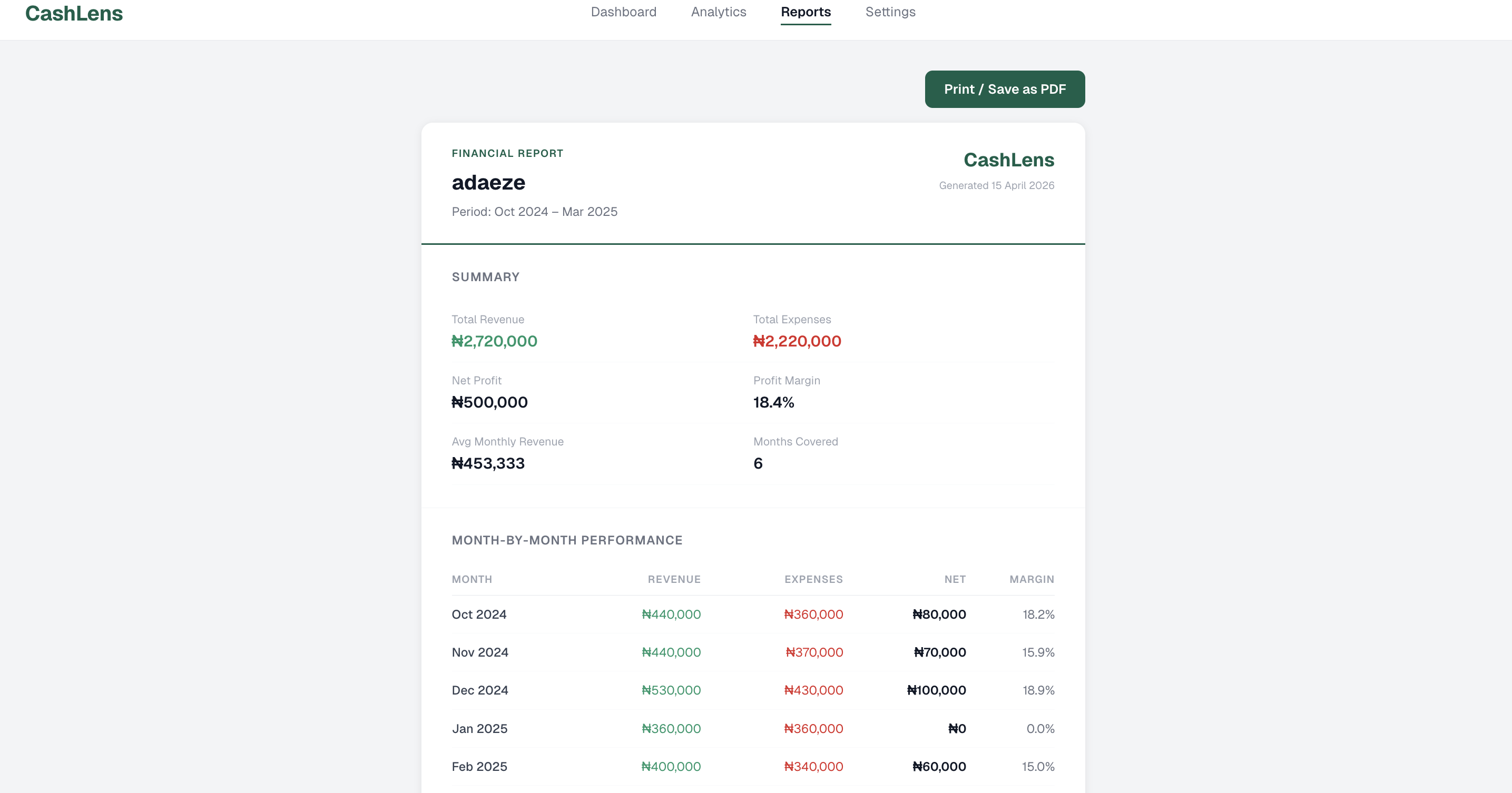
Reports page
-
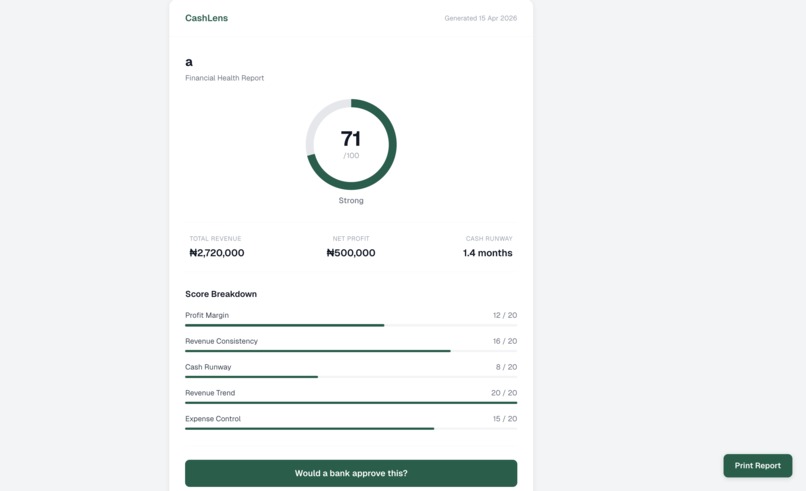
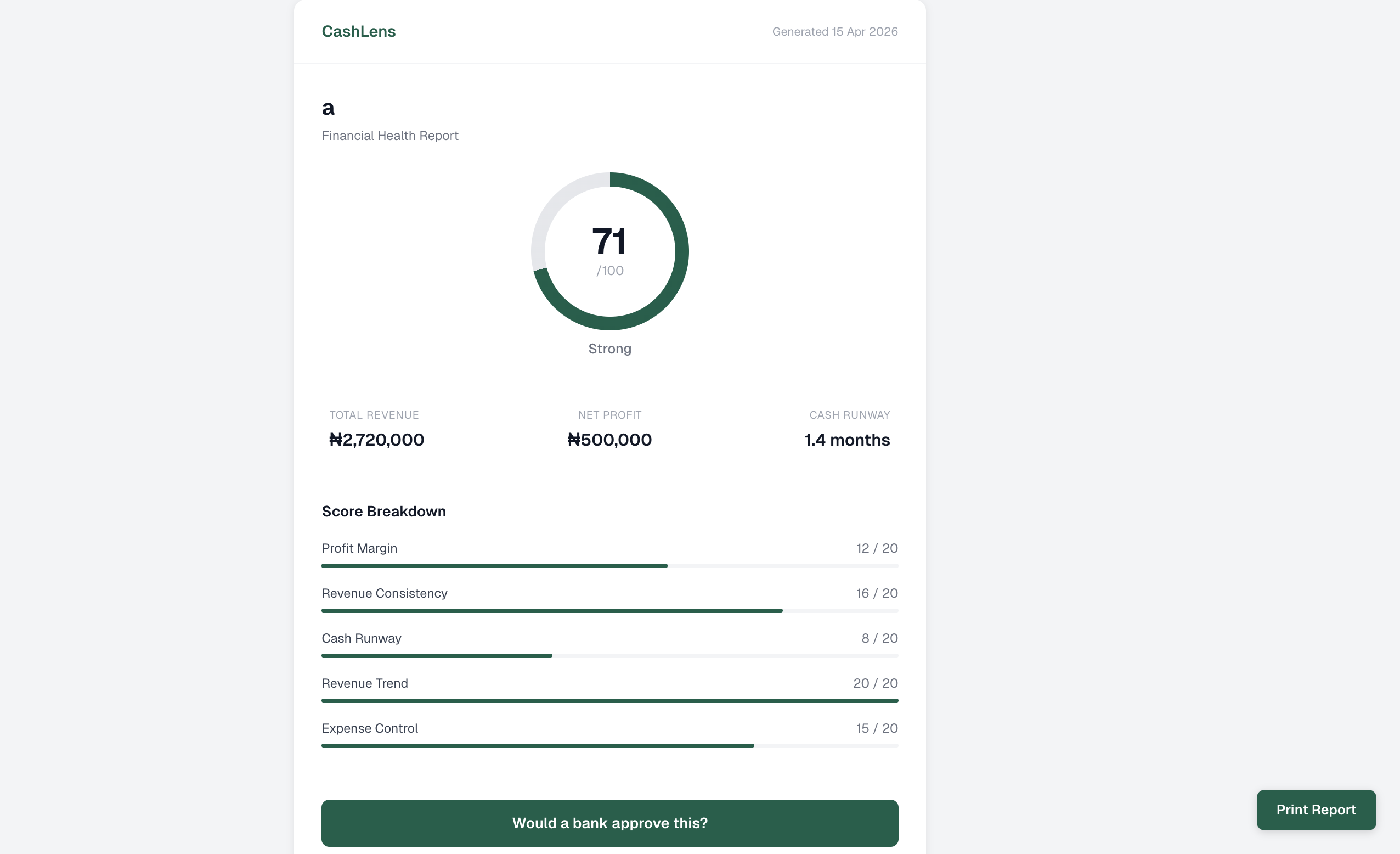
Health Card
Inspiration
Across Nigeria and much of Africa, small businesses are everywhere — from fashion houses to food vendors, generating real revenue every day. But when it comes to accessing credit, most of them hit the same wall: they can’t prove their financial health.
Not because the data doesn’t exist, but because it’s scattered — in WhatsApp messages, bank alerts, notebooks, and memory.
CashLens was inspired by this gap. The idea was simple: what if a business owner could take the data they already have and instantly turn it into something a lender would actually trust?
What it does
CashLens transforms raw transaction data into a structured financial profile for small businesses.
A user uploads a CSV of their transactions and immediately gets:
Automatically categorized income and expenses A 6-month cash flow visualization A 5-factor financial health score (0–100) A loan decision simulation that answers: “Would a bank approve me?”
The system analyzes profit margins, revenue consistency, growth trends, and cash runway to generate a decision (Approved, Conditional, or Declined), along with an estimated loan amount and clear reasoning.
All of this is packaged into a Financial Health Card, a clean, shareable summary designed to help business owners communicate their financial story to lenders.
How I built it
CashLens was built as a full-stack web application with a focus on simplicity and speed.
Backend: NestJS with TypeORM and SQLite for a lightweight, portable data layer Frontend: Next.js 14 with TypeScript and Tailwind CSS Data Visualization: Recharts for cash flow and category insights File Processing: CSV parsing pipeline for ingesting transaction data
The core of the system is a stateless analytics engine that derives all insights directly from transaction history. Every metric : from cash flow to health score is computed on demand, ensuring transparency and reproducibility.
The loan simulation logic was designed to mirror how a human credit analyst evaluates a business, combining multiple financial signals into a structured decision.
Challenges we ran into
One of the biggest challenges was defining what “financial health” actually means for an informal business.
Traditional financial models don’t translate well to SMEs operating without formal accounting systems, so we had to rethink the metrics from the ground up focusing on signals like consistency, runway, and trend rather than rigid financial ratios.
Another challenge was building a scoring and decision system that felt believable. It wasn’t enough to output a number, the reasoning had to make sense in plain language, as if it came from a real credit officer.
On the technical side, designing a stateless analytics pipeline that could process raw transaction data and generate meaningful insights instantly required careful structuring to keep it both fast and reliable.
Accomplishments that we're proud of
We’re most proud of how quickly raw, messy data becomes something meaningful.
In a single flow — upload → analysis → health card → loan decision — CashLens turns unstructured transactions into a clear financial story.
The loan simulator stands out as a key achievement. Instead of just scoring a business, it explains why a decision was made, which makes the output feel practical and actionable.
We’re also proud of the simplicity of the system. It runs on lightweight infrastructure, requires no prior setup, and can realistically be used or deployed in low-resource environments.
What I learned
Building CashLens reinforced that the biggest barrier isn’t always technology, it’s accessibility.
The tools to analyze financial data already exist, but they’re not designed for the realities of informal businesses. Bridging that gap required thinking less like an engineer and more like a business owner.
We also learned that trust is everything. A financial tool isn’t useful unless the user believes the output. That meant focusing just as much on explanations and clarity as on the underlying calculations.
What's next for CashLens
The next step is making CashLens even more accessible and closer to how SMEs actually operate.
This includes:
Integrating directly with mobile money and bank APIs to remove the need for CSV uploads Adding WhatsApp-based input and report sharing for easier adoption Refining the loan simulation with real-world lender feedback Expanding the health scoring model with more localized financial patterns
Long-term, CashLens could serve as a bridge between informal businesses and formal financial institutions, helping SMEs not just understand their finances, but actually unlock opportunities for growth.
Built With
- nestjs
- next.js
- recharts
- sqlite
- tailwindcss
- typeorm
- typescript


Log in or sign up for Devpost to join the conversation.