Inspiration
Small businesses usually fail because they run out of cash, not customers. The owner of a twelve-seat café is behind the counter at 7 a.m., not in a spreadsheet, and the question that keeps them up at night is short: can I make payroll next month? We wanted that question to get a trustworthy spoken answer in about five seconds, from the voice assistant already sitting in the kitchen.
What it does
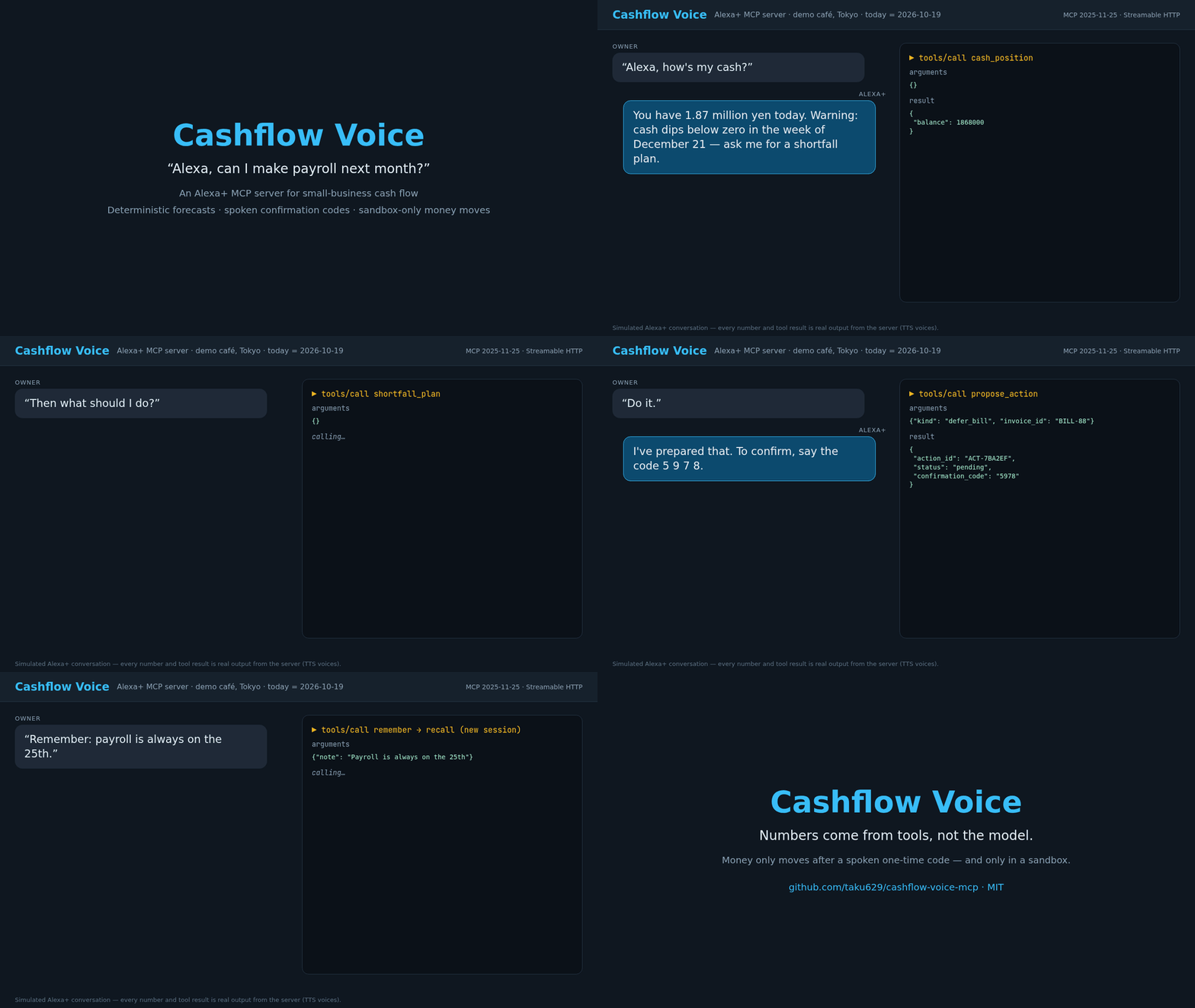
Cashflow Voice is a self-hosted MCP server for Alexa+ (spec 2025-11-25, Streamable HTTP) with 12 tools:
- Know where you stand:
cash_positiongives today's balance plus a one-sentence 13-week outlook ("You have 1.87 million yen today. Cash dips below zero in the week of December 21"). - Look ahead:
forecast_cashflowbuilds a week-by-week forecast and shows what drives each week (rent, payroll, invoices due). - Decide:
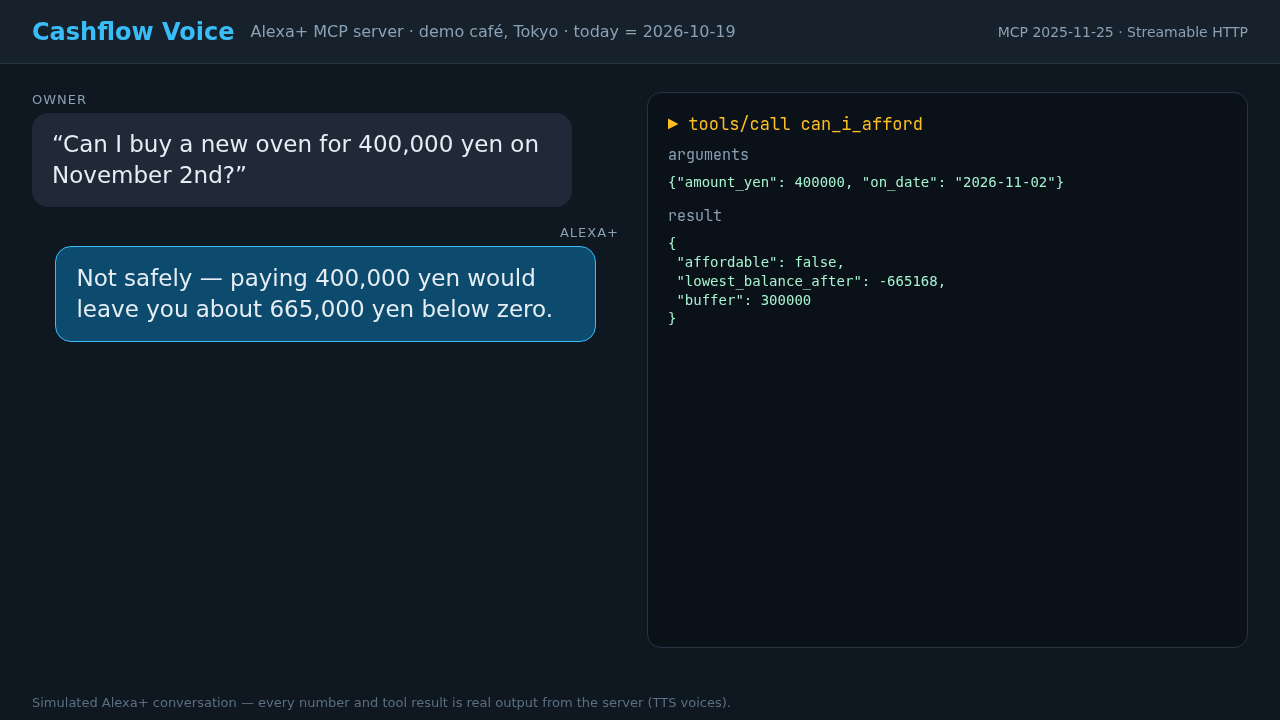
can_i_affordanswers "Can I buy a ¥400k oven on November 2nd?" against a safety buffer. - Fix it:
shortfall_planranks concrete fixes: collect receivables early, defer a supplier bill, or borrow only the gap. - Act safely:
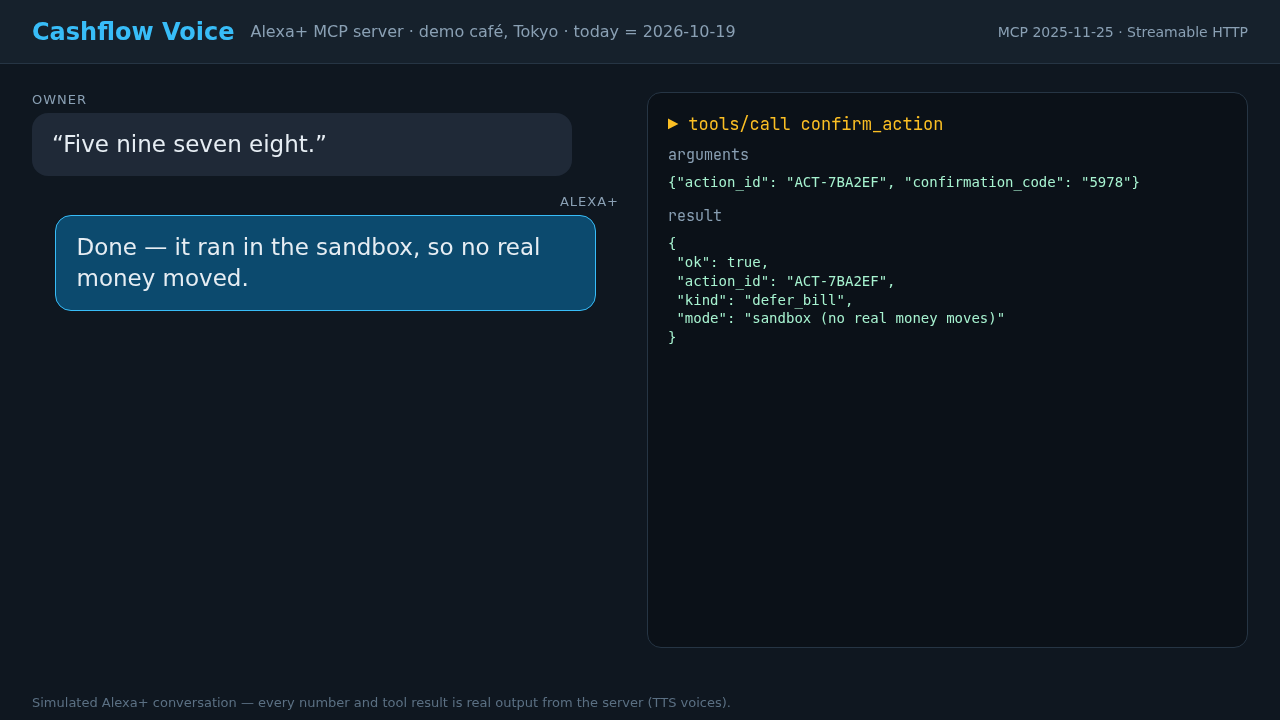
propose_actionprepares an action and returns a one-time 4-digit code.confirm_actionruns it only after the owner reads the code back, and only in a sandbox, so no real money moves.cancel_actiondrops a pending action. - Remember and account for everything:
remember/recallkeep notes like "payroll is always the 25th" across Alexa sessions, andaudit_logtimestamps every import, question, proposal and confirmation. - Bring your own data:
import_transactions/import_invoicesload a bank CSV and open invoices. Each business id is isolated from the others.
How we built it
- Python + the official MCP Python SDK (FastMCP) over Streamable HTTP in stateless JSON mode, served by uvicorn with uvloop and httptools.
- A deterministic forecasting engine: it detects recurring patterns (rent, payroll, utilities, cost of goods) and adds open receivables and payables. The LLM only speaks. Every number comes from a tool, so the same input always gives the same answer.
- SQLite (WAL) for per-business memory, pending actions and the audit trail. Forecasts are memoized by business, week count, day and data version.
- A small ASGI bearer-token shim that returns a bare
401with noWWW-Authenticateheader, as Alexa+ discovery requires. AnX-Response-Time-Msheader on every response makes the 500 ms latency budget measurable. - pytest + ruff in GitHub Actions, plus Docker and a
render.yamlblueprint. It is deployed on Render athttps://cashflow-voice-mcp.onrender.com/mcp.
Challenges we ran into
- Keeping numbers out of the model's hands. Voice assistants like to round, guess and invent. We made every figure come from a tool and wrote tool replies as short
speechstrings that can be read aloud as-is. - Auth that matches Alexa+ exactly. The SDK's built-in auth middleware adds a
WWW-Authenticateheader, which Alexa+ forbids during discovery, so we wrote our own ASGI shim. Hardening it turned up an edge case: a non-ASCIIAuthorizationheader crashed the string comparison with a 500. It now compares raw bytes and returns a clean 401, and a regression test covers it. - Safe-but-not-annoying confirmation. Money actions needed a step that holds up over voice. Our answer is a one-time, single-use, per-business 4-digit code that can't be replayed, read back by the owner.
- SDK churn. MCP SDK 2.x removed
mcp.server.fastmcp, so we pinnedmcp>=1.25,<2.
Accomplishments that we're proud of
- A complete propose → confirm → audit loop with no replay, per-business isolation and sandbox-only execution.
- About 5 ms median per tool call measured locally, well inside Alexa+'s 500 ms budget.
- Prompt-injection hygiene: transaction descriptions are treated as data, and a test covers it.
- A lint-clean, tested codebase (18 tests in CI), MIT-licensed, that anyone can run in under a minute.
What we learned
- For money, voice works best when the assistant is the mouth and deterministic code is the brain.
- MCP's tool schemas make a backend usable by Alexa+ with very little glue. The hard work is in reply design (short spoken sentences plus structured data) and in auth details.
- Small protocol details (an extra header on a 401, the bytes in a header) decide whether an integration works at all, so they deserve tests.
What's next for Cashflow Voice
- Real account linking with OAuth 2.1 + PKCE (Login with Amazon) and a protected-resource metadata document.
- Direct imports from freee, QuickBooks and bank APIs instead of CSV.
- Proactive "cash alert" notifications on Echo Show when the forecast crosses the buffer.
- Real lender and invoice-factoring comparisons in
shortfall_plan, and actions that leave the sandbox only with explicit owner opt-in.

Log in or sign up for Devpost to join the conversation.