-
-
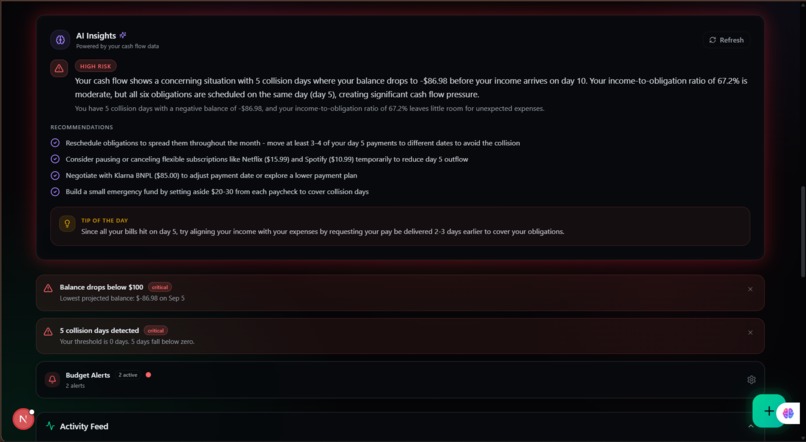
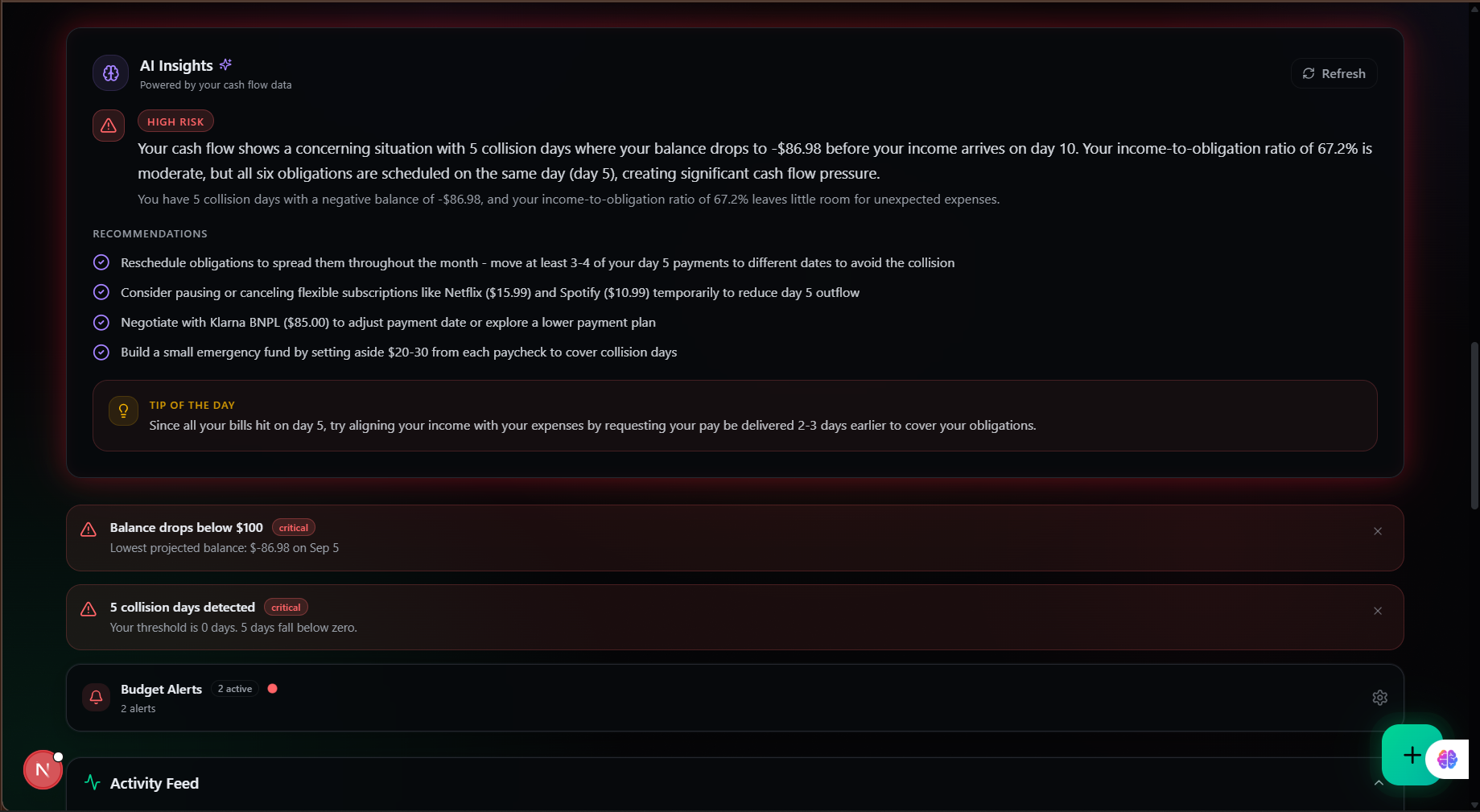
AI Insights
-
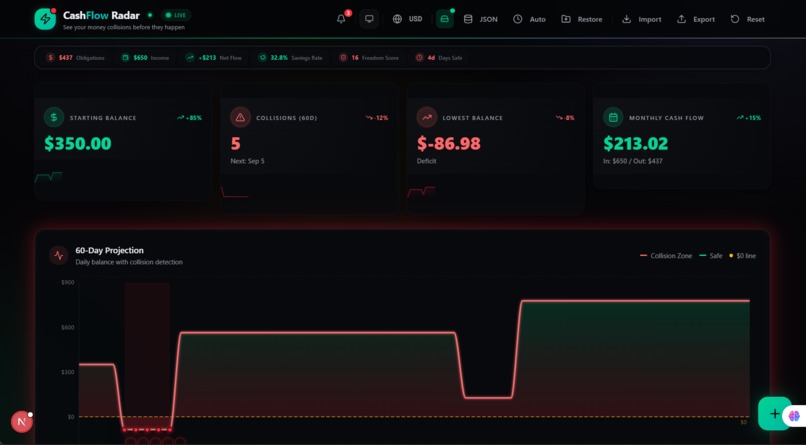
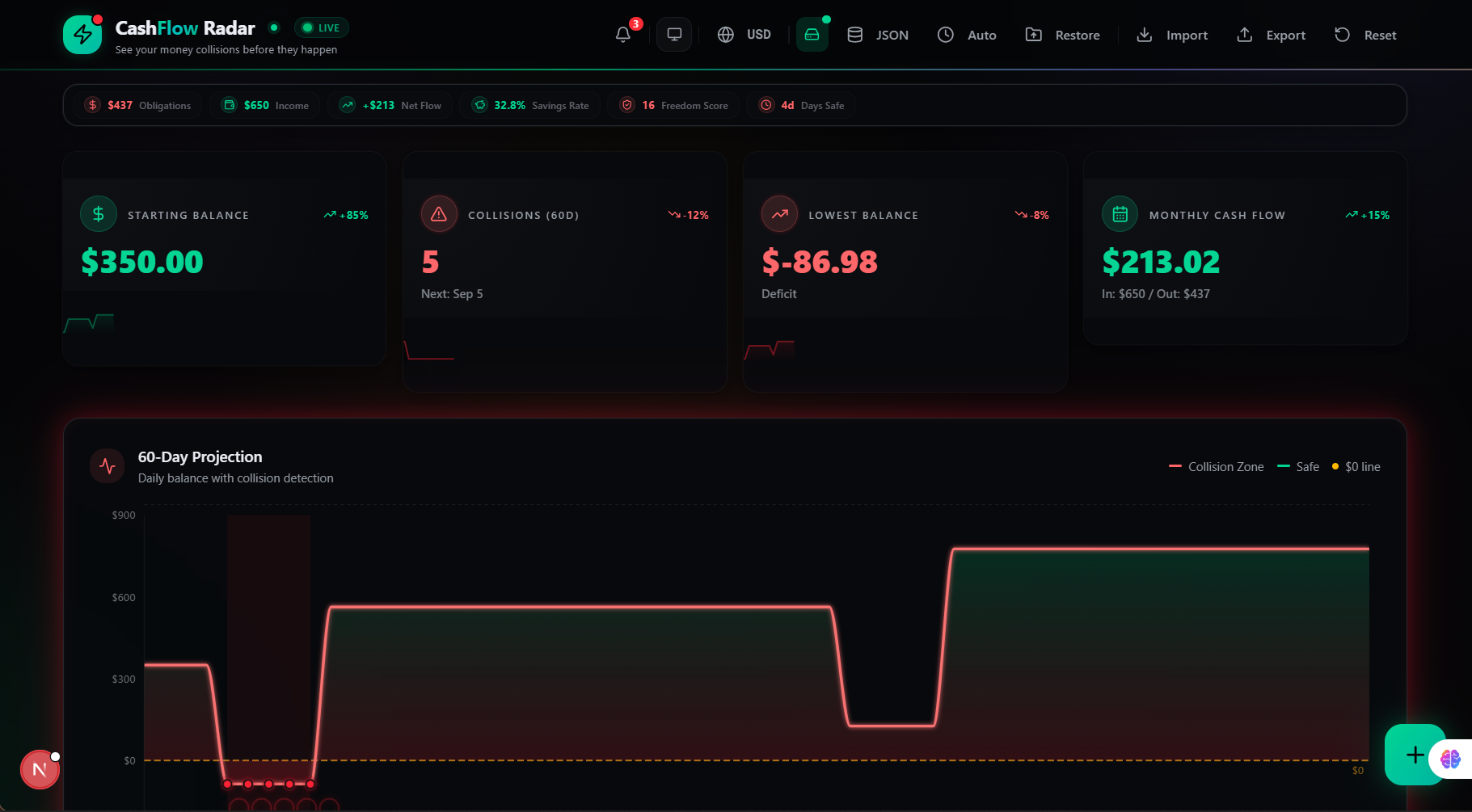
Dashboard
-
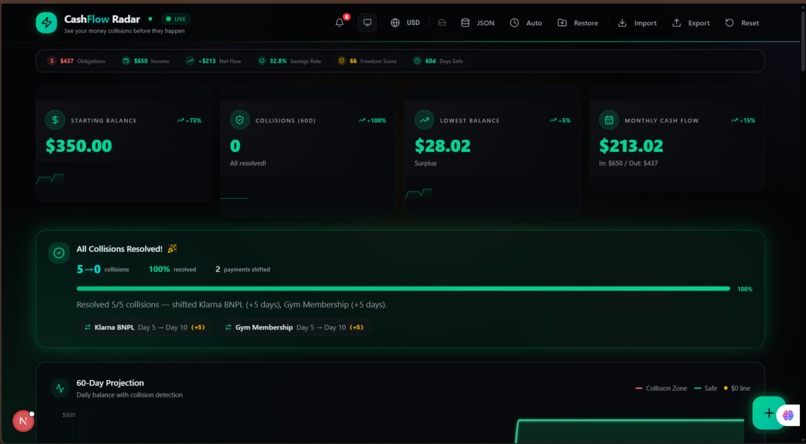
After optimization
-
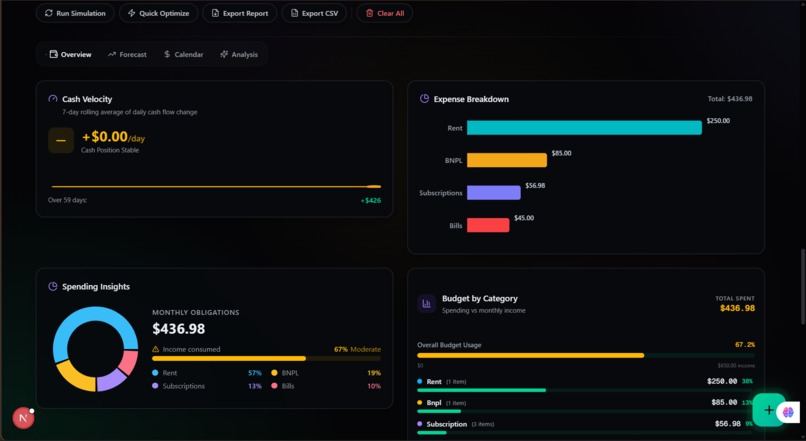
Overview
-
Insights
-
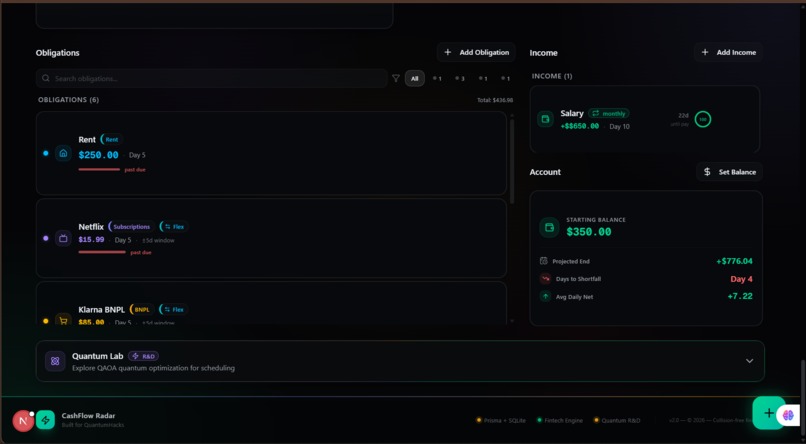
Obligations and Income sources
Inspiration
The explosive growth of Buy Now, Pay Later (BNPL) schemes and subscription-based micro-billing has fragmented how we track our finances. Traditional budgeting applications excel at showing what a user owes over a 30-day window, but they completely fail at mapping when those obligations hit.
This creates a critical visibility gap. A consumer might be perfectly solvent on paper across the month, yet experience a catastrophic financial "collision" on a random Tuesday when three bi-weekly BNPL installments and a streaming subscription pull simultaneously from an account sitting at a temporary low balance.
We realized that personal cash flow is not a spreadsheet bookkeeping problem, it is a discrete job-shop scheduling problem. We wanted to build a tool that treats bills not as static liabilities, but as movable puzzle pieces that can be algorithmically rescheduled to protect user liquidity and eliminate predatory overdraft fees.
What it does
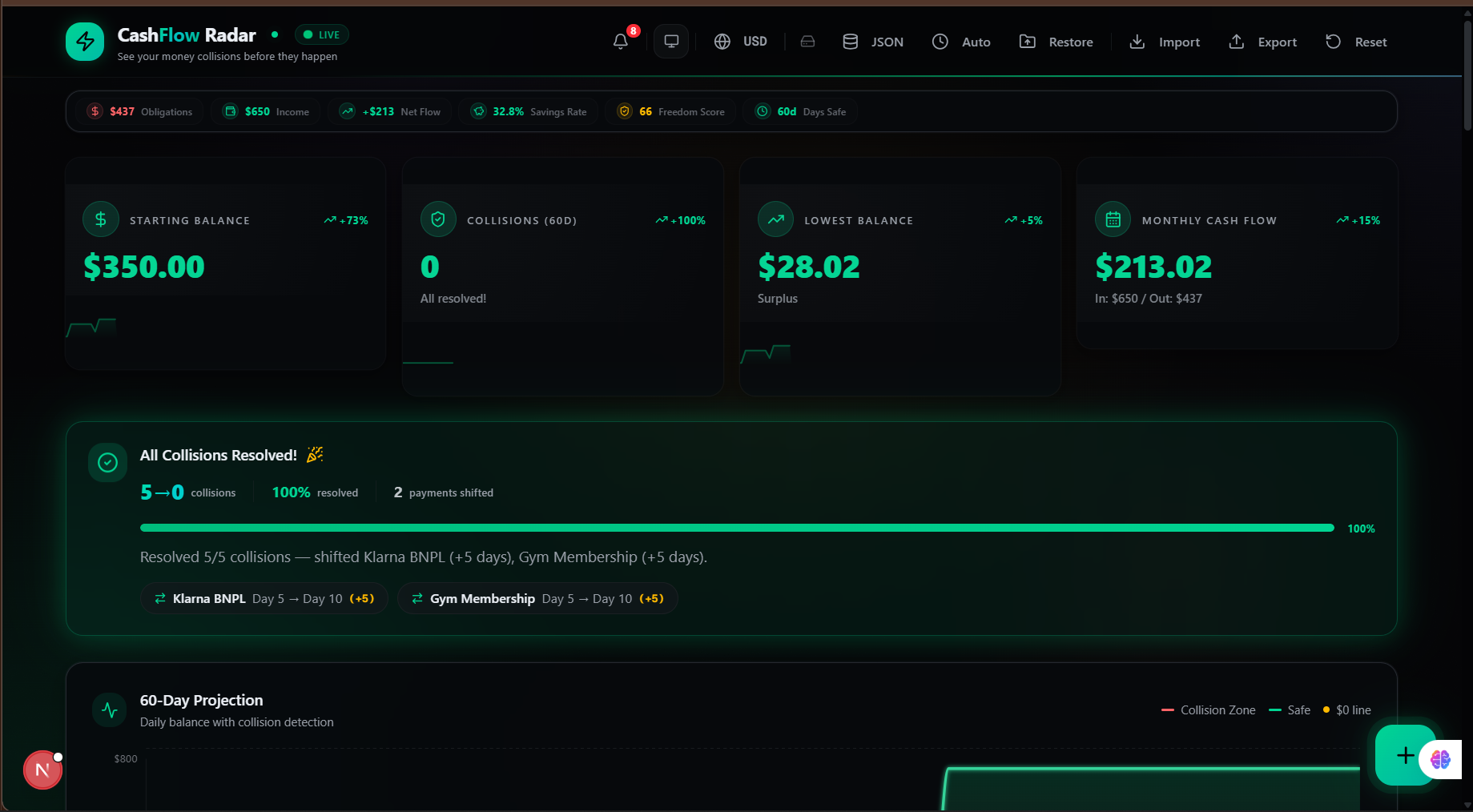
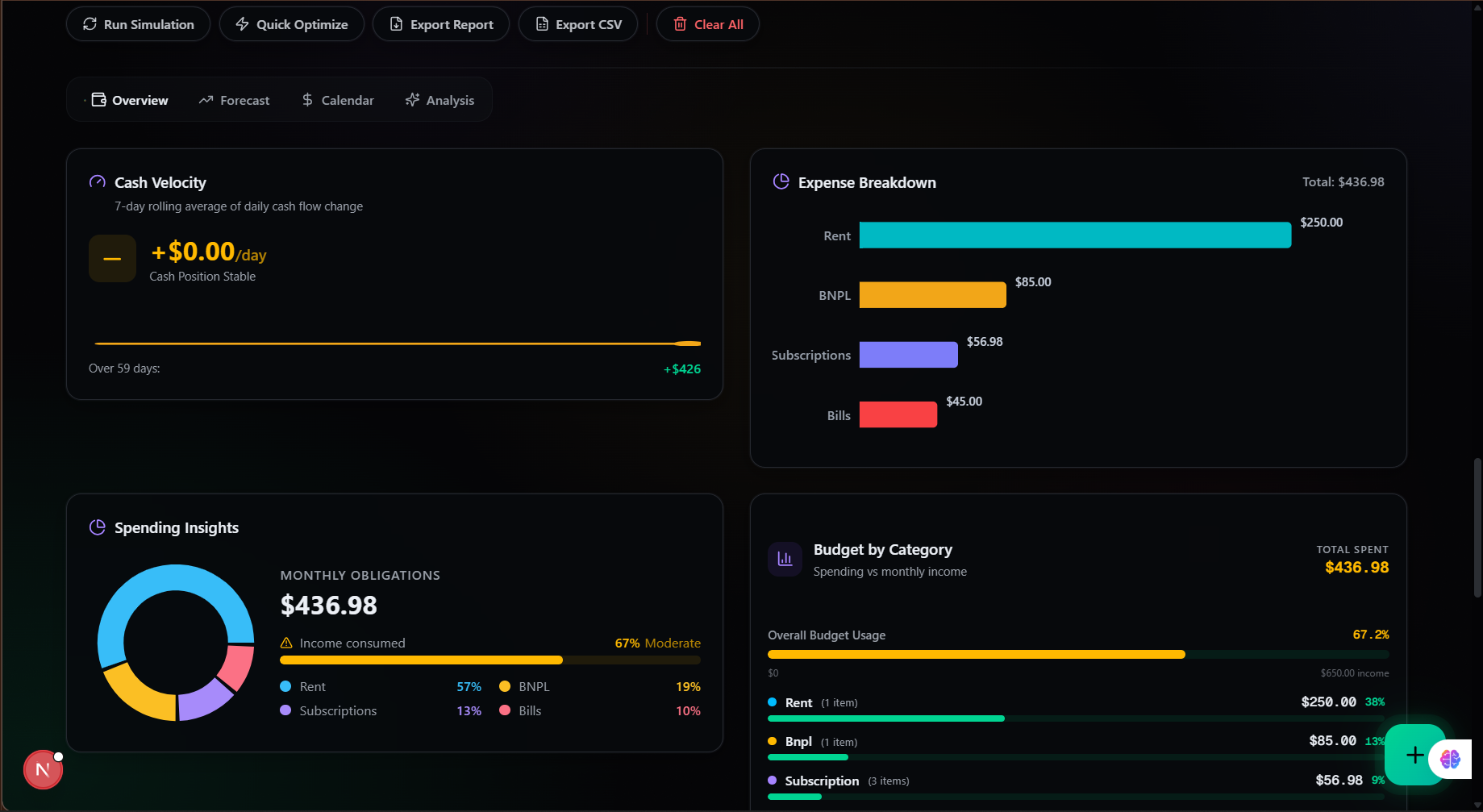
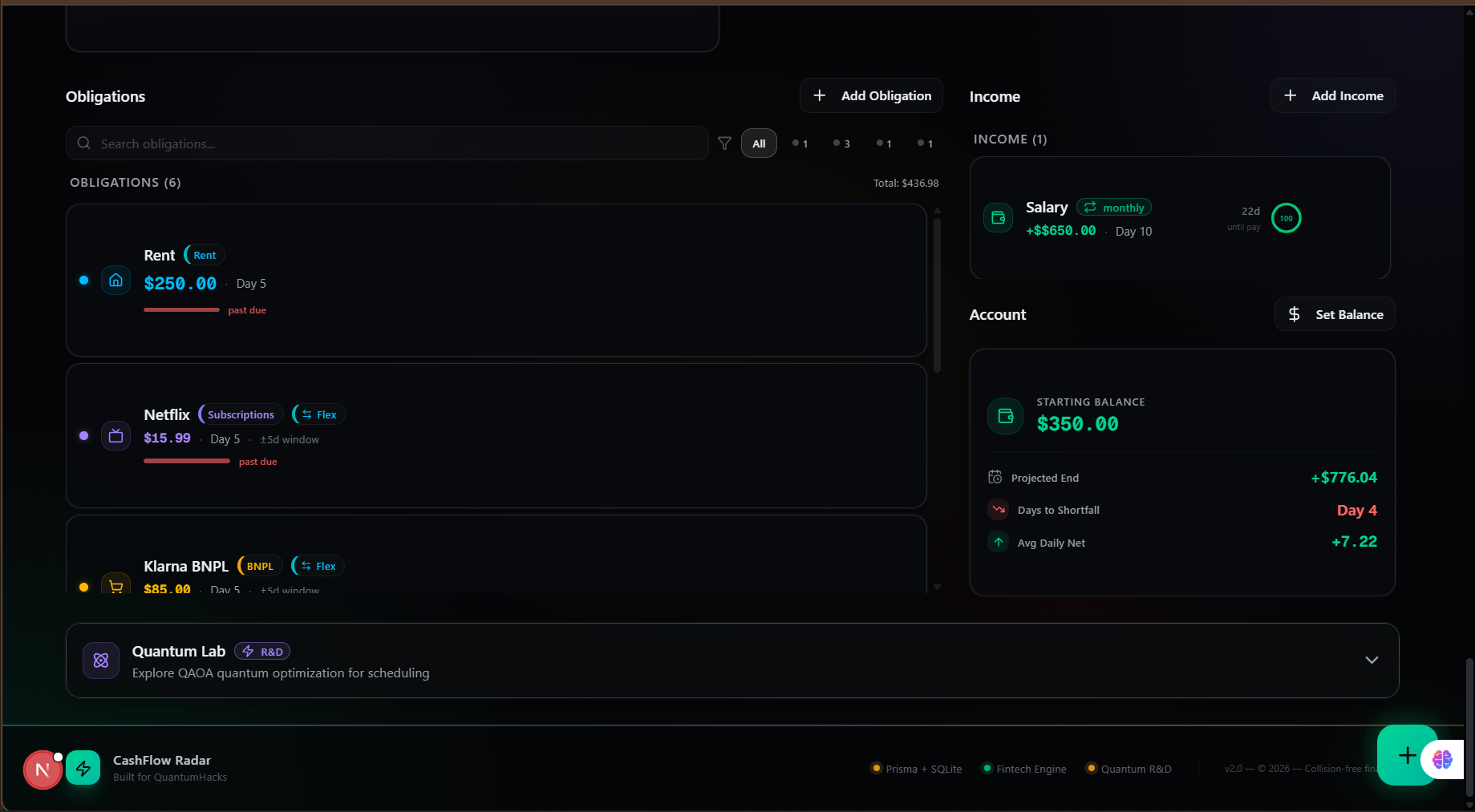
CashFlow Radar is a predictive financial health platform that models personal cash flow as an actively optimized schedule.
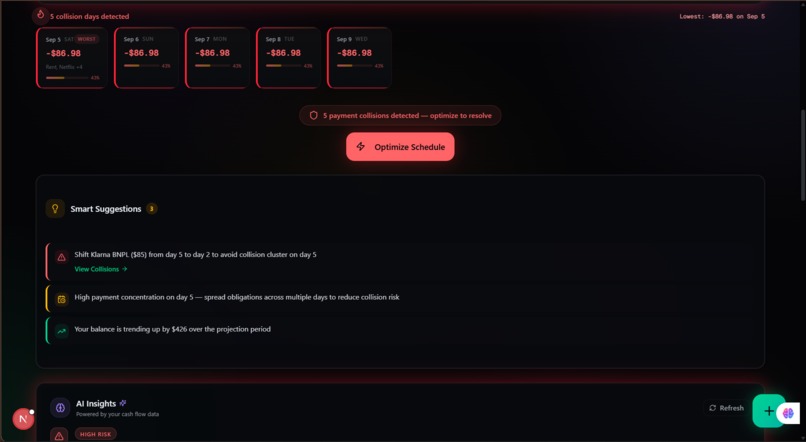
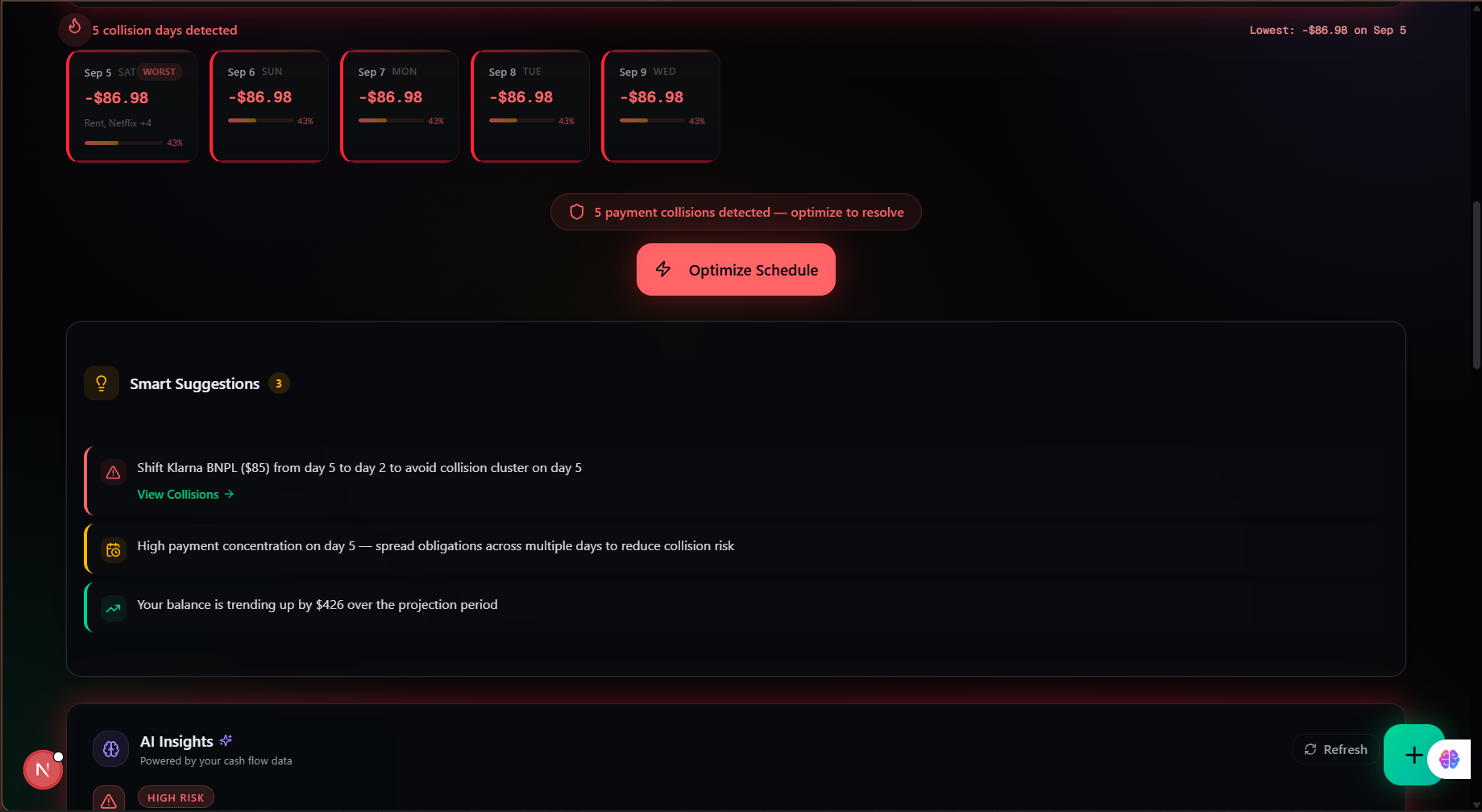
- Predictive Simulation Engine: Users securely import historical transaction records. The system projects their exact account balance day-by-day over a rolling 60-day horizon, explicitly flagging "collision days" where the forward balance dips into the negative.
- One-Click Rescheduling Optimization: By hitting "Optimize," the platform identifies flexible obligation windows (such as subscription billing periods or forgiving BNPL grace timelines) and dynamically suggests alternative due dates to flatten out cash drain.
- Dual-Core Solver Panel: A dedicated developer dashboard provides an honest side-by-side performance audit comparing a traditional, rapid greedy scheduling script against a cutting-edge, quantum-inspired optimization framework.
How we built it
We built CashFlow Radar using a lean, high-throughput hybrid technology stack designed to bridge heavy local computing with experimental physics modeling:
- Data Storage & Time-Series Engine: We used DuckDB to orchestrate our analytical forecasting engine. DuckDB’s vectorized execution allows us to run localized, ultra-fast time-series balance calculations instantly over thousands of simulated date-shifting variations without the overhead of an external relational database server.
- The Classical Production Path: Written entirely in Python, our primary engine uses an optimized greedy scheduling algorithm to compute immediate, deterministic date recommendations for the UI frontend.
- The Quantum R&D Path: We formulated the multi-bill clashing problem as a Quadratic Unconstrained Binary Optimization (QUBO) problem. Using Qiskit Aer, we implemented a genuine Quantum Approximate Optimization Algorithm (QAOA) loop to map overlapping dates onto a Max-Cut graph problem, executing parameter optimization via a simulated quantum circuit.
- Frontend Visualization: An interactive 60-day timeline UI that transforms cash flow danger zones from high-risk red to stabilized green upon algorithmic optimization.
The Mathematical Framework
To bridge finance and quantum states, we mapped our flexible billing constraints into a cost Hamiltonian. Let $x_{i,t} \in {0, 1}$ represent whether bill $i$ is scheduled on day $t$. The objective function minimizes cash violations $V(t)$ where the projected balance $B(t)$ drops below zero:
$$ H = A \sum_{t} \max\left(0, -B(t)\right) + B \sum_{i} \left( \sum_{t \notin W_i} x_{i,t} + \left(1 - \sum_{t \in W_i} x_{i,t}\right)^2 \right) $$
Where $W_i$ represents the permissible scheduling window for bill $i$, and coefficients $A$ and $B$ penalize account overdrafts and illegal date assignments respectively. This QUBO matrix is directly translated into phase-separation operators within our Qiskit circuit layers.
Challenges we ran into
Translating real-world, highly conditional personal finance rules into a mathematical architecture suitable for a quantum simulator was an uphill battle. Quantum optimization algorithms like QAOA natively handle unconstrained binary variables. However, banking rules are full of strict constraints (e.g., "Netflix can move up to 3 days later, but land-lord rent cannot move a single hour"). Writing a penalty system that accurately weighted these real-world boundary conditions without creating an over-constrained QUBO matrix that broke our Qiskit circuit depth limits required intense mathematical refinement.
Additionally, keeping the UI highly reactive posed a challenge. Running iterative optimization loops over time-series data can cause noticeable lag. We overcame this by moving all analytical calculations into memory-mapped DuckDB instances, keeping frontend data round-trips close to zero milliseconds.
Accomplishments that we're proud of
- End-to-End Quantum-to-Finance Pipeline: We succeeded in building a real, executable bridge where clicking a button on a consumer-style banking dashboard actually maps live data variables into a multi-qubit Qiskit quantum circuit simulator and extracts a meaningful result.
- Aligning Market Incentives: We proved a business model where consumer advocacy directly profits the lender. Rather than relying on late fees, our scheduling system acts as a credit risk mitigation tool for B2B financial providers.
What we learned
We gained a deep, grounded understanding of NISQ-era (Noisy Intermediate-Scale Quantum) computing limitations. Throughout development, we discovered that for a single user tracking ten bills, our classical greedy Python script out-performed our QAOA quantum simulation in both raw speed and cost efficiency every single time.
However, we uncovered exactly where the combinatorial explosion happens: the true value of the quantum scheduling approach scale isn't designed for an individual's wallet. It emerges when you expand the optimization graph to a shared household or a city-wide multi-party utility grid where thousands of interconnected entities are simultaneously negotiating moving payment windows. In those massive exponential search spaces, classical greedy methods hit a hard wall, and quantum's multi-state superposition becomes mathematically mandatory.
What's next for CashFlow Radar
- Enterprise B2B SDK: We plan to package our DuckDB/Greedy scheduling engine into a plug-and-play API designed for BNPL vendors (e.g., Klarna, Affirm) allowing them to offer algorithmic "Optimal Pay Date" selections directly inside checkout flows to lower default risks.
- Physical QPU Deployment: Transitioning our backend execution from local Qiskit Aer software simulations to physical, fault-tolerant hardware architectures via IBM Quantum Cloud Services.
- Autonomous Open Banking Integration: Moving beyond manual uploads and sandbox systems to connect with real-world open banking frameworks, allowing CashFlow Radar to automatically trigger automated bill-shifting sequences directly inside user accounts via secure webhooks.


Log in or sign up for Devpost to join the conversation.