Inspiration
Small business owners rarely lose money because customers refuse to pay — they lose it because they don't know who to chase first, or what to say when they do. A tailor with fifteen customers owing different amounts on different dates ends up either chasing everyone with the same generic "please pay" message, or chasing no one, because the mental math of who's actually urgent is exhausting to do by hand, every day, on top of running the business itself.
Existing AI-powered accounts receivable tools already solve a version of this problem — but they're built for finance teams sitting on top of an ERP: enterprise platforms with per-seat pricing, integration requirements, and workflows assuming a dedicated collections function. That's the wrong solution for the businesses we kept coming back to: the shop owner who tracks debts in a notebook or a WhatsApp thread, who has never used accounting software, and who can't justify a $20–100/month enterprise tool for receivables that might total a few hundred thousand naira. That gap — powerful AI prioritization, but sized and priced for the informal economy — is what CashFlow Recovery is built for.
What it does
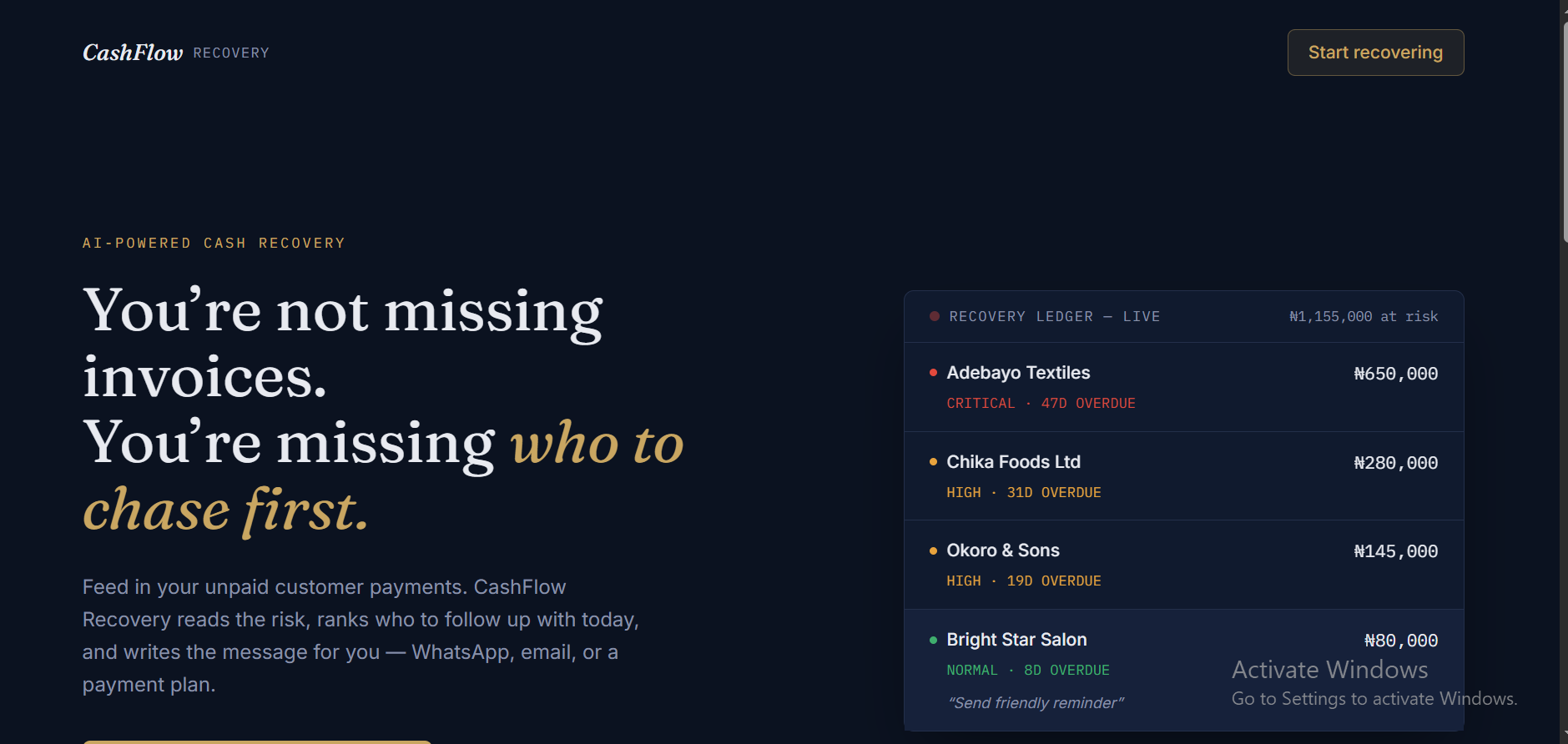
CashFlow Recovery turns a business owner's list of unpaid customer payments into a prioritized recovery plan.
Add an outstanding payment — customer name, amount owed, due date, and whatever the owner already knows about that customer's payment habits (always on time, sometimes late, frequently late). AI analyzes it — weighing how overdue the payment is, the amount at risk, and the customer's payment history to produce a risk score. AI prioritizes it — every customer lands in a ranked queue: Critical, High, or Normal, with a plain-language explanation of why, not just a red dot. AI recommends the next move — a concrete action, e.g. "send a firm reminder today and offer a payment plan" versus "send a friendly nudge, no need to escalate." AI writes the message — a ready-to-send WhatsApp message, email, or payment-plan proposal, matched to the situation, that the owner can edit and send in seconds.
The result: instead of a flat list of invoices, the owner opens the app and immediately knows who to call today, why it matters, and exactly what to say.
How we built it
We started with the business problem, not the tech: talking through what an informal SME's actual receivables workflow looks like (a notebook, a WhatsApp chat, memory) before deciding what "AI-powered" should even mean for that context. That shaped the core design decision — the tool needed to replace the owner's judgment, not just digitize their invoice list, which is why every prioritization decision comes with a reason attached, not just a score.
For the working demo, we built a Next.js (App Router) and TypeScript front end styled with Tailwind CSS, using the Gemini API for the two AI-driven steps: risk analysis/prioritization and message generation. Both calls are constrained with structured JSON output so the UI can render priority badges, risk scores, and draft messages directly without extra parsing. Customer data is held client-side for the demo (no backend database), which was the right trade-off for proving the concept fast without over-building infrastructure a real pilot doesn't need yet.
Challenges we ran into
Avoiding "yet another dashboard." It was easy to default to building something that looked like a smaller Tesorio or Upflow. The harder, more useful work was designing for someone who has never used AR software at all — which meant cutting features, not adding them. Making AI reasoning trustworthy, not just decorative. A priority badge means nothing if the owner doesn't believe it. We spent real effort getting the AI to explain its reasoning in plain language tied to the actual numbers, instead of generic boilerplate like "this payment is overdue." Designing for a real-world channel, not a hypothetical one. WhatsApp is the default communication tool for the segment we're targeting, so message generation had to feel like something a person would actually send — not a corporate collections template.
Accomplishments that we're proud of
A complete, working demo of the full loop — add a payment, watch it get analyzed and prioritized live, read the AI's reasoning, and generate a ready-to-send message — in under a minute, start to finish. A prioritization model that explains itself in the owner's terms (amount, days overdue, payment history) rather than a black-box score. A clear, deliberate positioning against an already-mature AI-AR market: we're not competing with enterprise collections platforms, we're serving the segment they don't reach.
What we learned
The AI wasn't the hard part — reasoning over a handful of numbers and drafting a message is a solved problem for a model like Gemini. The hard part, and the part that actually matters for adoption, is deciding what not to build: no ERP integration, no accounting ledger, no login wall for a demo. Every feature we cut made the tool feel more usable for the person it's actually for. We also came away convinced that "AI for finance" products default to enterprise assumptions by habit, and that there's real, underserved room in designing the same intelligence for people with none of that infrastructure.
What's next for CashFlow Recovery: AI for Informal SMEs
Payment tracking to close the loop — a "mark as recovered" step so the tool tracks actual cash recovered, not just messages sent, and can show owners their recovery rate over time. WhatsApp Business API integration — sending the generated message directly from the app instead of copy-paste, matching how this segment already communicates. Local language support — drafting messages in Pidgin and other locally spoken languages/tones, not just formal English. Distribution through trusted channels — partnering with trade associations, cooperatives, and mobile money or microfinance providers who already have the trust and reach this segment listens to, rather than a cold-start consumer app launch. A pricing model built for the segment — a low flat monthly fee or a success-fee model (a small percentage only on money actually recovered) instead of enterprise per-seat pricing.
Built With
- ai
- cashflow
- fintech
- gemini
- nextjs
- nigeria
- react
- smallbusiness
- tailwindcss
- typescript
- verce;


Log in or sign up for Devpost to join the conversation.