-
-
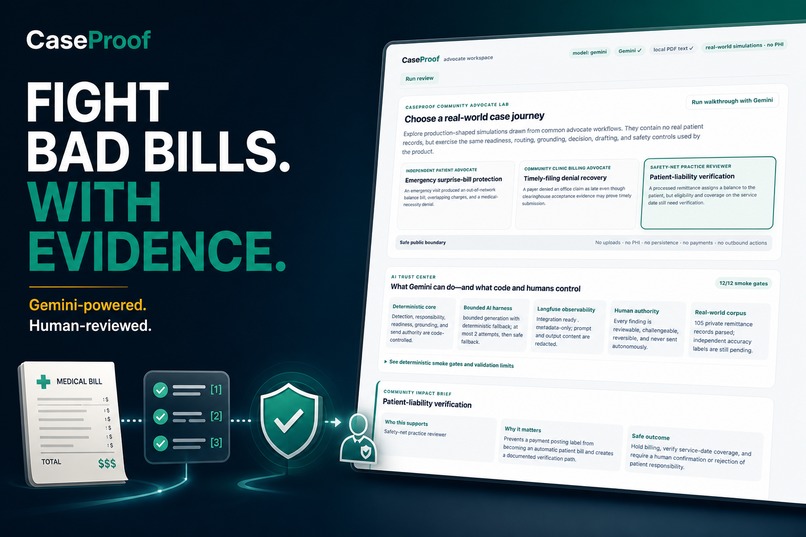
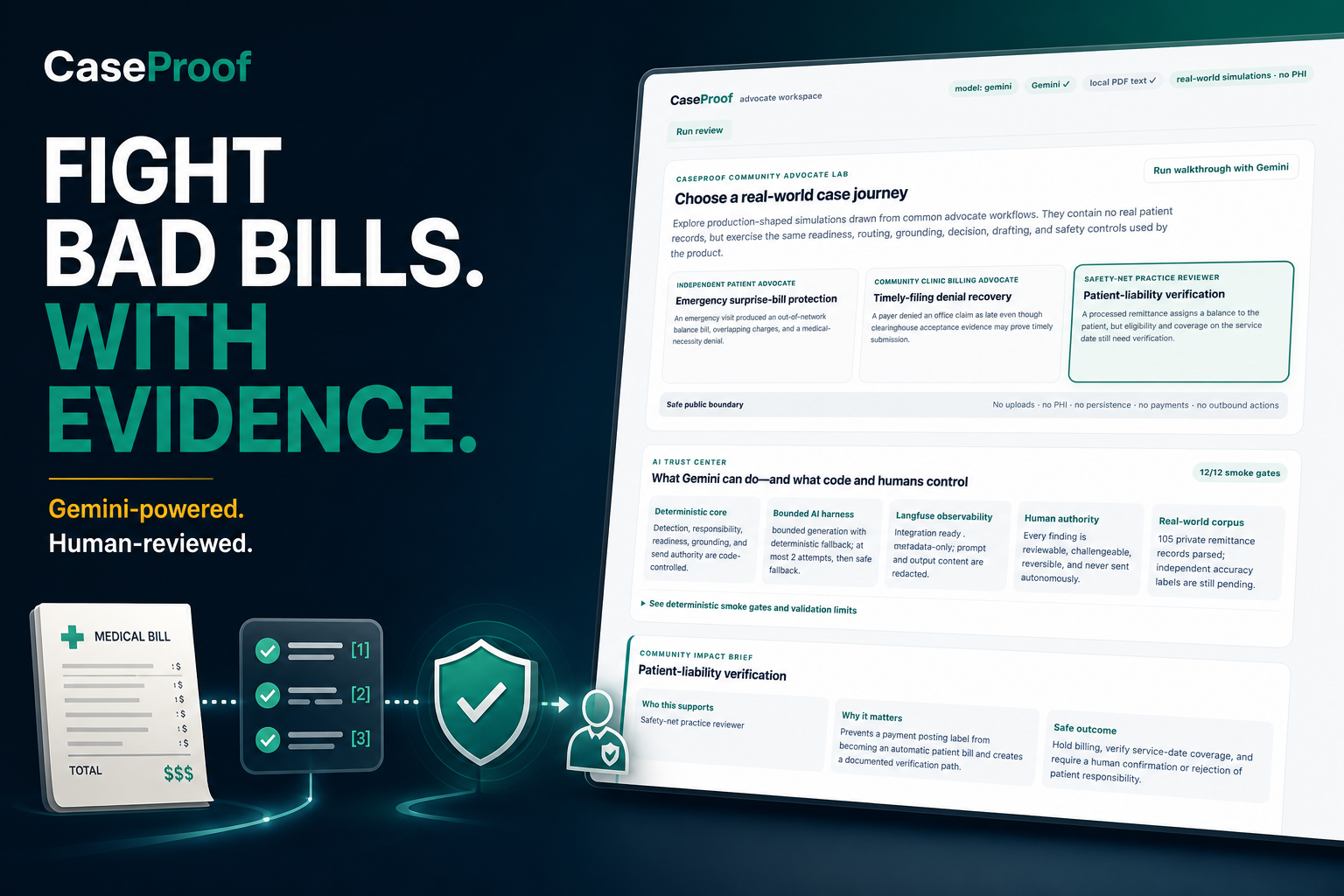
CaseProof turns medical-billing evidence into safe, cited, human-reviewed actions with Gemini.
-
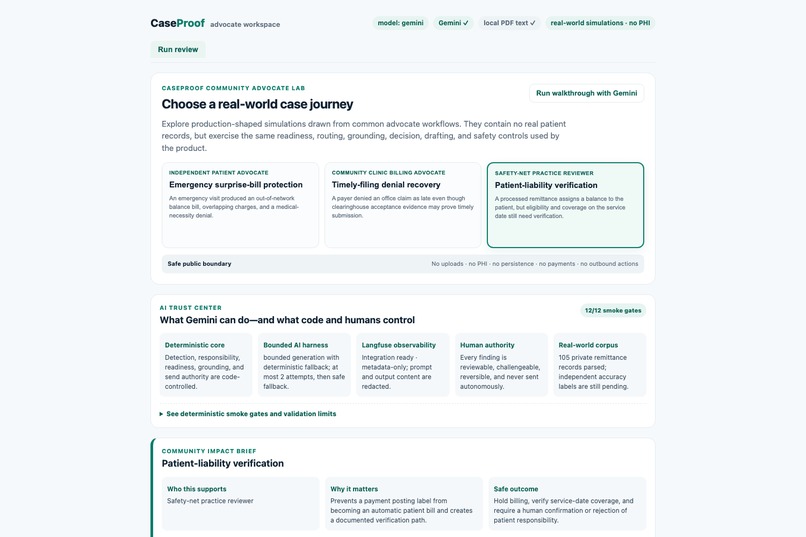
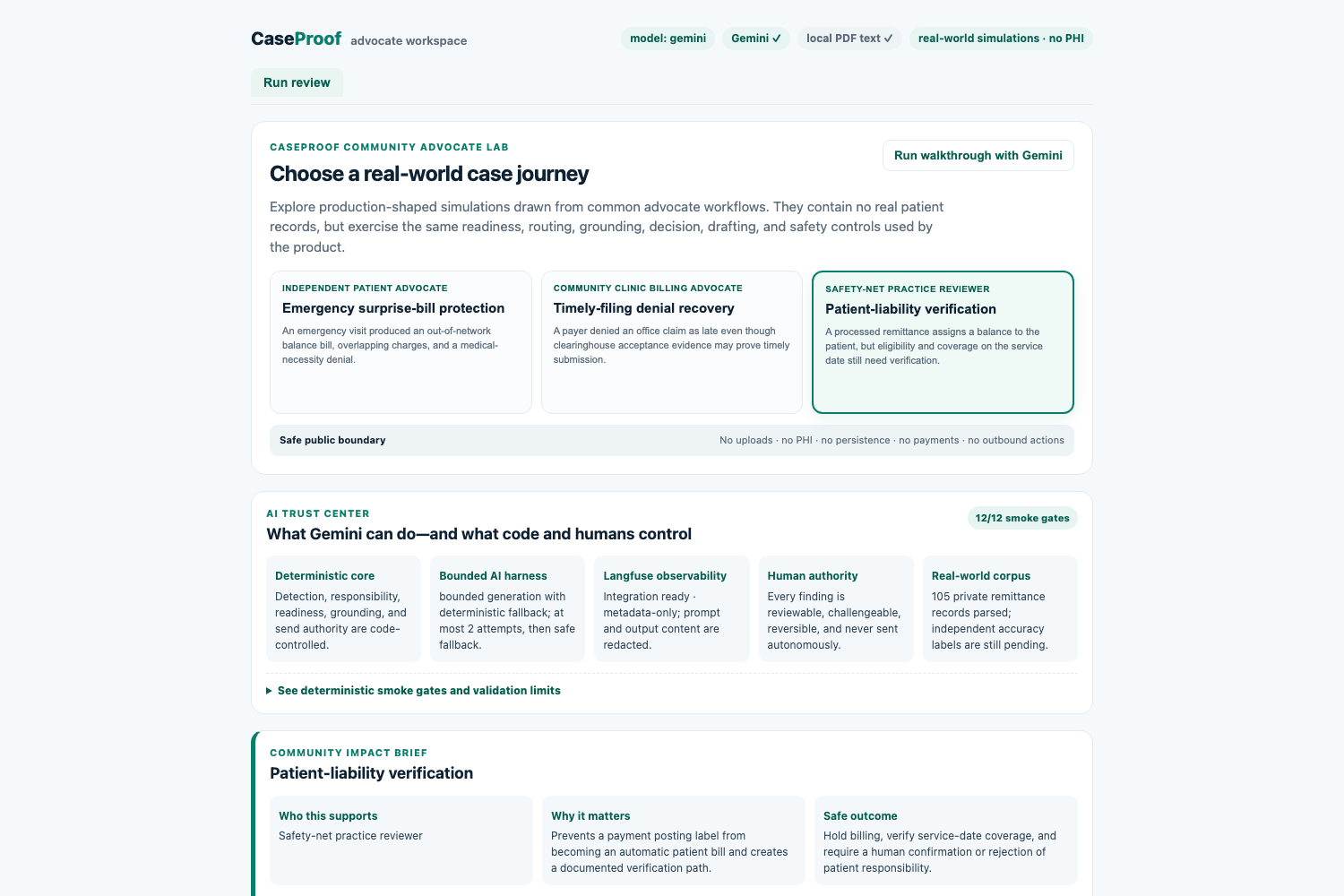
Three PHI-free journeys cover emergency protection, timely filing, and patient-liability verification.
-
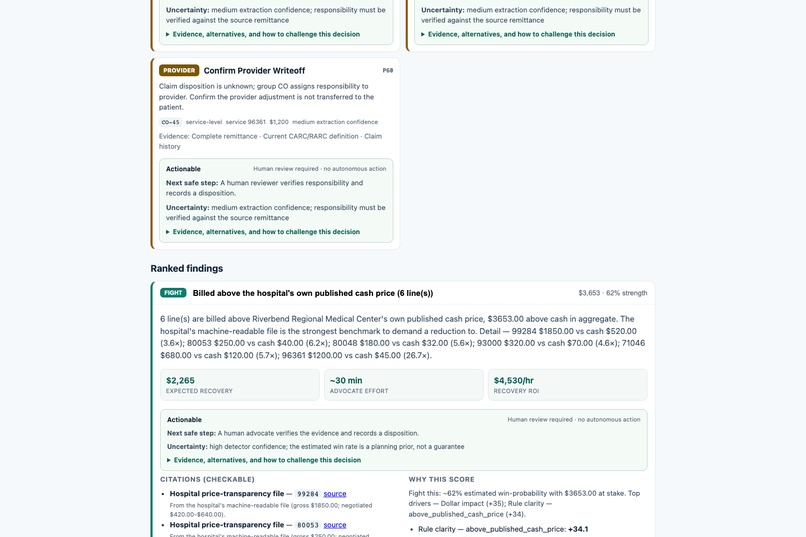
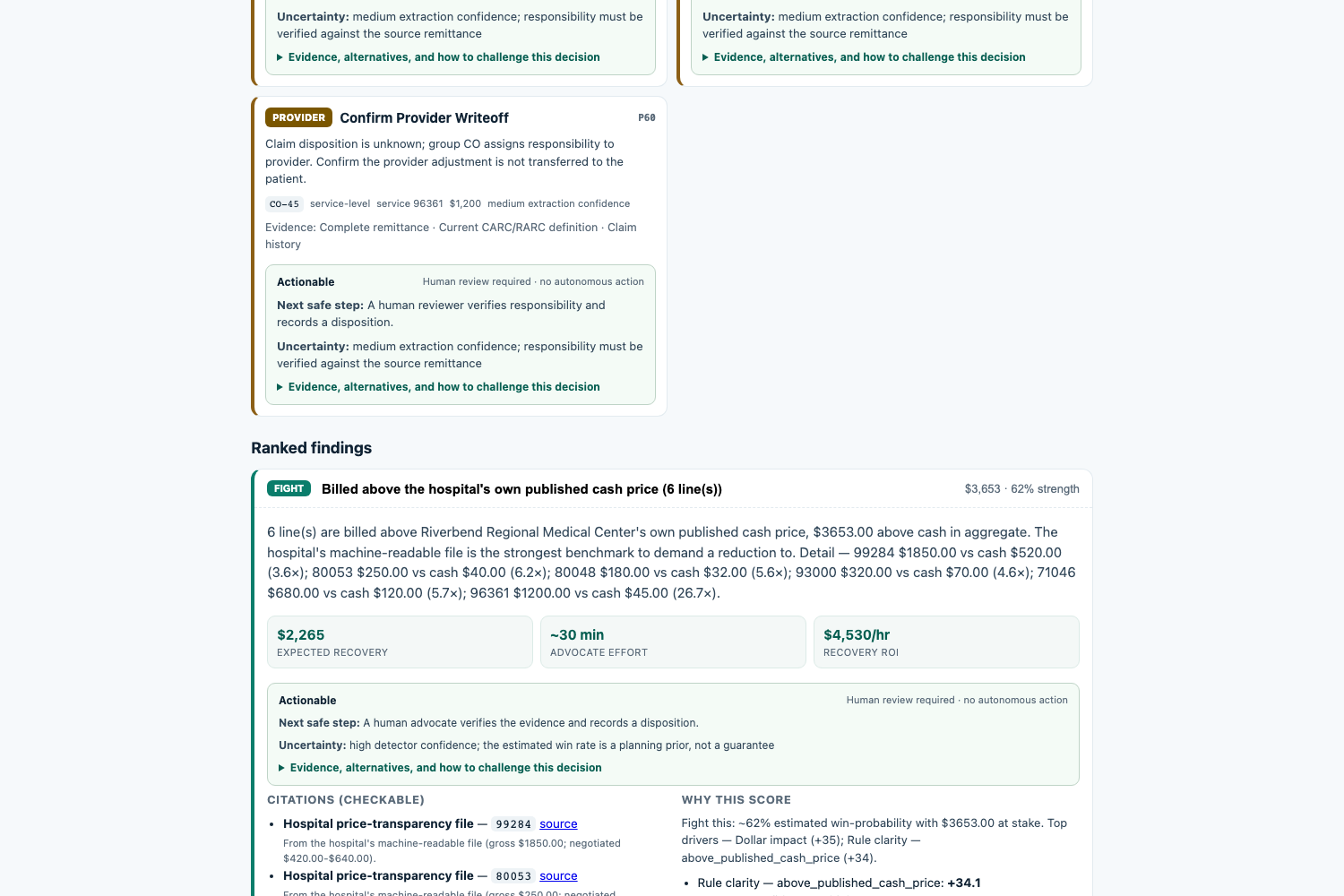
Evidence-first triage ranks findings by recovery and effort, with citations, uncertainty, and human review.
-
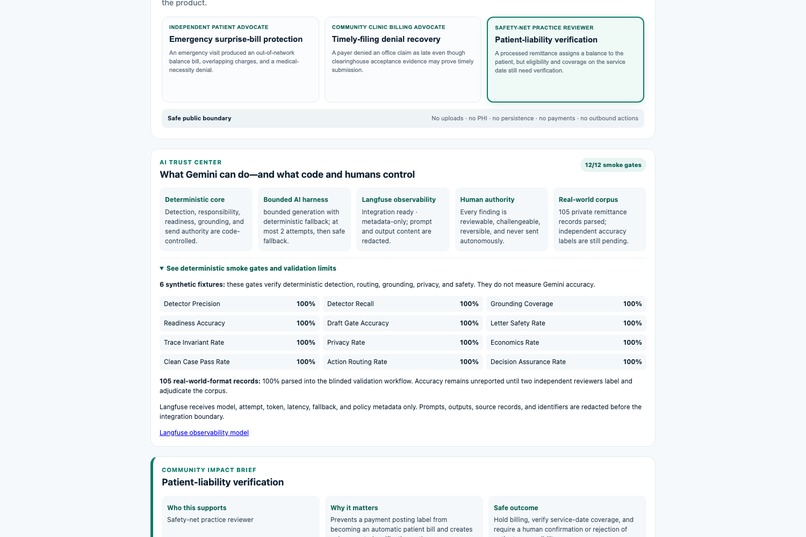
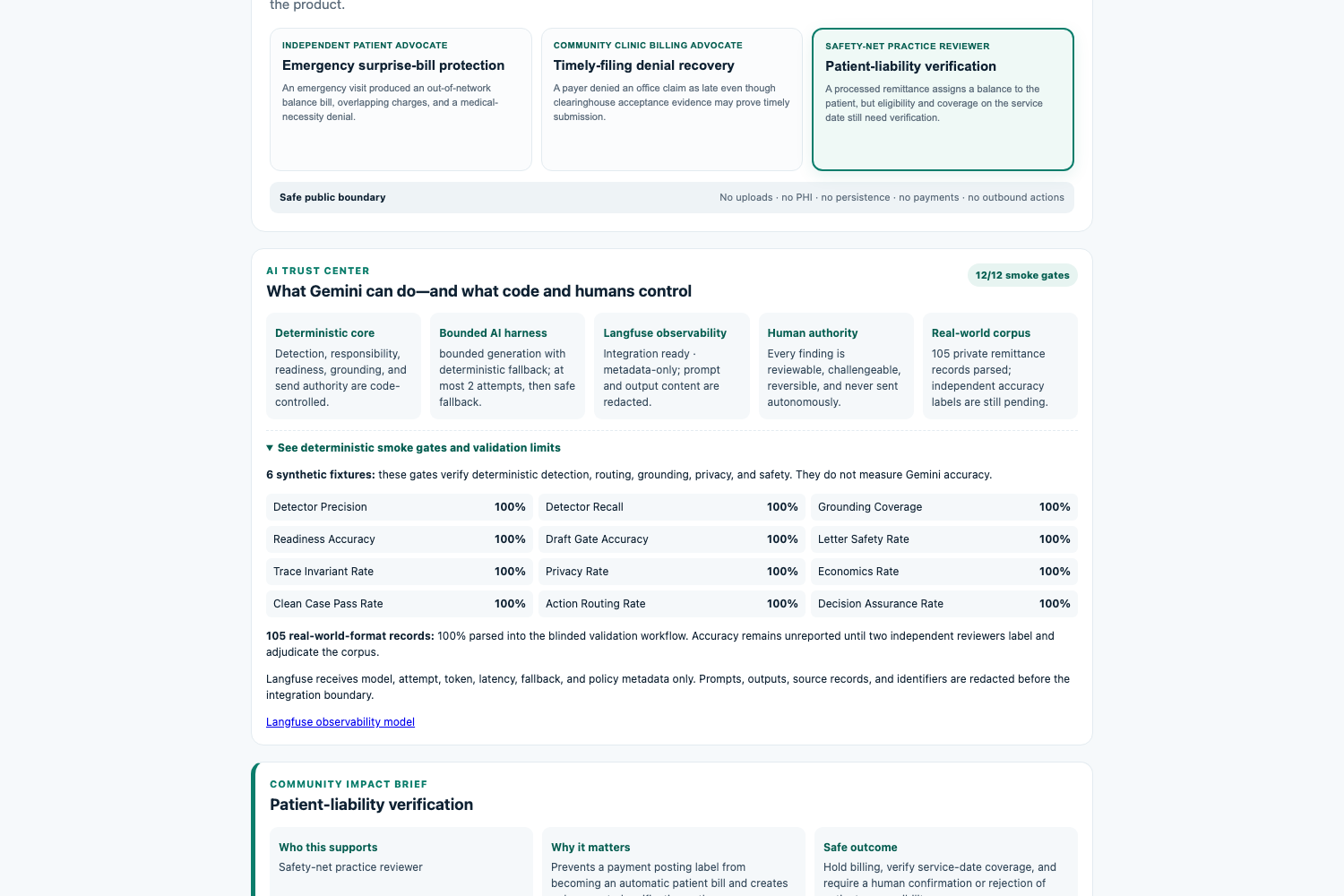
The Trust Center separates 12/12 synthetic gates from 105 real-world-format records awaiting expert labels.
Inspiration
Independent patient advocates and community billing teams work in a difficult gap. Patients receive complex bills and denials, but understanding what is actually wrong requires slow, line-by-line reconciliation across itemized bills, EOBs, denial notices, remittances, policies, and deadlines.
A generic chatbot can produce a convincing appeal letter before the evidence is complete. We wanted the opposite: a system that helps a human advocate determine when the evidence supports action, when another document is needed, and when the safest recommendation is to stop.
CaseProof grew from that need for decision quality before document generation. It does not replace an advocate. It gives small advocacy practices the operational leverage to review more cases consistently while keeping judgment, communication, and authority with accountable people.
CaseProof fits the Small Business Services category because independent patient-advocacy practices are often small teams that need safe, practical technology to serve more people without surrendering consequential decisions to automation.
What it does
CaseProof turns medical-billing records into a reviewable evidence and action workspace. The implemented non-public product workflow accepts itemized bills, EOBs, denial letters, remittance PDFs, and X12 835 transactions. It parses claim and service-line details, separates claim adjustments from provider-level PLB adjustments, and checks for supported issues such as duplicates, NCCI bundling conflicts, MUE unit limits, published-price anomalies, No Surprises Act signals, and denial reason codes.
Before drafting anything, a deterministic readiness gate identifies missing or conflicting evidence. CaseProof then builds a responsibility graph showing who owns the next move: the patient, provider, payer, or reviewer.
Supported findings are ranked using estimated recovery, evidence strength, and advocate effort. Every decision card exposes its citations, uncertainty, alternatives, and next safe step. Drafts remain editable and human-reviewed. In the managed workflow, changing a draft invalidates its approval fingerprint so outdated approval cannot authorize the revised document.
The public XPRIZE deployment is intentionally synthetic-only. Judges can run three production-shaped journeys:
- Emergency surprise-bill protection
- Timely-filing denial recovery
- Patient-liability verification
These journeys exercise the product’s real readiness, routing, grounding, decision, drafting, and safety controls without uploading PHI or creating persistent customer records.
How we built it
The product interface uses React, TypeScript, and Vite. FastAPI and Pydantic provide the Python API and typed domain contract. A deterministic pipeline performs parsing, de-identification, detection, grounding, readiness assessment, triage, drafting, and audit tracing.
Public and reference data supports exact, checkable lookups. CaseProof does not treat semantic similarity or model confidence as proof of a billing rule.
Gemini runs through Vertex AI inside a bounded AI harness with:
- Input screening
- Timeouts and attempt limits
- Token and cost budgets
- Output-policy validation
- Deterministic fallback behavior
- Fail-closed operation in public-demo and production modes
The codebase also includes optional Langfuse/OpenTelemetry observability. Only operational metadata—such as model, operation, attempts, token counts, latency, fallback reason, and policy outcome—may cross that boundary. Prompts, outputs, source records, identifiers, and reviewer notes are redacted.
Langfuse is deliberately disabled in the public deployment because live credentials and an approved data region have not been configured. Google Cloud Monitoring provides the submitted demo’s live Gemini operational evidence.
The application is containerized with Docker and deployed to Google Cloud Run through Cloud Build and Artifact Registry. The codebase includes production-capable Firestore and Cloud Storage adapters with application-layer encryption for structured records and blobs. Production manifests support Secret Manager, while OIDC tenant and role enforcement is implemented behind fail-closed launch gates.
Those production capabilities are not presented as active in the public demo. The public service runs without PHI persistence, authentication claims, payments, or outbound actions.
Challenges we ran into
The hardest problem was not generating prose. It was preserving medical-billing semantics and refusing unsafe shortcuts.
Adjustment group codes affect financial responsibility. Reversals cannot be counted as new denials. Provider-level PLB adjustments are not ordinary claims. A confident-looking appeal can still be wrong when the EOB, deadline, jurisdiction, policy, or submission evidence is missing.
Privacy created a second constraint. Product evidence and observability had to remain useful without becoming another route for PHI exposure. We therefore built redacted traces, synthetic public journeys, application-layer encryption, and a strict public-route allowlist.
We also learned that real-world format coverage is not the same as accuracy. CaseProof processed 105 claim pages across 36 private remittance PDFs and resolved knowledge coverage for all 217 extracted adjustments. However, the archive did not include independent ground-truth labels.
We report that result as evidence of format and lookup coverage—not as model or decision accuracy.
Accomplishments that we're proud of
- A live Gemini operation through Vertex AI with redacted execution evidence.
- Three distinct PHI-free journeys that exercise the actual product decision contract rather than a static mockup.
- Twelve of twelve deterministic smoke and regression gates passing across grounding, privacy, routing, readiness, drafting, trace integrity, and safety.
- One hundred percent parsing coverage across 105 claim pages from 36 real-world-format remittance PDFs.
- Knowledge coverage for all 217 extracted adjustments, while independently measured accuracy remains correctly marked as pending.
- 172 passing Python tests, browser accessibility coverage, container CI, and clean Python and npm dependency audits.
- Human approval fingerprints, encrypted storage adapters, durable worker leases, backup and restore tooling, and fail-closed production-readiness checks implemented and tested in the codebase.
- A public demo that clearly separates what is live today from what still requires legal, operational, and independent review.
What we learned
Trustworthy AI is often defined by restraint.
The most valuable answer is not always an appeal letter. It may be:
- “Request the missing EOB.”
- “Verify coverage before billing the patient.”
- “This adjustment belongs to the provider.”
- “The current evidence does not support a challenge.”
Deterministic controls and generative AI work best when each has a clear responsibility. Code protects invariants. Gemini handles bounded language and classification tasks. Humans own consequential decisions.
We also learned to separate three claims that are often blurred together:
- Format compatibility
- Deterministic regression performance
- Independently measured real-world accuracy
A trustworthy product must report each one honestly.
What's next for CaseProof
Two qualified independent reviewers will label and adjudicate the blinded 105-claim-page validation packet. This will allow us to publish reviewer agreement and accuracy by claim status, adjustment group, payer, and document quality.
Before processing production PHI, we will also:
- Load licensed and current production code sets
- Complete BAA, privacy, and security review
- Configure production OIDC and tenant administration
- Validate Firestore and Cloud Storage retention, backup, and restore procedures
- Run worker, incident-response, and disaster-recovery drills
- Activate PHI-safe observability only in an approved region
- Complete qualified workflow review before enabling outbound operations
In parallel, we plan to onboard a small advocate pilot and measure time to review, finding disposition, recovered dollars, false-positive burden, cost per case, and people served.
Payments will remain outside the PHI-handling application in the operator’s approved invoicing and accounting workflow.
CaseProof will grow from evidence-backed pilots and measured outcomes—not from claims the product cannot yet prove.
Built With
- artifactregistry
- cloudbuild
- cloudrun
- cloudstorage
- docker
- documentai
- fastapi
- firestore
- gemini
- google-cloud
- healthcareai
- langfuse
- oidc
- opentelemetry
- playwright
- pydantic
- pytest
- python
- react
- ruff
- secretmanager
- typescript
- vertexai
- vite
- x12edi


Log in or sign up for Devpost to join the conversation.